CPT code 93503: Swan-Ganz catheter billing and modifiers
CPT code 93503: Official descriptor and procedure overview In the AMA CPT code s...

Last Updated: Oct 23, 2026

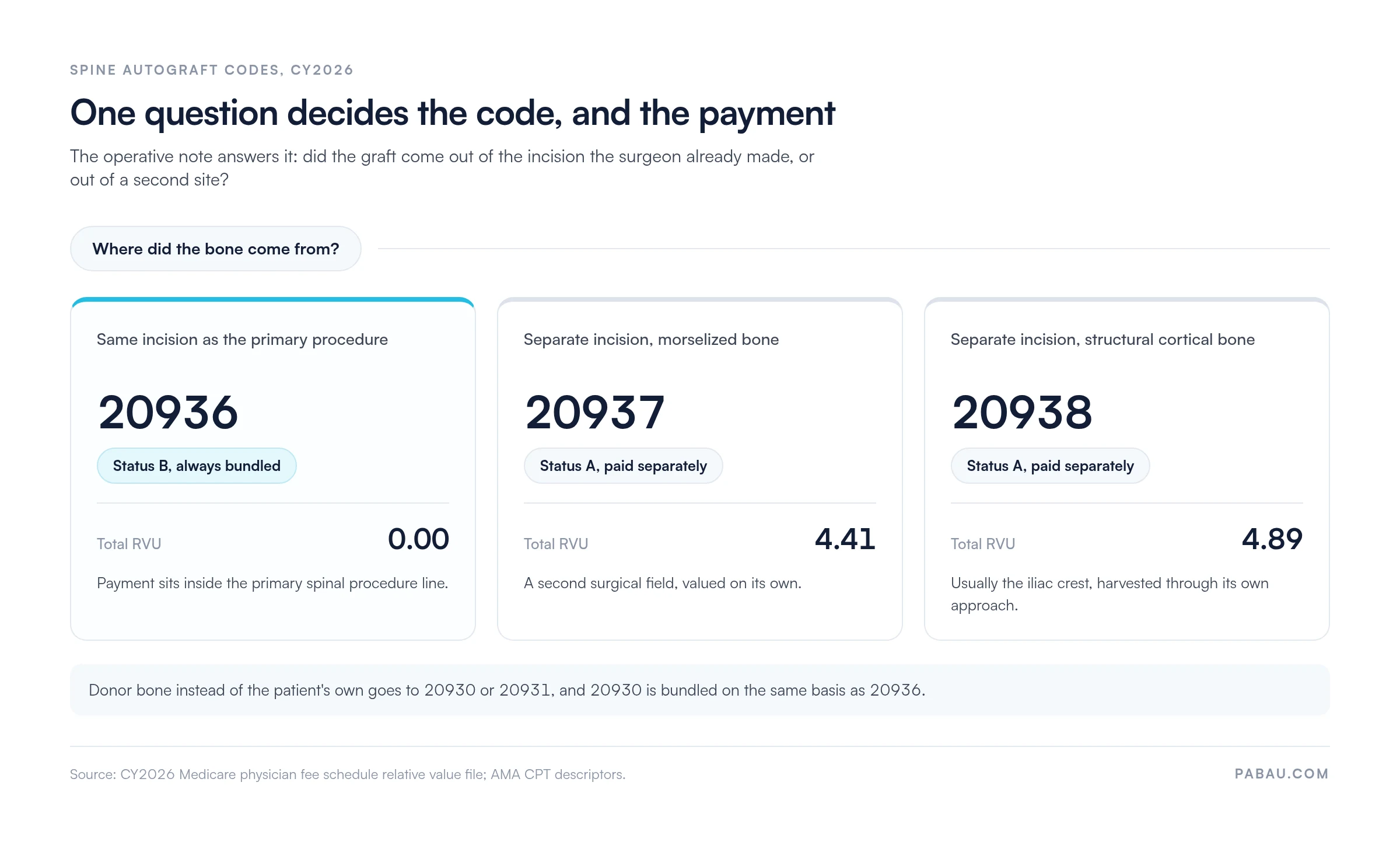
CPT code 20936 is an add-on code for local autograft harvesting during spine surgery. The bone comes from the same incision, such as rib, spinous process, or laminar fragments.
Medicare assigns 20936 status indicator B, so it carries 0.00 RVUs and is never paid separately. Its value sits inside the primary spinal procedure payment.
It must always be reported with a primary spinal procedure code and cannot be billed as a standalone service.
Sibling codes 20937 and 20938 are separately payable, which is why the same-incision test decides the code.
Pabau’s claims management software pre-fills the CMS-1500 from the treatment record, checks required fields, and submits through Claim.MD to thousands of US payers.
CPT code 20936 is an add-on code for local autograft in spine surgery, and it will never pay you a cent. The bone comes from the incision the surgeon already opened, whether that is rib, spinous process, or laminar fragments.
Medicare assigns status indicator B, so the code carries 0.00 RVUs and its value sits inside the primary spinal procedure.
Accuracy still matters. A wrong primary pairing can stall the claim that does pay, and an appeal on a bundled line just wastes staff hours. What follows is the descriptor, the primary pairings, the bundling edits, and the note that defends the line.
The code describes autograft for spine surgery only, and it includes the harvesting work. Qualifying bone is rib, spinous process, or laminar fragments taken without opening a second surgical site.
That one condition, same incision, separates 20936 from every other autograft code in the family. Spine medical billing teams trip on it more than any other detail on the claim.
The American Medical Association (AMA) maintains 20936 as an add-on code, so it cannot stand alone on a claim. Every submission needs a reportable primary spinal procedure code beside it.
Spine surgeons, orthopedic coders, and surgical billing teams meet this code often. It turns up most in ACDF, TLIF, and PLIF cases, where harvesting local bone is routine.
Here is the full AMA descriptor. Autograft for spine surgery only (includes harvesting the graft); local (eg, ribs, spinous process, or laminar fragments) obtained from same incision.
Read the last four words twice, because they carry the payment consequence. The code sits in the General Grafts (or Implants) section of the CPT code set.
The table below holds the details a coder reaches for at claim prep.
These two codes sit in the same family and describe different graft types. Mixing them up is one of the most common errors in spine surgery billing.
The table sorts out which one applies.
Reporting both 20936 and 20930 on the same claim is an NCCI bundling conflict. Verify the current CCI edit table via the CMS Physician Fee Schedule lookup before submitting, since bundling edit tables update quarterly.
Report 20936 when the surgeon harvests local autogenous bone from the same operative incision during a spinal procedure.
The graft source is the trigger. Qualifying bone is already exposed inside the primary surgical field, rather than retrieved through a separate iliac crest or remote approach.
Common qualifying scenarios include:
One question settles the code in every one of those cases, and the operative note answers it.
Medical necessity rests on the primary procedure, not on the harvest. Confirm the diagnosis supports the fusion or the decompression before you add 20936 to the claim. The ICD-10 codes that usually carry these cases appear further down.
20936 must appear on the same claim as a primary spinal procedure code. The table lists the pairings that show up most in spine surgery billing. ACDF and TLIF codes are the frequent hosts.
Longer posterior constructs move from 22842 up to 22844, and anterior cervical cases often report 22554 as the primary fusion. Level count does not change the graft logic.
Use the AAPC Codify lookup to confirm add-on pairing rules and payer restrictions before you finalize the claim. Some payers accept a narrower set of primary pairings than Medicare does.
Medicare never pays CPT 20936 separately. The code carries status indicator B on the Medicare Physician Fee Schedule, which means it is always bundled into payment for another service.
In the CY2026 national physician fee schedule relative value file, every RVU component for 20936 is 0.00 and the global period is XXX. Payment for the graft harvest sits inside the primary spinal fusion or graft code you report alongside it.
This is not a 2026 change. CPT 20936 held status B in the CY2025 file as well, and CPT 20930 is bundled on the same basis. Any source quoting a payable rate for 20936 has not checked the fee schedule file.
The calculation ends before it starts. CMS assigns 20936 no work, practice expense, or malpractice value, in the facility or the non-facility column.
The CY2026 conversion factor is $33.4009, or $33.5675 for a qualifying APM participant. Neither figure produces a payment for this code, because both get multiplied by a total of 0.00. Watch for articles citing $32.35 as the 2026 factor, since $32.3465 was the CY2025 conversion factor.
The setting makes no difference to 20936. CMS lists 0.00 practice expense RVUs in both the facility and the non-facility column, so place of service changes nothing.
Geographic practice cost indices change nothing either, because a GPCI adjustment applied to 0.00 still returns 0.00.
Report 20936 when the operative note supports it, since the line documents the work performed. Just keep it out of your revenue forecast. Reconcile the primary procedure line against the electronic remittance advice instead, because that is where the harvest gets paid.
The two sibling autograft codes describe a second surgical field, and CMS values that extra work. Both carry status indicator A, which means separately payable.
That split is why the same-incision test carries so much weight. Harvesting through the primary incision counts as part of the exposure the surgeon has already made.
Opening a separate site, usually the iliac crest, is distinct work with its own values. Code from what the operative note describes, never from which line pays more.
Do not build a fee expectation around CPT 20936, and do not appeal a Medicare line that comes back bundled. Put the review effort into the primary procedure code instead, since that line carries the payment for the graft work. If the operative note describes a harvest through a separate incision, the correct code is 20937 or 20938, and both of those are separately payable.
Add-on codes carry modifier rules that differ from standalone procedure codes. The table covers the four that come up on 20936. Payer policies vary, so read the relevant LCD before you submit.
Modifiers on the 20936 line affect claim editing and payer reporting, and they do not change what Medicare pays. Reach for one only when a payer policy asks for it.
The National Correct Coding Initiative (NCCI) maintains bundling edits that define which code pairs cannot be reported together. 20936 carries several of those relationships.
Under Medicare, status B already blocks separate payment, so these edits matter most for payers that price the code.
The CARC and RARC pairs on the remittance name the edit that fired. Our guide to denial codes shows which of them are correctable and which need an appeal.
Follow one spine claim end to end and the bundled line stops looking odd. Five steps, in the order they happen.
Take a thoracic fusion coded 22532, where the surgeon packs the interspace with bone taken through the same approach. Both codes go out together, the fusion gets paid, and the graft line comes back at zero.
Post it as bundled and close the account. That line still earned its place, because it documents the work behind the code that paid.
Denials on 20936 cluster around a short list of problems, and each one is catchable at the desk. Three areas cover most of them. Documentation completeness comes first, then primary code selection, then edit awareness.
One distinction saves a lot of wasted effort. A Medicare remittance showing no payment on the 20936 line is the fee schedule working as designed, not a denial to work.
The patterns below apply to payers that price the code, and to the primary procedure line that carries the money.
The operative note is what defends a 20936 claim. Five elements make it complete:
Templated note fields for graft type and source keep a coder from hunting through the record at billing. When the note is dictated after the case, confirm all five elements before the claim goes out.
Start by identifying the denial reason from the CARC code on the remittance advice. If the code says bundled and the payer is Medicare, there is no appeal to file.
Status B is the correct outcome, not an error. For a commercial payer that does price 20936, confirm whether a modifier 59 override fits the clinical circumstances.
Gather the operative note, the primary procedure code, and any payer LCD on spinal autograft coverage. Draft a short letter citing the descriptor, the same-incision documentation, and the payer’s own policy.
Submit inside the appeal window, typically 60 to 120 days from the denial date. Diary that deadline, because a late appeal closes the file.
The diagnosis codes on a spine claim support the primary fusion or decompression, not the graft harvest. CPT 20936 has no medical necessity test of its own, because it has no separate payment.
The codes below are the ones that most often carry these cases.
Cervical cases use the M50.1 series for cervical disc disorders with radiculopathy rather than the lumbar codes above. Code to the highest level of specificity in every case, since several parent codes in this range are not billable alone.
M48.06 is the common trap, because a claim needs M48.061 or M48.062. Check current lists on the CMS ICD-10 codes page.
20936 sits in a small family covering autograft and allograft for spinal surgery. Knowing the whole family prevents miscoding, since the right add-on changes with the graft’s source and shape.
Audit all five codes once a year against current AMA guidance.
Two axes decide which code applies. Structural or morselized is the first, same incision or separate is the second. Teach the coding team both and this family stops causing trouble.
Audit your spine surgery claims quarterly across the 20930-20938 family. Look specifically for cases where 20938 was billed but the operative note describes only a local laminar or spinous process harvest. That mismatch swaps a 0.00 RVU code for a 4.89 RVU code, which makes it both a frequent audit finding and a correctable overpayment.
Six quick checks catch the problems above while the claim is still yours to fix.
Build those into your clean claim scrubbing routine and the 20936 line stops generating work for the billing team.
Spine billing carries more lines than almost any other area of the CPT set. One case can involve a primary fusion code, an instrumentation add-on, an interbody device code, and a graft code. Each line has to reach the payer exactly as the coder selected it. Retyping codes into a claim form is where that breaks down.
Practice management software like Pabau covers the submission side of that work. Its claims management software pre-fills the CMS-1500 from the treatment record, so the coded lines carry through without retyping. Code lookup libraries sit in the billing screen, and required-field validation holds a claim back when data is missing.
The Claim.MD integration then routes the finished claim to thousands of US payers as an 837P transaction. Eligibility checks and ERA return land in the same screen, so a spine case gets reconciled where it was billed.
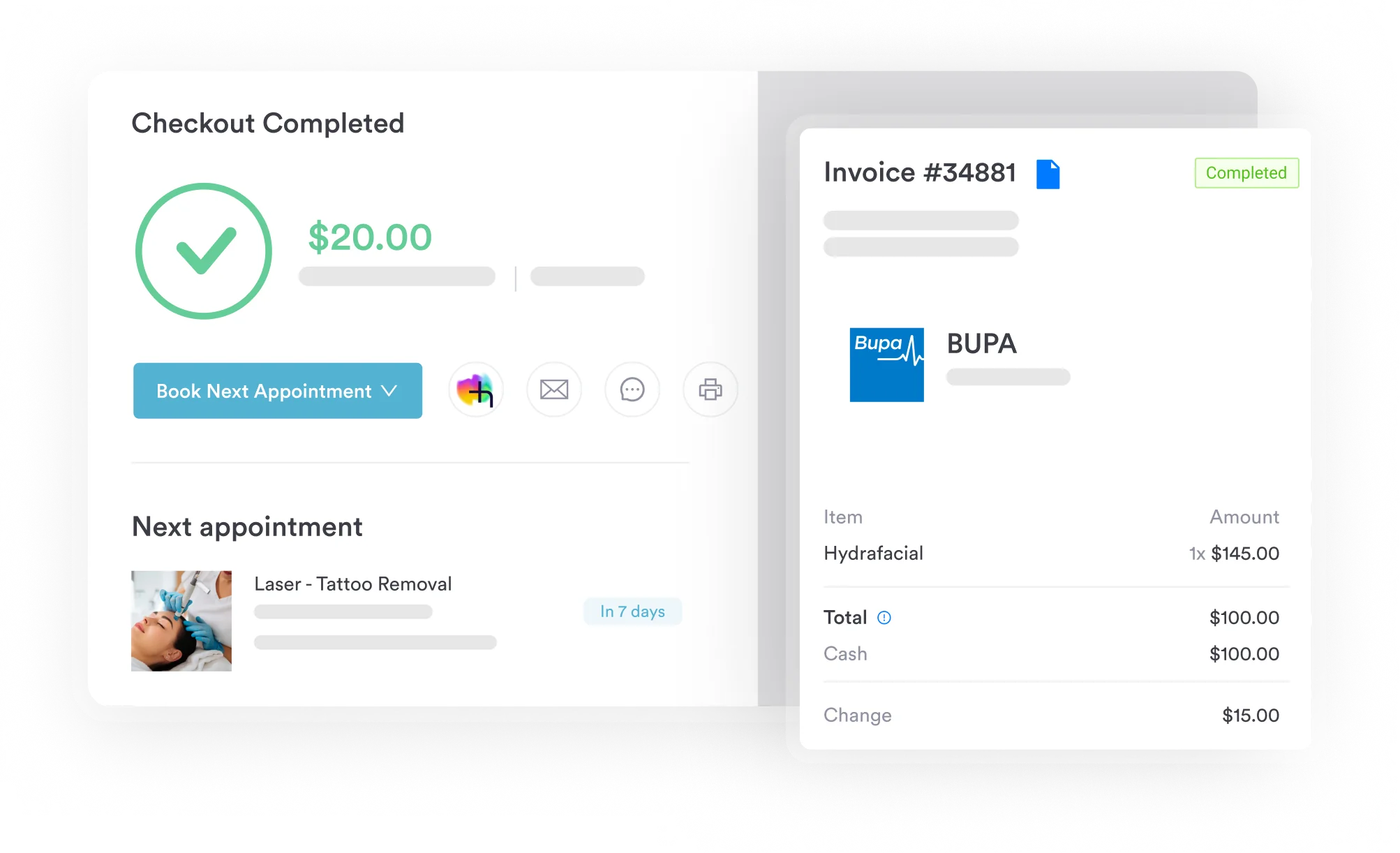
A spine practice rarely bills only surgery. Groups running in-house physical therapy or sports medicine services keep those claims in the same queue, so one remittance screen covers the whole practice.
Every submission produces an 837 file that meets current HIPAA transaction standards, and the remittance posts back against the original invoice. Staff stop rebuilding the same claim for each payer.

Pabau pre-fills the CMS-1500 from the treatment record, checks the required fields, and submits through Claim.MD to thousands of US payers. See how a multi-code spine claim moves in a live demo.

CPT code 20936 records a specific piece of work, local bone harvested through the incision the surgeon already opened. Under Medicare it carries no payment of its own, so it earns its place through accuracy rather than revenue. The primary code beside it and the note behind it are what protect the money.
The same-incision test is the one place this decision moves money, since 20937 and 20938 are separately payable. Read the note, code what it describes, and leave the bundled line alone.
Pabau carries the coded record into a CMS-1500, checks the required fields, and sends it out through Claim.MD. Book a demo to see how your spine claims would move.

Coding a multi-level fracture repair? CPT code 22328 covers the add-on that reports each additional vertebra treated in the same session.
Billing a second vertebroplasty level? CPT code 22512 walks through the add-on for each additional thoracic or lumbar body.
Harvesting a graft that is not bone? CPT code 20922 sets out how a fascia lata graft is reported and documented.
Operative notes dictated after the case? Best medical transcription software compares the tools that turn surgical dictation into a usable note.
Report it once per operative session, however many levels the surgeon fuses. The 20930 to 20938 codes are reported one time per spinal procedure, not once per interspace. A quantity above one on a bundled line only invites an edit.
No. The descriptor limits 20936 to spine surgery, so a harvest for any other site needs a different code. Bone grafts outside the spine fall to 20900 or 20902, depending on how much bone the surgeon takes.
Some price it, and Medicare never does. Check the contract and the fee schedule before you expect payment, because bundling rules vary outside Medicare. Plans that follow the Medicare fee schedule apply status B and bundle the line.
No. The fee schedule assigns 20936 a global period of XXX, so the global surgery concept does not apply. Post-operative visits fall under the primary spinal procedure’s global period instead.
Yes. 20936 is active in 2026, and the CY2026 Medicare fee schedule file still shows it as status indicator B for that year. The descriptor is unchanged, so the same-incision test still decides the code.