CCSD code G5100: Bypass of duodenum billing guide
CCSD code G5100 bills a bypass that leaves the duodenum in place CCSD code G5100...

Last Updated: Oct 16, 2026
CCSD code G4530 covers catheterless oesophageal pH monitoring, the wireless reflux test most people know as Bravo. During an upper endoscopy, a small capsule is pinned to the lining of the esophagus. It records acid exposure for 48 hours, sometimes 96, and sends the readings to a receiver the patient wears.
The code sits in CCSD Chapter 10, Endoscopic GIT Procedures, and UK private medical insurers use it to pay for the test. A claim pays first time when it carries a clear indication, a matching ICD-10 code and insurer pre-authorization. It also needs a signed report stating how long the recording ran.
Let Pabau's smart automation suggest the right codes, reduce claim denials, and keep your practice compliant—effortlessly.
Automate repetitive tasks and focus on what matters most—your patients.
Reduce coding errors and ensure compliance with the latest regulations.
Clean claims, fewer denials, and faster reimbursements.
Powerful insights and reporting to help your practice thrive.
HIPAA compliant SOC 2 certified GDPR-compliant Trusted by 4,000+ clinics worldwide

CCSD code G4530 is catheterless oesophageal pH monitoring, such as the Bravo capsule, in Chapter 10 of the CCSD schedule.
CCSD lists diagnostic OGD (G6500), rigid oesophagoscopy (G1900) and three therapeutic OGD codes as unacceptable combinations with G4530.
Insurers expect the notes to show the indication, PPI washout, capsule placement, recording duration and a signed report.
Pre-authorization rules differ by insurer and policy, so confirm each case through the insurer’s provider portal before the test.
CCSD code G4530 covers catheterless oesophageal pH monitoring, with Bravo as the named example. The test measures how often acid reaches the esophagus over two days or more. Gastroenterologists and upper gastrointestinal (GI) surgeons order it when symptoms and endoscopy findings leave the diagnosis open.
US practices bill the same capsule study under CPT 91035, so cross-border teams can map one test to both systems.
NICE reviewed the technique in its interventional procedures guidance IPG187. It found the evidence adequate for use with normal consent and audit arrangements. The guidance also notes the capsule suits patients who can’t tolerate a nasal catheter.
That endoscopy in step two matters for billing. The next section explains why.
CCSD lists five unacceptable combinations on its G4530 code page. Each one is an upper GI endoscopy code:
A patient with persistent heartburn on PPIs is referred for wireless pH testing. The consultant performs an OGD and places the Bravo capsule in the same session.
The tempting claim is G6500 plus G4530. CCSD rules that pairing out, so the claim carries G4530 without the diagnostic OGD. If the endoscopy finds something that changes the plan, look the extra procedure up in our CCSD codes for consultants before you code it.
Insurers pay for the test the notes describe. A thin record invites a query, so build the file while the test happens. Check that the record covers each of these points:
Keep the consent form and the patient’s symptom diary with the report. Both tend to come up when an insurer audits a claim.
If the capsule detaches early, record the achieved recording time and the reason. That one line heads off an insurer query about a failed study.
The ICD-10 code should name the reason for the test, not the result you expect. UK private claims use the WHO ICD-10 classification. These are the usual pairings:
Pick the code that the referral and notes support. Once the report confirms reflux, later episodes can move to the confirmed diagnosis. If the results lead to anti-reflux surgery, that operation bills on its own code, such as G2430 for the transabdominal approach.
Treat pre-authorization as a question for each patient, not a rule you learn once. Cover differs by insurer, by scheme and by member. So the safe answer always comes from the insurer.
Who confirms cover? The insurer does, through its provider portal or provider helpline. Ask before you set the test date.
What should you send? Send G4530, the ICD-10 code, the indication and a short clinical summary. Record the authorization number and its expiry date.
Where do fees live? Each insurer publishes its own. Check the Aviva fee schedule, the Vitality fee finder, or our guide to Bupa CCSD procedure codes. For AXA Health, WPA and others, use their provider portal.
Does the consultant matter? Yes. Insurers pay recognized consultants, so confirm your recognition is current with each one.
A payable G4530 claim carries four parts and leaves five endoscopy codes off. The panel below puts both on one page.
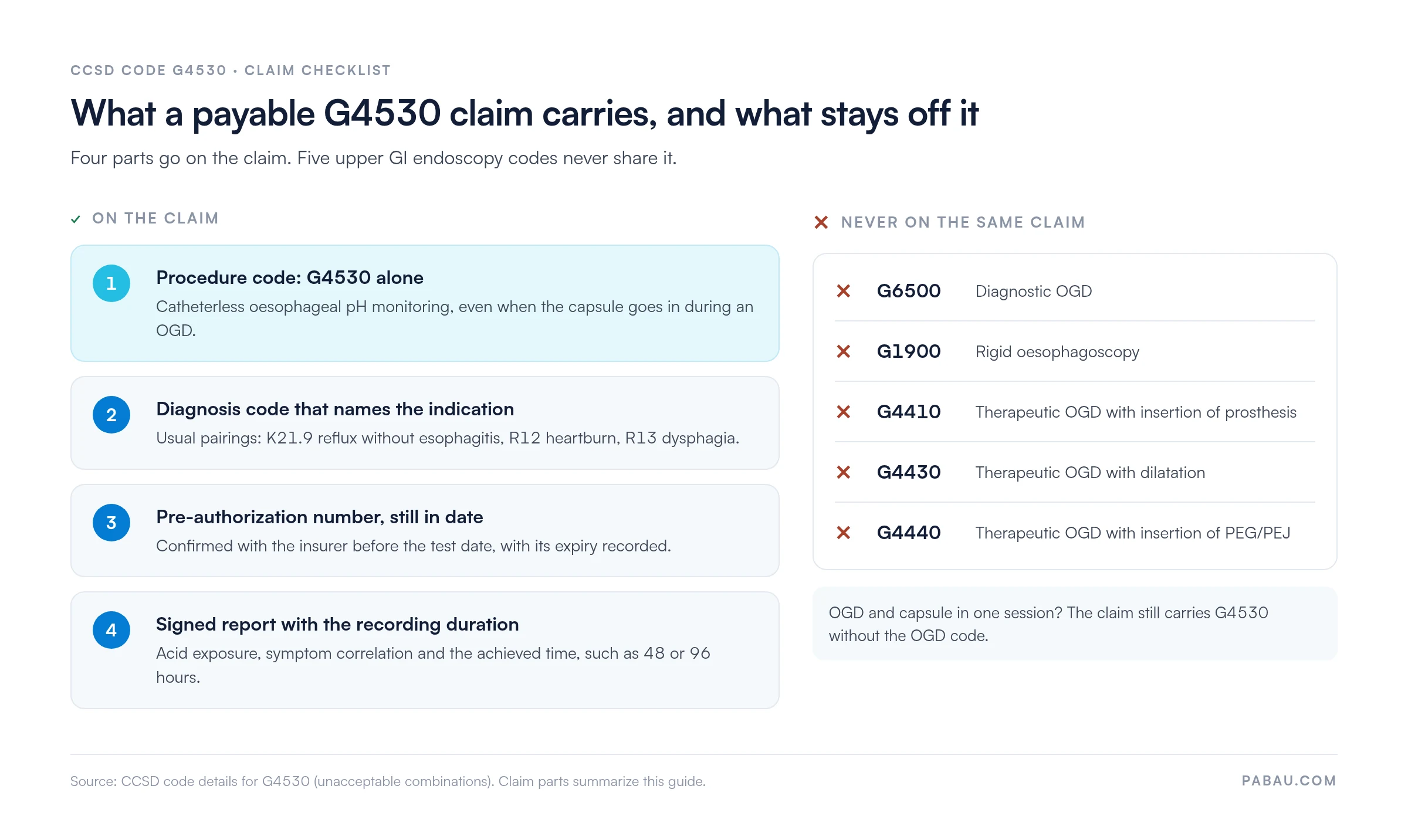
Then run through this list before each claim goes out:
Rejections on this code tend to repeat. These are the ones to design out:
A rejection isn’t the end of the claim. Work through it in this order:
Log every rejection reason as it arrives. Over a few months, the log shows which step of your process needs work.
pH-study claims usually stall for dull reasons. The authorization number lives in an email, the report sits in another system, and the claim goes out incomplete.
Pabau, the practice management platform we build for private practices, keeps the referral, consent, notes and report on one patient record. Its claims software for specialists pre-fills the claim from that record. It also checks that required fields, such as the membership number and authorization code, are complete before sending.
For UK insurers, claims go out through Pabau’s Healthcode integration, and you track their status in the same place. Pabau doesn’t choose codes for you. Instead, it makes sure the claim you’ve coded leaves complete.

Pabau keeps pH-study notes, consent and reports on one patient record. It then pre-fills the claim and checks required fields before it goes to Healthcode.

G4530 pays reliably when the file is built before the capsule goes in. Chasing the authorization number or the recording time after a rejection costs weeks you won’t get back.
The combination rule is the easiest one to break, because the endoscopy happens in the same session. So make one habit stick with your coders. Bill the capsule alone, and most appeals never need writing.
Book a demo to see how Pabau keeps pH-study records and insurer claims together on one patient record.

Need a CCSD procedure code reference specific to Bupa? Bupa CCSD procedure codes maps the Bupa fee schedule and explains how Bupa applies CCSD coding for recognized consultants.
Looking to cut claim rejections across your practice? Claims management software covers how Pabau pre-fills, validates and tracks insurer claims.
Billing the same test in the US? CPT code 91035 covers wireless esophageal pH monitoring under US rules.
Does the pH study point to surgery? CCSD code G2430 explains how to bill transabdominal antireflux operations.
G4530 covers catheterless oesophageal pH monitoring, such as the Bravo capsule. A capsule is fixed to the esophageal wall after endoscopy and records acid exposure, usually for 48 hours. The code sits in CCSD Chapter 10, Endoscopic GIT Procedures.
No. CCSD lists G6500, diagnostic OGD, as an unacceptable combination with G4530. The same applies to G1900, G4410, G4430 and G4440. Bill G4530 without them, even when the capsule goes in during an endoscopy.
Common pairings are K21.9 for suspected reflux disease, R12 for heartburn and R13 for dysphagia. Choose the code that the referral and clinical notes support.
Rules vary by insurer and policy, so check each case. Confirm cover through the insurer’s provider portal or helpline before the test date. Then record the authorization number on the claim.
Ask for the reason in writing, correct any admin errors and resubmit. For clinical queries, send the indication, prior workup and signed report. A policyholder can take an unresolved complaint to the Financial Ombudsman Service after eight weeks.