CPT code 93503: Swan-Ganz catheter billing and modifiers
CPT code 93503: Official descriptor and procedure overview In the AMA CPT code s...

Last Updated: Oct 23, 2026

CPT code 20922 reports a fascia lata graft harvested by incision and area exposure, as a sheet or a complex configuration.
The technique in the operative note decides between 20920 and 20922, not the size or the use of the graft.
20922 is a standard surgical code with a 90-day global period, and it carries no add-on designation.
Thin complexity documentation drives most denials, so the note must record the incision, the exposure, and the tissue harvested.
Practice management software like Pabau pre-fills the claim from the client record and checks required fields before submission.
CPT code 20922 covers a fascia lata graft taken by incision and area exposure, complex or sheet. It pays for the harvest itself, so it rides alongside the repair that uses the tissue. One detail decides whether it survives review. The note has to describe an open incision with broad area exposure.
Get the wording wrong and the payer pays 20920 instead, the simpler stripper harvest. Sections below walk through the descriptor, the note, the modifiers, the pairings, and the denials that follow a thin record.
The official AMA descriptor reads fascia lata graft, by incision and area exposure, complex or sheet.
Two conditions sit inside that wording. First, the surgeon opens the lateral thigh and exposes an area of fascia. Second, the tissue raised is a sheet or a complex configuration.
Fascia lata is the dense connective tissue sheet running down the lateral thigh. Surgeons take it when a repair needs living, non-synthetic material for reinforcement. Orthopedics, plastic and reconstructive surgery, urology, and ophthalmology all use it, which is why 20922 turns up on claims from very different specialties.
The American Medical Association maintains CPT as the HIPAA-mandated code set. Within it, 20922 sits in the General Grafts or Implants subsection, codes 20900 to 20939.
Neighboring codes cover other donor tissue, so read the descriptor before reaching for one. Tendon grafts fall to CPT 20924, and spinal autografts to CPT 20936.
The harvest starts with a longitudinal incision over the lateral thigh, which exposes the iliotibial band and the fascia beneath it.
Complexity is the deciding factor. A sheet harvest needs wider dissection than a narrow strip, and the note should show that extra work.
Surgeons reach for a fascia lata sheet in a handful of situations:
Because the harvest sits at a separate site from the repair, you bill it with the primary procedure code. That linkage matters for documentation.
Pelvic floor and urology practices see the sling version most often. In their pelvic health software, the harvest note has to sit alongside the sling note. Reconstructive teams face the same requirement inside plastic surgery software.
Technique decides the code, and the tissue does not. A stripper harvest is 20920, even when the strip comes out long. Open dissection with area exposure is 20922, even when the sheet is modest.
Billing 20922 on documentation that only supports 20920 is upcoding, and it is the fastest route to an audit flag. The panel below matches common note language to the code it supports.
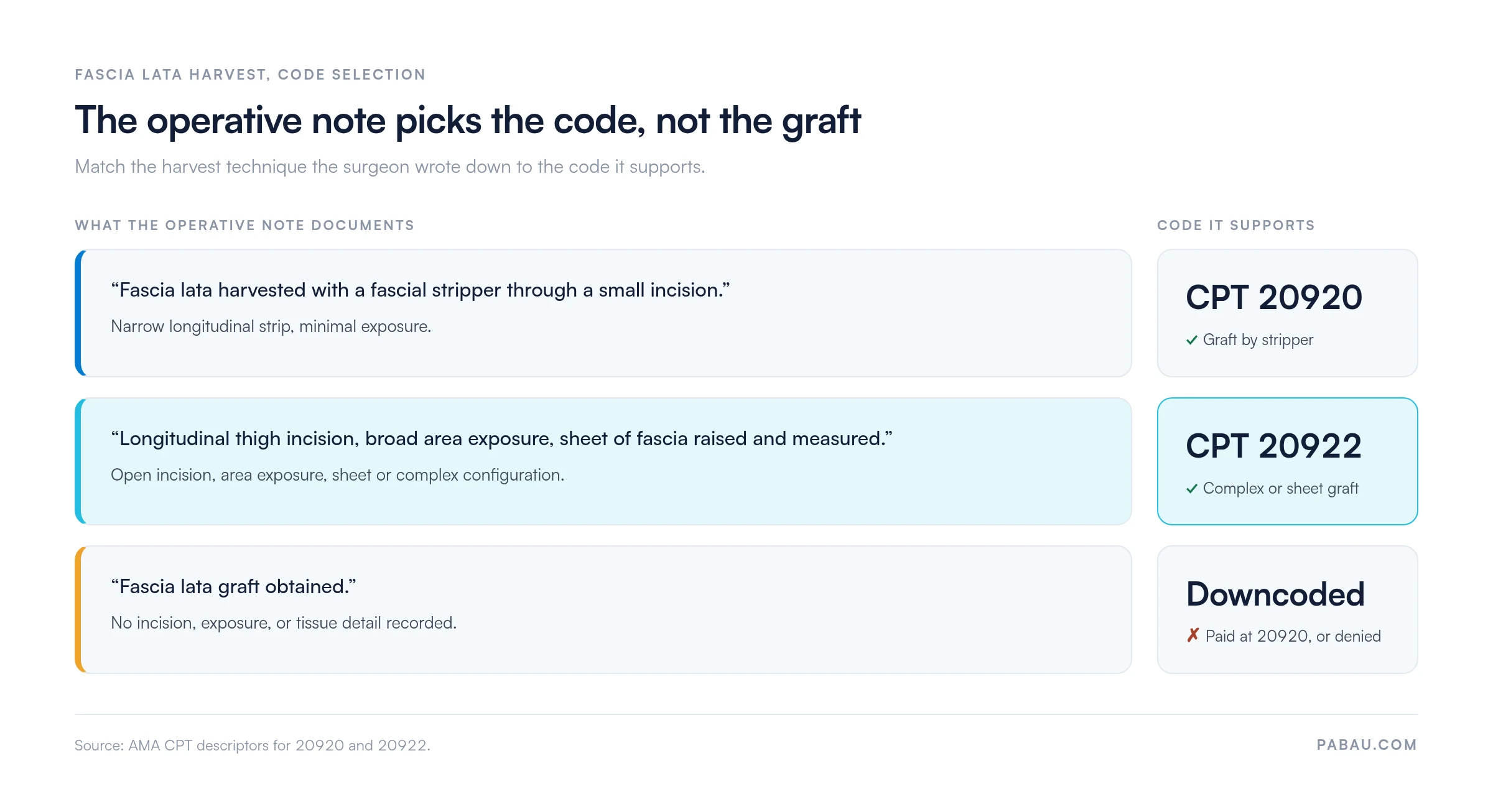
Thin complexity documentation is the main reason a 20922 claim gets downcoded. Reviewers hunt for the phrase “by incision and area exposure”, or a plain description of the same technique.
Seven elements belong in the operative note:
Compare two versions of the same case. The first says only that a fascia lata graft was obtained from the right thigh. That line names no technique, so a coder cannot defend the higher code.
The second version records four details:
Same operation, yet only the second version supports 20922. Clean claim work on this code is mostly a dictation habit, built before anyone touches the charge.
Modifier choice follows the primary procedure rather than the graft. Check current National Correct Coding Initiative (NCCI) edits and the payer’s own policy before appending one, because bundling rules differ by plan.
Since 20922 usually accompanies a primary reconstruction, -51 comes up most often. The code has no add-on designation in CPT, and it carries a 90-day global period like other major surgical codes. So standard multiple-procedure rules apply, and the fee schedule is worth checking before you assume any exemption.
Payment runs through the Resource-Based Relative Value Scale. Medicare’s Physician Fee Schedule sets national RVU values, then adjusts them by the geographic practice cost index and the annual conversion factor.
Pull current numbers from the CMS fee schedule lookup for your locality, because rates change every calendar year. For a payment figure in one step, the FastRVU 2026 lookup applies this year’s conversion factor and GPCI values.
Medicare covers 20922 when the diagnosis and the operative note establish medical necessity. Your Medicare Administrative Contractor (MAC) publishes Local Coverage Determinations (LCDs) that set the detail, so read them for the indication you are billing. Commercial plans often follow the same framework, then add prior authorization or their own bundling rules.
Running insurance eligibility verification before the surgery date surfaces those requirements while there is still time to act. Some plans exclude fascia lata graft for cosmetic reconstruction, which is worth catching before the patient is on the table.
A 20922 charge travels the standard medical billing path, with two checkpoints that matter more than usual. Here is the route a clean claim takes:
Steps two and three carry most of the risk. Dictation decides whether the code is defensible, and coding decides whether the payer sees a distinct service.
When a note reaches the coder without technique detail, ask for an addendum before submission rather than after a denial.
That review takes a minute, and it catches most of what payers send back.
Fascia lata denials repeat themselves. Six causes account for most of them, and every fix sits upstream of the appeal. Good denial management for graft claims starts in the operating room, not in the follow-up queue.
When a denial does land, read the remittance code first. The denial codes reference tells you which kind you are holding. A technical denial gets corrected and resubmitted, while a coverage denial needs an appeal with clinical records attached.
The diagnosis has to justify the graft, not only the primary repair. Use the AAPC Codify lookup while you build claim templates, then verify each pairing against the patient record and the payer’s LCD.
Code to the highest specificity the record supports. An unspecified diagnosis on a 20922 line invites a medical necessity review, and reviewers rarely settle those in your favor. For a femoral shaft fracture, that means a full seven-character code such as S72.345C rather than a truncated stem.
One trap sits right next door. S82.0- is the patella, not the tibia, so tibial fractures belong in S82.1- through S82.3-. Check that digit before you attach the diagnosis to a graft claim.
20922 is a harvest code, so it rides with the procedure that uses the tissue. The pairing sets the modifier, and sometimes it decides whether the harvest is separately billable at all.
Run an NCCI edit check before you send any of these pairings. Where the codes are mutually exclusive with no override indicator, separate payment needs an appeal backed by the operative note.
Can I add 20922 to a fascial sling ptosis repair? No. 67902 already includes obtaining the fascia, and 67901 uses banked material, so neither one leaves a harvest to report. UK private practices code that same operation as CCSD code C1813, which carries the autologous fascia inside the descriptor.
Can I bill 20920 and 20922 for the same harvest? No. One harvest earns one code, and the technique in the note settles which of the two it is.
Is 15734 the leg flap code? No. 15734 covers the trunk, while 15738 covers the lower extremity. Swapping them puts the wrong body area on the claim, and payers catch it.
This work usually sits in two systems. The operative note lives in the clinical record, then the claim gets rebuilt by hand in a billing tool. That second keying is where codes and diagnoses drift apart.
Practice management software like Pabau closes that handoff. Pabau’s claims management software pre-fills the claim from the client record. The CPT code attached to the service lands on the charge line, and recorded diagnoses seed the ICD-10 slots.
Code libraries for CPT and ICD-10 sit behind a search icon. Required-field checks then hold the claim until authorization codes and membership numbers are present.
US practices submit through the Claim.MD integration, which reaches thousands of insurance payers and returns eligibility checks, claim status, and electronic remittance. Pabau does not pick your modifier, and no software should. It does stop a 20922 claim from leaving with a blank required field, or with a code that never crossed over from the note.
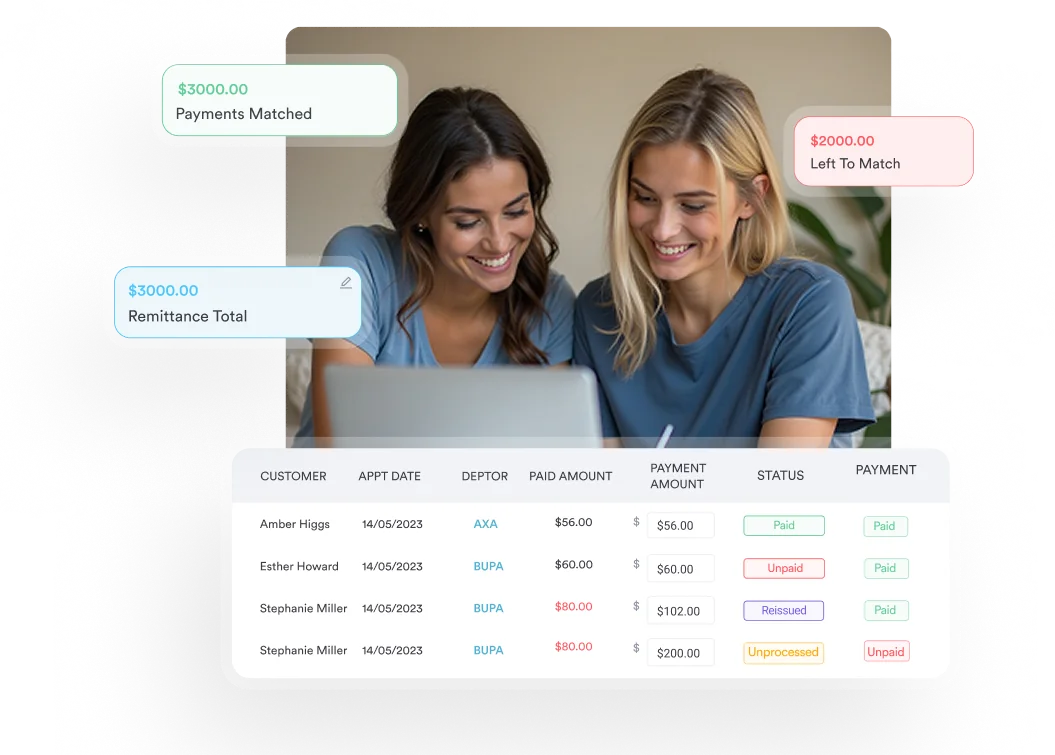

Pabau’s claims management pre-fills each claim from the client record, checks required fields, and submits electronically through Claim.MD. Fewer graft claims come back for a missing detail.

20922 gets paid when the operation genuinely needed an open harvest and the note proves it. Lose either half and the claim pays at 20920, or not at all.
So the work belongs upstream of billing. Give surgeons a dictation prompt for incision, exposure, and tissue configuration, and the coding decision stops being a judgment call. That one habit prevents more denials than any appeal letter you will write this year.
Pabau brings the record and the claim into one workflow, so what the surgeon documented is what the payer receives. Book a demo to see how it handles surgical billing end to end.

Billing a skin substitute instead of the patient’s own tissue? CPT code 15271 covers wound size, units, and the documentation payers ask for.
Working with a genuine add-on code for once? CPT code 22512 shows how add-on reporting differs from a standalone surgical code like 20922.
Need the tibial fracture codes that 20922 claims often miss? ICD-10 code S82.226G sets out the shaft-of-tibia detail and the seventh-character rules.
Billing guided injections in the same practice? CPT code 20611 explains the imaging documentation that keeps musculoskeletal claims clean.
Handling fracture care alongside a graft? CPT code 20650 walks through skeletal traction billing and its global period rules.
No. 20922 reports harvesting the patient’s own fascia lata. Banked or donor fascia involves no harvest, so only the primary repair code goes on the claim.
No. Closing the thigh incision is part of the harvest. Report a separate repair code only where the surgeon documents complex reconstruction of the donor site itself.
Routine follow-up care tied to the surgery is included in the payment for 90 days. Bill an unrelated visit inside that window with modifier -24 and a supporting diagnosis.
In practice, yes. Reviewers look for a distinct description of the incision, the exposure, and the tissue raised. A single clause inside the primary procedure narrative rarely survives review.