CPT Code 25210: Excision of a single carpal bone
CPT Code 25210: Official descriptor and quick-reference data CPT Code 25210 is a...

Last Updated: Nov 26, 2026
88346 is the CPT code for immunofluorescence, per specimen; initial single antibody stain procedure. It covers the first direct or indirect immunofluorescence stain a pathologist reads on one tissue specimen.
Each further antibody on that specimen is reported with add-on code +88350, so a four-antibody DIF panel is 88346 x 1 plus 88350 x 3. The code sits in the Surgical Pathology subsection of the AMA CPT code set. Most denials trace back to billing every antibody as a unit of 88346.
Let Pabau's smart automation suggest the right codes, reduce claim denials, and keep your practice compliant—effortlessly.
Automate repetitive tasks and focus on what matters most—your patients.
Reduce coding errors and ensure compliance with the latest regulations.
Clean claims, fewer denials, and faster reimbursements.
Powerful insights and reporting to help your practice thrive.
HIPAA compliant SOC 2 certified GDPR-compliant Trusted by 4,000+ clinics worldwide

CPT code 88346 covers the initial single antibody immunofluorescence stain on one tissue specimen, by the direct or indirect method, billed once per specimen.
Each additional antibody on the same specimen is reported with add-on code +88350. CPT 88347 was deleted on January 1, 2016.
Common clinical applications include skin biopsy for pemphigus and bullous pemphigoid, the lupus band test, and renal biopsy for glomerulonephritis.
The most frequent denial triggers are missing medical necessity diagnosis codes, unit errors across 88346 and 88350, and thin pathology report documentation.
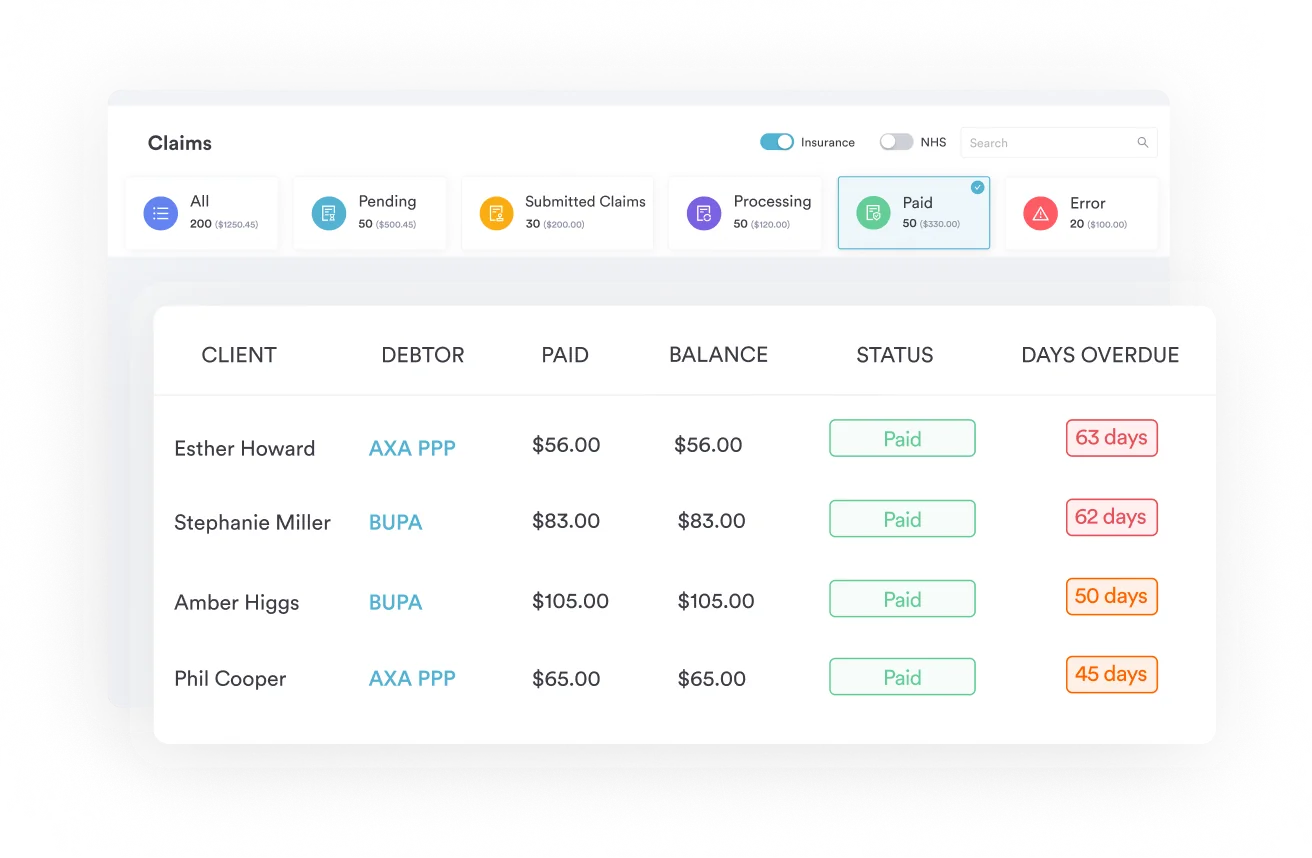
Pabau’s claims management software works with the Claim.MD clearinghouse to submit claims, check eligibility, track status, and post remittances against the patient record.
CPT code 88346 reads “Immunofluorescence, per specimen; initial single antibody stain procedure.” The code sits within the Surgical Pathology Procedures subsection of the CPT code set, maintained by the American Medical Association (AMA).
Since the 2016 revision, it covers both the direct and the indirect method on a tissue specimen. The critical billing nuance is in the unit definition. One unit of 88346 covers the first antibody on a specimen, and each further antibody on that specimen is a unit of +88350.
CMS’s 2026 NCCI policy manual sets the unit of service as each antibody stain per specimen. A direct immunofluorescence (DIF) panel using IgG, IgA, IgM, and C3 on one skin biopsy is therefore 88346 x 1 plus 88350 x 3.
Coders see this pair most often on dermatopathology and nephropathology requisitions, where DIF helps diagnose autoimmune blistering disorders and glomerulonephritis. Most errors come from an old habit of billing every antibody as a unit of 88346. Knowing the medical billing rules for add-on codes stops those denials before the claim reaches a payer.
Direct immunofluorescence works by applying fluorescently labeled antibodies directly to a frozen tissue section, then examining the section under a fluorescence microscope. The pathologist looks for deposits of immunoglobulins, complement components, or fibrinogen at specific anatomical locations. That pattern of deposition is what distinguishes one autoimmune diagnosis from another.
Direct immunofluorescence is ordered when a clinician suspects an autoimmune condition that produces characteristic immunoglobulin or complement deposits in tissue. At dermatology practices, the most common driver is a vesiculobullous skin disorder. There, the DIF pattern often makes the diagnosis on its own.
The clinical indication must be documented on the requisition and supported by an ICD-10 diagnosis code. Missing this link is the fastest path to a medical necessity denial.
Payers require a supported ICD-10 diagnosis code on every 88346 claim line to establish medical necessity. The table below organizes the most commonly accepted codes by clinical category.
Use the most specific code available. Where the ordering physician suspects IgA nephropathy, the N02.B- codes (recurrent and persistent immunoglobulin A nephropathy, effective October 1, 2023) are more precise than N02.9.
That precision reduces the chance of a medical necessity query. Verify acceptable ICD-10 pairings against the payer’s local coverage determination (LCD) for laboratory immunofluorescence before submitting.
Run a diagnosis crosswalk before submitting any 88346 claim. The most specific ICD-10 code available for the clinical scenario reduces medical necessity denials and shortens appeal timelines. If the ordering clinician provides only a rule-out diagnosis, query the chart for a confirmed or suspected code before the claim goes out.
The billing rule is simple once coders separate the two codes. The first antibody stain on each specimen is one unit of 88346. Every additional antibody on that same specimen is one unit of add-on code +88350, which is never billed without 88346.
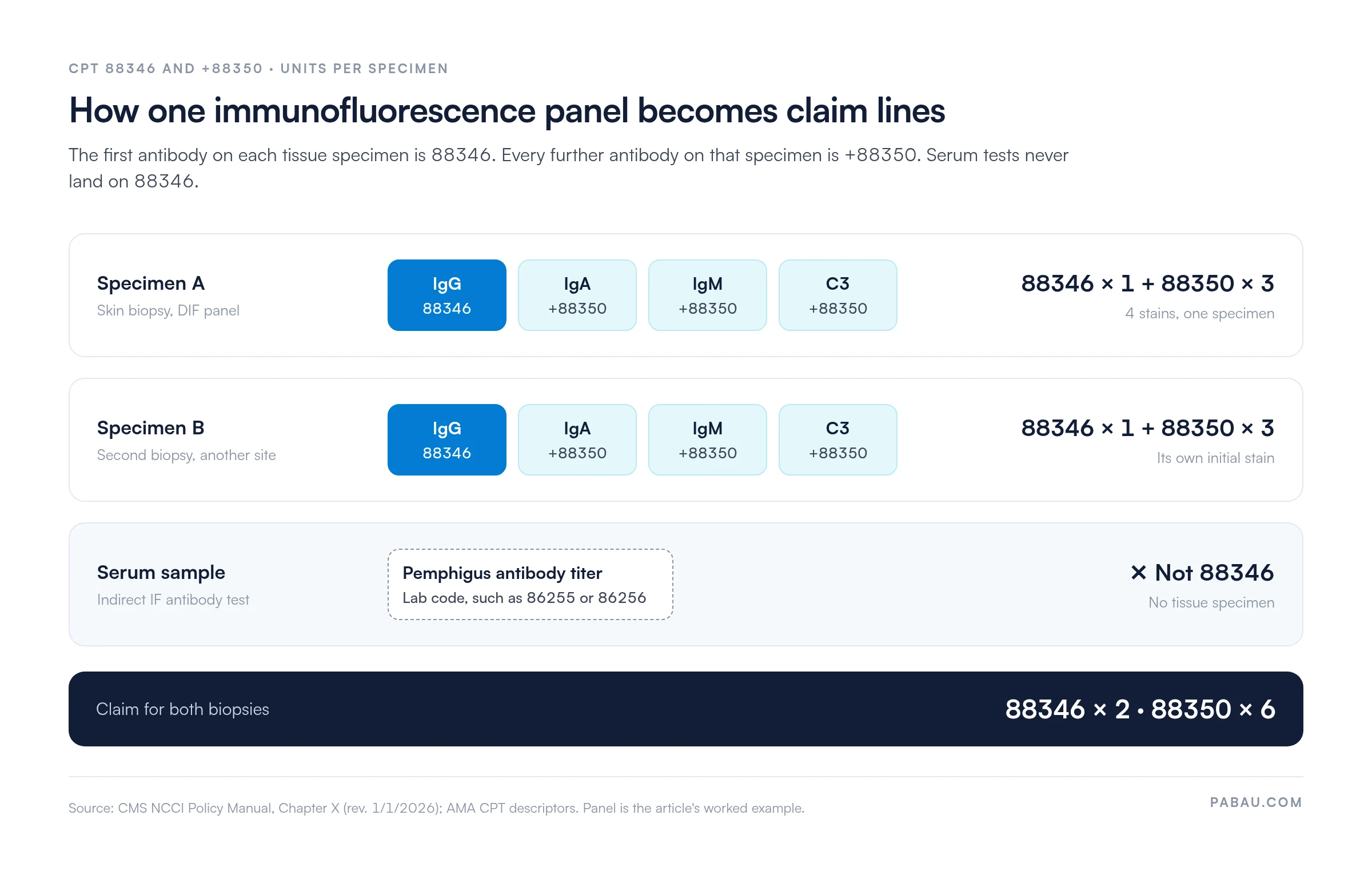
A second specimen, such as a biopsy from another site, gets its own 88346 for its first antibody. Unit-checking claims management compares the requisition’s antibody list against the units on both lines before the claim goes out. A mismatch between the pathology report and the claim is a leading denial trigger.
The claim carries two lines: 88346 with 1 unit and 88350 with 3 units. Billing all four stains as 88346 x 4 conflicts with the per-specimen definition and invites edits and recoupment.
If the same panel runs on a second biopsy from another site, that specimen adds its own 88346 x 1 and 88350 x 3. The diagram below shows how two biopsies and a serum test split across the claim.
Modifier 26 (professional component) applies when the pathologist interprets the DIF study but does not own the laboratory performing the technical work. Modifier TC (technical component) is used by the performing laboratory. When the same entity performs and interprets the study, no modifier is needed.
Apply the same component modifier to the 88350 line as to 88346. Modifier 59 may apply when 88346 is billed alongside 88305 on the same specimen. Verify the current NCCI edit status before submitting, as payer policies vary.
CPT 88346 and +88350 travel together on every multi-antibody panel. 88346 reports the first antibody stain on a specimen, and 88350 reports each additional antibody stain on the same specimen. Both codes cover the direct and the indirect method on tissue, so the technique does not change the code.
Older billing guides still compare 88346 with CPT 88347, the former code for indirect immunofluorescence. The AMA deleted 88347 on January 1, 2016, when it rewrote 88346 to cover both methods and created 88350. A claim that still carries 88347 is rejected as an invalid code.
Indirect immunofluorescence on a patient’s serum, such as a pemphigus antibody titer, is a laboratory test. It is reported with lab codes such as 86255 or 86256, never with 88346.
A specimen sent in formalin cannot be processed for direct IF. When a biopsy is submitted in formalin and 88346 is billed, payers may deny the claim as technically incorrect. The requisition and pathology report should both document the transport medium to protect against this denial.
88365 reports in situ hybridization (ISH), such as FISH, for the initial single probe on a specimen. Each further probe on that specimen goes on add-on code 88364, the way 88350 follows 88346.
ISH detects nucleic acid sequences, so it is a different technique from immunofluorescence. The codes are not interchangeable, even though both families are billed per specimen.
Digital pathology (whole slide imaging) raises its own billing questions. Some payers now apply specific billing guidance when DIF is interpreted remotely from a digitized slide. Consult current CAP coding resources and your payer’s LCD before billing DIF interpretations performed via digital slide review.
Medicare reimburses 88346 and 88350 under the Medicare Physician Fee Schedule (MPFS), and each code has its own allowable. 88346 pays once per specimen for the initial stain, while 88350 pays for each additional antibody on that specimen.
The non-facility rate applies when the laboratory performs and interprets the study independently. The facility rate applies in a hospital outpatient setting. Sending claims through Claim.MD lets practices check patient eligibility before submission.
Use the CMS Physician Fee Schedule lookup tool to retrieve the current-year allowables for 88346 and 88350 in your locality. Geographic practice cost indices (GPCIs) mean allowables vary by region. The FastRVU 2026 RVU lookup provides work, practice expense, and malpractice RVU values alongside calculated Medicare rates for any ZIP code.
A standard DIF panel of four antibodies (IgG, IgA, IgM, C3) on one specimen pays one 88346 allowable plus three 88350 allowables. A renal biopsy panel of six to eight antibodies adds more 88350 units, not more 88346 units.
Payers also apply medically unlikely edits (MUEs) that limit the units of each code per day. Check the current MUE values and the applicable LCD before billing a large panel.
Always look up the Medicare allowables for 88346 and 88350 in your specific locality, not a national average figure. Rates vary by geographic area. Billing from a national average can lead to under-collection, or to compliance exposure if your locality’s rate is audited against your posted charges.
Payers that audit 88346 claims look for a consistent chain of documentation from the ordering clinician to the pathology report. A missing step triggers a request for additional records, and several missing steps produce denials. Applying clean claim submission standards to lab billing means every element below is in place before the claim leaves the practice.
Payers conducting post-payment audits compare the claim’s units against the pathology report. Take a report showing three antibodies on a claim billed as 88346 x 1 plus 88350 x 3. That mismatch leads to a repayment demand, which costs more than a denial. Build verification into the billing workflow rather than relying on post-audit correction.
88346 denials cluster around three failure points: missing medical necessity support, unit errors across 88346 and 88350, and thin documentation. Each has a distinct CARC code on the remittance.
Reviewing denial management workflows before the first 88346 claim goes out saves significant rework. Pathology lab denials often need clinical documentation requests that delay the appeal by weeks.
When an 88346 claim is denied for medical necessity, the appeal should include the physician order with the clinical indication and the pathology report. A
dd a written statement from the ordering provider explaining the diagnostic rationale. Review common CARC denial codes to understand which remittance codes correspond to each denial type before drafting appeals.
Most payers do not require prior authorization for outpatient DIF testing when the clinical indication is established. LCD requirements, though, work like a pre-authorization check.
Medicare administrative contractors (MACs) publish local coverage determinations for laboratory immunofluorescence that specify which diagnoses support coverage and which are non-covered.
Reviewing medical billing compliance requirements for laboratory services before onboarding a new dermatology or nephrology practice saves significant retroactive denial risk.
Key policy research steps for any payer:
Prior authorization for 88346 is uncommon but does occur in some high-utilization management programs for certain commercial plans. When in doubt, submit an advance beneficiary notice (ABN) for Medicare patients where the DIF indication falls outside the LCD-listed diagnoses.
Immunofluorescence claims fail on small mismatches. Typical ones are an extra 88346, an 88350 count that drifts from the report, or a diagnosis the LCD does not list.
Pabau, a practice management and billing platform, keeps the clinical record and the claim in one system. The billing team codes from the pathology report itself, not from a re-keyed summary. Pabau’s claims management software handles submission, eligibility checks, claim status, and remittance posting in the same place.
Claims route out through the Claim.MD clearinghouse as CMS-1500/837P claims. Eligibility responses, claim status updates, and electronic remittance advice come back against the same patient record. A rejected 88350 line shows up the day it comes back, not at month-end reconciliation.

Pabau’s claims management software submits claims through the Claim.MD clearinghouse, checks patient eligibility, and posts remittances against the patient record. See how it handles 88346 and 88350 pathology billing.

The 2016 rewrite turned immunofluorescence into a two-code job, and most 88346 errors still come from the old per-antibody habit. Bill one 88346 per specimen, put every further antibody on 88350, and retire 88347 from your charge master. Then make sure the pathology report lists each antibody per specimen and the diagnosis matches the payer’s LCD.
Get the unit split right and the rest of the claim is routine documentation. Book a demo to see how Pabau keeps the pathology report and the claim in one workflow.

Looking for the 837 format for lab submissions? 837 electronic claim file guide covers the data elements required for professional and institutional lab claims.
CPT code 88346 covers immunofluorescence on one tissue specimen for the initial single antibody stain, by the direct or indirect method. It is billed once per specimen. Each additional antibody on that specimen is reported with add-on code +88350. The code sits within the Surgical Pathology Procedures subsection of the AMA CPT code set.
CPT 88346 is not billed per antibody. Bill one unit of 88346 for the first antibody stain on each specimen. Report every additional antibody on that specimen with add-on code +88350, one unit each. A four-antibody panel (IgG, IgA, IgM, C3) on one specimen is billed as 88346 x 1 plus 88350 x 3.
CPT 88347 no longer exists. Before 2016 it reported indirect immunofluorescence, but the AMA deleted it on January 1, 2016. Since then, CPT 88346 covers the initial antibody stain on a tissue specimen by either the direct or the indirect method. Each additional antibody on the same specimen is billed with +88350. Indirect immunofluorescence on serum is a lab test, reported with codes such as 86255 or 86256.
Commonly accepted ICD-10 codes include L10.0 (pemphigus vulgaris), L12.0 (bullous pemphigoid), L13.0 (dermatitis herpetiformis), and L93.0 (discoid lupus erythematosus). M32.9 (systemic lupus erythematosus) and N02-N04 series codes for glomerulonephritis are also common. Always verify against the applicable MAC LCD for the current accepted diagnosis list.
The most frequent denial reasons are missing or unsupported ICD-10 codes and unit errors, such as billing 88346 for every antibody instead of using 88350. Missing pathologist signatures and incorrect 26/TC modifiers are also common. Some denials arise when units exceed a medically unlikely edit (MUE) or a payer’s per-day limit.
Billing 88346 with 88305 on the same specimen may be appropriate in some scenarios. The combination is subject to NCCI (National Correct Coding Initiative) bundling edits that vary by payer. Verify the current edit status and payer policy before submitting both codes. Modifier 59 may bypass the edit in documented circumstances, but it should not be applied routinely.
Medicare sets separate allowables for CPT 88346 and add-on code 88350, and both vary by geographic locality. Use the CMS Physician Fee Schedule lookup tool at cms.gov or the FastRVU calculator to retrieve current facility and non-facility rates. A panel’s total is one 88346 allowable per specimen plus one 88350 allowable for each additional antibody.