CPT Code 25210: Excision of a single carpal bone
CPT Code 25210: Official descriptor and quick-reference data CPT Code 25210 is a...

Last Updated: Nov 26, 2026
90621 is the CPT code for the meningococcal recombinant lipoprotein vaccine, serogroup B (MenB-FHbp), given on a 2 or 3 dose schedule by intramuscular injection. The only US product it describes is Trumenba, made by Pfizer.
The code covers the vaccine supply only, so each dose also needs an administration code, 90471 or 90472. Bexsero, the other MenB vaccine, is billed with CPT 90620 instead, and the two codes are not interchangeable.
Let Pabau's smart automation suggest the right codes, reduce claim denials, and keep your practice compliant—effortlessly.
Automate repetitive tasks and focus on what matters most—your patients.
Reduce coding errors and ensure compliance with the latest regulations.
Clean claims, fewer denials, and faster reimbursements.
Powerful insights and reporting to help your practice thrive.
HIPAA compliant SOC 2 certified GDPR-compliant Trusted by 4,000+ clinics worldwide

CPT code 90621 reports Trumenba (MenB-FHbp, Pfizer) only. Bexsero (MenB-4C, GSK) is billed with CPT 90620, and the two codes are not interchangeable.
Trumenba runs on a 2-dose (0 and 6 months) or 3-dose (0, 1 to 2, and 6 months) schedule. Every dose is billed as its own 90621 line.
Each 90621 line pairs with administration code 90471 for the first vaccine of the visit, or 90472 for each additional one.
Medicare Part B does not cover MenB vaccine, but Part D does, with no beneficiary copay since 2023.
Pabau’s claims management software carries the NDC, lot number, and VIS date from the vaccine record onto the claim. That removes the most common 90621 denials.
CPT code 90621 is the vaccine product code for Trumenba, the meningococcal serogroup B vaccine made by Pfizer. Its official descriptor, published by the American Medical Association, reads: “Meningococcal recombinant lipoprotein vaccine, serogroup B (MenB-FHbp), 2 or 3 dose schedule, for intramuscular use.”
CDC’s CPT-to-CVX vaccine table maps 90621 to that descriptor and to CVX 162, the code CDC assigns to Trumenba. The code covers the vaccine supply itself, and administration is billed separately.
ACIP ties the descriptor’s “2 or 3 dose schedule” to the patient. Healthy people aged 16 to 23 get two doses, while people at increased risk get three. The chart has to show which path the patient is on, because payers check the dose count against it.
ACIP’s eligibility language matters here too. For patients aged 16 to 23, ACIP recommends MenB vaccination through shared clinical decision-making between provider and patient. Commercial payers look at that recommendation type when they judge medical necessity on CPT code 90621 claims.
CPT 90621 covers Trumenba (MenB-FHbp, Pfizer). CPT 90620 covers Bexsero (MenB-4C, GSK). The two codes are not interchangeable, and the right one depends only on the product given, whatever the payer or the patient’s age.
Submitting 90621 when Bexsero was given is incorrect coding under HIPAA transaction and code set standards. A series also cannot be started with one brand and finished with the other, so a mid-series switch is a clinical error as well. Record the brand name and NDC in the chart before the claim is built.
The vaccine product code and the administration code always go on separate lines. Here is the step-by-step sequence.
A clean claim submission for CPT code 90621 needs the following elements in the patient record and on the claim form:
CPT code 90621 is a vaccine product code only, and the administration service is not included. Bill CPT 90471 for the first immunization given on a date of service, then CPT 90472 for each additional vaccine given at the same encounter.
Two Trumenba doses never fall on the same date of service: the shortest interval in either schedule is one month. Each visit in the series therefore gets one unit of 90621 and its own administration code. A patient on the 3-dose schedule produces three separate claim lines across three visits, and a patient on the 2-dose schedule produces two.
Check your payer contracts before billing 90472 for a same-date administration. Some commercial payers bundle the second administration fee into the first. Others reimburse 90472 without restriction. A quick contract review prevents routine underpayment or denials.
Coverage for CPT code 90621 varies by payer and patient age. An eligibility check before the visit shows whether the patient’s plan covers the vaccine, and under which benefit.
Medicare Part B does not cover MenB vaccine, so a 90621 claim to the MAC will deny. Medicare covers it under Part D instead. Since January 1, 2023, the Inflation Reduction Act has removed Part D cost sharing for ACIP-recommended adult vaccines. A Medicare patient who qualifies for Trumenba therefore pays no copay for the vaccine.
The practical work is in the billing route. A Part D claim goes to the patient’s drug plan, not to the MAC, and many physician offices bill it through a plan-approved portal. Others refer the patient to an in-network pharmacy. Confirm the route with the patient’s plan before you give the vaccine, and record the plan name in the chart.
ACIP’s MenB recommendations define two distinct patient groups, and each one maps to a different Trumenba schedule. Mixing them up is a frequent source of payer denials on CPT code 90621. The timeline below shows how many 90621 claim lines each schedule produces.
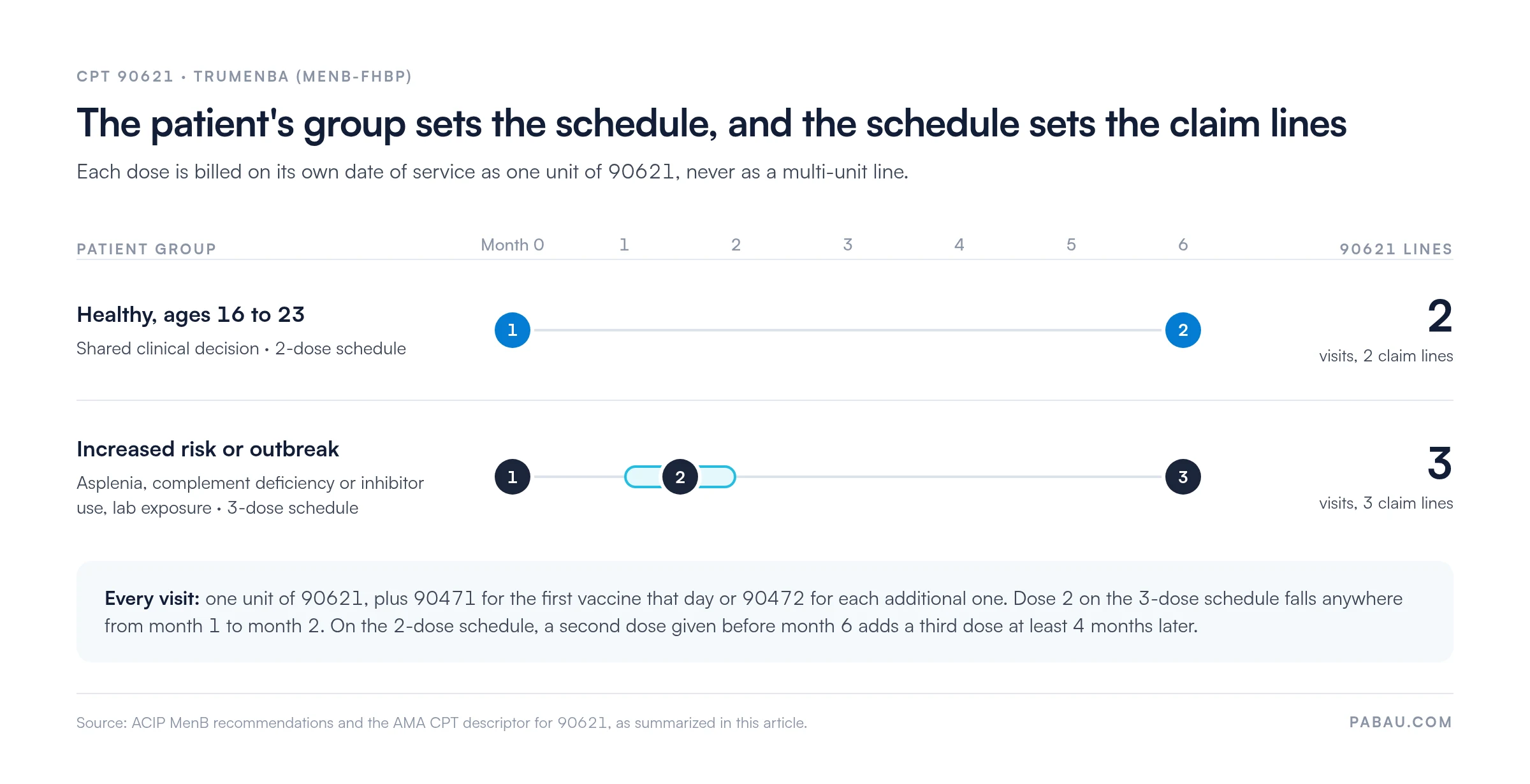
For a 16-to-23-year-old patient under shared clinical decision-making, add a short chart note documenting the discussion and the patient’s informed choice. That note is your defense if a commercial payer requests medical necessity documentation during a post-payment audit.
Pabau’s claims management software tracks documentation requirements by encounter, so a missing note shows up before the claim goes out.
The ICD-10 code paired with CPT code 90621 tells the payer why the vaccine was given. Z23 covers the vast majority of encounters. Add a secondary code when a high-risk condition is the reason for the vaccination, or for the 3-dose schedule. For a condition outside this table, the ICD-10-CM codes library lists every diagnosis code by chapter.
Some payers require a Z-code as the first-listed diagnosis on immunization claims. Others accept the high-risk condition code as the primary. Check each payer’s coverage policy before finalizing the claim sequence.
CPT code 90621 claims tend to deny for the same handful of reasons. A denial management workflow turns each rejection into a fix further up the process. The table lists the common reasons and how to resolve each one.
Most of these denials start in the chart. If the record names the product, the NDC, the dose number, and the schedule, the claim built from it rarely comes back.
Run a quarterly audit of your CPT 90621 claims by pulling all denied lines and sorting by denial reason code. If ‘missing NDC’ or ‘wrong product code’ appear more than twice, the fix belongs in your documentation workflow. Start with the EHR vaccine administration template.
A Trumenba series spans two or three visits, sometimes months apart, and each one needs the same product, NDC, and schedule on its claim. In most practices the vaccine record and the claim live in different places, so a detail gets re-keyed and lost along the way.
In Pabau, the NDC, lot number, and VIS date are captured at the point of care, and the claim is built from that record. Claims routed through Claim.MD’s clearinghouse network run eligibility checks and payer rule validation before submission. Avoidable errors get caught before they turn into denied claims that need manual rework.

Pabau tracks NDC numbers, lot documentation, and VIS dates at the point of care, then routes claims through Claim.MD for eligibility checks before submission. Fewer denials, less manual rework.

CPT code 90621 is a Trumenba code, and almost every billing problem with it comes from forgetting that. The product decides the code, and the patient’s risk decides between two and three doses. Medicare claims go to Part D, because Part B does not cover the vaccine.
Pabau captures vaccine documentation at the point of administration and routes 837P claims through Claim.MD. For practices running immunization programs alongside other services, each claim then carries the NDC and dose details exactly as charted. Book a demo to see how Pabau handles vaccine billing for your practice.

Giving MenACWY at the same visit? CPT code 90619 explains how to bill the MenACWY conjugate vaccine.
Confused about denial reason codes on 90621 claims? Denial codes in medical billing explains CARC codes and how to map them to corrective action.
Want to benchmark your vaccine billing accuracy? Best medical billing software for US practices outlines what to look for in an integrated billing solution.
CPT code 90621 covers the meningococcal serogroup B vaccine product Trumenba (MenB-FHbp, Pfizer), given on a 2- or 3-dose intramuscular schedule. The administration service is not included. Bill CPT 90471 for the first immunization and 90472 for any additional vaccine given on the same date.
CPT 90621 is for Trumenba (MenB-FHbp, manufactured by Pfizer). CPT 90620 is for Bexsero (MenB-4C, manufactured by GSK). The two codes are product-specific and not interchangeable. Select the code that matches the vaccine given, confirmed by the product’s NDC.
Yes, but under Part D, not Part B. Medicare Part B does not cover MenB vaccine, so do not bill the MAC for it. Part D plans cover ACIP-recommended vaccines, and since 2023 beneficiaries pay no copay for them. Bill the patient’s Part D plan through its approved route.
Two or three, depending on the patient. Healthy people aged 16 to 23 get two doses at 0 and 6 months. People at increased risk, or in an outbreak, get three doses at 0, 1 to 2, and 6 months. A third dose also follows when the second came less than 6 months after the first. Each dose is one unit of 90621 on its own date of service.
The most common reasons are the wrong product code (90620 vs 90621) and a missing or badly formatted NDC. Others include a third dose with no supporting diagnosis, and missing prior authorization outside routine ages. Missing shared clinical decision notes and duplicate billing of one dose also cause denials.
Yes, MenB vaccine is available through the VFC program for eligible children and adolescents. When using VFC-supplied vaccine, do not bill CPT 90621 for the product. Bill the administration fee only. VFC eligibility depends on patient criteria, not provider choice, and incorrect VFC billing is a compliance risk.