CPT Code 25210: Excision of a single carpal bone
CPT Code 25210: Official descriptor and quick-reference data CPT Code 25210 is a...

Last Updated: Nov 26, 2026
92933 is the CPT code for percutaneous transluminal coronary atherectomy with an intracoronary stent in a single major coronary artery and its branches. Any angioplasty in that artery is included. Atherectomy separates it from 92928, which reports a stent placed without it.
The code does not say whether the stent is drug-eluting or bare-metal. Since January 1, 2026, branch work sits inside 92933, because its branch add-on 92934 was deleted.
Let Pabau's smart automation suggest the right codes, reduce claim denials, and keep your practice compliant—effortlessly.
Automate repetitive tasks and focus on what matters most—your patients.
Reduce coding errors and ensure compliance with the latest regulations.
Clean claims, fewer denials, and faster reimbursements.
Powerful insights and reporting to help your practice thrive.
HIPAA compliant SOC 2 certified GDPR-compliant Trusted by 4,000+ clinics worldwide

CPT code 92933 reports coronary atherectomy with a stent in one major coronary artery and its branches, with any angioplasty included.
Atherectomy is what separates 92933 from 92928, and no CPT code says whether the stent is drug-eluting or bare-metal.
The branch add-on 92934 was deleted on January 1, 2026, so 92933 has no current add-on code and branch work sits inside it.
A second major artery takes its own primary code, and many payers expect a coronary modifier such as LD, LC or RC on each line.
Pabau’s claims management software submits PCI claims through Claim.MD, checks eligibility, and tracks claim status and remittances.
CPT code 92933 reports percutaneous transluminal coronary atherectomy with an intracoronary stent in a single major coronary artery and its branches. Balloon angioplasty in that artery is included when it is performed. The 2026 coronary CPT descriptors list it as one of the revised PCI base codes.
The cardiologist first debulks or modifies the plaque with an atherectomy device, often in a heavily calcified lesion. A stent is then deployed in the same artery. Both parts must happen for 92933 to fit.
Three parts of the descriptor decide whether 92933 is the right code. Check each one against the cath lab report.
The stent type does not change the CPT code. A drug-eluting stent and a bare-metal stent both fall under 92933 when atherectomy was performed in the same artery.
CPT 92928 reports intracoronary stent placement in a single major coronary artery and its branches, with angioplasty when performed. It does not include atherectomy. When the report shows atherectomy and a stent in the same artery, 92933 replaces 92928.
Never report both codes for the same artery in the same session. 92933 already includes the stent work that 92928 describes.
Older guides often call 92933 the drug-eluting stent code, which is wrong. Only the hospital outpatient HCPCS C-codes name the stent type: C9600 for a drug-eluting stent, and C9602 for a drug-eluting stent with atherectomy. Check the current OPPS addenda before choosing between C9602 and 92933 on a facility claim.
Audit your cath lab report template for an atherectomy field. If it records the stent but not the atherectomy device, coders cannot support 92933 and the claim drops to 92928. Ask the interventional cardiologist to confirm the device and the treated lesion before the report is signed.
Several services are paid inside 92933 and cannot be reported on their own. Others are billable next to it when the documentation supports them.
NCCI edit tables change quarterly, so check the current pairs before you submit. Reporting a bundled service without a valid modifier is the fastest route to a CO-97 denial.
The PCI family was restructured on January 1, 2026. The six branch add-ons were deleted, and their work moved into the revised base codes. Two new codes cover multi-lesion stenting and combined-approach chronic total occlusion work.
The grid below works through one artery at a time. 92933 is the cell where atherectomy and a stent meet.
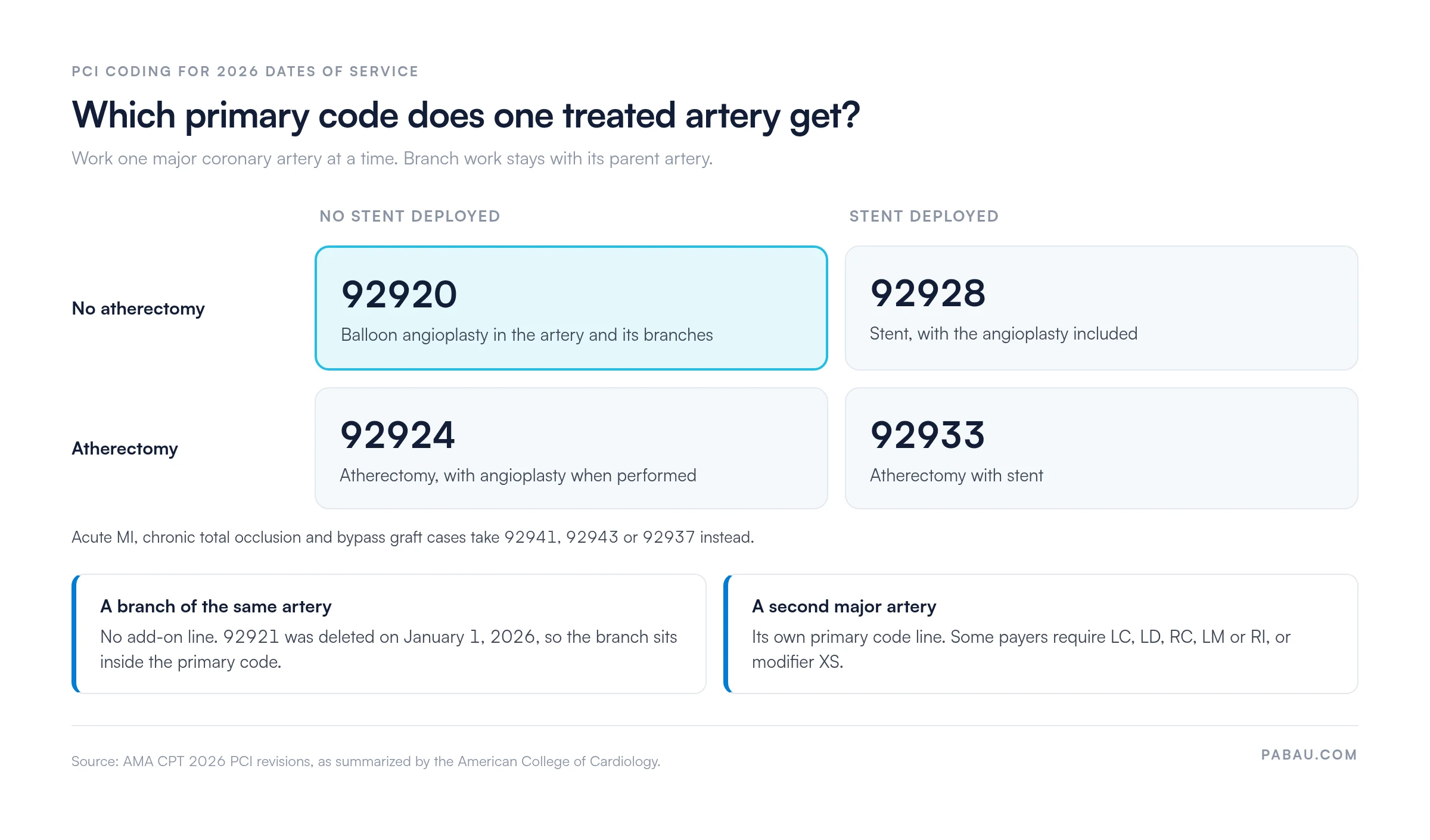
Key rule: pick one primary code per major artery. Acute MI, chronic total occlusion and bypass graft cases go to 92941, 92943 or 92945, and 92937, even when atherectomy is used. Our guide to CPT code 92920 covers the balloon-only end of the same family.
A clean claim for 92933 depends on what the interventional cardiologist writes in the cath lab report. Check each element below before the claim goes out.
Place of service affects payment. Most 92933 procedures happen in hospital outpatient departments or inpatient settings, and Medicare also pays it in an ambulatory surgery center.
The diagnosis on the claim must support both the stent and the atherectomy. Clinical context decides the code, and the pairings below are the most common ones.
I25.84 is easy to miss and it matters here. Calcification is the usual reason for atherectomy, so a claim that carries it explains the device work before a reviewer asks.
Modifier choice on 92933 affects both payment and audit exposure. Ask one question every time: does the documentation support the extra service on its own?
Some MACs prefer XS over -59 for separate anatomy. Check your local MAC guidance before you default to -59.
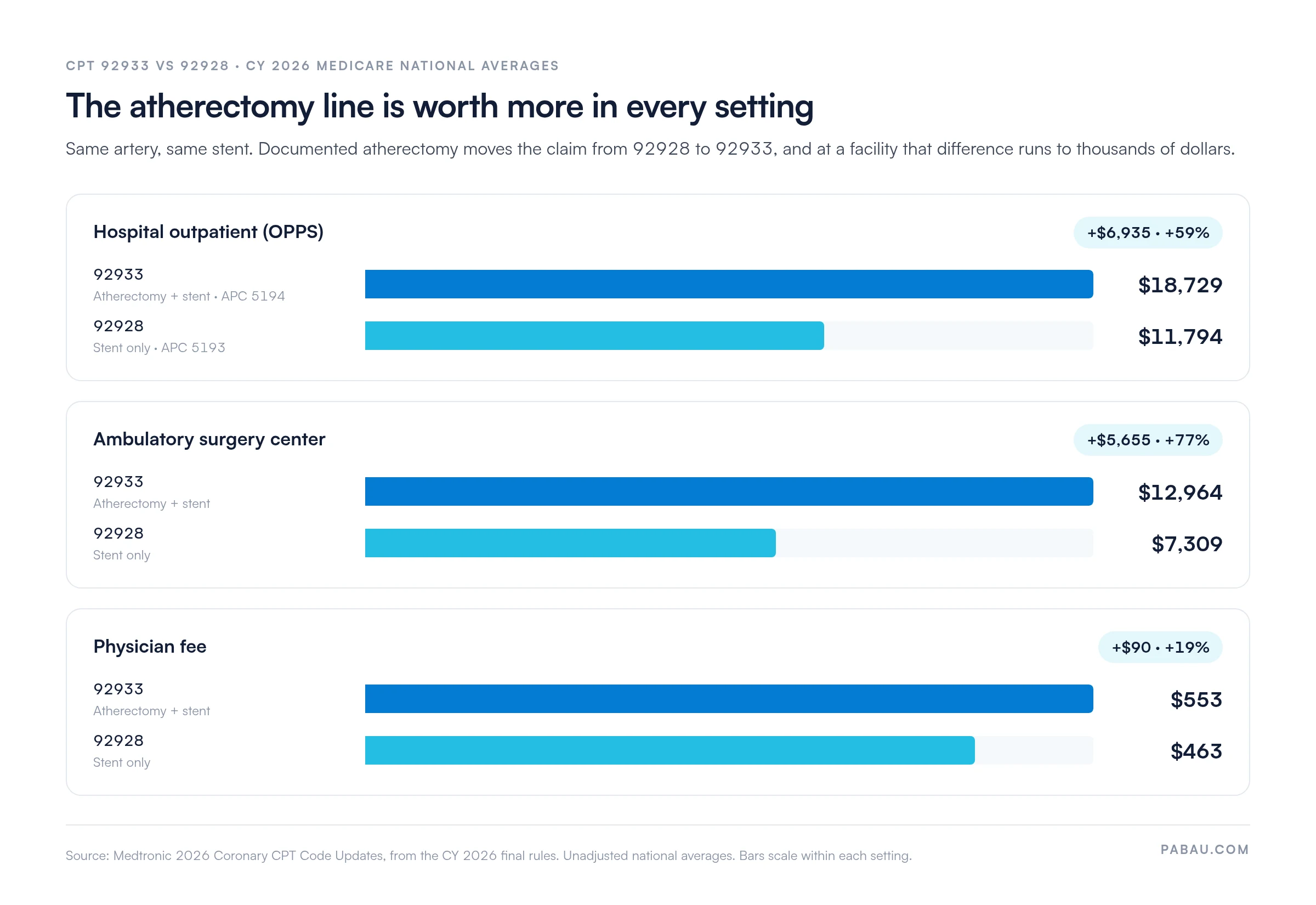
Medicare pays the physician under the Physician Fee Schedule and the facility under OPPS or the ASC payment system. The national average rates below come from the Medtronic 2026 coronary coding guide, which draws on the CY 2026 final rules.
These rates are unadjusted, so local amounts will differ. Pull your locality rate from the CMS Physician Fee Schedule lookup before you quote a figure.
That payment difference is why payers look hard at 92933, and the chart below shows how large it gets at a facility. A 92933 claim without atherectomy in the report is an overpayment the payer can recoup.
Traditional Medicare does not require prior authorization for most PCI procedures. Medicare Advantage and commercial plans often do for elective cases, and some ask for evidence of ischemia and failed medical therapy.
Emergent PCI is usually exempt, but many contracts still require notification within a set window. Build the check into your prior authorization process at scheduling, not on the day of the procedure.
A short list of root causes drives most 92933 denials. Learn the claim denial codes behind them, because a targeted denial management workflow fixes them faster than a general audit.
Run a 92933 charge check before every submission. Confirm the atherectomy device is documented, each artery has its modifier, and no deleted add-on code is on the claim. Then check that a calcification diagnosis appears where the report describes one.
Without a connected system, a PCI claim gets tracked across a payer portal, a clearinghouse login and a spreadsheet. Status checks happen by phone, and remittances get matched by hand.
Pabau, a practice management platform, puts that work in one place. Its claims management software submits claims through the Claim.MD clearinghouse and checks eligibility before the procedure. Claim status and electronic remittance advice then come back into Pabau.

The coding decisions in this guide still belong to your coders. What shrinks is the time spent chasing claims, which leaves more of the week for working denials against the report.

Pabau submits CPT 92933 claims through Claim.MD, checks patient eligibility, and tracks claim status and remittances in one place. See how it fits your cardiology billing workflow.

Code 92933 from the atherectomy line in the report. If the report shows a device run and a stent in the same artery, 92933 fits. If it shows only the stent, 92928 does, whatever the stent is coated with.
Update your charge templates for 2026 now. Take 92934 off every superbill and add an atherectomy field to the cath lab report. The cost is a closer read of each report, which is far cheaper than a recoupment on the highest-paid code in the family.
Pabau keeps those claims visible from submission to remittance, so denials surface while you can still fix them. Book a demo to see how it handles PCI claims for your cardiology practice.

Reporting intravascular imaging beside the stent? CPT code 92978 covers IVUS and OCT of the first coronary vessel, billed as an add-on next to the PCI code.
Confused by denial code CO-97 on a PCI claim? Medical billing denial code reference explains the most common NCCI bundling and modifier-related denial codes with resolution steps.
Want to reduce claim rework across your whole practice? Revenue cycle management overview covers the end-to-end workflow from charge capture to payment posting.
CPT Code 92933 covers coronary atherectomy with an intracoronary stent in a single major coronary artery and its branches. Angioplasty in that artery is included when performed. Diagnostic angiography, FFR and intravascular imaging are reported separately with the right documentation.
Atherectomy. CPT 92933 requires atherectomy plus a stent in the same artery, while 92928 reports a stent without atherectomy. The stent type plays no part in the choice, and both codes are never reported for the same artery.
No. No CPT code says whether a stent is drug-eluting or bare-metal. Hospital outpatient claims use HCPCS C-codes for that: C9600 for a drug-eluting stent and C9602 for a drug-eluting stent with atherectomy.
No. CPT 92934 was deleted on January 1, 2026, along with the other PCI branch add-ons. Branch work is now included in 92933, which has no current add-on code. A 2026 claim that lists 92934 will be denied.
Common pairings are I25.10, I25.110 and I25.119 for native coronary artery disease. I25.84, coronary atherosclerosis due to calcified coronary lesion, is often added because calcification is the usual reason for atherectomy.
Yes, when atherectomy with a stent is performed in two different major coronary arteries. Each artery gets its own 92933 line. Many payers also expect a coronary modifier, such as LD or RC, on each line.