CPT Code 19361: Latissimus dorsi flap breast reconstruction
CPT code 19361: Official descriptor and payment basics CPT code 19361 is the Cat...

Last Updated: Nov 18, 2026
Q4169 is the HCPCS Level II code for Artacent wound, per square centimeter (add-on, list separately in addition to primary procedure).
It reports Artacent Wound, an amniotic membrane skin substitute, at one unit per square centimeter of product applied to a qualifying chronic wound. Since January 1, 2026, Medicare pays skin substitutes without a biologics license as incident-to supplies, at one flat rate per square centimeter. Coverage still turns on wound type, failed conservative care, and your MAC's current policy.
Let Pabau's smart automation suggest the right codes, reduce claim denials, and keep your practice compliant—effortlessly.
Automate repetitive tasks and focus on what matters most—your patients.
Reduce coding errors and ensure compliance with the latest regulations.
Clean claims, fewer denials, and faster reimbursements.
Powerful insights and reporting to help your practice thrive.
HIPAA compliant SOC 2 certified GDPR-compliant Trusted by 4,000+ clinics worldwide

HCPCS Code Q4169 reports Artacent Wound, an amniotic skin substitute billed per square centimeter as an add-on to the application procedure.
Medicare coverage needs a qualifying chronic wound, documented failure of conservative care, and a claim that meets your MAC’s current skin substitute policy.
Since January 1, 2026, CMS pays non-BLA skin substitutes as incident-to supplies at one flat rate per square centimeter, not quarterly ASP.
Report one unit per square centimeter of product applied, never bill discarded product, and leave the JW and JZ modifiers off the line.
Pabau, our practice management software, records wound measurements and notes in the patient record and submits claims through Claim.MD.
HCPCS Code Q4169 reports Artacent Wound, an amniotic membrane skin substitute applied to chronic wounds. Its official descriptor reads “Artacent wound, per square centimeter (add-on, list separately in addition to primary procedure),” per the AAPC code listing for Q4169.
The code covers one product only. AmnioArmor has its own code, Q4188, while AmnioBand bills under Q4168 and Cygnus under Q4170. Bill Q4169 only when the application note names Artacent Wound.
Q4169 sits in the skin substitutes and biologicals range, Q4101 through Q4440, which CMS publishes and maintains through quarterly HCPCS updates. As an add-on code, it is always reported with a skin substitute application code from the 15271-15278 range. A trunk, arm, or leg wound starts with CPT 15271 for the first 25 sq cm.
Medicare covers Q4169 when the claim meets the skin substitute policy of your Medicare Administrative Contractor (MAC). In December 2025, CMS announced that the MACs were withdrawing the new skin substitute LCDs scheduled for January 1, 2026. Some MACs still apply older skin substitute LCDs, while others review each claim for medical necessity.
The qualifying wound types accepted across most policies include diabetic foot ulcers (DFUs), venous leg ulcers (VLUs), pressure ulcers, and non-healing surgical wounds. Beyond wound type, the claim must also show that standard conservative care failed before the skin substitute was applied.
Many Medicare Advantage plans add prior authorization requirements on top of traditional Medicare rules. Some commercial payers classify amniotic membrane products as experimental or investigational and deny them regardless of clinical justification. Verify payer policy before applying the product.
Pull your MAC’s current skin substitute policy before the first Q4169 claim of the year. CMS withdrew the LCDs planned for 2026, so the rules your MAC applies now may differ from last year’s. Keep a saved copy in the wound care protocol file.
The ICD-10-CM diagnosis codes on the claim must fall within the wound categories your MAC’s policy covers. Using a diagnosis code outside the covered list is one of the most common and easiest-to-prevent denial reasons for HCPCS Code Q4169. For a diabetic foot ulcer, pair E11.621 with an L97 code that names the ulcer’s site and severity.
Always cross-reference the specific diagnosis codes against your MAC’s current covered-diagnosis list. Some MACs publish a companion article with the exact ICD-10-CM codes that satisfy medical necessity for skin substitutes. A code outside that list makes the claim likely to be denied, even when it is clinically accurate. An appeal must then show the policy criteria were met.
Q4169 is reported in square centimeters of Artacent Wound. One unit equals one square centimeter of product, per the code descriptor. Measure the wound at application so the record supports the size of product you applied. The flow below shows where each check sits on the claim line.
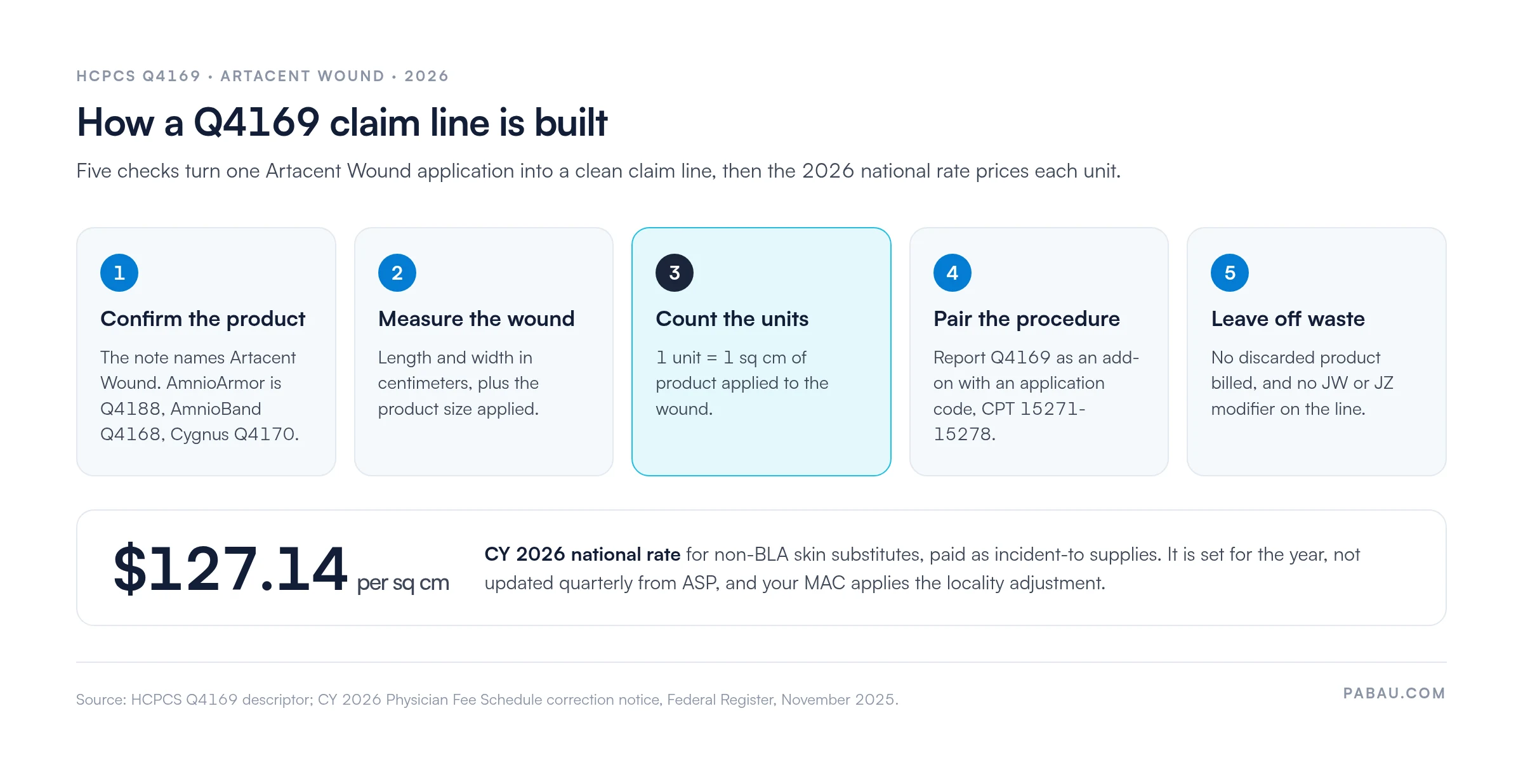
Common error: billing discarded product. Medicare does not pay for discarded amounts of an incident-to supply. CMS limits the JW and JZ modifiers to separately payable drugs and biologicals, so leave them off Q4169. Follow your MAC’s instructions for documenting any discarded amount.
For 2026, CMS changed how Medicare pays for most skin substitutes. The CY 2026 Physician Fee Schedule final rule reclassified products not licensed under a biologics license application (BLA) as incident-to supplies. Medicare now pays them at a single national rate per square centimeter, set for the year rather than updated quarterly from ASP data.
A November 2025 correction notice in the Federal Register set that CY 2026 rate at $127.14 per square centimeter. Artacent Wound, like most amniotic allografts, is not a BLA-licensed biologic, so it falls under this policy. Confirm the product’s category with your MAC before you bill.
Quarterly ASP files no longer set the Q4169 rate in 2026. Check your MAC’s fee schedule for the locality-adjusted amount before you quote a figure to a patient or a manager.
Traditional Medicare does not require national prior authorization for Q4169. Rules can still differ by MAC and by program, so check your MAC’s current policy before assuming no prior authorization is needed.
Medicare Advantage plans often require prior authorization for skin substitute codes, and many apply their own coverage policies. Confirm the plan’s requirements and turnaround time before you schedule the application.
Commercial insurers vary widely. Some classify amniotic membrane wound products as investigational, which makes approval unlikely regardless of documentation quality. Verify the specific plan’s coverage policy before applying the product.
Auditors deny many Q4169 claims because the chart cannot show what was applied or why. The medical record must support both medical necessity (why the product was needed) and the claim specifics (which product, what size, applied to which wound).
Pabau’s patient records keep wound measurements and visit notes together, so each application sits alongside the history behind it. Its digital intake forms capture the patient’s history before the visit, which helps show the conservative care tried before the skin substitute.
Create a Q4169 documentation checklist and attach it to every wound care encounter template. Before submitting the claim, run through each checklist item. A single missing element, such as an unsigned application note or an undated wound photo, is enough to trigger a denial or a post-payment recoupment.
Neighboring Q-codes each name a single product, so the code follows the product named on the application note. Billing the wrong one is a coding error and an overpayment risk.
The usual error is coding by product type rather than product name. If your practice stocks several amniotic products, check the product name on the application note before you assign the HCPCS code. For a broader crosswalk of related skin substitute codes, the AAPC HCPCS code lookup and CrossCoder both allow side-by-side descriptor comparison.
Most Q4169 denials fall into a predictable set of categories. The table below maps each denial type to its most common CARC code. It also lists the corrective action with the best chance of recovery. Our guide to medical billing denial codes explains each CARC and RARC in more detail.
When appealing a CARC 50 or 167 denial, attach the applicable policy to the appeal letter and annotate exactly which criterion your documentation satisfies. A generic letter gives the reviewer no criterion to check your record against.
Verify HCPCS code details through the PGM Billing HCPCS lookup tool and confirm current code status at the CMS HCPCS page before each appeal cycle.
Most Q4169 denials trace back to the chart. Wound measurements sit in one file, the application note in another, and the biller rebuilds the claim from memory.
Pabau keeps wound measurements and visit notes together on one patient record. Its claims management for practices then submits the claim through Claim.MD and tracks its status.
The outcome is a claim built from the same record an auditor will read. Your team spends less time hunting for notes when a payer asks for them.

Pabau records wound measurements and notes in the patient record and submits claims through Claim.MD. Your billing team works from the same record an auditor reads.

Q4169 is a narrow code: one product, Artacent Wound, billed per square centimeter as an add-on. Most errors come from treating it as a family code for any amniotic graft.
The 2026 changes raise the stakes on accuracy. Medicare now pays one flat rate per square centimeter and nothing for wastage, while MAC policies keep shifting. The record has to show exactly what was applied and why.
Match the code to the product name, bill only what was applied, and recheck your MAC’s policy each January. Book a demo to see how Pabau keeps wound measurements, notes, and claims on one patient record.

Need a denial management framework for wound care codes? Denial codes in medical billing explains common CARC and RARC codes and how to structure an appeal workflow.
Looking to keep wound documentation and claims in one place? Claims management software from Pabau submits claims through Claim.MD and tracks their status from the patient record.
Covering a wound larger than 25 sq cm? CPT 15272 reports each additional 25 sq cm of skin substitute applied to the trunk, arms, or legs.
HCPCS Code Q4169 is the Level II code for Artacent wound, per square centimeter, an add-on reported with the skin substitute application procedure. It covers one product, Artacent Wound, an amniotic membrane skin substitute applied to qualifying chronic wounds such as diabetic foot ulcers and venous leg ulcers.
Q4168 is AmnioBand, billed per 1 mg. Q4169 is Artacent Wound, billed per square centimeter. They are different products with different units, so the product name on the application note decides the code. AmnioArmor bills under Q4188 and Cygnus under Q4170, not under Q4169.
One unit equals one square centimeter of Artacent Wound, per the code descriptor. Report the square centimeters of product applied, and record the wound measurements that support that size. Discarded product is not payable, and the JW and JZ modifiers do not belong on an incident-to supply.
For 2026, CMS pays non-BLA skin substitutes such as Artacent Wound as incident-to supplies at one flat national rate. A Federal Register correction set that rate at $127.14 per square centimeter, before locality adjustment. Check your MAC fee schedule for the exact amount.
Traditional Medicare does not require national prior authorization for Q4169, but rules can differ by MAC, so check your MAC’s current policy. Medicare Advantage plans often require prior authorization for skin substitute codes. Confirm the plan’s requirements before scheduling the application.