CCSD Code V1730: Extraoral fixation of mandible
What is CCSD code V1730? CCSD code V1730 is the UK private medical insurance cod...

Last Updated: Nov 24, 2026
Q4164 is the HCPCS Level II code for Helicoll, a bovine type I collagen skin substitute, billed per square centimeter applied to a wound.
It is reported with an application code from CPT 15271-15278, chosen by wound site and size. Since January 2026, Medicare pays it as a supply at one flat national rate per sq cm. Documented failed conservative care supports medical necessity, and payer policies vary.
Let Pabau's smart automation suggest the right codes, reduce claim denials, and keep your practice compliant—effortlessly.
Automate repetitive tasks and focus on what matters most—your patients.
Reduce coding errors and ensure compliance with the latest regulations.
Clean claims, fewer denials, and faster reimbursements.
Powerful insights and reporting to help your practice thrive.
HIPAA compliant SOC 2 certified GDPR-compliant Trusted by 4,000+ clinics worldwide

HCPCS Code Q4164 reports Helicoll, a bovine collagen skin substitute, billed per square centimeter applied rather than per sheet purchased.
Every Q4164 claim pairs the code with an application code from CPT 15271-15278, chosen by wound site and total wound area.
Since January 2026, Medicare pays Q4164 at one flat national rate per sq cm in the office, the hospital outpatient department and the ASC.
Documented failed conservative care supports medical necessity, but coverage now depends on whether your MAC has an active skin substitute policy.
Pabau’s claims management software helps US practices submit and track claims, including CMS-1500 claims with supply and application codes.
HCPCS Code Q4164 is the Level II supply code for Helicoll, a skin substitute billed per square centimeter applied to a wound. CMS’s January 2026 ASC update lists Q4164 as “Helicoll, per square centimeter” and pays it separately at $127.14 per sq cm.
Helicoll is a reconstituted bovine type I collagen sheet made by Encoll. The FDA device record for Helicoll lists it as a collagen wound dressing cleared through 510(k) K040314. Therefore, that 510(k) status is what places Q4164 in the 510(k) skin substitute category CMS uses for 2026 payment. Architect, an equine pericardium matrix billed under code Q4147, sits in the same 510(k) category.
Also, the code is reported at the point of application, not purchase. A practice that buys Helicoll but applies none on a date of service has nothing to bill for that encounter. Wound care centers, podiatrists and plastic surgeons report it most, mainly for diabetic foot ulcers, venous leg ulcers and pressure injuries.
Q4164 covers the Helicoll sheet itself when it is applied to a chronic wound that meets the payer’s medical necessity criteria. Wound types payers commonly accept include:
The code does not cover cosmetic use, wounds without documented medical necessity, or applications where the wound was never measured and recorded. However, acute surgical wounds expected to close by primary intention generally fall outside coverage.
Q4164 also never stands in for the application procedure. The supply code and the procedure code both go on the claim, because the supply code alone captures none of the clinical work.
Q4164 is billed per square centimeter of product applied. Instead, measure the wound at the time of application, not at the previous visit.
In other words, units follow the amount applied, not the sheet opened. For example, trim a 16 sq cm sheet to fit a 3 cm x 2 cm wound and you bill 6 units.
Since January 2026, Medicare pays products like Helicoll as supplies rather than as separately payable drugs or biologicals. The JW and JZ drug-wastage modifiers were built for drugs and biologicals, so they generally no longer apply to Q4164. Check your MAC’s current instructions before you remove them from a claim template.
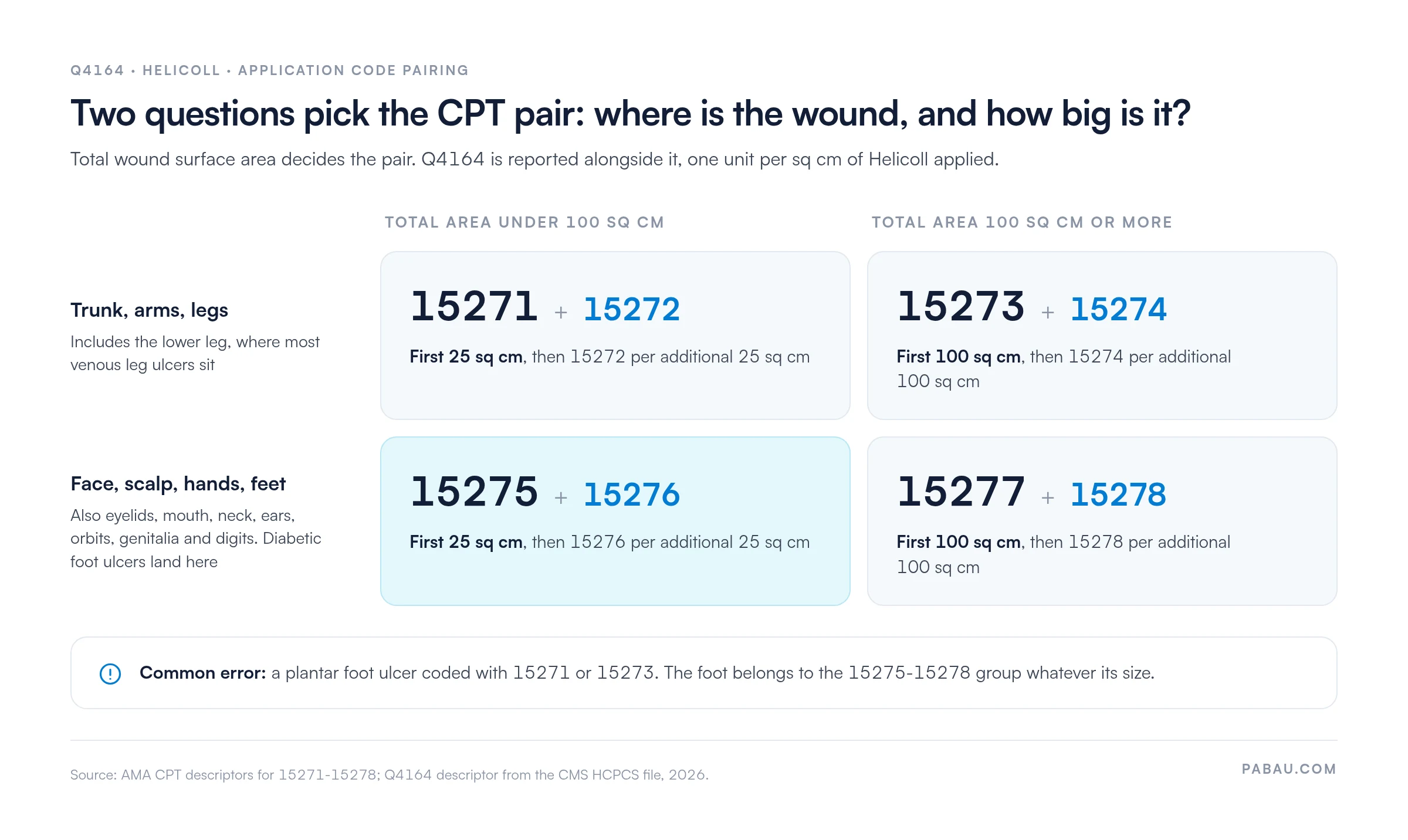
Q4164 is a supply code only, so every claim also carries an application code from CPT 15271-15278. Two facts pick that code: the wound’s anatomic site and its total surface area at application. A superbill for wound care should map each skin substitute to its application codes, so coders don’t rebuild the pairing from chart notes.
Lower-leg and trunk wounds take 15271 and 15272 below 100 sq cm, or 15273 and 15274 at 100 sq cm or more. In contrast, foot, hand and face wounds take 15275 and 15276 below 100 sq cm, or 15277 and 15278 at 100 sq cm or more.
The add-on block size follows the base code. 15272 and 15276 each add 25 sq cm, while 15274 and 15278 each add 100 sq cm. The grid below shows how site and size combine to pick the pair.
Each code in the skin substitute series maps to one named product or product family. Billing the wrong neighbor is a material error, because the product on the invoice and in the chart must match the code descriptor. Not every code in the series is billed by area, either. HCPCS Q4174 covers liquid PalinGen and ProMatrX products and is reported per 0.25 cc. PalinGen sheets, by contrast, stay on Q4173 for sheets, billed per square centimeter.
The practical rule: pull the current CMS HCPCS file, search the product name from the invoice, and bill the code that matches. Q4165 sits next to Q4164 numerically but names a different product, so it never substitutes for Helicoll. Likewise, Q4163 sits one code below Helicoll and reports Woundex or Bioskin, so it never substitutes for Q4164 either. A product with no code of its own now goes to the unlisted codes Q4431-Q4433, not to a neighbor.
Product-to-code mapping changes with HCPCS updates, so verify it at the start of each quarter. Additionally, the AAPC Codify HCPCS lookup and the PGM Billing HCPCS lookup tool can confirm active code status.
From January 1, 2026, Medicare pays Q4164 as an incident-to supply rather than as a biological. In a physician office, the rate is one flat national figure of $127.14 per sq cm, set in CMS’s November 2025 correction notice. Moreover, the rate holds for the calendar year and no longer tracks acquisition cost or quarterly ASP data.
However, coverage is a separate question from payment. Specifically, the MACs withdrew their skin substitute LCDs for diabetic foot and venous leg ulcers, including L35041, on December 24, 2025. Novitas, CGS and First Coast keep older policies, while the other Part B MACs publish none. Coverage therefore depends on whether your MAC has an active policy.
Where a policy is active, its covered diagnosis list governs the claim. Codes commonly reported include E11.621 with an L97 ulcer-site code, and I87.311-I87.319 for chronic venous hypertension with ulcer. Where no policy exists, the MAC judges each claim as reasonable and necessary from the record.
Meanwhile, commercial payers handle Q4164 coverage inconsistently. Some follow the former Medicare LCD criteria, while others write narrower indications or step-therapy rules. Verify each commercial payer’s policy before the first application.
Check whether your MAC has an active skin substitute policy before the first application, then recheck each quarter. Save a dated copy of what you found, so an auditor can see which rules applied on the date of service.
Since January 2026, the payment rate for Q4164 is the same in all three settings. What changes is who owns the product and who puts Q4164 on the claim.
Still, hospital-owned wound centers create the most errors here. A hospital-employed physician who bills Q4164 on a professional claim, while the hospital bills the same product, creates a duplicate-billing problem. Confirm who owns the product at every application encounter before coding.
Run a quarterly reconciliation between Q4164 units billed and Helicoll invoices. If billed units regularly fall well short of the sheet sizes ordered, either the practice is over-ordering or the notes are missing wound measurements. Both draw audit attention.
Original Medicare does not require prior authorization for Q4164 in most of the country. The exception is CMS’s WISeR model, which since January 2026 runs prior review on selected services in Arizona, New Jersey, Ohio, Oklahoma, Texas and Washington. If you bill in those states, confirm whether your skin substitute applications are on the WISeR list.
Outside WISeR, Medicare can still audit after payment and request the record. Many commercial payers require prior authorization for skin substitute procedures before the graft is applied. Applying the product without a required authorization may lead to a denial that is difficult to overturn.
Standard prior authorization documentation for commercial payers includes:
Therefore, build a checklist into the clinical workflow. The treating provider then documents these items at each wound care visit, not after a claim has denied.
After all, the medical record must support every element a payer may audit. In fact, missing documentation is a frequent cause of Q4164 denials that a simple resubmission cannot fix. A complete wound care note covers these elements at every application visit:
Wound photographs are not required by every payer, but a record without them weakens the medical necessity case on post-payment audit. Submitting a clean claim means the chart note, the product details and the billed units agree before the claim leaves the practice.
Wound care claims deny often because each one needs two codes and a documented medical necessity case. The table below covers common denials and the corrective action for each. Our guide to medical billing denial codes explains each CARC in more detail.
Track denials by CARC so you can see whether they cluster around documentation, unit counts or prior authorization. Repeated CARC 50 denials usually point to the clinical record rather than the coding.
A Q4164 claim holds up only when the wound note, the product record and the claim agree. In many wound care practices those sit in three places: the chart, a supply spreadsheet and the billing system.
Pabau, the practice management platform we build, keeps the treatment note and the claim on the same patient record. Its claims management software helps US practices submit and track claims, including CMS-1500 claims with supply and application codes.
Your billers see each claim’s status in one place, so a denied Q4164 line gets worked before it ages in accounts receivable.

Pabau’s claims management helps US practices submit and track claims, including CMS-1500 claims with supply and application codes. See how it fits your wound care billing workflow.

Q4164 billing got simpler in 2026 and less predictable at the same time. The rate is one flat figure per sq cm in every setting, but coverage now turns on whether your MAC has a policy at all.
Put your effort into the two decisions that drive rework. Bill the area of Helicoll applied, and pick the application pair from site and size before the claim is built. Then recheck your MAC’s policy status every quarter.
Pabau’s claims management helps US practices submit and track claims, including CMS-1500 claims with supply and application codes. Book a demo to see how it keeps your wound care claims and treatment records on one patient file.

Need to understand how claims move through a clearinghouse? Medical claims clearinghouse guide explains how electronic claims are validated and routed to payers.
Getting repeat denials with no clear pattern? Denial codes in medical billing breaks down the most common CARC and RARC codes and what each means for your appeals workflow.
Want the bigger picture behind each Q4164 payment? Revenue cycle management overview covers the full payment cycle, from charge capture to remittance.
Billing a different skin substitute? HCPCS Code Q4159 covers units, application codes and 2026 payment for another product in the series.
Covering a large trunk or leg wound? CPT code 15273 explains the application code for the first 100 sq cm.
HCPCS Code Q4164 covers Helicoll, a bovine collagen skin substitute, billed per square centimeter applied to a wound at one encounter. It pays for the product itself and is always paired with an application CPT code from 15271-15278. Since January 2026, Medicare pays it at a flat national rate per sq cm rather than at acquisition cost.
Multiply the wound’s longest length by its widest perpendicular width in centimeters, then round to the nearest whole square centimeter. One unit of Q4164 equals one sq cm. Bill the area of Helicoll applied, not the package size purchased or the sheet size opened.
The pairing depends on wound site and total area. Trunk, arm and leg wounds take 15271 and 15272 below 100 sq cm, or 15273 and 15274 at 100 sq cm or more. Face, hand and foot wounds take 15275 and 15276 below 100 sq cm, or 15277 and 15278 at 100 sq cm or more.
Original Medicare does not require prior authorization for Q4164 in most states. CMS’s WISeR model runs prior review on selected services in Arizona, New Jersey, Ohio, Oklahoma, Texas and Washington. Many commercial payers require authorization, and applying without one may lead to a denial that is difficult to overturn.
Common denial causes are a missing commercial prior authorization, a diagnosis outside the payer policy’s covered list, and too little documentation of failed conservative care. Unit counts that exceed the documented application, and Q4164 submitted without a paired application CPT code, also deny often.