CPT Code 27425: Lateral retinacular release billing guide
CPT Code 27425: Official descriptor and procedure overview CPT code 27425 is def...

Last Updated: Nov 16, 2026
Q4135 is the HCPCS Level II code for Mediskin, per square centimeter. It bills the supply of Mediskin, a frozen, irradiated porcine (pig) xenograft used as a temporary skin substitute. It covers a burn, donor site or other skin loss until an autograft is placed or the skin regrows.
Q4135 is an add-on code, billed with an application CPT code from 15271-15278. Mediskin is not amniotic tissue, so an amniotic graft such as Biovance bills under its own code, Q4154. In 2026 Medicare pays about $127 per square centimeter.
Let Pabau's smart automation suggest the right codes, reduce claim denials, and keep your practice compliant—effortlessly.
Automate repetitive tasks and focus on what matters most—your patients.
Reduce coding errors and ensure compliance with the latest regulations.
Clean claims, fewer denials, and faster reimbursements.
Powerful insights and reporting to help your practice thrive.
HIPAA compliant SOC 2 certified GDPR-compliant Trusted by 4,000+ clinics worldwide

HCPCS code Q4135 bills Mediskin, a frozen, irradiated porcine xenograft, per square centimeter. It is an add-on code, so it always rides with an application CPT code.
Mediskin is pig skin, not amniotic or placental tissue. Biovance, often confused with it, has its own code: Q4154.
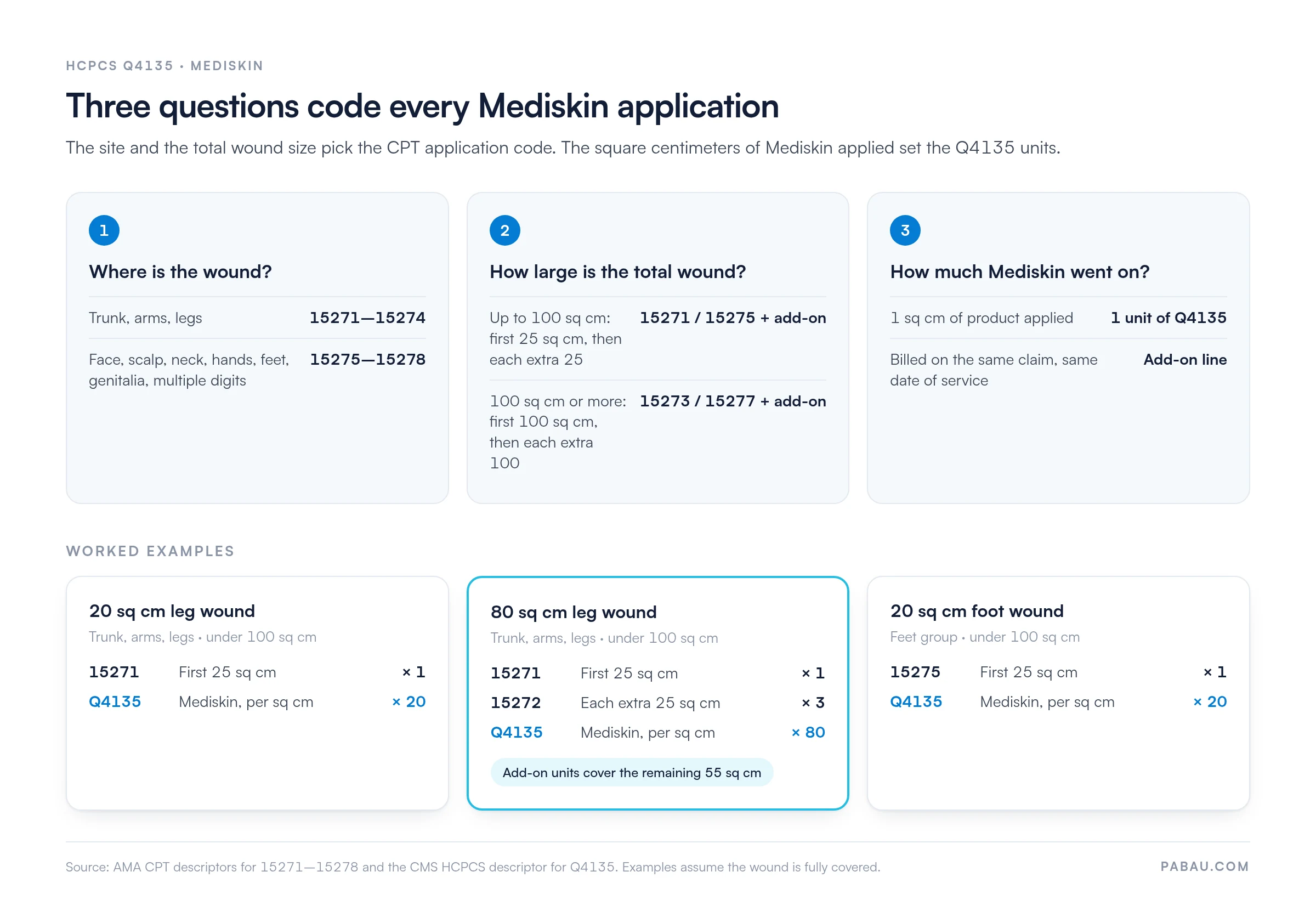
Pair Q4135 with CPT 15271-15278, chosen by anatomic site and total wound size. Units equal the square centimeters of Mediskin applied.
In 2026 Medicare pays skin substitutes about $127 per square centimeter in the office and the hospital outpatient department alike.
Pabau’s claims management software sends Q4135 claims through the Claim.MD clearinghouse and posts remittances against the patient record.
HCPCS code Q4135 is the Level II code for Mediskin, billed per square centimeter. The Centers for Medicare & Medicaid Services (CMS) maintains the HCPCS Level II code set, which covers products and supplies that CPT codes leave out. CMS created Q4135 on January 1, 2013. On January 1, 2026, it revised the descriptor to mark Q4135 as an add-on code, and the code is active for 2026.
Mediskin is a frozen, irradiated porcine (pig) xenograft with a dermal and an epidermal layer. Clinicians use it as a temporary skin substitute or biological dressing. It covers a wound until an autograft is placed or the patient’s own skin regrows, and it sloughs off as the wound heals.
Bill from the product name on the package. Many Q4100-series codes describe amniotic or placental grafts, so an amniotic product is easy to bill under Q4135 by mistake. Q4135 is only for Mediskin. Biovance, a dehydrated human amniotic membrane allograft, bills under HCPCS code Q4154.
Q4135 covers the supply of Mediskin applied as a temporary wound covering. Coverage still depends on the wound type, the setting and the patient’s payer policy.
One unit of Q4135 equals one square centimeter of Mediskin applied. Units come from the product placed on the wound, so the procedure note has to record the size of every sheet used.
Mediskin is applied with the skin substitute graft codes 15271-15278. These codes replaced the old xenograft codes 15400 and 15401. The anatomic site and the total wound size decide which code applies, whatever graft is used.
A 20 sq cm leg wound covered with Mediskin bills as 15271 plus 20 units of Q4135. An 80 sq cm wound on the same site bills as 15271, three units of 15272, and 80 units of Q4135. A 20 sq cm wound on the foot moves to 15275 instead. The chart below runs all three cases through the same three questions.
Every Q4135 claim needs an ICD-10-CM code that explains why the wound needed a temporary skin substitute. Mediskin is most often used on burns and donor sites, so burn codes lead the list. Confirm the covered diagnoses in your payer’s policy before the date of service.
Documentation tip: the diagnosis code alone does not prove medical necessity. The record also needs the wound measurements, the treatment plan, and the reason a temporary graft was chosen.
Medicare pays skin substitutes, Q4135 included, about $127 per square centimeter in 2026. Under the CY2026 Physician Fee Schedule final rule, CMS pays these products as incident-to supplies at one uniform rate. CMS groups them by FDA pathway, and Mediskin sits in the 510(k) group.
For a 20-unit claim, the Medicare product payment comes to about $2,540, before the patient’s 20% coinsurance. The application CPT code is paid separately on top of that.
No national coverage determination governs skin substitutes. Coverage sits with each MAC and each commercial plan.
Medicare Part B does not require prior authorization for skin substitute application in the office. Many commercial and Medicare Advantage plans do, and the rule can change with the site of service.
Check the product box before you check the code. Mediskin arrives frozen and is a porcine graft, so an amniotic or placental product in the same supply room is a different code. Add the product name to your charge capture template, and let the coder match it to Q4135 or Q4154 from that line.
Thin documentation is the most common reason a Q4135 claim fails a post-payment review. Each application visit needs the elements below in the record.
A clean Q4135 claim pairs the product with the right application code, setting and modifiers.
A clean claim for Q4135 has every field verified before it leaves the practice. A superbill with slots for the product name, lot number and unit count cuts transcription errors at the front end.
Q4135 sits among dozens of skin substitute codes, and most of its neighbors describe human tissue. The table below compares it with the codes most often mixed up with it. You can search the rest of the range through the AAPC HCPCS code lookup.
The product applied decides the code. An EpiFix graft, for example, bills under Q4186 even when it covers the same wound. Match the name on the package to the current CMS HCPCS file before every application visit.
Skin substitute claims draw close payer scrutiny, and their denials cluster around a few patterns. The table below maps each one to its fix. For appeal workflows and tracking, see our guide to denial management and our list of denial codes used in medical billing.
A Medicare redetermination, the first level of appeal, must be filed within 120 days of the initial determination. File it with the MAC that processed the claim.
Most Q4135 denials start with a detail lost between the procedure room and the claim form. The sheet size never reaches the coder, or the product name gets re-keyed as the wrong graft.
Pabau, the practice management platform we build, keeps the clinical record and the claim in one system. The billing team works from the procedure note itself, with the product, sheet sizes and wound measurements in view. Pabau’s claims management software sends CMS-1500 and 837P claims through the Claim.MD clearinghouse. Eligibility checks and ERA remittances come back to the same patient record.
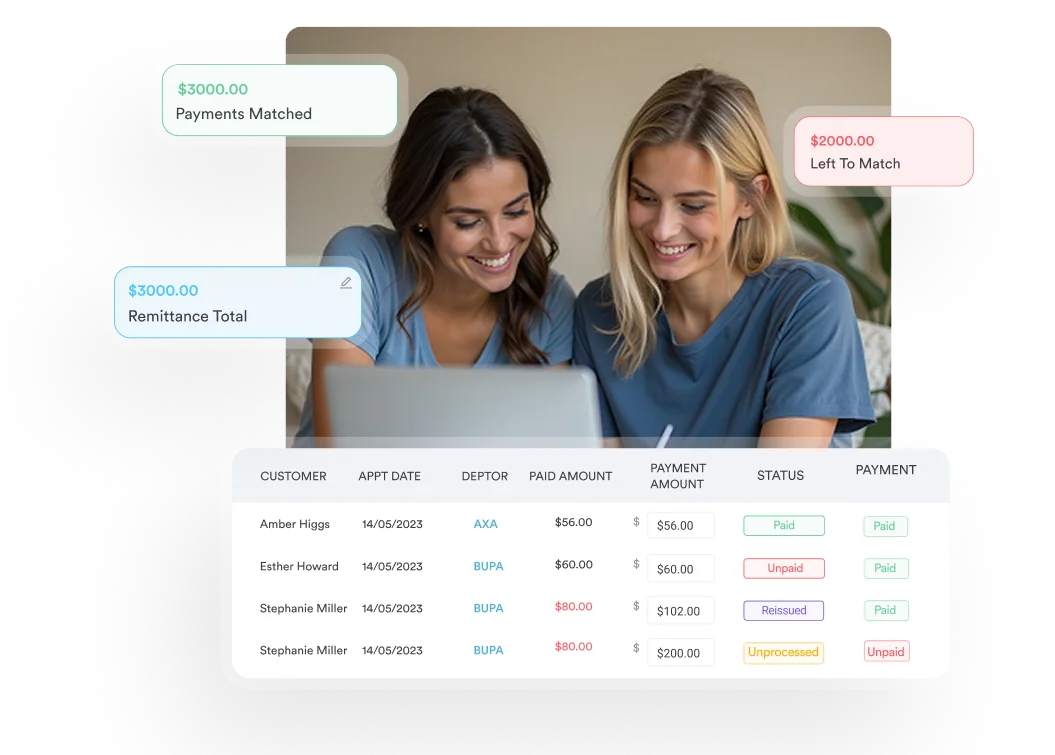
Stock in Pabau carries a batch number, so each Mediskin lot is recorded against the patient and the appointment. Prior authorizations sit on the case with their dates and sessions, and Pabau warns when one is missing. A rejection then shows up in claim status the day it happens, well before month-end reconciliation.

Pabau sends skin substitute claims through the Claim.MD clearinghouse and keeps each graft’s lot number on the patient record. Your billing team spends less time chasing denials.

Q4135 is one of the few skin substitute codes for an animal-derived graft, and that is what makes it easy to get wrong. The Q4100 range is full of amniotic products, and a coder working from habit can land on the wrong code. The fix is simple. The product name on the package decides the code.
Get the name, the sheet sizes and the wound measurements into the procedure note, and the claim follows. Book a demo to see how Pabau keeps that note and the claim in one workflow.

Need a full framework for managing claim rejections? Denial management strategies in healthcare covers root-cause analysis, appeal workflows, and tracking methods for high-volume billing teams.
Looking to understand the broader HCPCS billing landscape? Revenue cycle management fundamentals explains how HCPCS product codes fit into the end-to-end claim submission process.
Want to reduce errors before claims submit? Submitting a clean claim details the pre-submission checklist that catches missing modifiers, incorrect units, and mismatched diagnosis codes.
Billing a wound larger than 25 sq cm? CPT code 15272 explains the add-on code for each additional 25 sq cm of skin substitute graft.
HCPCS code Q4135 covers Mediskin, billed per square centimeter. Mediskin is a frozen, irradiated porcine xenograft used as a temporary skin substitute on burns, donor sites and other skin loss. It is an add-on code, billed with an application CPT code from 15271-15278.
No. Q4135 is the code for Mediskin, a porcine (pig) skin xenograft. Biovance is a dehydrated human amniotic membrane allograft, and it bills under HCPCS code Q4154.
One unit equals one square centimeter of Mediskin applied to the wound. Record the wound measurements and the size of each sheet used in the procedure note. The units billed must match that record.
Use a skin substitute application code from 15271-15278. 15271-15274 cover the trunk, arms and legs, and 15275-15278 cover the face, scalp, neck, hands, feet and similar sites. Within each group, the total wound size decides the code: up to 100 sq cm, or 100 sq cm and more.
Medicare pays skin substitutes, including Q4135, about $127 per square centimeter in 2026. CMS pays them as incident-to supplies at one rate in the office and the hospital outpatient department. The application CPT code is paid separately.
Q4135 is Mediskin and Q4136 is E-Z Derm. Both are porcine-derived products billed per square centimeter, but they are different products with different codes. Bill the code that matches the product name on the package.