CPT Code 86160: Complement component billing and coding guide
CPT code 86160: Official descriptor and definition CPT code 86160 is defined by ...

Last Updated: Nov 26, 2026
92585 was the CPT code for a comprehensive auditory brainstem response (ABR) study. It was deleted from CPT effective January 1, 2021, and is valid only for dates of service through December 31, 2020.
Bill a comprehensive ABR today with 92652 for threshold estimation or 92653 for a neurodiagnostic study. The reason for referral decides which one, and only one goes on the claim for a session.
Let Pabau's smart automation suggest the right codes, reduce claim denials, and keep your practice compliant—effortlessly.
Automate repetitive tasks and focus on what matters most—your patients.
Reduce coding errors and ensure compliance with the latest regulations.
Clean claims, fewer denials, and faster reimbursements.
Powerful insights and reporting to help your practice thrive.
HIPAA compliant SOC 2 certified GDPR-compliant Trusted by 4,000+ clinics worldwide

CPT Code 92585 was deleted from the CPT code set effective January 1, 2021, and it has not been reinstated.
Comprehensive ABR testing is now billed with 92652 for threshold estimation or 92653 for a neurodiagnostic study, chosen by the reason for the test.
ASHA lists 92651, 92652 and 92653 as mutually exclusive, so a single session carries one of them, never two.
Keep 92585 only for dates of service on or before December 31, 2020, such as an appeal or an audit response.
Pabau’s claims management software sends claims through Claim.MD and posts remittances to the patient record, so a deleted-code denial shows up early.
CPT code 92585 is no longer a valid code. It was deleted from CPT effective January 1, 2021, together with its limited counterpart, 92586. Four auditory evoked potential codes took over, 92650 through 92653. A comprehensive ABR is now billed with 92652 or 92653, depending on why the test was ordered.
The test itself has not changed. Surface electrodes on the scalp record the response of the auditory nerve and brainstem to clicks or tone bursts. Clinicians also call it BAER (brainstem auditory evoked response) or auditory evoked potential testing. Only the codes that report it are new.
Until the end of 2020, 92585 reported a comprehensive auditory evoked potential study. One unit covered the threshold search and the neurodiagnostic analysis in the same session. The interpretation looked at the latency and amplitude of waves I, III and V.
Its sibling, 92586, reported a limited study. Practices had to choose between the two on scope, and the line between them caused frequent coding disputes. The 2021 revision replaced that comprehensive-or-limited split with codes defined by the purpose of the test.
The four codes that replaced 92585 and 92586 are defined by what the test sets out to answer. The descriptors below are as published by the American Academy of Audiology for the 2021 CPT changes.
There is no one-to-one replacement for 92585. ASHA’s Medicare coding rules state that 92651, 92652 and 92653 are not reported together. So the old comprehensive scope cannot be rebuilt by adding two new codes to one claim line.
Bill the code that matches the clinical question behind the referral. The American Academy of Audiology puts the choice in terms of motivation. A neurologic concern, such as a space-occupying lesion or the integrity of cranial nerve VIII, points to 92653. A question about hearing thresholds points to 92652. The chart sets out the full choice, starting with the date of service.
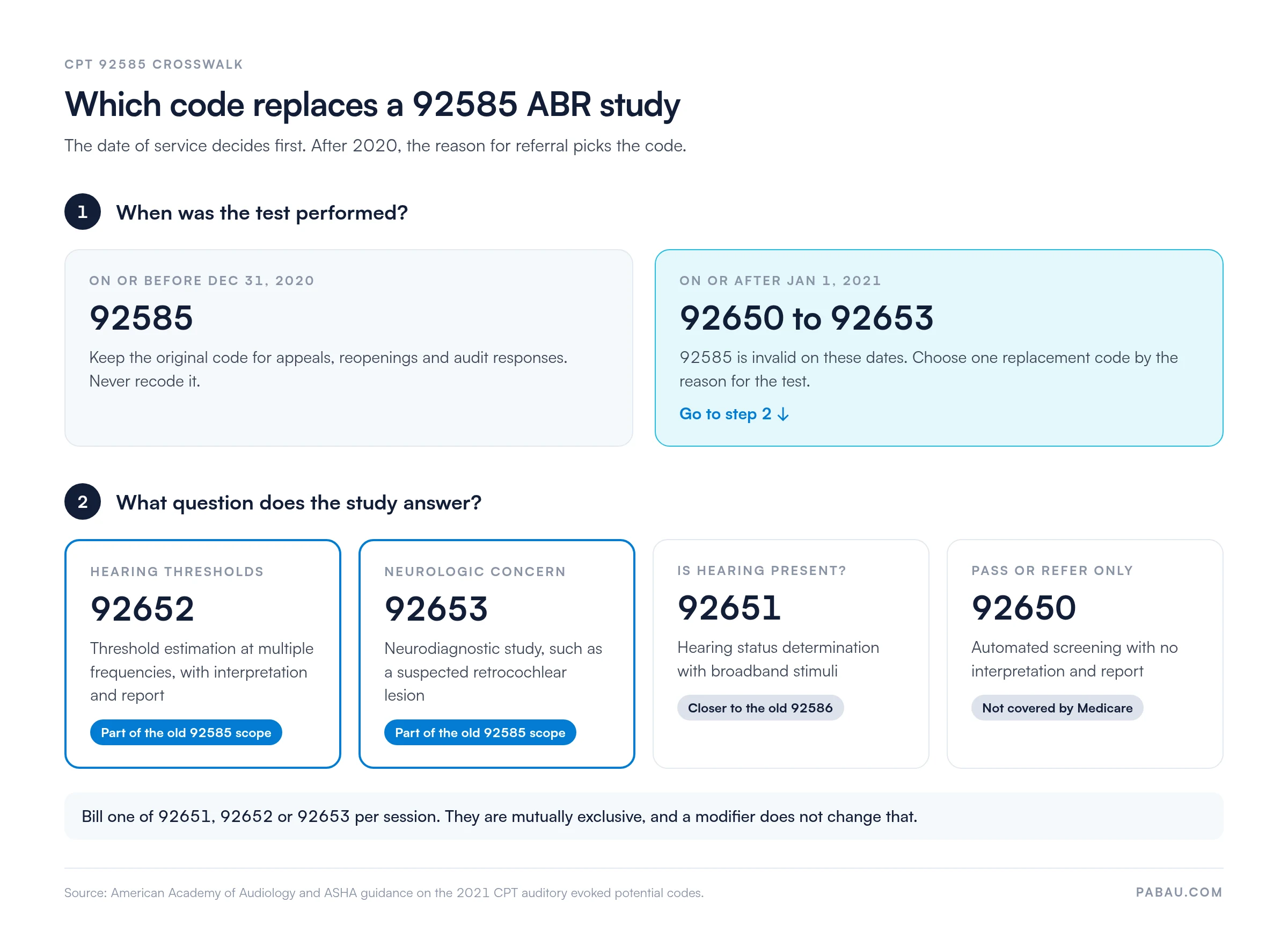
Report one of 92651, 92652 or 92653 per session. When a study covers both thresholds and neurodiagnostic waveforms, the documented reason for referral decides the code. ASHA advises modifier 52 (reduced services) when only one ear is tested.
The ICD-10-CM code on the claim has to explain why that specific study was needed. These pairings are common starting points, but the covered list comes from your MAC’s local coverage determination.
CPT codes are assigned by date of service, not by the date the claim is sent. A service performed on or before December 31, 2020 is still reported with 92585 or 92586. A service performed on January 1, 2021 or later never is.
Medicare’s timely filing limit is 12 months from the date of service, so original claims for 2020 dates are long past it. Today 92585 mostly appears in three places:
Do not convert an old 92585 line to 92652 or 92653 when you respond to one of these. The codes did not exist on that date, so the change would itself create a coding error.
The new AEP codes follow the same modifier logic that applied to 92585. The table covers the modifiers audiology practices use most with ABR testing.
A modifier never makes 92652 and 92653 billable together for one session. Other same-day tests have their own codes, such as 92557 for comprehensive audiometry or 92588 for distortion product OAEs. Check the current quarterly NCCI table before the claim goes out.
The record has to show why the chosen code fits, since the purpose of the test now decides the code. Auditors reviewing an AEP claim look for these elements:
Medicare Part B covers 92651, 92652 and 92653 as diagnostic tests when they are reasonable and necessary. ASHA notes that 92650 is not covered, because Medicare does not pay for screening. A claim that still carries 92585 for a current date of service is denied for an invalid code before coverage is even considered.
Payment rates for the new codes change every year and by locality. Pull the current figure from the CMS Physician Fee Schedule lookup rather than an old 92585 rate. Many commercial payers also require prior authorization for diagnostic audiology, so check insurance eligibility before the appointment.
Most AEP denials since 2021 come from a stale fee schedule or from the new mutual-exclusion rule. A working denial management workflow catches each of these patterns. Every remittance names a claim adjustment reason code, and our denial code lookup explains what each one asks you to fix.
A deleted code usually reaches a claim through a charge master that nobody updated in January. The audiologist documents the study correctly, and the billing system still attaches the old code. The denial then arrives weeks later, after the payer has rejected it.
Pabau, a practice management platform with US insurance billing, keeps the clinical record and the claim in one place. Its claims management software submits 837P claims through the Claim.MD clearinghouse. Eligibility checks, claim status and ERA remittances come back to the same patient record.
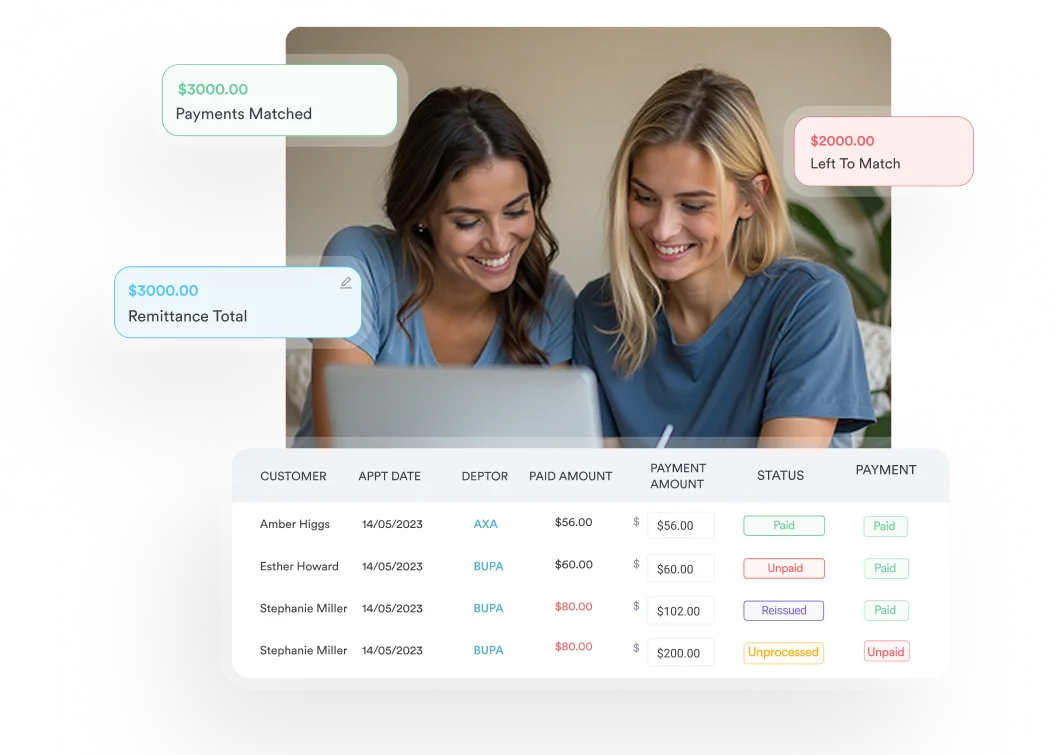
A rejection for an invalid code shows up on the claim as soon as Claim.MD returns it, not at month-end. Prior authorization codes are tracked on the case, with a warning when one is missing. Both checks matter for commercial ABR referrals.

Pabau’s claims management software sends audiology claims through Claim.MD and posts ERA remittances to the patient record. A rejected line surfaces the day it returns.

If 92585 still appears in your fee schedule, remove it today. Every ABR performed since January 1, 2021 belongs under 92652 or 92653, and the reason for referral decides which one. Write that reason into the report in plain words, and the code choice will hold up in an audit.
The one place 92585 keeps a role is the paperwork for 2020 dates of service. Leave those lines as they were filed. Book a demo to see how Pabau keeps audiology documentation and claim submission in one workflow.

Sending audiology claims through a clearinghouse? Claim.MD clearinghouse guide explains how claims, eligibility checks and remittances move between the practice and its payers.
Want to understand the full billing lifecycle? What is revenue cycle management explains how claims move from patient encounter to final payment.
No. CPT code 92585 was deleted effective January 1, 2021, and it has not been reinstated. It is valid only for dates of service on or before December 31, 2020.
Four auditory evoked potential codes replaced 92585 and 92586: 92650, 92651, 92652 and 92653. The former comprehensive study is now billed with 92652 for threshold estimation or 92653 for a neurodiagnostic study.
No. ASHA’s Medicare coding rules list 92651, 92652 and 92653 as mutually exclusive. Bill the one code that matches the documented reason for the test.
The claim is denied because the code is invalid on that date, usually with claim adjustment reason code 181. Rebill with the correct replacement code and remove 92585 from your charge master.
Add modifier 52 (reduced services) to the AEP code, which is ASHA’s general guidance for unilateral testing. Some commercial payers ask for -LT or -RT instead, so check the payer policy first.
Yes. Medicare Part B covers 92651, 92652 and 92653 when the test is reasonable and necessary and the diagnosis supports it. Automated screening under 92650 is not covered.
No. A claim for a 2020 date of service keeps 92585, because the new codes did not exist then. Use the original code in any appeal, reopening or audit response.