ICD-10 Code R34: Anuria and oliguria
ICD-10 Code R34 is the billable ICD-10-CM diagnosis code for anuria and oliguria...

Last Updated: Oct 6, 2026
Billable Code Specific Code
T45.625D is the billable ICD-10-CM code for adverse effect of hemostatic drug, subsequent encounter.
The code sits inside chapter S00-T88, which covers injury, poisoning, and other consequences of external causes. Within that chapter it belongs to the T36-T50 block for poisoning, adverse effects, and underdosing of drugs. Its parent code T45.625 is not billable on its own, so the 7th character carries the encounter information.
Let Pabau's smart automation suggest the right codes, reduce claim denials, and keep your practice compliant—effortlessly.
Automate repetitive tasks and focus on what matters most—your patients.
Reduce coding errors and ensure compliance with the latest regulations.
Clean claims, fewer denials, and faster reimbursements.
Powerful insights and reporting to help your practice thrive.
HIPAA compliant SOC 2 certified GDPR-compliant Trusted by 4,000+ clinics worldwide

T45.625D is the billable ICD-10-CM code for adverse effect of hemostatic drug, subsequent encounter, valid for FY 2016 through FY 2026.
The 7th character ‘D’ means active treatment is complete and the patient is in routine follow-up care, not that this is a second visit.
Adverse effect coding applies when the drug was given correctly and still caused harm, and the condition it caused leads the claim.
Coagulation factors and desmopressin are not indexed to T45.625, so a factor reaction takes T45.8X5D rather than this code.
Where a payer or state law asks for an external cause code, Y44.9XXD is the one that pairs with T45.625D.
Practice management software like Pabau flags a missing or mismatched code pair before the claim leaves the practice.
The table below captures every field a billing team or EMR needs for ICD-10 code T45.625D.
Per the CMS ICD-10 codes page, T45.625D sits in the broader T45 category alongside the poisoning and underdosing codes for the same drug class. Those three labels decide both the code and its position on the claim.
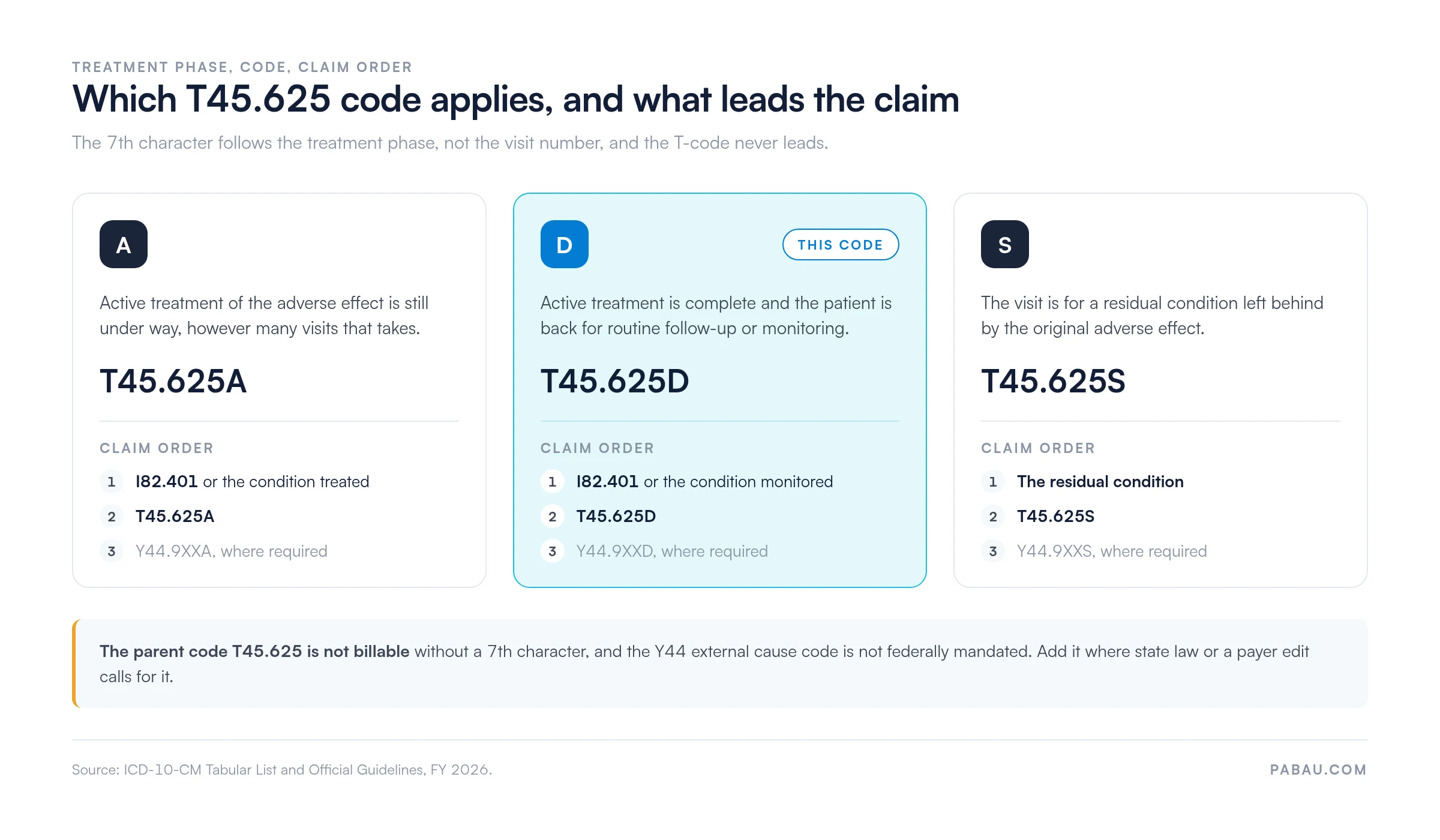
‘D’ means the active treatment phase of the condition is over and the patient is receiving routine care, healing checks, or follow-up management. It does not mean the patient’s second visit. ICD-10-CM Official Guidelines Section I.C.19.a covers how 7th characters apply in Chapter 19, and the count of encounters never enters into it.
A patient seen on three consecutive days in the ER for tranexamic acid thrombosis takes the ‘A’ code all three times. Active treatment is still under way. The same patient returning two weeks later for a thrombosis check takes ‘D’. Other chapters run the same logic, as S72.91XG shows on a fracture claim.
For sequela encounters, the residual condition code is sequenced first and T45.625S follows it, per ICD-10-CM Guidelines Section I.C.19. A sequela code from another chapter such as S69.91XS behaves the same way. The three codes differ only in treatment phase, and all three share one claim order.
Adverse effect, poisoning, and underdosing describe three separate events, and each one codes to a different subcategory. The chart note decides which applies, not how severe the reaction was.
ICD-10-CM Official Guidelines Section I.C.19.e.5(a) covers adverse effects. It sequences the nature of the adverse effect as the principal diagnosis, with T45.625D listed after it. Poisoning runs the other way round, and its rule sits in Section I.C.19.e.5(b). Coding a correctly administered drug as a poisoning misstates what happened in the chart, and a payer audit picks up that kind of mismatch.
Document in the chart exactly how the drug was prescribed, dispensed, and administered before selecting between adverse effect and poisoning codes. If the chart note confirms correct administration and the patient had a reaction, that is an adverse effect regardless of severity. Auditors look for this documentation first.
The ICD-10-CM Alphabetic Index points to T45.625 for adverse effects of agents that promote hemostasis, meaning blood clotting. Chart notes often describe a drug reaction without ever using the word hemostatic. Knowing the drug classes prevents a slide into a vaguer T45 code.
The substances behind most T45.625D claims, according to the CDC’s ICD-10-CM Table of Drugs and Chemicals, are these:
Two drug groups are treated as hemostatics at the bedside and are indexed somewhere else entirely. Coding them to T45.625D is the error a hematology or hemophilia claim runs into most often.
Thrombosis is the adverse effect coded most often across this drug class, particularly for the antifibrinolytics. The code for the thrombotic event is sequenced first, with T45.625D after it. For an acute deep vein thrombosis of the right lower extremity that first code is I82.401. The femoral-vein-specific codes are I82.411, I82.412, and I82.413. Check the drug’s FDA label for its adverse effect profile before finalizing the note.
T45.625 is a non-billable parent code, and submitting it without a 7th character will be rejected. The full hierarchy leading to T45.625D runs like this:
Sitting inside T45.6 tells you the scope: fibrinogen, fibrinolytic inhibitors, and related agents all land here. Anyone learning medical billing from the ground up meets this block structure early. Sequencing rules attach to the block rather than the individual code.
An external cause code from the Y40-Y59 range names the drug responsible for the adverse effect. Reporting it is not mandated nationally. Per ICD-10-CM Official Guidelines Section I.C.20.a, no national requirement covers Chapter 20 external cause reporting. State law or a payer contract can still ask for it.
Most billing teams add it anyway, and pair it consistently on every claim. It adds one code to the claim, and it identifies the drug for anyone reviewing the record later. Consistency is also what keeps medical billing compliance defensible across a mixed payer list. The codes that apply to hemostatic drugs are these:
Take a follow-up visit for DVT monitoring after a tranexamic acid reaction. The code set reads I82.401 for the acute thrombosis, then T45.625D, then Y44.9XXD where the payer wants an external cause code. Pabau’s Claim.MD integration validates each set against payer edits before submission, so an incomplete pair is caught in the practice rather than at the clearinghouse.
A T45.625D claim rests on four statements in the note. Each one answers a question a payer or an auditor will otherwise ask later.
The phase statement is the one most often missing. A note that never says follow-up leaves the ‘D’ unsupported, and the reviewer reads the visit as active treatment. When claims on this code pend, the remark codes usually point back at one of the four statements. Reading them against the denial codes list shows which one your notes keep leaving out.
Denials on this code follow a predictable pattern, and six mistakes account for most of them. Each one is visible in the chart note before the claim goes out.
A run of denials on this code usually traces back to one of the six. Reading them as a batch, the way a structured denial management review does, surfaces the encounter-type mismatch or the missing external cause code fast. Fixing it at the point of documentation is what turns the next batch into clean claims.
T45.625D rarely appears on a claim by itself. Coders working with hemostatic drug reactions reach for the sibling codes and the neighboring T45 codes below. The AAPC ICD-10-CM code lookup confirms each one for the applicable fiscal year.
The icd10data code entry also records two edits worth knowing: T45.625D is exempt from present-on-admission reporting, and it is not acceptable as a principal diagnosis. On an inpatient claim it therefore sits as a secondary code, which is where its effect on revenue cycle management is easiest to miss.
When a patient is seen for sequela of a hemostatic drug adverse effect, sequence the residual condition first. Chronic post-thrombotic syndrome is one example, and T45.625S follows it. Never use T45.625D for a sequela encounter. The encounter type and sequencing together decide whether the claim pays or pends.
In most practices, a mis-sequenced adverse effect code gets caught the slow way. The denial arrives, someone reopens the chart note, and the corrected claim goes back out three weeks later. The check happens after the payer has already said no.
Practice management software like Pabau moves that check to the point of documentation. The coded diagnosis lives on the same client record as the treatment note. A coder can see how the drug was prescribed and given before choosing between an adverse effect and a poisoning code. Pabau’s claims management software then keeps the condition code, the T-code, and the external cause code together as one set.
That matters most in the services that give these drugs day to day. Surgical suites in plastic surgery practices use fibrin sealants at the wound site, and IV therapy practices run tranexamic acid and factor concentrates.
The outcome your team feels is fewer rework cycles. Claims leave with the right 7th character and the right lead diagnosis. The follow-up visit gets paid first time, and nobody spends Friday afternoon re-reading three-week-old notes.

Pabau’s claims management tools integrate with Claim.MD to validate ICD-10 code pairs before submission, reducing denials on adverse effect and hemostatic drug claims. See how it works for your billing team.

Two decisions carry this code. Which treatment phase the patient is in, and which diagnosis leads the claim. Get both right and T45.625D pays without argument. Get either wrong and the denial lands before anyone has looked at the chart note.
Check the drug against the index before you reach for this code, because coagulation factors and desmopressin sit elsewhere. The external cause code is the one judgment call left. Find out what your largest payers expect, then apply the same house rule to every claim. Inconsistency costs more than either choice would.
Book a demo to see how Pabau keeps the diagnosis, the treatment note, and the claim in one record for your billing team.

Want another worked example of subsequent encounter coding? S82.226G applies the same 7th character logic to a fracture claim, including the delayed healing character.
Coding a residual condition instead of a follow-up visit? T22.342S shows how the sequela 7th character works on a burn claim, and which code leads there.
Billing the drug as well as the diagnosis? J7189 covers units, documentation, and payer expectations on the HCPCS side of a factor claim.
Need the note itself to support the code? Our progress note template gives you a structure that records the drug, the reaction, and the treatment phase.
T45.625D is a billable ICD-10-CM code used to document a subsequent encounter for an adverse effect of a hemostatic drug. It applies when the drug was administered correctly and a harmful reaction occurred. Active treatment must be complete, with the patient attending a follow-up or monitoring visit.
The ‘D’ 7th character means the active treatment phase of the condition is complete and the patient is receiving routine care. It does not mean the second visit to a provider. A patient can have several initial encounter visits while active treatment continues, then move to subsequent once that treatment ends.
An adverse effect occurs when a correctly prescribed, correctly dosed, correctly administered drug produces a harmful reaction. Poisoning occurs when the wrong drug, wrong dose, wrong route, a drug interaction, or intentional misuse causes harm. The distinction decides which T45 subcategory applies and how the codes are sequenced.
Use T45.625A while the patient is still in active treatment for the adverse effect of the hemostatic drug. Use T45.625D once active treatment is complete and the patient is at a follow-up, monitoring, or routine care visit. The clinical documentation should state the treatment phase clearly.
No. The CDC’s ICD-10-CM Table of Drugs and Chemicals indexes Factor VIII and Factor IX to T45.8X5, and Factor IX complex to T45.7X5. At a follow-up visit those become T45.8X5D and T45.7X5D. T45.625D covers hemostatics such as tranexamic acid and aminocaproic acid.
Not by national rule. ICD-10-CM Official Guidelines Section I.C.20.a leaves Chapter 20 external cause reporting to state law and payer policy. Where a payer edit expects one, add Y44.9XXD, which covers other and unspecified agents affecting blood constituents.
Yes. T45.625D is a valid, billable ICD-10-CM code for FY 2016 through FY 2026, confirmed by the CDC/NCHS ICD-10-CM web tool. The parent code T45.625 carries no 7th character, so it is non-billable and will reject if it is submitted on its own.