ICD-10 Code T32.52: Corrosions involving 50-59% of body surface
What is ICD-10 code T32.52? ICD-10 code T32.52 is the billable ICD-10-CM code fo...

Last Updated: Nov 2, 2026
Billable Code Specific Code
T41.45XD is the billable ICD-10-CM code for adverse effect of unspecified anesthetic, subsequent encounter. It applies to follow-up visits after a correctly prescribed and properly administered anesthetic caused an unintended reaction, once active treatment of that reaction is complete.
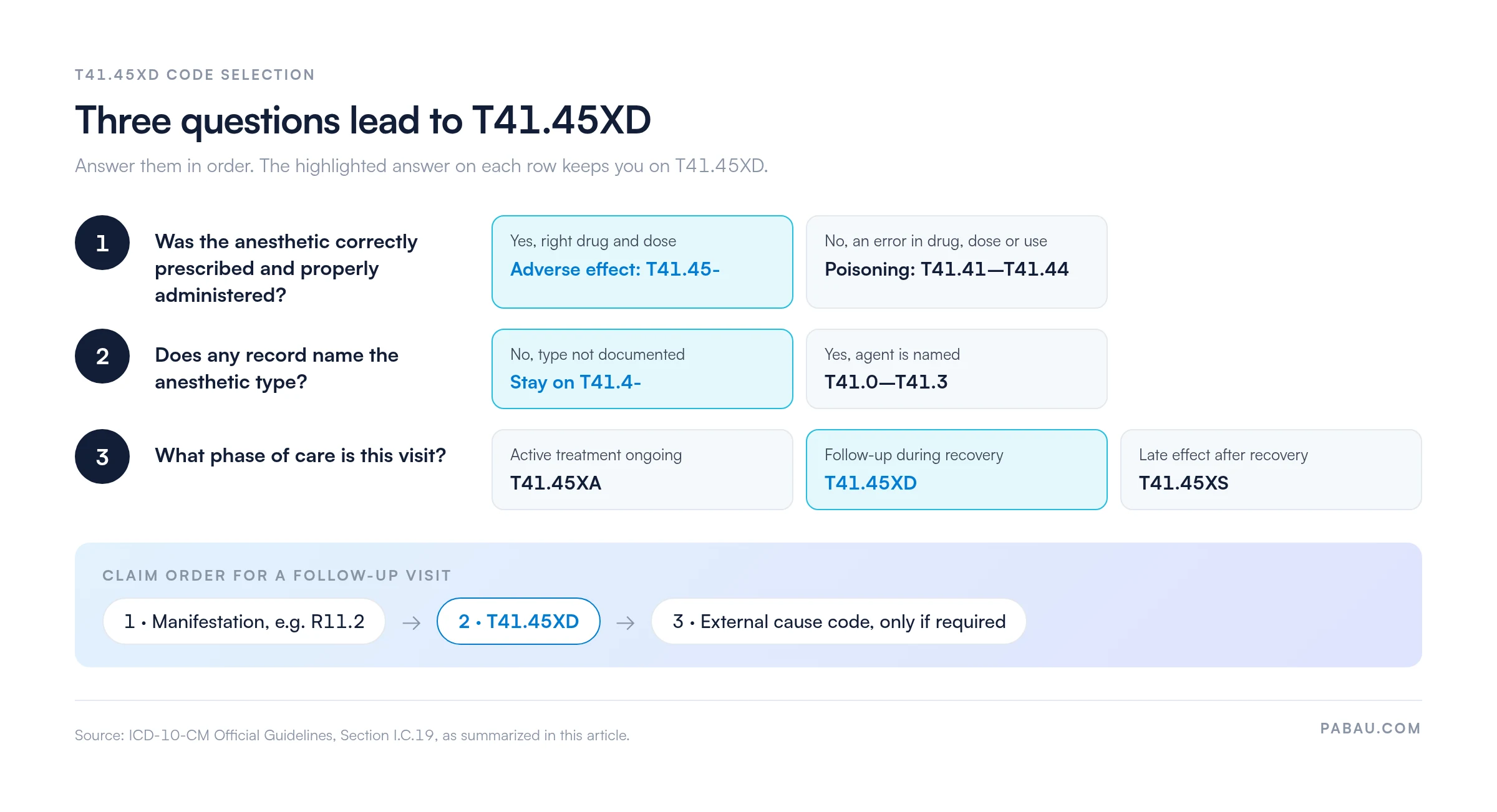
The code is never listed first. The manifestation, such as nausea or hypotension, is sequenced ahead of it. Use T41.45XA while active treatment continues, and T41.45XS for a late effect.
Let Pabau's smart automation suggest the right codes, reduce claim denials, and keep your practice compliant—effortlessly.
Automate repetitive tasks and focus on what matters most—your patients.
Reduce coding errors and ensure compliance with the latest regulations.
Clean claims, fewer denials, and faster reimbursements.
Powerful insights and reporting to help your practice thrive.
HIPAA compliant SOC 2 certified GDPR-compliant Trusted by 4,000+ clinics worldwide

T41.45XD is a valid, billable ICD-10-CM code for follow-up visits after an adverse reaction to an unspecified anesthetic.
The XD suffix means subsequent encounter, so active treatment of the reaction is complete and the patient is in routine recovery care.
T41.45XD is never the principal diagnosis, because the manifesting condition (nausea, hypotension, anaphylaxis) is always sequenced first.
When any record names the anesthetic agent, code the specific T41.0–T41.3 subcategory instead of T41.45XD.
T41.45XD needs no second drug code, and external cause codes are optional unless a payer or state requires them.
ICD-10 Code T41.45XD is the diagnosis code for adverse effect of unspecified anesthetic, subsequent encounter.
It is valid from FY2024 onward and in the current ICD-10-CM release. The code falls within Chapter 19 (Injury, Poisoning, and Certain Other Consequences of External Causes). It sits under category T41, which covers poisoning by, adverse effects of, and underdosing of anesthetics and therapeutic gases.
The code applies when a correctly prescribed and properly administered anesthetic causes an unintended harmful reaction, and active treatment of that reaction has ended. “Unspecified anesthetic” means the provider’s record does not name the anesthetic type. It does not mean that no anesthetic was given.
Every character in T41.45XD carries a specific meaning. Misreading one of them, particularly the placeholder X or the 7th character D, produces a code that payers cannot process. The table below breaks the code into its parts.
The placeholder X is the character coders drop most easily. ICD-10-CM requires a 7th character for T41.45, but the code has only five characters of its own. The X fills the 6th position so the 7th character D is structurally valid. Omitting it produces the invalid code “T41.45D.” Most encoders flag that at once, but some older systems pass it to the payer, which rejects the claim.
Subsequent encounter means active treatment of the adverse anesthetic reaction is complete and the patient is now receiving routine care during recovery. This is the ICD-10-CM definition under Section I.C.19 of the Official Guidelines for Coding and Reporting, maintained by CMS.
Three 7th characters govern encounters related to T41.45, and each maps to a distinct clinical phase. Picking the wrong one for the visit type is a common reason these claims are denied or returned for correction.
The switch from XA to XD is not defined by calendar days. It happens when the treating clinician decides that active intervention for the reaction is no longer needed. A patient hospitalized for three days with post-anesthesia respiratory depression may have every inpatient claim coded XA. The first outpatient follow-up visit then switches to XD. Document the clinical rationale for that switch in the note.
Adverse effect, poisoning, and undetermined intent are distinct ICD-10-CM classifications under T41.4. Selecting the wrong one creates both a billing error and a medical billing compliance risk. The distinction hinges on whether the drug was correctly prescribed and correctly administered.
ICD-10-CM Official Guidelines Section I.C.19.e confirm that adverse effect codes apply only when the right drug was given at the right dose. If any element of administration was incorrect, the encounter is a poisoning, not an adverse effect. Misclassifying a poisoning as an adverse effect is an audit risk, particularly under Medicare claims processing reviews.
T41.45XD supports coding for the follow-up visit when a patient is monitored or treated for the ongoing effects of the anesthetic reaction. The code never stands alone. It follows the manifestation code, which the ICD-10-CM guidelines always sequence first. You can confirm each code in the CDC/NCHS ICD-10-CM browser tool.
Manifestations commonly coded alongside T41.45XD:
Related codes to check before you assign T41.45XD:
When the provider documents the anesthetic type (e.g., propofol, sevoflurane, lidocaine), the coder must move to the specific subcategory rather than staying with T41.4. Using T41.45XD when a more specific code is available is an unspecified-code compliance issue that may not survive payer audit.
List the manifestation first, such as R11.2 for nausea with vomiting, and T41.45XD second. T41.45 is itself the drug-specific adverse-effect code, so the claim needs no second drug code from T36–T50. Getting this order right is foundational to clean claim submission for these encounters.
External cause codes are optional unless a payer or state requires them. Adverse-effect drug reactions rarely need the activity (Y93.-) or external cause status (Y99.-) codes, which are built for injuries.
Sequencing rule summary:
The decision path below pulls the code choice and the claim order into one view.
The provider note, anesthesia record, or operative report must contain specific elements for ICD-10 Code T41.45XD to withstand payer scrutiny during retrospective review.
The term “anesthetic unspecified” is defensible when no available record documents the anesthetic type, including the anesthesia record, operative note, or transfer documentation. Coding T41.45XD when a more specific agent is documented may be challenged during a Comprehensive Error Rate Testing (CERT) audit.
T41.45XD is a valid billable code for Medicare, Medicaid, and most commercial payers. It is not, however, a principal diagnosis. The manifesting condition governs the encounter’s medical necessity and is what the payer evaluates for coverage. T41.45XD supports the claim by explaining the clinical context.
Medicare does not publish a specific Local Coverage Determination (LCD) for T41.45XD as a standalone code. Coverage is determined by the principal diagnosis and the CPT procedure code for the visit. T41.45XD itself does not usually trigger prior authorization. The service being billed, such as an evaluation and management visit or a specialist consultation, may still need authorization under the payer’s policy.
Facility billing and professional fee billing differ in how T41.45XD affects reimbursement. On the UB-04 (facility claim), the code appears in the diagnosis fields and influences DRG assignment if the patient is inpatient. On the CMS-1500 (professional claim), it supports the E&M code’s medical necessity. Check with the payer whether T41.45XD on a professional claim triggers additional documentation requests.
Denials tied to ICD-10 Code T41.45XD usually fall into five predictable categories, and each has a correctable root cause. A denial management workflow that tracks these patterns shows a coding team where to focus retraining.
The wrong-7th-character error is the easiest of the five to prevent. Coders new to injury and poisoning codes often apply XA to every claim in a series without checking whether the clinical phase has changed. A desk reference such as a medical coding cheat sheet keeps the XA/XD/XS rule in front of the team. See the denial codes in medical billing reference for the CARC codes most often attached to these rejections.
Before you submit a T41.45XD claim, run three checks. Confirm the manifestation code comes first, the placeholder X sits in the 6th position, and the note describes follow-up rather than active treatment. If the clinician wrote ‘complication’ instead of ‘adverse effect’, query the provider before billing.
Many practices still code a follow-up visit on a paper superbill, then re-key T41.45XD and the manifestation code into a clearinghouse portal. Each re-keyed claim is another chance to drop the X placeholder or swap the order of the codes.
Pabau, the practice management platform we build, raises the claim from the invoice your team already creates at checkout. Its claims software for US practices works through the Claim.MD integration, so you submit claims electronically through a clearinghouse without a separate portal.
Claim status updates and electronic remittance advice come back into the same claims dashboard. A follow-up claim denied for a wrong 7th character shows up there for rework, next to the invoice it came from.

Pabau builds each claim from the visit invoice, sends it through Claim.MD, and tracks its status until the payer settles it.

T41.45XD is a narrow code with a clear rule set. Use it only for follow-up care after a correctly given anesthetic caused a reaction, and only when no record names the agent.
The decision that matters most is the switch from XA to XD. Write down when active treatment ended, and the code for every later visit follows from that note. Sequence the manifestation first, and query the provider whenever the anesthetic agent might be documented elsewhere.
If your team still re-keys these claims into a clearinghouse portal, every visit adds another chance to drop the X placeholder. Book a demo to see how Pabau builds follow-up claims from the visit invoice and sends them through Claim.MD.

Need a framework for managing clearinghouse denials? Medical claims clearinghouse guide covers how electronic claim validation works before payer submission.
Want to understand the ERA remittance process after a T41.45XD claim? Electronic remittance advice (ERA) explained breaks down how 835 files carry denial reason codes back to the practice.
Looking for eligibility verification before the encounter? Insurance eligibility verification explains benefit checks that prevent coverage-related denials.
Sending US claims through Claim.MD? Claim.MD clearinghouse explains how the clearinghouse routes claims to payers and returns their responses.
Filing a paper claim for a follow-up visit? Medical insurance claim form template gives you a ready form to complete and send.
ICD-10 Code T41.45XD is the billable diagnosis code for adverse effect of unspecified anesthetic, subsequent encounter. It covers a follow-up visit after an unintended reaction to a correctly administered anesthetic, once active treatment of that reaction is complete.
T41.45XA (initial encounter) applies when active treatment of the adverse anesthetic reaction is still ongoing. T41.45XD (subsequent encounter) applies once active treatment is complete and the patient is receiving routine follow-up or monitoring care. Using XA on a follow-up visit is a common coding error for this code family.
No. T41.45XD cannot be the principal or first-listed diagnosis. Under ICD-10-CM adverse effect sequencing rules, the manifesting condition (such as hypotension, nausea, or respiratory depression) is always coded first. T41.45XD follows the manifestation code to explain the cause of the reaction.
Unspecified means the type of anesthetic is not documented in the available clinical record, not that no anesthetic was administered. When the chart names the agent (propofol, sevoflurane, lidocaine), the coder must use the matching specific T41.x subcategory instead of T41.4.
Use the XD suffix for routine care, monitoring, or follow-up once active treatment of an injury or adverse effect is complete. The switch from XA to XD is clinically determined, not time-based. It happens when the treating provider decides active intervention for the original event is no longer needed.
Five coding errors cause the usual T41.45XD denials. Three are a wrong 7th character (XA instead of XD), a missing placeholder X, and T41.45XD listed as the principal diagnosis. The other two are a claim with no manifestation code, and an “unspecified” code when the chart names the anesthetic. Each one can be fixed before or after submission.