ICD-10 Code Y76.0: Diagnostic obstetric and gynecological devices
ICD-10 Code Y76.0: Definition and billable status ICD-10 Code Y76.0 is a valid, ...

Last Updated: Oct 23, 2026
Billable Code Specific Code
S82.226G is the billable ICD-10-CM code for nondisplaced transverse fracture of shaft of unspecified tibia, subsequent encounter for closed fracture with delayed healing.
Two details in that description trip coders up. S82.226 sits in the tibia shaft series rather than the fibula series, and the G character describes a closed fracture. Fibula shaft fractures are coded from S82.4, and open-fracture delayed healing takes H or J.
The parent code S82.226 cannot go on a claim without a 7th character. S82.226G is one of 16 billable child codes that complete it. Verify billable status against the current fiscal year, because the CMS ICD-10 codes page publishes updates every October 1.
Let Pabau's smart automation suggest the right codes, reduce claim denials, and keep your practice compliant—effortlessly.
Automate repetitive tasks and focus on what matters most—your patients.
Reduce coding errors and ensure compliance with the latest regulations.
Clean claims, fewer denials, and faster reimbursements.
Powerful insights and reporting to help your practice thrive.
HIPAA compliant SOC 2 certified GDPR-compliant Trusted by 4,000+ clinics worldwide

ICD-10 code S82.226G describes a nondisplaced transverse fracture of the tibial shaft, coded at a subsequent encounter where a closed fracture is healing slowly.
The 7th character G means closed fracture with delayed healing. Open-fracture delayed healing uses H for Gustilo type I or II, and J for type IIIA, IIIB, or IIIC.
S82.226 sits in the tibia shaft series, not the fibula series. The fibula counterpart is S82.426G, in the separate S82.4 family.
S82.226 leaves laterality unspecified. Code S82.224G for the right tibia or S82.225G for the left whenever the note names the side.
Practice management software like Pabau ties the 7th character to the note behind it, so wound status and healing outcome are recorded before billing.
Each segment of ICD-10 code S82.226G carries a specific clinical meaning. Reading the code from left to right gives you the full diagnostic picture without a lookup table.
A nondisplaced fracture means the fracture line is there but the fragments remain in anatomical alignment. That usually keeps the injury out of the operating room. Closed nondisplaced tibial shaft fractures are commonly managed with a cast or functional brace and protected weight-bearing.
The sixth digit in this subcategory does two jobs at once. Within S82.22, digits 1, 2 and 3 mark displaced fractures of the right, left and unspecified tibia. Digits 4, 5 and 6 mark the nondisplaced versions in the same order.
So the 6 in S82.226 tells you the fracture is nondisplaced, and it also records that laterality was never documented. Both halves of that meaning matter at claim review.
The 7th character is the most consequential part of any S82 fracture code. It encodes the encounter type, the wound status of the original injury, and the healing outcome. Getting it wrong is a leading source of fracture-code claim denials.
G is the closed-fracture character, and that is where most errors in this family start. Delayed healing reads like a healing concept, so coders reach for G even when the original injury broke the skin. The open-fracture versions are H and J.
S82.226 has 16 valid 7th character extensions, and every one of them is billable. The table below lists each child code, what it describes, and the encounter type it represents.
S82.226G is highlighted because it is the subject of this reference. The set runs from A to S, but the letters I, L and O are never used. That is why the sequence steps from H to J, from K to M, and from N to P.
Delayed healing splits three ways. G covers closed fractures, H covers open type I or II, and J covers open type IIIA, IIIB, or IIIC. Choose between them on the documented wound status of the original injury, not on how slow the healing is. The same split runs through the femur codes at S72.91XG and S72.466E.
The tibia is the weight-bearing bone of the lower leg, and its shaft is the diaphysis between the two metaphyses. Tibial shaft fractures are the most common long-bone fracture. A transverse pattern usually follows a direct blow, such as a fall, a tackle, or an impact to the front of the shin.
Because the fragments stay aligned in a nondisplaced fracture, conservative management is standard. Immobilization is followed by progressive weight-bearing and rehabilitation. Practices managing that recovery can follow a structured return-to-running protocol once weight-bearing progresses.
The tibia is also one of the slowest long bones to unite. The middle and distal thirds have a thin soft-tissue envelope and a limited blood supply, which leaves less blood flow to support repair. That anatomy is why the delayed-healing characters come up so often in the S82.2 series.
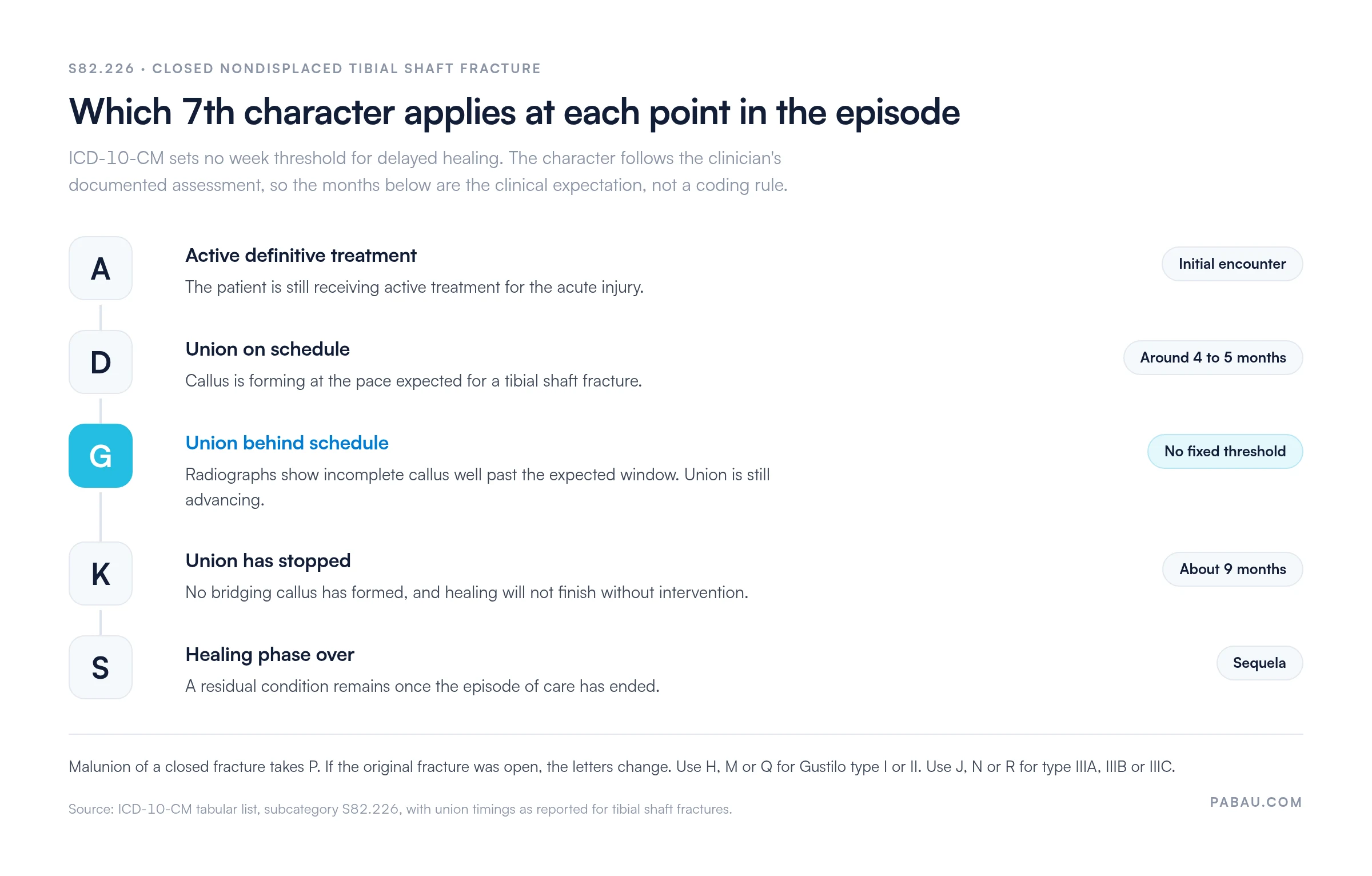
Union of a tibial shaft fracture commonly takes around four to five months. Delayed healing is raised when radiographs show incomplete callus well past that expected window, while union is still progressing. Several factors make it more likely:
No single factor decides the 7th character. ICD-10-CM sets no week threshold for delayed healing, so the character follows the clinician’s documented assessment rather than the calendar. Orthopedic and sports medicine practice software can link that assessment straight to the coding workflow.
The flow below maps each closed-fracture character in this subcategory to the point in the episode where it applies.
Applying ICD-10 code S82.226G correctly depends on meeting four criteria at the same encounter:
These three outcomes are the most commonly confused in fracture coding. Each maps to its own set of 7th characters, and each needs different supporting documentation. The character you pick depends on both the outcome and the wound status of the original fracture.
The dividing line between delayed healing (G) and nonunion (K) is whether union is still moving. Delayed healing means the fracture is late but progressing. Nonunion means the process has stalled and will not finish without intervention.
Coders shouldn’t make that call themselves. Submitting K on a note that only says “not yet healed” overstates the complication. Submitting D when the clinician recorded slow progress understates it, and can affect prior authorization for a bone stimulator or revision surgery.
S82.226G sits seven levels down the ICD-10-CM tabular list. Walking that chain is the quickest route to a neighboring code, and it confirms the note reached the required level of specificity.
Note that S82.2 is the tibia branch of the S82 category. The fibula shaft sits in a separate branch at S82.4, and the ankle codes sit further down again. Working from the tabular list rather than a code search result keeps those branches apart.
S82.226G sits within a family of S82.22x codes covering every transverse tibial shaft variant. Accurate coding means settling displacement status, laterality and wound status before you reach for the 7th character.
When laterality appears in the imaging or clinical note, do not fall back on S82.226G. Code S82.224G for the right tibia or S82.225G for the left. Payers increasingly flag unspecified laterality for edit review, so record the affected side in every encounter note.
The fibula shaft has its own series, and it is easy to reach for the wrong one because the digit patterns look almost identical. S82.226G is a tibia code. Its fibula counterpart is S82.426G, and the two are not interchangeable.
If the record documents a break in both bones, code them separately. A tibia and fibula fracture in the same leg needs one code from the S82.2 series and one from S82.4. Neither code captures the other bone.
Four documentation elements must be present in the clinical record before ICD-10 code S82.226G can be submitted:
POA (Present on Admission) exempt status likely applies to S82.226G. Subsequent encounter codes are generally exempt from the POA indicator requirement under current CMS ICD code lists. Verify this against the active fiscal year list before submission, because exemptions change with annual updates.
Practices using claims management software can configure code-level documentation checklists. Clinicians are then prompted to address encounter type, wound status, fracture pattern and healing outcome in every note. That cuts back-office rework and supports clean claim submission on the first pass.
Accurate patient record documentation across the whole fracture episode also matters at audit. A subsequent encounter claim is only as strong as the initial encounter record sitting behind it. The basics of a sound medical billing workflow apply here too.
Before submitting S82.226G, check that the note separates delayed healing from nonunion. A phrase such as “healing slower than expected, callus forming” supports G. A phrase such as “no bridging callus” points to K instead. Ask for that distinction while the clinician is still in the chart, not at billing.
Chapter 19 of the ICD-10-CM Official Guidelines for Coding and Reporting governs how fractures are coded across an episode of care. Four of its rules decide most S82.226G submissions.
The guidelines are republished with the tabular list each fiscal year, effective October 1. Reviewing the Chapter 19 fracture section before your practice’s annual coding refresh is the cheapest way to catch a rule change. Strong medical billing compliance habits start there.
S82.226G most often pairs with an established-patient office visit, serial imaging, bone stimulation, or a therapy code. CPT selection follows the services actually delivered at that encounter. Nothing in the table below belongs on a claim without clinical justification.
For physical therapy practice management, confirm coverage and authorization requirements with each payer before submission. Bone stimulation in particular is subject to payer-specific criteria.
The AAPC Codify lookup tool provides CPT-to-ICD-10 crosswalk references that help verify medical necessity pairings. Whatever the pairing, every diagnosis code must be supported by documentation for the date of service billed.
Three sources carry the official tabular list and the guidance behind it. Check S82.226G against one of them before submission, then again after each October 1 update.
Fracture episode coding only holds up if the notes behind it do. The habits that produce safer clinical notes apply in orthopedic and physical therapy settings too.
Fracture coding errors usually start in the clinical note. A clinician writes “tibia fracture, not yet healed” and moves on to the exercise plan.
The coder is then left without the detail that separates G from K, or a closed fracture from an open one. The claim goes out on a guess, and it can come back with one of the standard denial codes attached.
Practice management software like Pabau lets you attach documentation prompts to the codes your practice bills most often. When a clinician opens a fracture follow-up note, the template asks for encounter type, wound status, fracture pattern, laterality and healing outcome. Radiographic findings are captured in the same record as the diagnosis.
Pabau’s claims management then carries that structured note through to submission, so the 7th character you send is the one the record supports. Your team spends less time reworking denials and more time with patients.
Electronic claims leave through our Claim.MD integration, the clearinghouse that scrubs each claim before the payer sees it. Claims management, medical records and reporting are included in every Pabau subscription.

Pabau lets orthopedic and physical therapy teams configure code-level documentation prompts and track 7th character compliance. Wound status and laterality mismatches surface when the note is completed, well before denial review.

S82.226G is decided in the clinical note, not at the billing desk. Two facts about it are worth pinning to the wall. It is a tibia code, and the G stands for a closed fracture.
Get wound status, laterality, fracture pattern and healing outcome into every follow-up note, and the 7th character stops being the coder’s guess. That one habit is worth more than any extension table.
Pabau’s claims management helps orthopedic and physical therapy practices build those prompts into the encounter workflow. Book a demo to see how it keeps fracture claims tied to the notes that support them.

Coding delayed healing in a femur fracture? S72.91XG applies the same closed-fracture delayed-healing character higher up the leg.
Need the malunion version in the same S82 category? S82.026P walks through the patella equivalent at a subsequent encounter.
Working on an upper-limb shaft fracture? S42.332G covers the same delayed-healing character on a humerus shaft fracture.
Billing the cast that holds the fracture still? A4590 is the supply code for fiberglass casting material.
Coding a growth-plate fracture instead? S79.141A is graded by the Salter-Harris system rather than by displacement.
ICD-10 code S82.226G is a billable diagnosis code for a nondisplaced transverse fracture of the tibial shaft. It applies at a subsequent encounter, when the original fracture was closed and healing is documented as delayed. The full description reads: Nondisplaced transverse fracture of shaft of unspecified tibia, subsequent encounter for closed fracture with delayed healing.
S82.226G is a tibia code. It sits in S82.2, fracture of shaft of tibia, under the S82.22 transverse subcategory. Fibula shaft fractures are coded from the separate S82.4 series, where S82.426G is the closest counterpart. If both bones are broken, code one from each series.
Yes. S82.226G is a fully billable, specific ICD-10-CM code valid for HIPAA-covered transactions. Its parent code, S82.226, is non-billable and cannot be submitted without a 7th character extension. Verify billable status against the current fiscal year release, since the annual October 1 update can affect code validity.
The 7th character G denotes a subsequent encounter for a closed fracture with delayed healing. The patient is past active treatment for the acute injury, the skin was never broken, and union is running behind schedule. G is distinct from D (routine healing), K (nonunion) and P (malunion) of a closed fracture.
The two codes differ only on whether the original fracture was closed or open. S82.226G is a subsequent encounter for a closed fracture with delayed healing. S82.226H is a subsequent encounter for an open fracture of Gustilo type I or II with delayed healing. Type IIIA, IIIB or IIIC uses S82.226J instead.
No. Gustilo-Anderson grading applies only to open fractures, and S82.226G describes a closed one. The classification becomes relevant once the record documents that the skin was broken. At that point the code moves to S82.226H for type I or II, or S82.226J for type IIIA, IIIB or IIIC.
Use S82.224G when the record documents a right tibia and S82.225G when it documents a left tibia. S82.226G is the unspecified-laterality option, and it is only correct when the side is genuinely absent from the note. Payers flag unspecified laterality codes for edit review.
Delayed healing means the fracture is uniting more slowly than expected, with callus present but incomplete. Nonunion means union has stopped and no bridging callus has formed. In ICD-10-CM, 7th character G covers delayed healing of a closed fracture and K covers nonunion. Both need documentation to support them over routine healing (D).
S82.226 has 16 valid 7th character extensions, and all 16 are billable. The letters I, L and O are skipped, because I and O read as the digits one and zero. The complete set is A, B, C, D, E, F, G, H, J, K, M, N, P, Q, R and S.
The immediate parent is S82.226, nondisplaced transverse fracture of shaft of unspecified tibia, which is non-billable on its own. The hierarchy starts at S00-T88 (injury chapter), then S80-S89 (knee and lower leg injuries), then S82 (fracture of lower leg). It continues through S82.2 (shaft of tibia) and S82.22 (transverse) to S82.226 and S82.226G.