ICD-10 Code Z86.73: Personal history of TIA
ICD-10 Code Z86.73: Definition, descriptor, and code hierarchy ICD-10 Code Z86.7...

Last Updated: Nov 20, 2026
Billable Code Specific Code
I48.0 is the billable ICD-10-CM code for paroxysmal atrial fibrillation. It applies when the provider documents AF episodes that end within seven days of onset.
I48.0 sits in category I48, Atrial fibrillation and flutter, which holds six AF codes and three flutter codes. Assignment turns on the type the note states. A note that says only "atrial fibrillation" supports I48.91, so query the provider before coding.
Let Pabau's smart automation suggest the right codes, reduce claim denials, and keep your practice compliant—effortlessly.
Automate repetitive tasks and focus on what matters most—your patients.
Reduce coding errors and ensure compliance with the latest regulations.
Clean claims, fewer denials, and faster reimbursements.
Powerful insights and reporting to help your practice thrive.
HIPAA compliant SOC 2 certified GDPR-compliant Trusted by 4,000+ clinics worldwide

ICD-10 Code I48.0 is the billable code for paroxysmal AF, meaning self-terminating episodes under 7 days confirmed by rhythm documentation.
Assign I48.0 whenever the note says paroxysmal, and keep I48.91 for notes that still give no AF type after a provider query.
Report Z79.01 for documented long-term anticoagulant use, plus relevant comorbidity codes, to support medical necessity for AF services.
Practice software such as Pabau submits I48.0 claims through Claim.MD and tracks each remittance, so denial reasons reach your billers sooner.
ICD-10 Code I48.0 is a valid, billable ICD-10-CM diagnosis code with the official descriptor “Paroxysmal atrial fibrillation.” CDC’s FY2027 ICD-10-CM tabular list places it under category I48 (Atrial fibrillation and flutter), in Chapter 9 (Diseases of the circulatory system). The category became more granular in FY2020, when I48.11, I48.19, I48.20 and I48.21 took effect on October 1, 2019. I48.0 remains valid and billable in the current fiscal year (FY2027), with no descriptor change.
The clinical definition of paroxysmal AF is self-terminating irregular atrial activity that resolves within seven days of onset. Most episodes end within 48 hours. That self-limiting course separates I48.0 from the persistent and longstanding persistent subtypes, which run past defined duration thresholds or need intervention to end.
Coders can verify I48.0 in the CDC/NCHS ICD-10-CM web tool. It mirrors the official tabular list and index that CMS uses for FY2027 claims processing.
Paroxysmal AF is abrupt-onset irregular atrial activity that terminates without medical intervention. The ACC/AHA atrial fibrillation guidelines classify it as episodes lasting less than seven days. Persistent AF runs longer than seven days, and longstanding persistent AF runs continuously for more than 12 months. Type classification shapes treatment planning, anticoagulation decisions, and stroke risk scoring with CHA2DS2-VASc.
Each AF type maps to its own ICD-10-CM code, and payers read that code when they judge medical necessity. Monitoring, drug management, and procedures are all assessed against it. Cardiology coders who know where paroxysmal versus persistent episodes sit in the medical billing workflow stop most AF rejections before submission.
The FY2027 ICD-10-CM Tabular List lists I48.0 with no inclusion terms and no instructional notes of its own. The notes that matter come from the chapter above it and from its sibling codes.
No Excludes 1 note applies to I48.0. Neither category I48 nor code I48.0 carries one in the tabular list. Two sibling codes do: I48.1 excludes permanent AF (I48.21), and I48.20 excludes chronic persistent AF (I48.19).
The only Excludes 2 note that reaches I48.0 sits at the head of Chapter 9. It lists conditions classified elsewhere, such as transient cerebral ischemic attacks (G45.-) and endocrine diseases (E00-E88). When the provider documents one of them alongside paroxysmal AF, assign both codes and sequence by the reason for the encounter.
The tabular list carries no “use additional code” note under I48 or I48.0. Z79.01 (long-term (current) use of anticoagulants) is still reported under the general guideline for long-term drug therapy when the record documents it. Leaving it off weakens the medical necessity case for anticoagulation services.
The I48 category holds six AF codes and three flutter codes. Picking the wrong one is the most common source of I48.0 coding errors. The type the provider documents decides the code, as the map below shows.
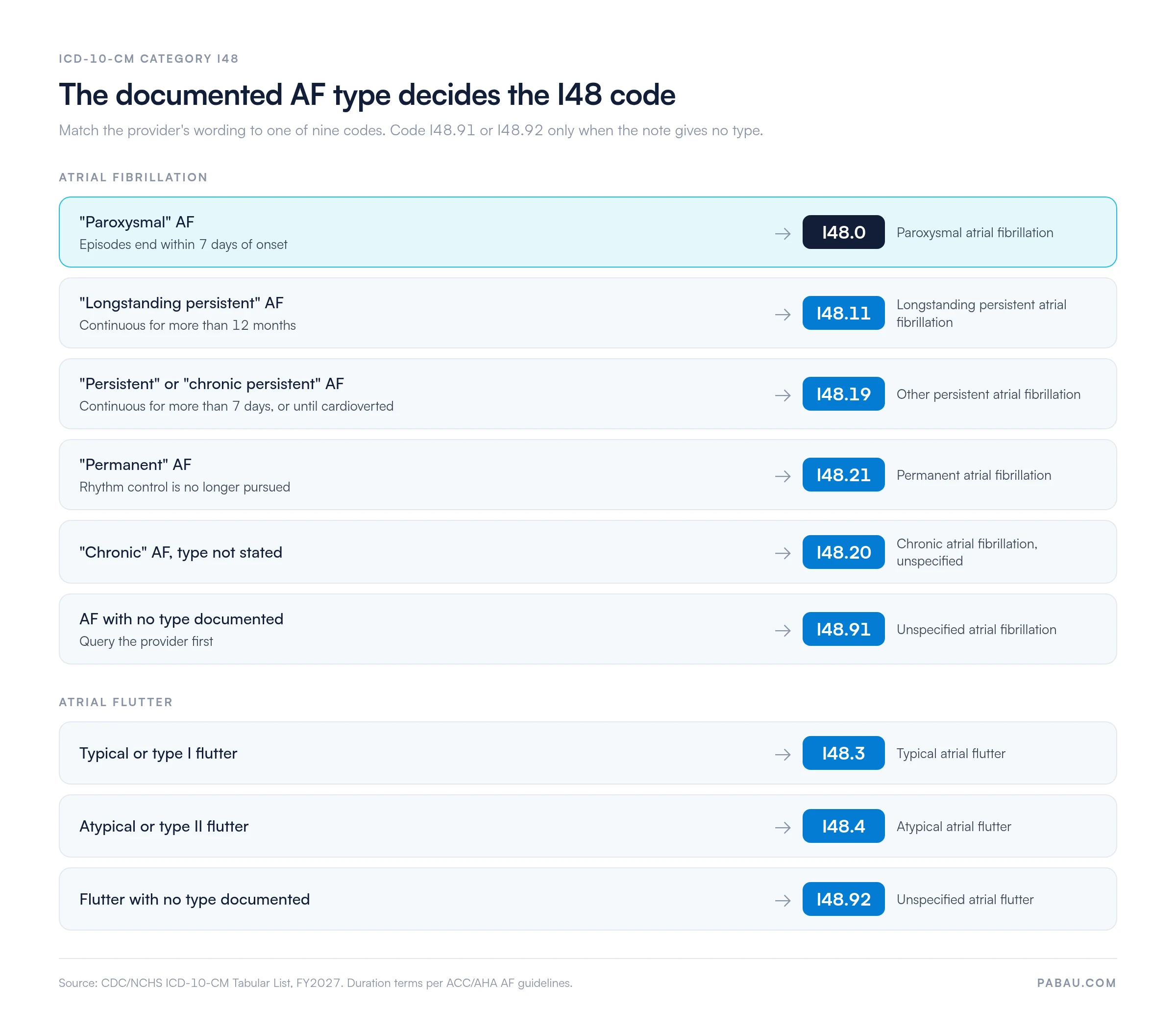
I48.0 versus I48.91: This is the key distinction. I48.91 fits only when the documentation does not let the coder determine the AF type. If the physician writes “paroxysmal AF,” I48.0 is required. When the note hints at a type, query the physician rather than defaulting to I48.91.
Run a quarterly audit of all I48.91 claims your practice submits. Flag any encounter where the note says ‘paroxysmal,’ ‘persistent,’ ‘longstanding,’ or ‘permanent’ but the claim shows I48.91. Each one is a documentation query opportunity, and a widespread pattern is a compliance risk.
The physician’s note must explicitly support I48.0 before the code can be assigned. Coders cannot infer the paroxysmal type from clinical context alone. The documentation must state it, or the coder sends a query to the provider.
Paroxysmal AF rarely presents in isolation. Most encounters involve comorbidities that need separate codes, and those codes affect medical necessity decisions for AF management services.
Stroke and cerebrovascular comorbidities are especially important to capture accurately, because they change the CHA2DS2-VASc score. Sequencing follows the principal diagnosis rule. Code first the condition chiefly responsible for the encounter, then the supporting comorbidities.
I48.0 is the principal diagnosis when the encounter is mainly for AF management. That covers an acute AF episode, a cardioversion evaluation, antiarrhythmic initiation, or rate and rhythm monitoring. It becomes secondary when the patient presents for another condition, such as heart failure decompensation or elective surgery. Incorrect sequencing is a common audit finding and can lead to refund requests under Medicare Recovery Audit Contractor (RAC) reviews.
CMS and commercial payers apply coverage policies to AF management services billed with I48.0. Requirements vary by payer and plan year. Verify the current local coverage determinations (LCDs) with the applicable Medicare Administrative Contractor (MAC) before you submit.
Cardiology practices can build payer-specific prior-authorization checklists into their pre-billing workflow to support clean claim submission. The CMS ICD-10 codes page publishes the annual update files and coding guidance that govern Medicare AF claims.
Denials on I48.0 claims follow predictable patterns. Catching them before submission costs less than working a denial queue afterward.
Each denial comes back with a CARC code on the electronic remittance advice, and the denial codes reference maps each one to its correction. Grouping those codes across claim batches shows which documentation habit keeps failing. Structured denial management in healthcare turns that pattern into a fix before it repeats on the next batch.
Procedural encounters for paroxysmal AF pair I48.0 with the correct CPT or ICD-10-PCS procedure code. A diagnosis that does not support the billed procedure triggers a medical necessity denial.
External cardioversion under 92960 is the procedure most often paired with I48.0. Warfarin follow-up under 93793 comes next for patients on long-term anticoagulation. CCI edits and medical necessity criteria for cardioversion and ablation change with annual CMS updates. The WHO ICD-10 browser gives the international context, while the CMS Tabular List governs US claims.
Before scheduling elective cardioversion for a paroxysmal AF patient, check whether the payer wants a documented antiarrhythmic drug trial first. Requirements vary by payer and MAC LCD, so check the applicable policy for DCCV (CPT 92960). Getting prior authorization with I48.0 as the supporting diagnosis avoids a preventable post-service denial.
Accurate I48.0 coding starts with the coder, but the claim still has to reach the payer and come back with an answer someone reads. In many cardiology practices that loop runs across a clearinghouse portal, a billing spreadsheet, and the chart.
Pabau’s built-in claims management software keeps that loop in one place. US claims go through Claim.MD as CMS-1500 or 837P submissions, with eligibility checks before the visit. Pabau submits and tracks the diagnosis and procedure codes your team enters. ERA remittances flow back with their CARC codes, and secondary claims go out from the same record.

The rhythm strips, physician notes, and coding decisions behind each AF encounter sit in the same patient record. When a payer asks for the ECG that supports “paroxysmal,” your team pulls it from the chart instead of a shared drive.
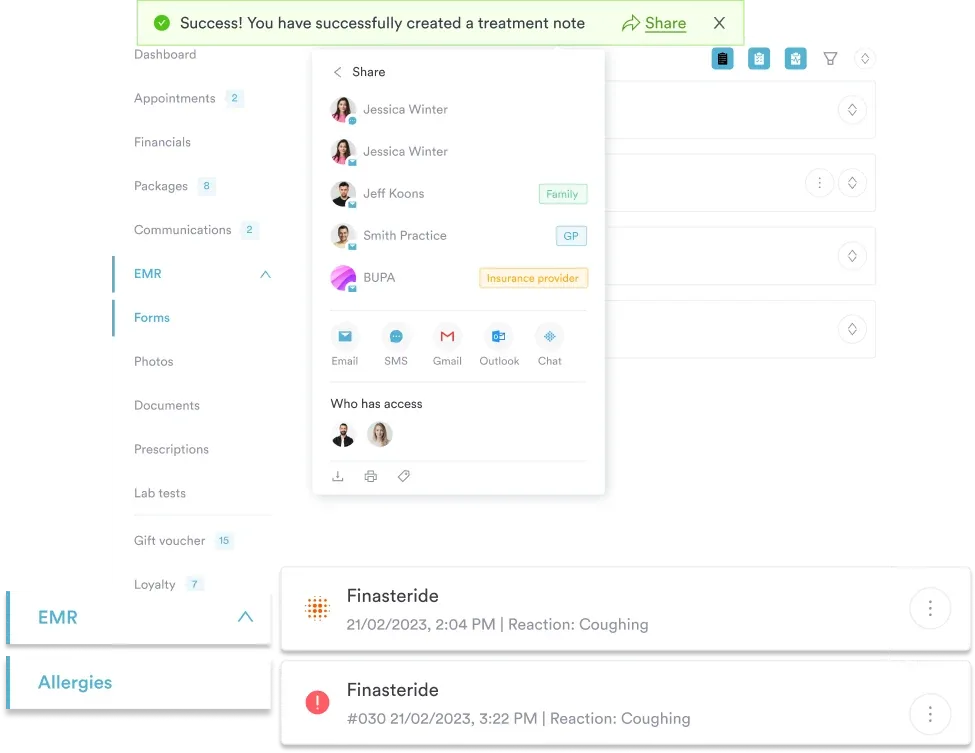

Pabau submits I48.0 claims through Claim.MD, checks eligibility before the visit, and brings ERA remittances back to the patient record. Your billers see each denial reason without leaving the chart.

ICD-10 Code I48.0 is specific, billable, and frequently under-coded. The costliest error is defaulting to I48.91 when the note supports paroxysmal AF. The next is billing AF procedures without the comorbidity and long-term medication codes that justify medical necessity.
Fix the note first, then the code. A provider query costs minutes, while an unspecified AF code can cost the whole claim. Book a demo to see how Pabau submits AF claims through Claim.MD and tracks every remittance back to the patient record.

Note gives no AF type? Unspecified atrial fibrillation (I48.91) explains when that code fits and when a provider query should come first.
Want to understand how claim denials are managed systematically? Denial management in healthcare outlines the workflow for identifying, appealing, and preventing recurring denials by CARC code.
Looking for broader context on ICD-10-CM billing fundamentals? Revenue cycle management explained covers the end-to-end process from diagnosis coding through payment posting.
ICD-10 Code I48.0 is the billable ICD-10-CM diagnosis code for paroxysmal atrial fibrillation. It covers self-terminating episodes of irregular atrial rhythm lasting less than seven days, most often under 48 hours. It falls under category I48 (Atrial fibrillation and flutter) and is valid in the current fiscal year (FY2027).
Yes, I48.0 is a valid, billable ICD-10-CM code in the current fiscal year (FY2027). It can be a primary or secondary diagnosis on outpatient and inpatient claims when the physician has documented paroxysmal atrial fibrillation.
I48.0 is used when the physician explicitly documents paroxysmal AF. I48.91 is reserved for encounters where the AF type cannot be determined from the documentation. Using I48.91 when the note says “paroxysmal” breaks the ICD-10-CM specificity rule. It can also trigger a payer specificity or medical necessity edit, such as CO-50 or CO-11.
The most common denial triggers for I48.0 claims are missing rhythm documentation and incorrect sequencing. Others are a missing Z79.01 when anticoagulation services are billed, and missing prior authorization for cardioversion or ablation where the payer requires it. Each denial carries a CARC code that identifies the root cause.