ICD-10 Code Y76.0: Diagnostic obstetric and gynecological devices
ICD-10 Code Y76.0: Definition and billable status ICD-10 Code Y76.0 is a valid, ...

Last Updated: Oct 23, 2026
Billable Code Specific Code
S72.91XG is the billable ICD-10-CM code for unspecified fracture of right femur, subsequent encounter for closed fracture with delayed healing.
Let Pabau's smart automation suggest the right codes, reduce claim denials, and keep your practice compliant—effortlessly.
Automate repetitive tasks and focus on what matters most—your patients.
Reduce coding errors and ensure compliance with the latest regulations.
Clean claims, fewer denials, and faster reimbursements.
Powerful insights and reporting to help your practice thrive.
HIPAA compliant SOC 2 certified GDPR-compliant Trusted by 4,000+ clinics worldwide

S72.91XG is a billable ICD-10-CM code for an unspecified fracture of the right femur, subsequent encounter for closed fracture with delayed healing.
The 7th character G means delayed healing. Routine healing for a closed fracture is 7th character D, and mixing the two is the most common error on this code.
S72.91 already specifies the right side. S72.90 is the code for an unspecified femur, and S72.92 covers the left femur.
The word unspecified in the description refers to the fracture site within the femur, not to laterality.
Omitting the placeholder X or picking the wrong 7th character are the two structural errors that trigger most S72 denials.
Pabau routes coded orthopedic encounters through Claim.MD, so structural and eligibility problems surface before the claim reaches the payer.
Use the table below to confirm the key facts before coding a follow-up visit for a right femur fracture. The full description is confirmed in the CMS ICD-10-CM tabular list.
Every character in S72.91XG carries a specific meaning. Misread one and the claim may deny. Here is what each position represents, per the CDC/NCHS ICD-10-CM official tool and the ICD-10-CM coding guidelines.
The placeholder X at position 6 is the most frequently dropped element. ICD-10-CM guidelines require it whenever a code needs a 7th character but has fewer than six characters before it. Without the X, the G falls into position 6 and the code becomes structurally invalid.
Not every femur code needs the placeholder. S72.302C already carries six already carries six characters before the 7th, so its letter attaches directly with no X in front of it.
S72.91 is a right-side code. The 9 in the fourth position says the fracture site within the femur was never documented. The 1 in the fifth position says the side was. Reading the word unspecified as a statement about laterality is what sends coders to S72.91 when the record never names a side.
The three subcategories under S72.9 split purely on laterality, and each one carries the same set of 7th characters.
None of the three is billable on its own. Each needs the placeholder X and a 7th character before it becomes a complete code.
S72.91X takes 16 valid 7th characters, and they are easier to hold in your head as a grid than as a list. Two things set the letter at once. One is whether the fracture is closed or open, and the other is what the healing looks like at this visit.
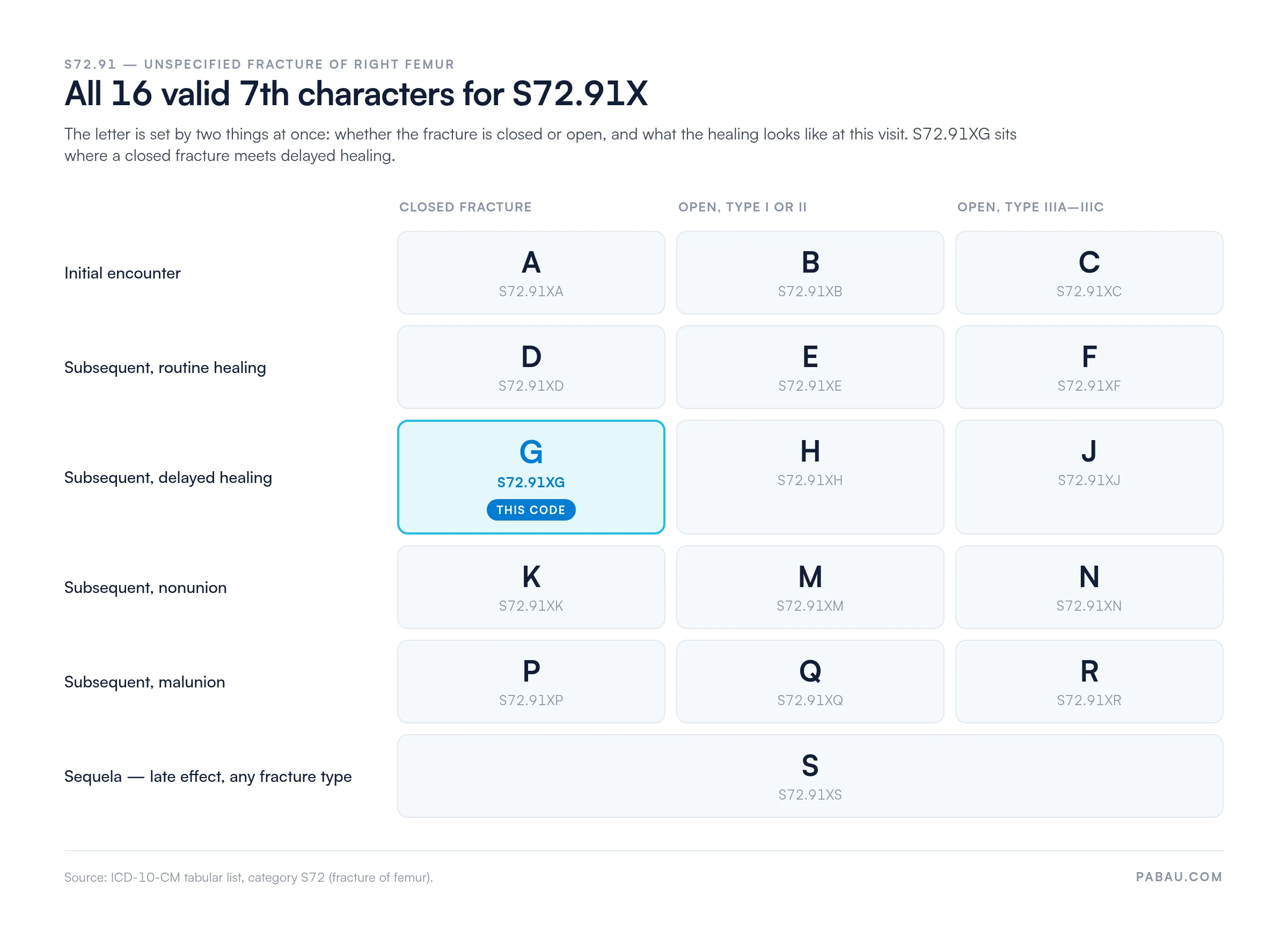
The full list below gives each character its description and the encounter it usually describes. The AAPC ICD-10-CM code reference provides a searchable index for verifying 7th character options by code family.
The pattern worth memorizing: the subsequent-encounter letters run in blocks of three. D, E and F are routine healing. G, H and J are delayed healing. K, M and N are nonunion, and P, Q and R are malunion. Within each block the first letter is the closed fracture, so G is always the closed-fracture delayed-healing option.
S72.91XG applies at a follow-up visit where a right femur fracture is healing more slowly than expected. Active treatment has ended, the fracture has not united yet, and the provider has documented the delay. Common settings include orthopedic follow-up appointments, post-surgical implant reviews, and physical therapy progress evaluations.
Orthopedic and rehabilitation teams managing these patients can use physical therapy practice management platforms with structured coding workflows. That keeps encounter-type selection consistent across a multi-provider team. A solo or two-provider office gets the same consistency from an EMR for small practices, where one person usually codes and bills.
Before you settle on D, read the radiology and progress note language. Phrases such as delayed callus formation, no bridging callus at 12 weeks, or union behind schedule rule routine healing out. That documentation supports G, and routine healing would understate the encounter. Assigning D by reflex on every follow-up quietly turns a delayed-healing visit into an under-coded claim.
Choosing between the neighbors of S72.91XG comes down to two questions. What does the record say about the side, and what does it say about healing progress? The table below sets out the decision points for the codes that get confused most often.
When the fracture site is documented, a more specific S72 code is always preferred. ICD-10-CM Official Guidelines Section I.B.2, Level of Detail in Coding, requires coders to select the most specific code the documentation supports.
A record that names a displaced fracture at the base of the right femoral neck belongs in S72.041B. Reaching for S72.91XG there is a specificity error, and it draws audit attention.
S72.91XG has to be supported by clinical documentation at every subsequent encounter. Claims submitted without adequate records are subject to denial, and Medicare audits of orthopedic follow-up claims look closely at encounter-type consistency. Grounding your team in medical billing fundamentals reduces that exposure.
The claims management software inside practice management software like Pabau routes claims through the Claim.MD integration. Catalogue validation runs there, so a missing placeholder X is caught before the claim leaves your office.
That matters most for orthopedic practices handling a high volume of fracture follow-up encounters. Running eligibility verification before the visit removes a second common denial reason. When rejections do arrive, a structured denial management workflow shows whether the 7th character or the documentation caused it.
Submitting a clean claim for a subsequent fracture encounter depends on three things lining up. You need the correct 7th character, documentation that supports that character, and an encounter date clearly after active treatment.
Five errors account for most S72.91XG denials and audit findings. Each one is preventable with a short pre-submission review.
In most orthopedic practices, a 7th-character problem is discovered by the payer first. The denial lands weeks after the visit, someone pulls the chart, re-codes the encounter, and resubmits. That round trip usually costs more staff time than the claim itself is worth. A coding error surfaces as a cash flow problem weeks later, which is why the healthcare revenue cycle is measured end to end.
Pabau keeps the diagnosis code attached to the encounter it came from. Your coder works from the same progress note the provider wrote. The healing status behind G is on screen at the moment the code is chosen. Claims then route to Claim.MD for eligibility checks, structural validation, and ERA processing.
The outcome is fewer resubmissions and a shorter path from follow-up visit to payment. Reporting shows you which denial reasons keep repeating, so you can fix the documentation habit behind them instead of reworking one claim at a time.

Pabau routes ICD-10 coded encounters through Claim.MD for real-time validation, eligibility checks, and ERA processing. Structural and 7th-character errors surface before the claim reaches the payer.

S72.91XG carries two facts that are easy to get wrong at the same time. The fracture is on the right femur, and the healing is delayed rather than routine. Confirm both in the documentation, keep the placeholder X in position 6, and the code will hold up under review.
Pabau supports orthopedic and rehabilitation practices with structured ICD-10 workflows and Claim.MD validation on the billing screen. Book a demo to see how that works on real fracture follow-up claims.

Billing an unlisted gastric procedure? CPT Code 43659 covers the unlisted laparoscopic stomach code used when no dedicated code exists for the procedure.
Billing a laparoscopic enterostomy closure? CPT code 44227 covers the inpatient-only code for a laparoscopic enterostomy closure with resection and anastomosis.
Billing a diagnostic colonoscopy? CPT code 45378 covers the 2026 fee schedule and RVU breakdown for a symptom-driven diagnostic colonoscopy.
Removing a polyp during colonoscopy? CPT code 45385 covers the snare-technique code used when a colonoscopy becomes a therapeutic polyp removal.
S72.91XG means an unspecified fracture of the right femur, subsequent encounter for closed fracture with delayed healing. The 9 says the fracture site within the femur was not documented. The 1 says the fracture is on the right side. The X is a required placeholder, and G marks a follow-up visit where healing is behind schedule.
S72.91XA is the initial encounter, meaning the first visit where the right femur fracture is actively treated. S72.91XG is a subsequent encounter where the fracture is documented as healing slowly. Once active treatment ends and the patient moves into follow-up care, A is no longer correct, however long that initial treatment lasted.
No. S72.91 is the right femur. The word unspecified in the description refers to the fracture site within the femur, not to the side. S72.90 is the code for an unspecified femur when the record never states left or right, and S72.92 covers the left femur.
D is a subsequent encounter for a closed fracture with routine healing. G is a subsequent encounter for a closed fracture with delayed healing. Both describe follow-up care, so the deciding factor is what the provider documented about union progress at that visit.
Use a subsequent encounter code once active treatment has ended and the patient is in the healing or recovery phase. In ICD-10-CM, subsequent encounter does not mean the second appointment. It means the post-active-treatment phase, which can begin right after surgery or cast application.
Only when the specific fracture site is not documented. Most hip fractures have an identified anatomical site, such as the femoral neck or the intertrochanteric region. Those belong in the matching S72 subcategory. The S72.0 group covers fractures of the head and neck of the femur, and it fits those cases better than the unspecified S72.91 family.
S72.91X takes 16 valid 7th characters. A, B and C cover initial encounters. D, E and F cover routine healing, and G, H and J cover delayed healing. K, M and N cover nonunion, and P, Q and R cover malunion. S covers sequela. Verify the list each fiscal year with the CDC ICD-10-CM tool.
Common companion codes include external cause codes from the W00-W19 fall range to explain the mechanism of injury. Z codes for aftercare are also frequent, such as Z47.2, the encounter for removal of an internal fixation device. Contributing conditions like osteoporosis may be reported as well. Always confirm companion pairing against payer-specific LCD policies.