ICD-10 Code I48.0: Paroxysmal atrial fibrillation
ICD-10 Code I48.0: Definition and official descriptor ICD-10 Code I48.0 is a val...

Last Updated: Nov 20, 2026
Billable Code Specific Code
Z86.73 is the billable ICD-10-CM code for personal history of transient ischemic attack (TIA), and cerebral infarction without residual deficits. It applies once the episode is over and the patient carries no lasting neurological deficit from it.
Coders often confuse it with G45.9, the active-episode TIA code, a common source of coding errors on neurology follow-up visits. G45.9 belongs to the encounter where the TIA is evaluated or treated. Z86.73 belongs to later encounters, once the clinician documents the event as past history with no residual deficits.
Let Pabau's smart automation suggest the right codes, reduce claim denials, and keep your practice compliant—effortlessly.
Automate repetitive tasks and focus on what matters most—your patients.
Reduce coding errors and ensure compliance with the latest regulations.
Clean claims, fewer denials, and faster reimbursements.
Powerful insights and reporting to help your practice thrive.
HIPAA compliant SOC 2 certified GDPR-compliant Trusted by 4,000+ clinics worldwide

Z86.73 covers a resolved TIA or cerebral infarction that left no residual neurological deficits, never an active episode.
G45.9 codes the encounter where a TIA is evaluated or treated. Z86.73 applies at later encounters, once the TIA is documented as history.
Lasting deficits after an infarction take an I69.- sequelae code, which the Z86.73 Excludes1 note keeps off the same claim.
Z86.73 may be the first-listed diagnosis on an outpatient visit focused on cerebrovascular risk history, under the ICD-10-CM Official Guidelines.
Pabau’s claims management software helps you submit and track claims with the codes your clinicians document.
ICD-10 Code Z86.73 is a billable, specific ICD-10-CM code for Personal history of transient ischemic attack (TIA), and cerebral infarction without residual deficits. It became effective on October 1, 2015, and it remains valid in CMS’s current ICD-10-CM code files.
Z86.73 sits in Chapter 21, the Z-code chapter that records factors influencing health status rather than active disease. For the chapters and categories around it, the ICD-10-CM code library lists each code with its own guide.
Z86.73 covers a prior episode of transient ischemic attack or cerebral infarction that has fully resolved, with no persisting neurological deficits. Under ICD-10-CM Official Guidelines Section I.C.21, a personal history code fits only when the condition is no longer being treated. The patient carries the history as a risk factor or as context for the current visit.
Clinically, the physician has documented that the TIA occurred in the past and that acute management is complete. The note also shows no residual weakness, speech impairment, or vision change from that event. The code supports encounters such as:
G45.9 is the code for the encounter where a TIA is being evaluated or treated. Z86.73 is the code for later encounters, once the clinician documents the TIA as past history with no residual deficits. Swapping the two is a common source of coding errors in neurology billing.
The purpose of the encounter decides it. When the TIA is worked up or treated, even during an observation stay, G45.9 is the code. When a later visit’s note documents the TIA as past history with no deficits, Z86.73 is correct. Lasting deficits after an infarction need a third code, and the decision flow below sorts all three.
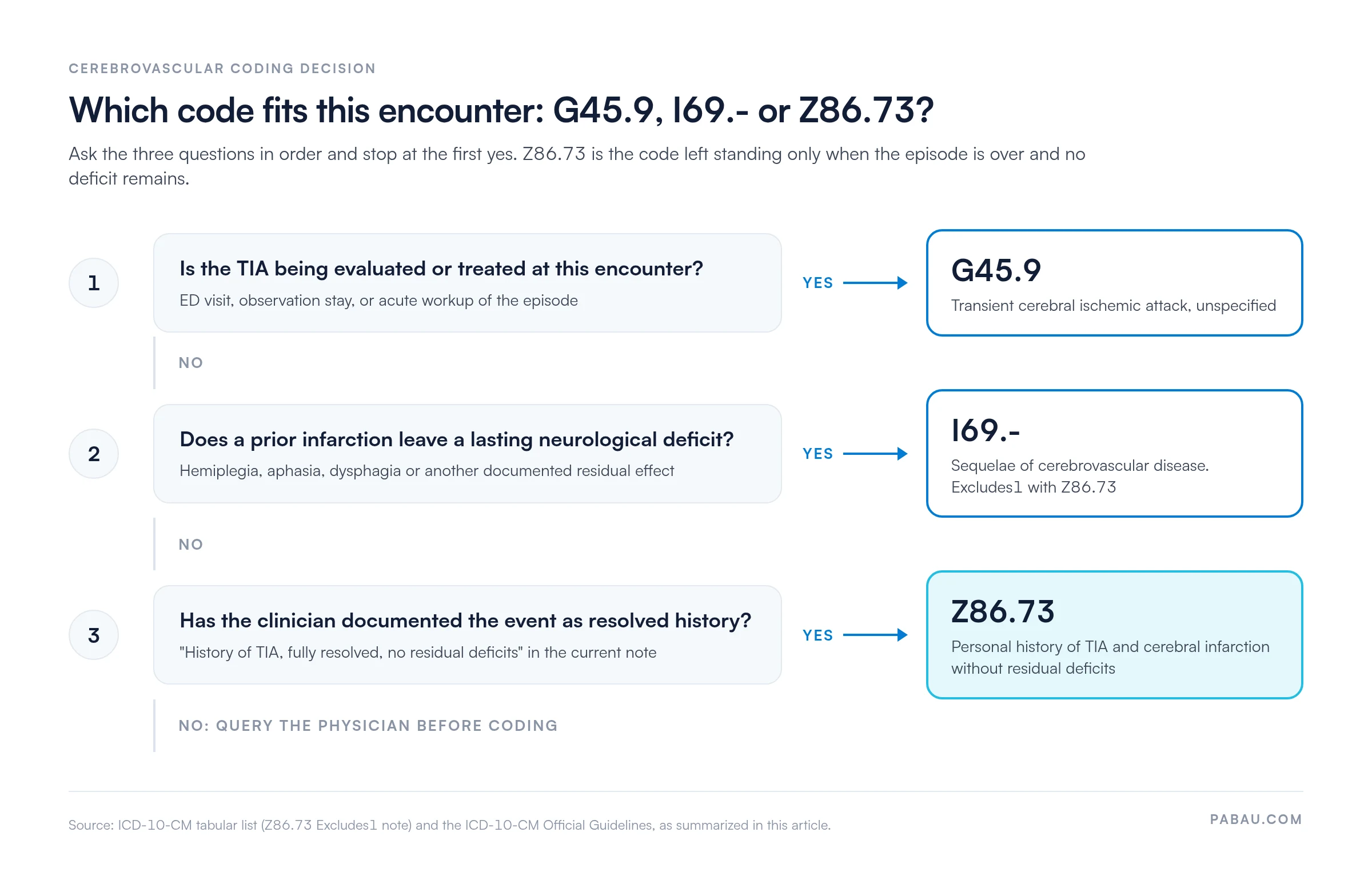
Read the current note, not the problem list, before you choose. A resolved TIA that still sits on the active problem list is the usual way G45.9 ends up on a follow-up claim.
Z86.73 sits within the Z86 category, which covers personal history of certain other diseases. Coders in neurology and primary care often choose between Z86.73 and nearby cerebrovascular codes. The choice gets harder when a patient has a history of both TIA and stroke.
The line between Z86.73 and the I69-series is residual deficit. If a cerebral infarction left any lasting neurological impairment, the code comes from the I69 category, not Z86.73. Assigning Z86.73 when deficits exist is a documentation mismatch that payers flag on audit.
The acute stroke stay is coded differently again. The infarction itself takes a code from the I63 category, such as I63.9 when the type is unspecified.
Z86.73 carries an Excludes1 note that coders must review before assigning the code. The code records history only. It never covers an active episode or one that left a residual neurological effect.
A common coder error is assigning Z86.73 at the encounter where the TIA is still being evaluated or treated. G45.9 belongs to that encounter. Z86.73 belongs to later encounters, once the note documents the TIA as past history.
ICD-10-CM Official Guidelines Section IV explicitly permit Z codes as the first-listed diagnosis for outpatient encounters. Z86.73 may be the first-listed code when the whole purpose of the visit is to evaluate or manage cerebrovascular risk history. No other active condition can be driving the encounter.
In practice, that means two distinct scenarios determine which position Z86.73 takes:
Z86.73 does not affect MS-DRG assignment in inpatient settings. It is neither a complication or comorbidity (CC) nor a major one (MCC) under the CMS MS-DRG Definitions Manual. Its billing impact sits mainly in outpatient encounters, where it supports medical necessity for follow-up and risk-management services.
Before assigning Z86.73 as first-listed, confirm the physician’s documentation explicitly states the visit purpose is TIA history review or cerebrovascular risk management. A chief complaint that names any active condition – even hypertension or atrial fibrillation – usually makes that active condition the first-listed code and Z86.73 secondary.
Defensible use of ICD-10 Code Z86.73 rests on four documentation elements that the medical record must contain before coding is finalized.
When TIA history comes from outside records, the treating clinician must review and explicitly acknowledge those records in the current note. A coder cannot infer a Z86.73 diagnosis from an attached discharge summary alone without that acknowledgment.
Medicare accepts Z86.73 as a valid diagnosis code on outpatient claims. No separate active-condition code is required when the encounter is focused on cerebrovascular risk history. Local Coverage Determinations (LCDs) still decide whether Z86.73 alone supports medical necessity for a given service. Check the LCD for the service billed before relying on Z86.73 as the only supporting code.
Three high-volume scenarios where Z86.73 supports medical necessity deserve attention:
Z86.73 is not an HCC-mapped code under the current CMS-HCC model, so it does not affect the patient’s risk adjustment factor (RAF) score. Practices using Z86.73 to influence risk-adjustment submissions are using it outside its intended scope.
Z86.73 denials usually trace back to one of five errors. Each has a clear correction once the root cause is understood.
A pre-submission review catches most of these. Check every Z86.73 claim for a contradictory code pair and for sequencing against the reason for the visit before it goes out.
Z86.73 is easier to get right at the point of care than to correct at the billing desk. These four steps cut downstream coding errors and missing documentation.
The clinician’s note decides whether Z86.73 is the right code. Once it is on the encounter, the work moves to submission and follow-up, where a rejected claim can sit for weeks before anyone chases it.
Pabau, a practice management platform with built-in billing, keeps the note and the claim on one patient record. Its claims management software helps you submit and track claims with the codes your clinicians document.
Through the Claim.MD connection, your team runs real-time eligibility checks, sends 837P claims, and receives remittances without leaving Pabau. Our guide to the Claim.MD clearinghouse explains how that connection works.
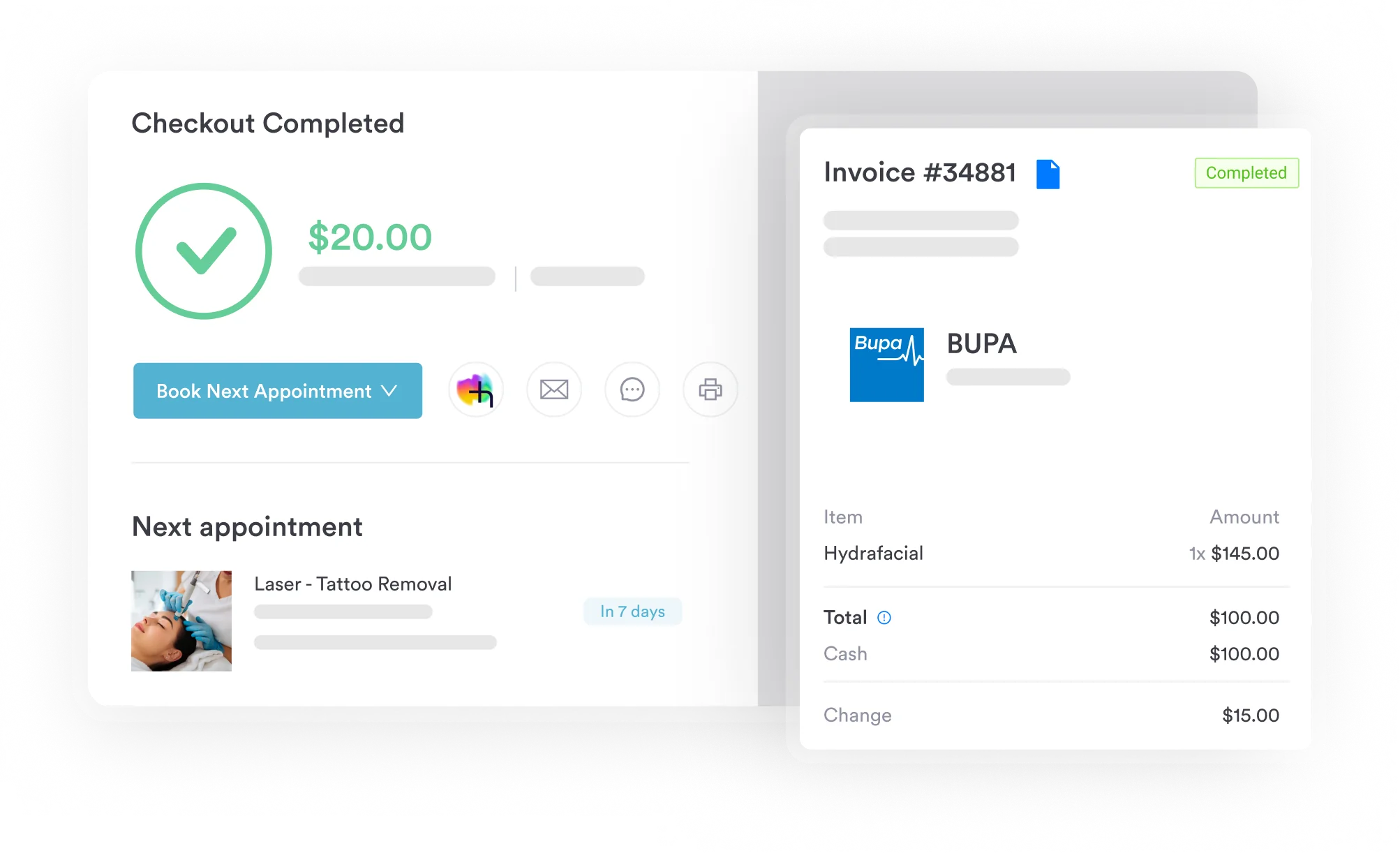

Pabau’s claims management helps you submit and track claims with the codes your clinicians document. Check eligibility, send 837P claims, and receive remittances from the same patient record.

Z86.73 fits a narrow moment in a patient’s record. The TIA or infarction is over, no deficit remains, and the treating clinician says so in the current note. Before that moment the code is G45.9, and with a lasting deficit it is I69.-.
Build that standard into the follow-up template and many of these mix-ups never reach a coder. The trade-off is a little more structure in the clinician’s note, in exchange for claims that hold up on review.
Book a demo to see how Pabau helps your team submit and track claims with the codes your clinicians document.

Need to understand how Z-codes interact with denial patterns? Denial codes in medical billing explains the most common CARC denial reasons and how to respond to each one.
Submitting ICD-10 claims through a clearinghouse? What makes a clean claim covers the formatting and coding requirements payers check before adjudicating any diagnosis code.
Building a Z-code audit checklist for your team? Revenue cycle management overview provides the end-to-end framework for catching coding errors before they reach the payer.
ICD-10 Code Z86.73 is the billable ICD-10-CM diagnosis code for personal history of transient ischemic attack (TIA) and cerebral infarction without residual deficits. It applies when a prior TIA has fully resolved and the patient has no ongoing neurological impairment from that event.
Yes, Z86.73 is a billable, specific ICD-10-CM code. It is a valid leaf code with no further subclassification required. Medicare, Medicaid, and commercial payers accept it on properly documented outpatient claims.
Z86.73 is for a past TIA that has completely resolved with no residual deficits. G45.9 is for the encounter where a TIA is being evaluated or treated. The two describe mutually exclusive clinical states, so only one fits a given encounter. The Excludes1 note on Z86.73 points to the I69.- sequelae codes. The clinical timeline, confirmed in the physician’s note, determines which applies.
No. Z86.73 is not mapped to any Hierarchical Condition Category (HCC) under the current CMS-HCC risk adjustment model. It does not directly affect a patient’s RAF score. Practices should not use Z86.73 with the expectation of influencing risk-adjustment submissions.