ICD-10 Code V09.01XS: Pedestrian injured in nontraffic accident involving military vehicle, sequela
ICD-10 Code V09.01XS: Code description and clinical meaning ICD-10 code V09.01XS...

Last Updated: Oct 26, 2026
Billable Code Specific Code
T22.342S is the billable ICD-10-CM code for burn of third degree of left axilla, sequela.
Two characters decide whether this code is correct, and both get misread. The 3 after the decimal means third-degree burn, not corrosion. The 4 that follows means axilla, not shoulder. Both errors point coders at a different code family, and both are easy to catch once you know where they sit.
Let Pabau's smart automation suggest the right codes, reduce claim denials, and keep your practice compliant—effortlessly.
Automate repetitive tasks and focus on what matters most—your patients.
Reduce coding errors and ensure compliance with the latest regulations.
Clean claims, fewer denials, and faster reimbursements.
Powerful insights and reporting to help your practice thrive.
HIPAA compliant SOC 2 certified GDPR-compliant Trusted by 4,000+ clinics worldwide

T22.342S is the ICD-10-CM code for burn of third degree of left axilla, sequela. It is valid and billable for fiscal year 2026.
The T22.3 subcategory covers third-degree burns. Chemical injuries to the same region are corrosions, and they sit in T22.4 through T22.7.
The site digit 4 means axilla, not shoulder. A third-degree burn of the left shoulder is T22.352S instead.
The S suffix marks a sequela visit. Sequence the late effect first, then T22.342S to establish what caused it.
Practice management software like Pabau routes these claims through Claim.MD, so sequela coding errors surface before submission.
Every character in T22.342S carries a distinct clinical meaning. Coders who know the positional logic can verify injury type, depth, site, laterality, and encounter type at a glance. That check catches the common T22 errors before the claim leaves the practice.
The positional pattern holds across every T22 code. Character five is always the site and character six is always the side. A right-axilla patient coded to T22.342S has the wrong laterality, and the correct code is T22.341S. T22.342 without a seventh character is invalid and will reject.
T22.342S sits one digit away from two very different codes. One swaps the injury type from burn to corrosion. The other swaps the site from axilla to shoulder. Both mistakes produce a code that looks plausible on the claim line and describes a different injury.
The safest habit is to read the code back as a sentence before you submit it. Say the injury type, the depth, the site, the side, and the encounter type out loud. If the chart says a chemical splash reached the shoulder, T22.342S is wrong on both counts.
ICD-10-CM draws a hard line between thermal burns and chemical corrosions inside the same T22 category. The causative agent decides which half of the category applies, and depth only chooses the subcategory within that half.
Third-degree depth means full-thickness skin loss. The epidermis and dermis are both destroyed, and the injury often reaches subcutaneous tissue. That depth is what drives the reconstructive and rehabilitative care a sequela claim usually covers.
The seventh character S is easy to attach to the wrong encounter. Applying it to an active burn, or omitting it on a late-effect visit, produces claim errors that payers flag on audit.
Under ICD-10-CM Official Guidelines Section I.C.19.a, S is reserved for conditions caused directly by a prior injury. The injury itself must already be healed. Scar formation after a burn is the guidelines’ own example. Codes outside the burn chapter follow the same rule, including soft-tissue injuries coded to soft-tissue injuries coded to S69.91XS.
Sequencing follows from that definition. The late-effect condition being treated goes first on the claim, and T22.342S follows as a secondary code to establish the cause. An axillary scar contracture limiting left shoulder abduction is a typical example. The diagram below traces that decision from the chart note to the finished claim line.
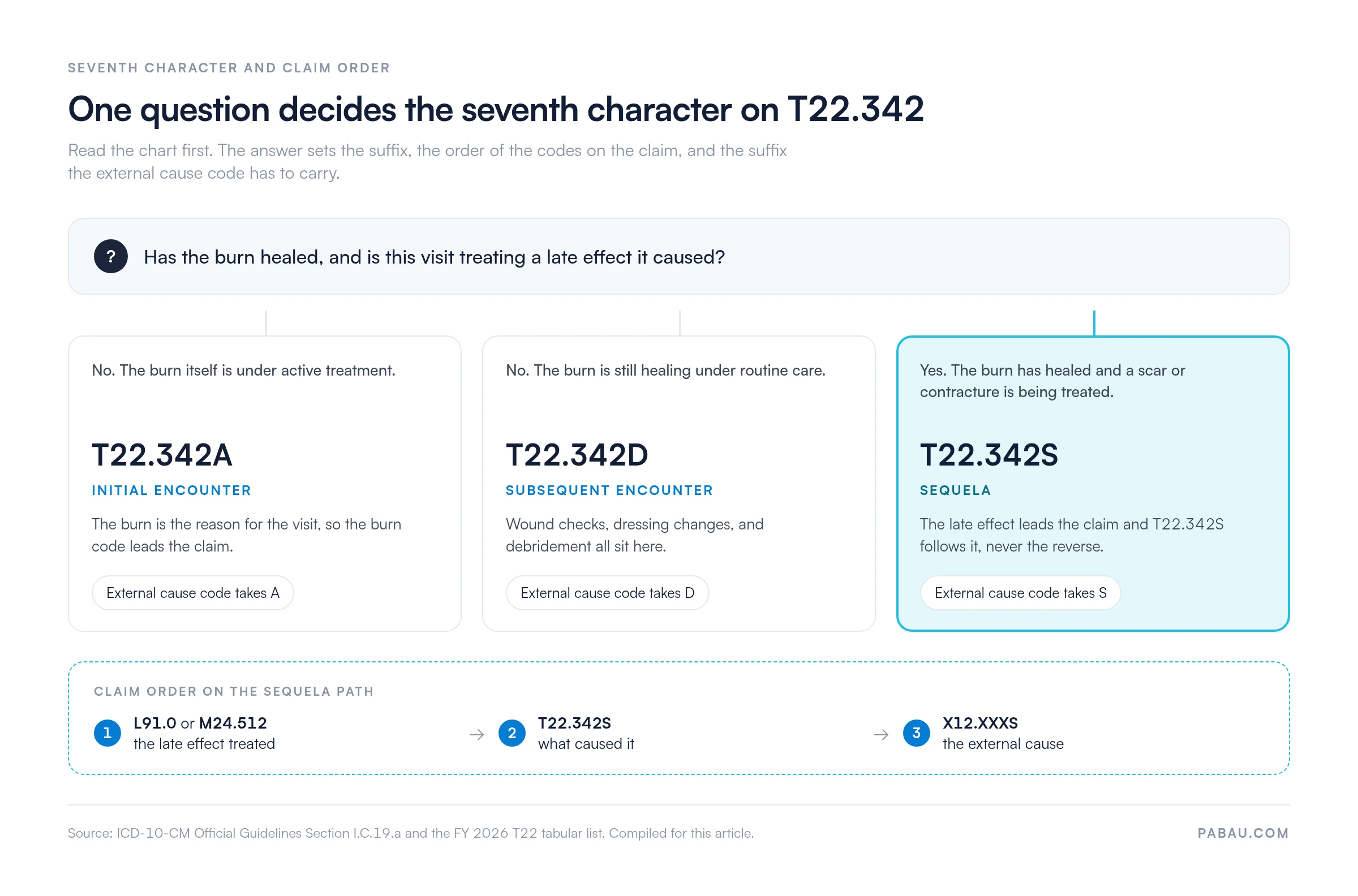
The seventh character S attaches to the injury code only. The code for the late effect itself never carries it. There is also no time limit on a sequela code. A burn from twenty years ago still supports T22.342S, provided the chart documents the link.
T22.342S applies when a patient is treated for a late effect of a third-degree thermal burn of the left axilla. The original burn must be healed. Axillary burns matter clinically because scar tissue crossing the armpit restricts shoulder abduction, flexion, and extension. Common valid encounters include:
The code is not appropriate for an active burn still under wound care. Use T22.342A for the initial encounter and T22.342D while the burn is healing. A record can carry both a current burn code and a sequela code. That happens when an old burn and a new injury coexist.
The T22 category carries an instructional note to use an additional external cause code identifying the source, place, and intent of the burn. The named ranges are X00–X19, X75–X77, X96–X98, and Y92. Chemical ranges such as T51–T65 belong to corrosion codes and do not apply here. Mandatory status varies by payer, so confirm requirements against individual payer policies. Revenue cycle management reporting separates claims that were denied from claims nobody submitted.
The external cause code takes the same seventh character as the injury code. On a sequela visit that means S, so a scald from hot cooking oil becomes X10.2XXS rather than X10.2XXA. Getting that suffix wrong is a common reason a sequela claim fails an edit check.
Record the heat source in the original encounter note, not just the word burn. When the patient returns years later for scar release, the coder can pull the right X-code straight from the chart. A note that says only thermal injury leaves the external cause code hard to defend on audit.
Knowing the parent and sibling codes helps coders confirm specificity and spot when an adjacent code fits better. The T22 category follows a consistent depth, site, and laterality hierarchy, so each neighbor differs from T22.342S by exactly one character.
The AAPC ICD-10-CM code lookup and the CDC/NCHS ICD-10-CM web tool both publish browsable T22 hierarchies with the excludes notes attached. Use either one to confirm that T22.342S does not conflict with a concurrent code on the same claim.
Coders can assign T22.342S only when the note supports every specificity element in the code. Thin documentation is the main driver of payer queries and retrospective denials on sequela claims. Following medical billing compliance practice and keeping HIPAA-compliant documentation both require the chart to answer five questions:
Add a burn history field to the intake template you use for scar and contracture visits. Capture the injury date, the heat source, the documented depth, and the treating facility. Structured fields make sequela coding faster and far easier to defend when a payer asks for records.
Sequela claims carry more audit exposure than active-injury claims. Payers expect the record to link the current condition to an injury that healed long ago. Knowing the usual denial patterns cuts rework and protects payment.
Medicare covers medically necessary treatment of burn sequela when the diagnosis codes and documentation support it. Covered care includes scar release surgery, graft work billed under CPT 15271, physical therapy, and pain management.
The CMS Physician Fee Schedule lets you verify RVU values and payment amounts for the procedure codes reported alongside T22.342S. Medicaid follows CMS mandates but varies by state, so confirm coverage with each state program.
Four patterns show up repeatedly on denied T22.342S claims. Reversed sequencing puts the injury code ahead of the late-effect condition. The active-injury suffix A or D appears on a healed-burn visit. The external cause code is missing or carries the wrong seventh character. The current note never documents the original burn at all.
Claim denial management protocols that flag sequela encounters for review before submission cut rejection rates. Medical billing workflows should include that sequencing checkpoint by default.
In many practices a sequela claim is assembled by hand. Someone opens the old burn note and copies the depth and heat source into the current chart. Then they look up the external cause code and hope the codes land in the right order.
Every one of those steps is a place where T22.342S turns into T22.352S or loses its S suffix. Practice management software like Pabau keeps the clinical record and the claim in one place. Built-in ICD-10-CM and CPT catalogs let the coder pick T22.342S from a validated list, so nobody types a site digit by hand.
Custom intake and treatment forms hold the burn history in structured fields. The depth, the heat source, and the injury date are still there years later, when the patient returns for scar management.
From there the claim moves through the Claim.MD integration, which connects to thousands of US payers for electronic submission and real-time eligibility checks. It supports 837P claim files and returns electronic remittance advice, so your team tracks sequela claim status without leaving the platform.
Pabau’s claims management software surfaces rejections against the clean claim submission standard before the file leaves the practice. The outcome is fewer reworked claims and faster payment on the encounters payers scrutinize hardest.


Pabau’s claims management tools cover ICD-10-CM code lookup, 837P submission, and ERA tracking. Your team spends less time on rework and more time on patient care.

T22.342S is a precise code, and the precision is what makes it fragile. It holds up only when the chart backs every character. That means a thermal cause, full-thickness depth, the axilla rather than the shoulder, the left side, and a healed burn with a late effect.
The habit worth building costs a few seconds. Read the code back as a sentence before you submit, and the two characters that cause the trouble stop being a risk.
For practices handling burn sequela alongside other multi-code claims, Pabau validates diagnosis codes and sequencing before the claim reaches the payer. To see that on your own sequela encounters, book a demo.

Coding another sequela encounter? ICD-10 code S51.029S works through the same 7th-character rules on an elbow laceration.
Need the sequela rules on a fracture? ICD-10 code S42.399S applies the same late-effect sequencing to a healed humerus shaft fracture.
Billing the reconstruction that follows? CPT code 15221 sets out the add-on rules for full-thickness graft work.
Need the spinal version of a late effect? ICD-10 code S14.118S shows how the S suffix behaves on a complete cord lesion.
Coding a low-complexity occupational therapy evaluation? Occupational therapy evaluation billing guide covers CPT code 97165 for a low-complexity evaluation reported once per episode of care.
ICD-10 code T22.342S is the ICD-10-CM code for burn of third degree of left axilla, sequela. It describes a full-thickness thermal burn of the left armpit that has healed. The patient is now treated for a late effect such as a scar contracture, fibrosis, or neuropathic pain. The S suffix marks the visit as a sequela encounter rather than active burn treatment.
T22.342S is a burn code. The 3 after the decimal places it in T22.3, the third-degree burn subcategory for the shoulder and upper limb. Corrosions are chemical injuries and sit in T22.4 through T22.7. The corrosion equivalent for the same site and encounter type is T22.742S.
It describes the axilla, or armpit. In T22.3 the fifth character is the site digit, and 4 means axilla while 5 means shoulder. A third-degree burn of the left shoulder is T22.352S. A third-degree corrosion of the left shoulder is T22.752S, which is the code T22.342S is most often confused with.
The S suffix is the seventh character for a sequela encounter. The original injury has healed and the patient is treated for a late effect that it caused. For burns that includes scar release, contracture treatment, and chronic pain management. Use A for initial active treatment and D for routine care during healing.
The T22 note calls for an external cause code identifying the source, place, and intent of the burn. The named ranges are X00 to X19, X75 to X77, X96 to X98, and Y92. On a sequela claim the cause code takes the S suffix too, as in X12.XXXS. Place, activity, and status codes are reported at the initial encounter only. Payer requirements vary, so check each policy.
No. On a sequela claim the late effect being treated is sequenced first. Examples are L91.0 for a hypertrophic scar and M24.512 for a left shoulder contracture. T22.342S follows as a secondary code to establish the causal link to the original burn. Listing it first is a sequencing error under ICD-10-CM Official Guidelines Section I.C.19.a.