ICD-10 code S61.201A: Open wound of left index finger without nail damage
ICD-10 code S61.201A covers a left index finger wound of unstated type ICD-10 co...

Last Updated: Oct 16, 2026
Billable Code Specific Code
T22.462S is the billable ICD-10-CM code for corrosion of unspecified degree of left scapular region, sequela.
Let Pabau's smart automation suggest the right codes, reduce claim denials, and keep your practice compliant—effortlessly.
Automate repetitive tasks and focus on what matters most—your patients.
Reduce coding errors and ensure compliance with the latest regulations.
Clean claims, fewer denials, and faster reimbursements.
Powerful insights and reporting to help your practice thrive.
HIPAA compliant SOC 2 certified GDPR-compliant Trusted by 4,000+ clinics worldwide

ICD-10 Code T22.462S is the diagnosis code for corrosion of unspecified degree of the left scapular region, sequela.
In fact, it covers a late-effect encounter after a chemical burn to that site, once the original injury has healed.
T22.462S is billable for fiscal year 2026, which runs October 1, 2025 through September 30, 2026. In short, billable means the code carries full specificity for claim submission.
The 7th character ‘S’ marks the sequela encounter. Specifically, the patient presents for a condition caused by the earlier corrosion, not for the corrosion itself.
For example, practice management software like Pabau submits ICD-10-CM claims through the Claim.MD clearinghouse and tracks the denials that come back.
ICD-10 Code T22.462S is the diagnosis code for corrosion of unspecified degree of the left scapular region, sequela. It sits in Chapter 19 of ICD-10-CM, Injury, Poisoning and Certain Other Consequences of External Causes, inside the S00-T88 range. CMS and NCHS maintain the classification jointly, and the code is listed in the CDC/NCHS ICD-10-CM lookup tool.
Corrosion in ICD-10-CM means injury caused by a chemical or caustic agent rather than a thermal source. The “unspecified degree” component means the record does not classify the depth as superficial, partial thickness, or full thickness. The scapular region covers the posterior shoulder area, including the scapula bone and the soft tissue immediately around it.
Specifically, the table below sets out the reference data for T22.462S as it applies to fiscal year 2026, checked against the CMS ICD-10 codes page.
The 7th character is what separates three otherwise identical codes for the same body site and degree. Specifically, for T22.462S, the ‘S’ says the encounter is for a condition that resulted from a prior corrosion. Indeed, the corrosion itself is no longer under treatment.
The ICD-10-CM Official Guidelines cover this in Section I.C.19.a, Application of the 7th Characters in Chapter 19. A sequela is a late effect produced by the injury. As a result, the initial encounter code no longer applies, because the patient presents for the consequence.
The wrong 7th character is a routine reason these claims come back. If a patient presents with scarring or contracture from a prior chemical burn to the left scapular region, T22.462S is the correct code. If the chemical injury is still under active treatment, A or D applies instead.
All three codes share the same parent category, T22.462, and describe corrosion of unspecified degree of the left scapular region. The 7th character is the only variable, and it sets both the clinical and the billing context.
Coding T22.462S while the patient is still in active wound care is an audit risk, because T22.462D covers that phase. In short, the distinction hinges on whether the original injury has healed.
On a sequela encounter, the specific residual condition is sequenced first. As a result, scar contracture or fibrosis becomes the principal diagnosis, and T22.462S follows as a secondary code that explains the cause. ICD-10-CM guidelines keep the sequela code out of the principal position whenever the residual condition itself can be coded.
Corrosion differs from a thermal burn at the ICD-10-CM level. A burn results from heat, whether fire, steam, a hot object, or radiation. By comparison, a corrosion results from chemical contact with acids, alkalis, caustic cleaning products, or industrial solvents.
Practices providing wound care, occupational health services, or burn rehabilitation see both. Consequently, recording the causative agent and the depth at the initial encounter is what makes the sequela code defensible years later.
A chemical injury and a thermal burn can look similar on examination, but the ICD-10-CM tabular list routes them into separate code families. As a result, documentation that says only “burn to the left shoulder blade” leaves the coder guessing which family applies.
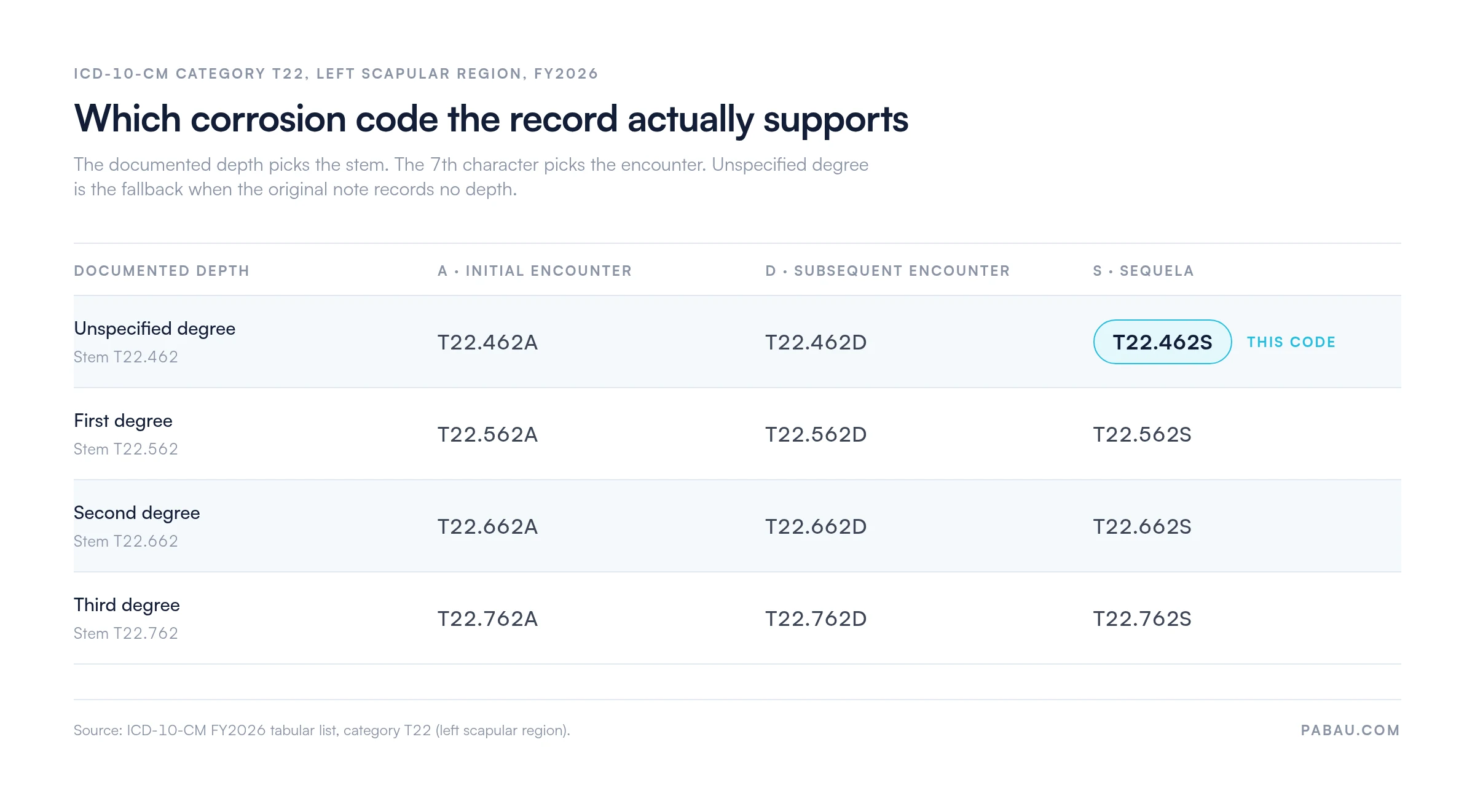
Within the corrosion range, the depth in the record picks the stem and the 7th character picks the encounter. Each stem carries the same three 7th characters, so the grid below has one cell for every combination at this site.
The parent path shows what each character narrows. Reading it upward is how you find a more specific code when the record supports one. The full path runs from chapter to code:
The AAPC ICD-10-CM lookup and the CDC/NCHS tabular tool both confirm this hierarchy for FY2026. Check that the parent code is still valid before you select a terminal code, because annual revisions occasionally reorganize subcategories.
ICD-10-CM guidelines pair a corrosion injury with an external cause code that identifies the chemical agent. That applies on a sequela encounter too. Specifically, the external cause code explains the mechanism behind the condition now being treated.
Section I.C.20 of the ICD-10-CM Official Guidelines applies external cause codes to every code in the T20-T65 range where the information is available. As a result, a corrosion sequela claim submitted without one can draw a request for records. Practices that handle these encounters inside their medical billing workflow can build the pairing into the claim template.
Relevant external cause categories for corrosion injuries include:
On a sequela encounter, these codes describe the circumstances of the original injury rather than the current visit. Confirm each category is still current for the fiscal year before you submit, since the external cause chapter changes annually. The ICD-10-CM code index lists the categories in force this year.
Document the causative chemical agent in the clinical note at the initial encounter. For sequela visits, carry that agent documentation forward as supporting context even though the external cause code is applied to the original injury. Notably, payers reviewing sequela claims often request original encounter records to verify the injury mechanism.
The T22.462 subcategory sits within a structured family of codes covering corrosion injuries by site, laterality, and degree. Specifically, the table below lists the closest sibling and adjacent codes for clinical reference.
Corrosion codes are selected by body region first, so a left ankle and foot injury leaves the T22 category entirely. ICD-10 code T25.792S covers corrosion of third degree of multiple sites of the left ankle and foot, sequela. It keeps the left laterality and the 7th character S, but T22.462S covers one site at an unspecified degree.
Other upper limb sites stay inside T22 but take a code of their own. T22.721S covers corrosion of third degree of the right elbow, sequela. By comparison, it moves the site to the elbow, flips the laterality, and records a full thickness depth.
Section I.C.19.a of the ICD-10-CM Official Guidelines governs the 7th characters used on injury codes, T22.462S included. Three rules apply consistently to sequela coding:
The documentation baseline is a clinical note that names the resolved original injury at every follow-up visit. Indeed, a note describing only the current condition, such as “posterior shoulder scarring”, leaves the sequela code unsupported. A single line settles it. For example, write “presenting with post-corrosion hypertrophic scarring following prior chemical injury to left scapular region”.
Several alternate terms map to T22.462S in clinical documentation and EHR systems. Coders encountering these descriptions in provider notes should resolve them to this code when the sequela encounter criteria are met:
Where the original record can be retrieved, the depth it documents upgrades the code. For example, a first-degree corrosion becomes T22.562S, second degree becomes T22.662S, and third degree becomes T22.762S. Unspecified degree stays correct when the original record is unavailable or silent on depth.
Unspecified-degree injury claims tend to come back with a request for records rather than a flat rejection. Reading the CARC reason code on the remittance tells you which record the payer wants.
Claims management software keeps the diagnosis code, the external cause code, and the encounter note on one claim. The coder checks the pairing before it goes out.
Check the original encounter record before you code unspecified degree. Where that note documents depth, use the degree-specific sequela code. Specifically, first degree is T22.562S, second is T22.662S, and third is T22.762S. As a result, specificity reduces audit exposure and supports the reimbursement the record earns.
A practice coding a sequela encounter usually works across three places. The note sits in the clinical record, the codes go onto a billing sheet, and the claim is rekeyed into a payer portal. When the remittance arrives weeks later, nobody can say quickly which encounter it belongs to.
Pabau, practice management software for healthcare practices, holds the encounter note, the assigned codes, and the claim on one patient record. Claims leave through the Claim.MD clearinghouse, and the remittance comes back against the same encounter with its CARC reason code attached.
The coder still decides which 7th character the record supports. What changes is the rework. The original encounter note sits one click from the claim. A payer asking how the scarring relates to the earlier chemical burn gets an answer the same day.

Pabau stores the encounter note, the codes, and the claim on one record, then submits electronically through Claim.MD. Eligibility checks and remittance reconciliation happen in the same place, so denials land against the encounter that caused them.

T22.462S is a narrow code, and that is the point of it. It fits only when the original corrosion of the left scapular region has healed and the patient is back for what it left behind.
The 7th character is a documentation decision before it is a coding one. If the note does not say the injury is resolved, the sequela character is not yet supported. Pull the original encounter record while it is still retrievable, because the depth recorded then is what lets you code a degree-specific sequela later.
Most of this comes down to whether the encounter record and the claim live in the same place. Book a demo to see how Pabau routes injury and sequela claims through Claim.MD and lands the denials against the encounter that produced them.

Need a reference for submitting a clean claim with ICD-10 codes? Submitting a clean claim covers the formatting, code pairing, and payer requirements that reduce first-pass denials.
Confused about how the clearinghouse fits into the billing process? Medical claims clearinghouse guide explains how electronic claim routing works between practices and payers.
Want to understand denial pattern data for injury codes? Denial management in healthcare covers CARC code interpretation and strategies for reducing avoidable claim rejections.
ICD-10 Code T22.462S is the diagnosis code for corrosion of unspecified degree of the left scapular region, sequela. It is used when a patient presents for a condition such as scarring or contracture. Specifically, that condition must result from a prior chemical burn to the site, after the original injury has healed.
Yes. In fact, T22.462S is a billable ICD-10-CM code for fiscal year 2026, which runs October 1, 2025 through September 30, 2026. Billable means the code carries full specificity, so it can be submitted on a claim without a more detailed code.
Sequela (7th character S) applies once the original injury has healed. In short, the patient is presenting for a late effect or residual condition rather than for the injury itself. Subsequent encounter (D) applies while the injury is still in the active healing phase. As a result, the clinical note should clearly identify that the original corrosion is resolved before assigning the sequela character.
The scapular region in ICD-10-CM coding refers to the posterior shoulder area overlying the scapula bone, including the immediately surrounding soft tissue. Notably, it is distinct from the shoulder joint itself (which maps to different subcategories) and from the axilla or upper arm. For T22.462S, “left scapular region” specifies the left-sided posterior shoulder blade area.