CPT code 93503: Swan-Ganz catheter billing and modifiers
CPT code 93503: Official descriptor and procedure overview In the AMA CPT code s...

Last Updated: Oct 23, 2026

CPT code 25600 describes closed treatment of a distal radial fracture, or an epiphyseal separation, performed without manipulation.
Use 25600 only when nobody reduced or repositioned the fragments, because manipulation moves the claim to 25605.
The global period runs 90 days, so routine fracture follow-up inside that window is not separately billable.
Two frequent rejections come from a missing LT or RT modifier, and from billing 29125 for the same-day splint.
Practice management software like Pabau pre-fills the claim from the patient record, checks eligibility, and tracks claim status.
CPT code 25600 covers closed treatment of a distal radial fracture, such as a Colles or Smith type, without manipulation. It also covers epiphyseal separation, and it includes treatment of an ulnar styloid fracture in the same encounter.
The one qualifier that decides the code is manipulation. If the clinician repositioned the fragments, 25605 applies instead. That single word sets the claim, and 25600 brings a 90-day global period with it.
The sections below cover the code family, the modifiers, the diagnosis pairings, and the points where these claims stall.
CPT code 25600 covers closed treatment of a distal radial fracture, including Colles and Smith types, plus epiphyseal separation. Closed treatment of a radial head or neck fracture without manipulation, at the elbow end of the same bone, falls under CPT code 24650.
If the clinician treats a fracture of the ulnar styloid during the same encounter, that work already sits inside this code. Do not report it separately. One condition runs through all of it: no manipulation is performed.
The fracture is immobilized in a splint or a cast, with no attempt to reduce or reposition the fragments.
Did the clinician move the fragments? That answer picks the code, on its own. Manipulation means the provider physically repositioned the fracture to improve alignment.
CPT code 25600 applies when no repositioning happened, and 25605 applies when it did. The clinician documents that decision and the coder reports it. An imaging report cannot stand in for the statement.
Billing 25605 for a fracture the note never describes as manipulated is upcoding, and payers treat it that way. Without a clear description of the technique, expect a downcode, a denial, or a request for records.
The safer position is always the code the documentation supports.
CPT code 25600 opens a family that tracks how much intervention the fracture needed. Closed treatment sits at the front, with 25600 for no manipulation and 25605 for manipulation.
Percutaneous skeletal fixation follows at 25606, where pins or wires stabilize the fracture without opening it. Open treatment with internal fixation covers 25607, 25608 and 25609, and the fragment count decides which of the three applies.
The fragment count behind 25607, 25608 and 25609 comes from the operative note, never from a coder’s reading of the imaging. Watch the middle of the family too.
A case that goes to percutaneous fixation is no longer closed treatment, so 25606 replaces 25600 rather than joining it on the claim.
Laterality comes first, because payers reject extremity codes that arrive without a side. The rest of the list handles bundling, repeats, and visits inside the global period.
Modifier 59 needs the most care of the six. Payers review it closely, and using it without a documented separate site or session invites a compliance review.
Check the current NCCI edits and the AAPC modifier guidance before you unbundle anything against 25600.
Medicare pays 25600 at two different rates, and the setting decides which one applies. Facility rates cover the procedure in a hospital or an ambulatory surgery center. Non-facility rates cover it in a physician office, and they run higher, because the practice absorbs the overhead itself.
For current figures, run code 25600 through the CMS Physician Fee Schedule lookup with your own locality. Geographic adjustment moves the number, so a national average is little help at the claim line. Commercial rates are negotiated separately, and they can land well above or below Medicare.
Before you send a 25600 claim to Medicare, run an eligibility check on the patient. Wrist fractures are often workers’ compensation or auto-liability cases, and that changes who pays first. Billing Medicare when another payer is primary creates a Medicare Secondary Payer (MSP) problem, which is separate from any coding error.
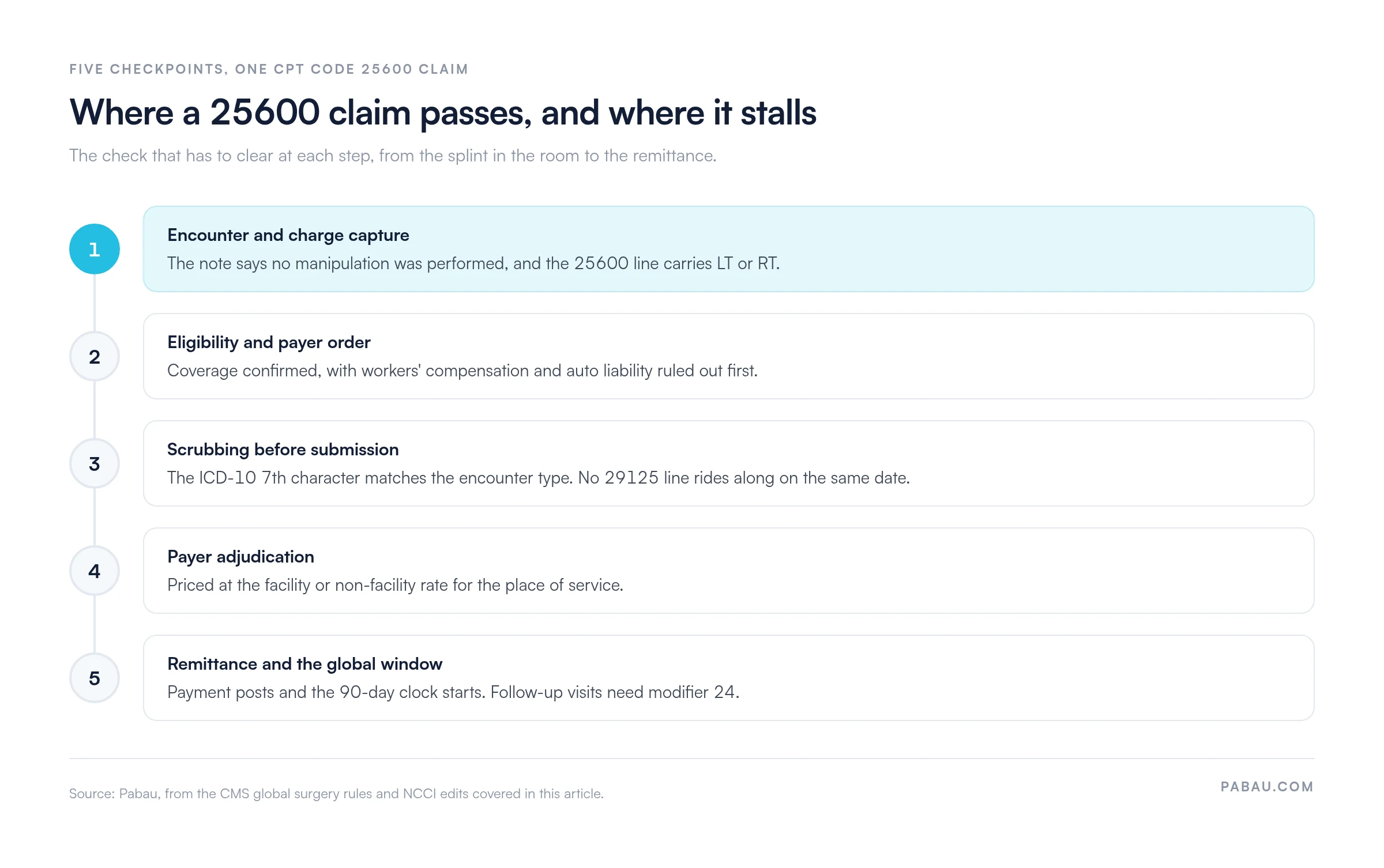
CPT code 25600 carries a 90-day global surgery period. Under CMS rules, the surgical package covers the day of the procedure plus 90 days of related follow-up care. These services are not separately billable inside that window:
Plenty still gets paid inside the window. Complications that need further treatment stay billable, as do unrelated visits with modifier 24 and separate procedures on another site with modifier 59. Misreading that line produces a steady stream of avoidable denials in this code family.
A 25600 claim needs an ICD-10-CM code that matches the note on three points: laterality, displacement, and encounter type.
The 7th character carries the encounter, with A for initial, D for subsequent care, and S for sequela. Pairing the wrong character is a routine rejection, and it is easy to catch before submission.
Pick the most specific code the note supports. Payers reject unspecified codes when the clinical note clearly states the side. Our ICD-10-CM code library lists the S52 options in full, and the CDC lookup tool confirms which 7th character each encounter type takes.
The note has to state that no manipulation was performed. That single line separates a supported 25600 from a downcoded one, and it is the entry most often left out.
The rest of the list below is standard fracture documentation, and payers expect all of it.
Structured note templates can carry that statement as a checkbox, so the clinician confirms it in the room. Fixing it there takes seconds. Fixing it at claims review takes an appeal.
A 25600 claim clears five checkpoints on its way to payment, and each one has its own failure mode. Knowing where claims stall tells you which step to tighten first.
Usually not. CPT 29125 covers application of a static short arm splint, and the first splint applied for the fracture belongs to the fracture care package.
Under NCCI rules, 29125 bundles into CPT code 25600 when the same physician reports both on the same date of service.
Two situations change the answer. A later encounter for recasting or splint replacement is billable, using the casting and strapping codes for that visit.
So is a splint applied for a separate condition by a provider outside the original global period. NCCI edits update quarterly, so confirm the pair before you send it.
Orthotic codes turn on fabrication, not application. HCPCS code L1940 needs a documented cast or scan model of the limb, while a stock device adjusted at delivery is custom fitted.
These six account for the bulk of 25600 denials, and each one is preventable at charge entry rather than at the appeal.
Denial management pays off fastest at the code level. Pull every denied 25600 from the last quarter and sort the reasons. The fix usually sits at charge entry rather than at the appeal desk.
Audit your 25600 denials each quarter and compare the rate against your 25605 claims. A high 25600 denial rate usually points at missing modifier entries. A high 25605 rate usually points at thin manipulation documentation. Structured note templates at the point of care fix both.
Six lines, half a minute, before the claim leaves the practice:
In a split system, the biller rebuilds each claim from the note by hand. The side, the diagnosis, and the procedure code all get retyped, and every retype is another chance to drop a modifier.
Practice management software like Pabau works from the record instead. The CPT code attached to the service lands on the charge line, and the ICD-10 slots seed from the patient’s recorded problem list.
Built-in CPT and ICD-10 lookup libraries sit behind a search icon, so a biller can confirm 25600 against 25605 without leaving the claim. Required fields have to be complete before the send button unlocks.
For US practices, Pabau’s claims software for practices submits through Claim.MD, a clearinghouse that reaches thousands of payers. Eligibility runs in real time before the claim leaves, remittances post back automatically, and claim status stays visible without a call to the payer.
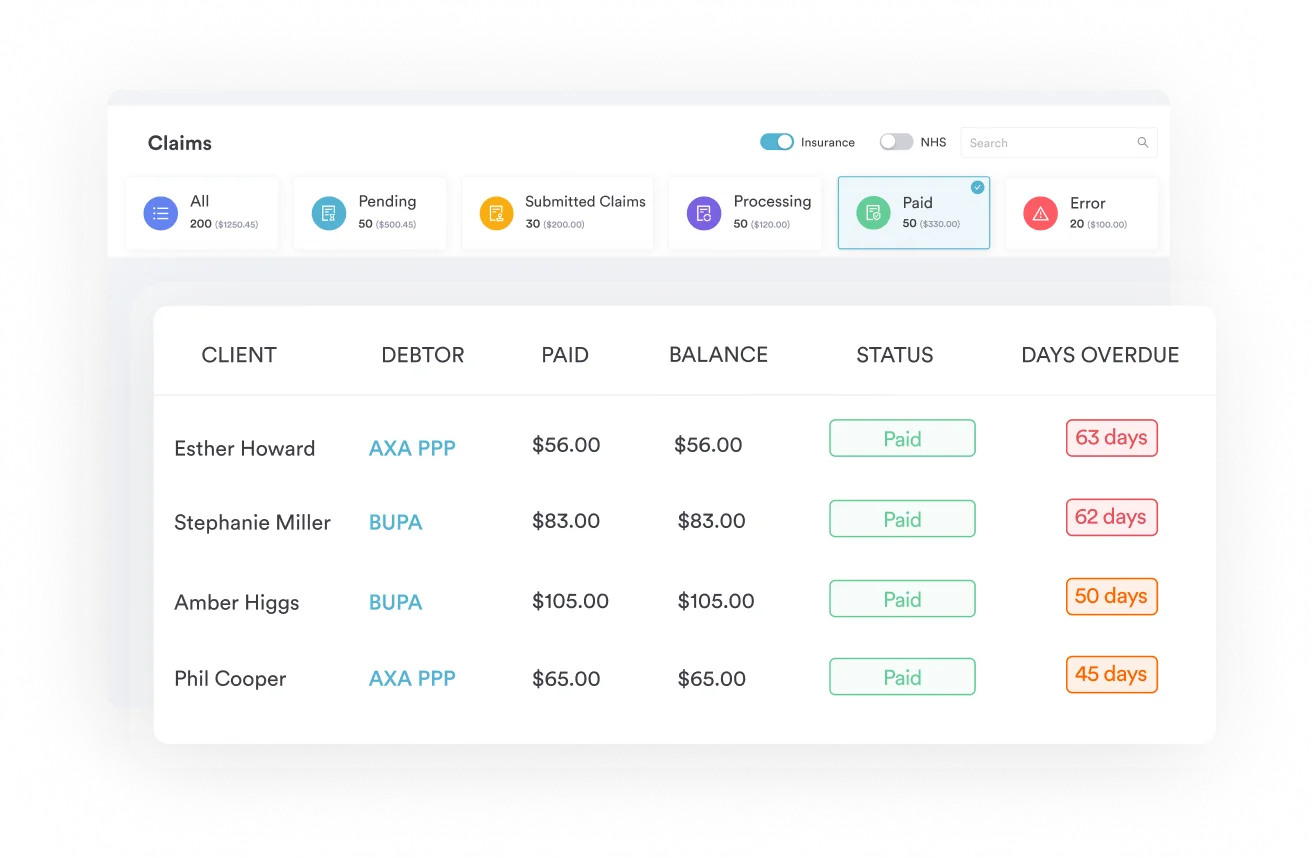

Pabau pre-fills the CMS-1500 from the patient record and keeps CPT and ICD-10 lookups beside the claim. US claims go out through Claim.MD, with real-time eligibility checks before they leave. Fewer retypes, fewer rejected 25600 lines.

CPT code 25600 is an easy code to report and an easy one to lose. The descriptor is short, but the note behind it has to say that nobody manipulated the fracture. The 90-day clock then starts the moment you bill it, and it governs every visit that follows.
So the work belongs upstream, not at the appeal desk. Put the manipulation statement in the note template, put laterality in the charge screen, and run eligibility before the patient is splinted.
Book a demo to see how Pabau moves those checks to the point of care, before a 25600 claim ever reaches a payer.

Want the claim to pay on the first pass? Clean claim best practices covers the submission standards that decide whether a payer pays or pends.
Denials stacking up by code? Denial management in healthcare sets out how to track, appeal, and prevent the patterns behind them.
Need the compliance picture around fracture billing? Medical billing compliance walks through the rules that sit behind audit requests and record reviews.
Case moved on to prosthetic replacement? CPT code 25441 explains how distal radius arthroplasty is coded and documented.
Split the global package. The provider who treats the fracture reports 25600 with modifier 54. The provider who handles the follow-up reports it with modifier 55. Many emergency physicians instead bill an E/M visit plus the splint application, and leave the fracture care code to orthopedics.
Yes, when that visit is where the decision on fracture treatment is made. Because 25600 carries a 90-day global period, the E/M takes modifier 57, not modifier 25. Modifier 25 belongs with minor procedures that have a zero or 10-day global period.
The application of the first cast or splint is part of the fracture care package, but the materials are not. Report those with the HCPCS Q codes for casting and splinting supplies. A replacement cast at a later visit takes its own application code.
Report 25600 on two lines, one with LT and one with RT. Check the payer’s bilateral policy first, because some plans want modifier 50 on a single line instead. Document each side separately in the note.
Report the surgical code with modifier 58, which flags a staged or more extensive procedure by the same physician. A new global period starts with that procedure. Keep the note that explains why closed treatment did not hold.