HCPCS Code G0163: Skilled nursing observation and assessment
What is HCPCS Code G0163? HCPCS Code G0163 is a deleted Level II code for skille...

Last Updated: Oct 15, 2026

CPT Code 11721 covers debridement of 6 or more nails by any method. Use CPT 11720 for 1 to 5 nails.
Medicare covers 11721 for mycotic nails, or when a qualifying systemic condition such as diabetes or peripheral vascular disease is documented.
Modifiers Q7, Q8, or Q9 are required on every Medicare claim to name the class of systemic finding present.
Most MACs cover nail debridement once per 60-day period, so the date of the last treatment belongs in the note.
Practice management software like Pabau helps surface the correct modifier and track documentation requirements, which reduces 11721 denials.
CPT Code 11721 is the billable code for debridement of six or more nails by any method in a single encounter.
Medicare treats nail care as routine foot care and excludes it by default. Coverage depends on documented mycotic nails, or on a qualifying systemic condition reported with the matching Q modifier.
This reference covers the official code description, the 11721 versus 11720 decision rule, and Medicare’s coverage requirements. It also sets out the required modifiers, the applicable ICD-10 codes, current reimbursement rates, documentation standards, and the denial reasons that recur most. The last section covers how claims management software handles the compliance steps that make 11721 billing error-prone.
The American Medical Association (AMA) maintains the CPT code set and defines 11721 as: Debridement of nail(s) by any method(s); 6 or more. The code is reported once per encounter, not once per nail treated.
Debridement in this context includes mechanical reduction of thickened, dystrophic, or mycotic nails. Methods covered under “any method(s)” include filing, grinding, clipping, or chemical softening. The code names no single technique, so 11721 applies regardless of the instrument used, as long as six or more nails are addressed.
Both codes sit within the AMA’s integumentary system section. Neither code requires a specific nail condition as a prerequisite for billing. Payers, and Medicare in particular, impose the medical necessity conditions that decide coverage.
The only factor that separates these two codes is nail count per encounter. Treat five nails or fewer and 11720 applies. Treat six or more and CPT Code 11721 is correct. Billing 11720 for six or more nails is undercoding. Billing 11721 for fewer than six is upcoding.
Document the exact number of nails treated in the clinical note before selecting the code. Payers audit nail debridement claims and will downcode 11721 to 11720 if records show fewer than six nails.
Medicare classifies routine nail care as a non-covered service under the routine foot care exclusion in the Medicare Benefit Policy Manual Chapter 15, section 290. CPT Code 11721 becomes covered under two specific exceptions.
Medicare covers nail debridement when mycotic nails are present and the treating physician documents the clinical findings supporting that diagnosis. Mycotic nails (onychomycosis) cause thickening and dystrophy that make self-care impractical. The documentation must confirm that treatment is medically necessary, not merely cosmetic.
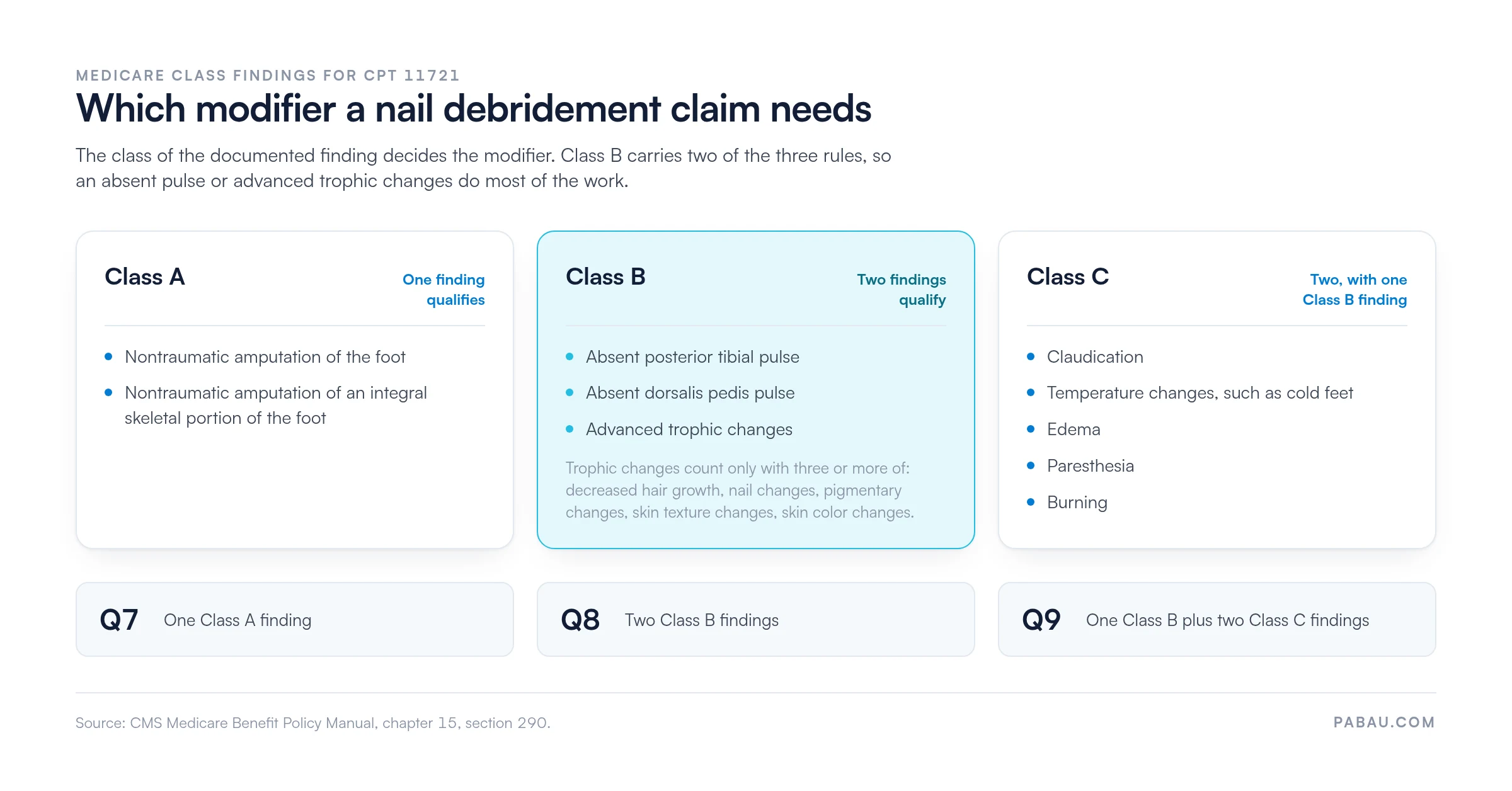
When a patient cannot safely perform self-care because of a systemic condition, Medicare covers nail debridement under a class-finding framework. CMS recognizes three classes of qualifying findings, and the combination documented decides which modifier the claim carries.
The modifier follows from the combination rather than from the diagnosis. Q7 reports one Class A finding, Q8 reports two Class B findings, and Q9 reports one Class B finding with two Class C findings.
MAC Local Coverage Determinations add jurisdiction-specific detail on how each finding must be documented. Verify the applicable LCD for your jurisdiction before submitting claims.
Frequency limits also apply. Most MACs limit coverage to once per 60-day period. Claims that exceed that frequency need additional medical necessity documentation, or they deny automatically.
Modifier selection determines whether a Medicare 11721 claim pays or denies. Three modifiers report the systemic condition exception. A separate set identifies which toes were treated.
One of these three modifiers is required on every Medicare claim for routine foot care nail debridement under the systemic condition exception. A claim submitted without Q7, Q8, or Q9 will deny as routine foot care, unless mycotic nails are documented as the sole basis for coverage.
Modifiers TA and T1 through T9 identify which specific toes were treated. TA designates the left great toe, and T9 designates the right fifth toe. Some MACs require these modifiers and others do not. Check your MAC’s billing instructions before adding T-codes, since unnecessary modifier use can itself trigger an edit.
Always verify modifier requirements with your specific MAC before submitting. Palmetto GBA (Jurisdiction J-J) and Noridian (Jurisdictions J-E and J-F) publish podiatry-specific billing guidance that may differ from general CMS policy. Submitting Q8 when only one Class B finding is documented is a documentation mismatch that triggers post-payment audits.
Every CPT Code 11721 claim requires a linked ICD-10 diagnosis code that supports medical necessity. The diagnosis code must reflect the clinical condition documented in the visit note, not a generic placeholder. Below are the codes most commonly applicable to nail debridement.
Not every ICD-10 code in a MAC’s LCD is covered in every clinical circumstance. The diagnosis code must be supported by clinical documentation at each visit. Using a systemic condition code like E11.40 requires that the note document the neuropathy findings, not just the diagnosis.
Medicare reimbursement for CPT Code 11721 is set annually through the Medicare Physician Fee Schedule (MPFS). Rates vary by geographic location and place of service.
The national average allowable for 11721 typically falls between $35 and $45 in non-facility settings, and facility rates are lower. Verify current-year rates with the CMS Physician Fee Schedule lookup tool for your locality and MAC jurisdiction.
Submitting claims electronically through a clearinghouse accelerates payment. It also surfaces eligibility or modifier errors before a claim reaches the payer. Remittance files then let billing staff reconcile payments against the expected allowable without manual cross-referencing.
Missing documentation is the most preventable cause of 11721 denials. Each visit note must independently establish medical necessity. A prior visit note does not carry forward to justify a current claim.
Practices that use structured digital documentation report fewer documentation-related denials. Fields that prompt for nail count and class findings at the point of care are what make the difference. Pabau’s digital forms let podiatry practices build templates that capture every required element before the patient leaves the room.

Nail debridement is a high-volume service with a predictable denial pattern. Most 11721 denials fall into a small set of recurring categories, and identifying the category is the first step toward an effective appeal. Pabau’s guide to denial codes covers the CARC and RARC codes that carry these messages.
Submitting a clean claim the first time requires that modifier selection, diagnosis codes, and documentation all align before submission. Post-payment audits that catch a documentation mismatch can produce recoupment demands well above the original claim value.
CPT Code 11721 belongs to a family of nail and foot care codes. Knowing the adjacent codes prevents misselection and helps practices code the full scope of a podiatry encounter.
G0127 is a HCPCS Level II code, not a CPT code, and carries different coverage rules from 11720 and 11721. Billing G0127 when debridement rather than simple trimming was performed is one of the most frequently cited errors in podiatry audits. The service rendered drives code selection.
Nail avulsion is a different service from debridement. When the nail plate is removed rather than reduced, report CPT code 11730 for the first nail treated, not 11721.
A custom-fabricated orthosis is documented and billed by the DMEPOS supplier, not the treating practice. HCPCS code L2060 requires a written order on file before delivery, and the delivery date stands as the claim’s date of service.
Podiatry billing for nail debridement is documentation-intensive. A practice with a large Medicare panel and frequent diabetic foot complications will process hundreds of 11721 claims a year. Each one needs the right modifier, a linked ICD-10 code, and visit-specific documentation.
Pabau connects clinical documentation directly to billing workflows. When a clinician records six or more nails treated alongside a linked class finding, the billing module can surface the matching modifier prompt. That happens before the claim is generated.
Claims then route through our Claim.MD integration for 837P electronic submission to thousands of US payers. Real-time eligibility checks and ERA matching close the loop on payment reconciliation.
Superbill generation lets podiatry practices pre-load their most-used code combinations, including 11721 paired with common ICD-10 codes and Q modifiers. Billing staff then spend less time on manual entry and more on claim review.
Practices that standardize their 11721 documentation with structured intake and clinical note templates also answer post-payment audit requests faster. The documentation sits in the patient record rather than scattered across paper files.

Pabau helps podiatry practices capture the right modifiers, link correct ICD-10 codes, and submit clean claims through integrated clearinghouse billing. See how it works for your practice.

The clinical work behind 11721 is simple, and the paperwork that gets it paid is not. The nail count, the class finding, the modifier, and the interval since the last debridement either appear in the note or the claim fails.
Build those four elements into the point-of-care note rather than reconstructing them at billing. Appeals cannot recover a class finding that nobody wrote down, so the note is the only place the claim can be won.
Book a demo to see how Pabau links podiatry documentation to modifier selection and clean claim submission.

Need to understand how denial codes affect your claims revenue? Denial codes in medical billing explains the most common CARC codes and how to respond to each one.
Want a complete guide to clean claim submission? Claim.MD clearinghouse guide covers how electronic claim submission works and how to reduce rejection rates.
Looking for guidance on managing post-payment audits? Medical billing compliance outlines the documentation standards that protect practices during payer reviews.
CPT Code 11721 is used to report debridement of six or more nails by any method in a single encounter. Podiatrists bill it for nail care when mycotic nails or a qualifying systemic condition is documented. Diabetes and peripheral vascular disease are the conditions that qualify most often.
CPT 11720 covers debridement of 1 to 5 nails and CPT 11721 covers 6 or more nails. The nail count documented in the clinical note is the sole determining factor. Both codes carry the same Medicare modifier and documentation standards.
Modifier Q7 reports one Class A finding, Q8 reports two Class B findings, and Q9 reports one Class B plus two Class C findings. One of the three must appear on a Medicare claim billed under the systemic condition exception. Without it the claim denies as routine foot care, unless mycotic nails are the documented coverage basis.
G0127 is a HCPCS Level II code for trimming of dystrophic nails and covers a different service than debridement. CPT 11721 involves mechanical reduction of nail tissue, while G0127 covers simple trimming. Billing G0127 when debridement was performed is a common coding error that triggers audits.
The most common reasons are a missing Q7, Q8, or Q9 modifier and a frequency violation within 60 days of a prior claim. Others are an ICD-10 code that is not on the MAC’s LCD, and documentation showing fewer than 6 nails. Claims also deny when the modifier on the claim is unsupported by the findings in the note.
Medicare reimbursement for CPT 11721 typically ranges from approximately $35 to $45 for non-facility settings, varying by geographic locality. Rates change annually with the Medicare Physician Fee Schedule update. Use the CMS Physician Fee Schedule lookup tool for your MAC jurisdiction to find current-year rates.