



HCPCS code E0198: Water pressure pad billing guide
HCPCS code E0198 is a water pad for a standard mattress HCPCS code E0198 is the ...

Last Updated: Oct 13, 2026

CPT code 22845 describes anterior spinal instrumentation for 2 to 3 vertebral segments and carries the add-on designation, so it never bills alone.
It must be reported alongside an eligible primary spinal fusion code such as 22551, 22558, or 22612 on the same claim.
NCCI edits can bundle 22845 with companion add-on code 22853. Modifier 59 on 22853 may apply when the operative note documents distinct work.
Medicare pays roughly $647.64 for 22845 in 2026, based on a total RVU of 19.39 and a work RVU of 11.64.
Pabau’s claims management software validates insurer details such as membership and authorization numbers before a claim leaves the practice.
CPT code 22845 covers anterior instrumentation applied to 2 to 3 vertebral segments during a spinal fusion. The American Medical Association designates it with a + symbol, which confirms its add-on status.
It sits in the Spinal Instrumentation subsection of the Musculoskeletal System chapter and is reported in addition to the primary arthrodesis code.
Two rules decide whether the line survives a payer’s edits. An eligible primary fusion code has to appear on the same claim, and the operative note has to document between 2 and 3 instrumented segments. When both hold, Medicare pays roughly $647.64 per line in 2026.
The full AMA CPT descriptor reads: Anterior instrumentation; 2 to 3 vertebral segments (list separately in addition to code for primary procedure). Per the AMA’s CPT code set, add-on codes cover additional intraoperative work performed at the same session as a primary procedure.
Add-on codes are always exempt from the multiple-procedure modifier 51. They behave differently from standalone codes across the whole of medical billing, and 22845 is one of the stricter examples.
Documentation has to cover both halves of the claim. The operative note must support the primary procedure and the additional instrumentation work, or a payer has grounds to deny 22845 as unsupported.
Hardware supplied after surgery stays off this line entirely. Cervical immobilization components bill under their own HCPCS codes, such as L0859.
Anterior spinal instrumentation uses hardware placed through an anterior approach to stabilize fused vertebral segments. Plates, screws, staples, and rods hold the alignment while the bone graft consolidates. CPT code 22845 applies when that hardware spans exactly 2 to 3 contiguous segments.
Graft material harvested through the same incision is reported separately under its own add-on code, 20936. The scenarios below are where 22845 itself is most often reported.
The segment count decides which code in the range applies. Surgeons and coders have to agree on that count before submission. Disagreement between the operative report and the coded claim is a common audit trigger.
CPT 22845 requires a primary spinal fusion or arthrodesis code on the same claim. AMA CPT guidelines specify which codes qualify, and reporting 22845 against an ineligible primary produces a technical denial. The codes below are the ones it pairs with most often.
For anterior cervical work, 22551 is the primary code most often paired with 22845. Cervical plating after a two or three level ACDF is the textbook scenario for this add-on.
Anterior fusions spanning more than one interspace carry a second add-on. Each extra interspace is reported with 22585, which pairs only with 22554, 22556 or 22558, not with 22551.
The most contested billing issue around 22845 is its NCCI relationship with 22853, the add-on code for interbody biomechanical devices. Both are add-on codes, and both are common in the same anterior fusion.
When 22853 is also billed, National Correct Coding Initiative edits have historically bundled the two as a single composite service. The pair is treated as one procedure rather than two distinct additions.
The International Society for the Advancement of Spine Surgery and the Congress of Neurological Surgeons have both written to CMS on this point. Their argument is that anterior plating and interbody device insertion represent clinically distinct work.
Where the operative note documents each separately, modifier 59 on 22853 may override the edit. Edit policies change quarterly, so check the current status in the CMS NCCI edit tables before you submit.
Before appending modifier 59 to CPT 22853 alongside 22845, confirm the current NCCI edit indicator in the CMS NCCI table. An edit indicator of 0 means the modifier cannot override the bundle. An indicator of 1 means modifier 59 is permitted. Checking first prevents an avoidable denial and reduces OIG audit exposure.
As an add-on code, 22845 is exempt from modifier 51 for multiple procedures. That is a built-in AMA rule rather than a payer policy. Appending modifier 51 anyway tells the payer’s edit system that whoever coded the claim does not know the add-on rules. That can trigger a manual review.
The 22845 to 22847 series covers the same procedure across three segment bands. Picking the wrong one is among the easiest coding errors to catch on audit, because the operative report states how many segments were instrumented.
Reporting 22846 when only two segments were instrumented is a compliance risk. The AAPC’s CPT code lookup confirms the bands do not overlap. Posterior segmental instrumentation runs on its own bands, ending at 22844 for 13 or more segments.
Medical necessity for anterior spinal instrumentation rests on the documented diagnosis. The ICD-10-CM codes below are the ones most often paired with 22845. Payers may ask for supporting records when these diagnoses appear with instrumentation codes, so preoperative notes have to be thorough.
Diagnosis code selection should reflect the primary indication in the operative report. A code such as M51.16 needs the radiculopathy recorded in the clinical note, not only in the imaging report. Reaching for a non-specific code when a precise one exists invites extra documentation requests.
Medicare pays roughly $647.64 for CPT 22845 in 2026. That figure comes from a total RVU of 19.39 and a work RVU of 11.64, multiplied by the year’s conversion factor. Geographic Practice Cost Index adjustments then move the amount by locality.
High-cost localities such as California, New York, and Alaska usually pay above the national figure. Confirm the current amount in the CMS Physician Fee Schedule lookup tool before you quote it to a payer or a patient.
CMS lists the same total RVU for both settings, so the site of service does not change what 22845 pays.
22845 is a facility-based surgical add-on, so the hospital operating room or ambulatory surgery center is where it is billed in practice. Geographic adjustment moves the rate by roughly 10 to 20 percent either side of the national figure, depending on the MAC locality.
For commercial claims, work from the payer’s own fee schedule rate rather than the Medicare average. The two diverge sharply on surgical add-ons, and an estimate built on the national figure will understate what a commercial payer allows.
Practice management software like Pabau routes 22845 claims with eligibility verified before the claim leaves the practice. Pabau’s Claim.MD integration reaches thousands of US payers, with 837P electronic claim submission and ERA remittance processing.
Denials on spinal instrumentation add-on codes cluster around a predictable set of mistakes, and four pre-submission checks catch almost all of them. For practices building out denial management workflows, these patterns belong in the claim audit.
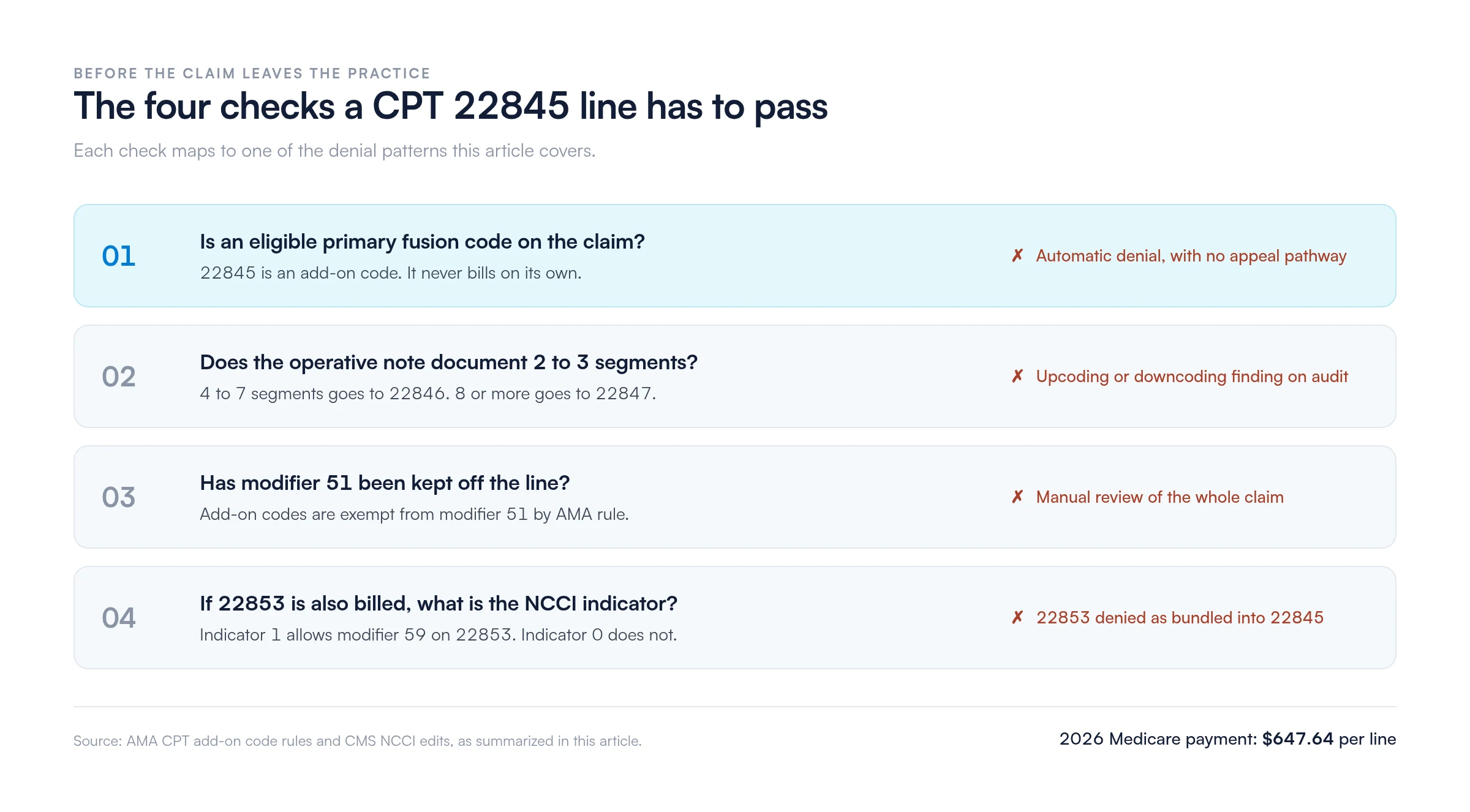
Applied consistently, the add-on rules above prevent most of these denials at the front end. A pre-submission check that flags a missing primary code and confirms the NCCI edit status takes about two minutes per claim.
Build a payer-specific fee schedule crosswalk for your top five payers, showing the allowed amount for CPT 22845 next to its most common primary codes. When a claim comes back with a reduced payment on the add-on, check the crosswalk. It tells you whether the reduction is a pricing disagreement or a coding error. That decides which appeal pathway the claim takes.
Spine practices carry a specific billing load. Surgical claims routinely run four to eight CPT codes per case, and one missing primary code can deny the whole add-on stack. Manual verification at submission is slow, and it fails most often in the busiest weeks.
Pabau’s claims management software validates insurer details before a claim goes out, including membership and authorization numbers. Those are the fields that fail quietly on a high-value surgical claim and send it back weeks later. From there, claims move into a clean claim workflow rather than a rework queue.
The same claim workflow serves the musculoskeletal specialties around a spine service. Sports medicine practices and chiropractic practices stack service units on one claim and hit the same validation problems.
Reporting on payer-specific denial patterns turns a run of 22845 denials into a decision. If one MAC keeps denying 22845 alongside 22853, the billing team can change its modifier strategy rather than appeal case by case.

Pabau validates insurer details before a surgical claim leaves your practice, then reports on the denial patterns behind each payer. Your billing team spends its time on decisions instead of rework.

Anterior instrumentation at 2 to 3 segments is a routine addition to cervical and lumbar fusion. Even so, 22845 produces more avoidable denials than most add-on codes. The causes repeat. Standalone submissions, the wrong segment band, and unresolved NCCI conflicts with 22853 account for most of them.
The fix is procedural rather than clinical. Whoever assembles the claim needs the operative report in front of them, the eligible primary code list to hand, and the current NCCI indicator checked. That costs minutes, against weeks for an appeal on a line worth $647.64.
Practices that treat medical billing compliance as a pre-submission step get that time back straight away. Book a demo to see how Pabau handles spinal instrumentation claims.

Reading a denial on the add-on line? Denial codes in medical billing breaks down the most common remittance codes and the response each one needs.
Tracing an add-on payment back to a remittance? Electronic remittance advice explains how to read an ERA and spot add-on code payment adjustments.
Billing a graft harvested at the same session? CPT code 20922 covers the fascia lata graft rules that sit alongside spinal instrumentation work.
Documenting lumbar radiculopathy for a fusion? ICD-10 code M47.26 sets out what the note has to say before the diagnosis supports surgery.
Collecting the patient balance on a surgical case? Patient payment plans covers how to structure instalments without adding to your admin load.
CPT code 22845 is an add-on code for anterior spinal instrumentation applied across 2 to 3 vertebral segments. It is reported alongside a primary spinal fusion or arthrodesis code. It covers the anterior hardware, such as plates, screws, or rods, that stabilizes the fused levels during the same surgical session.
Yes. CPT 22845 carries the + designation, which means it cannot be reported as a standalone procedure. It is also exempt from modifier 51 under AMA CPT rules. It must always appear on the same claim as an eligible primary spinal fusion code.
Sometimes, depending on the current NCCI edit indicator. NCCI edits have historically bundled these two add-on codes. Where the indicator is 1, modifier 59 on 22853 may override the bundle. The operative note has to document distinct work for the instrumentation and the interbody device. Verify the edit status in the CMS NCCI tables before each submission cycle.
The 2026 national Medicare rate for CPT 22845 is approximately $647.64, based on a total RVU of 19.39 and a work RVU of 11.64. CMS lists the same total RVU for facility and non-facility settings. Rates still vary by MAC locality, so confirm the exact figure in the CMS Physician Fee Schedule lookup tool.
CPT 22845 covers anterior instrumentation for exactly 2 to 3 vertebral segments, and CPT 22846 covers the same procedure for 4 to 7 segments. The segment count in the operative report decides which code is correct. Choosing on implant count rather than instrumented segment count is a common audit finding.
Modifier 59 for a distinct procedural service is appended to CPT 22853, not to 22845. It applies when both add-on codes are billed together and an NCCI edit exists. The modifier signals that the interbody device insertion and the anterior instrumentation are distinct work, supported by the operative documentation.



