Treatment summary
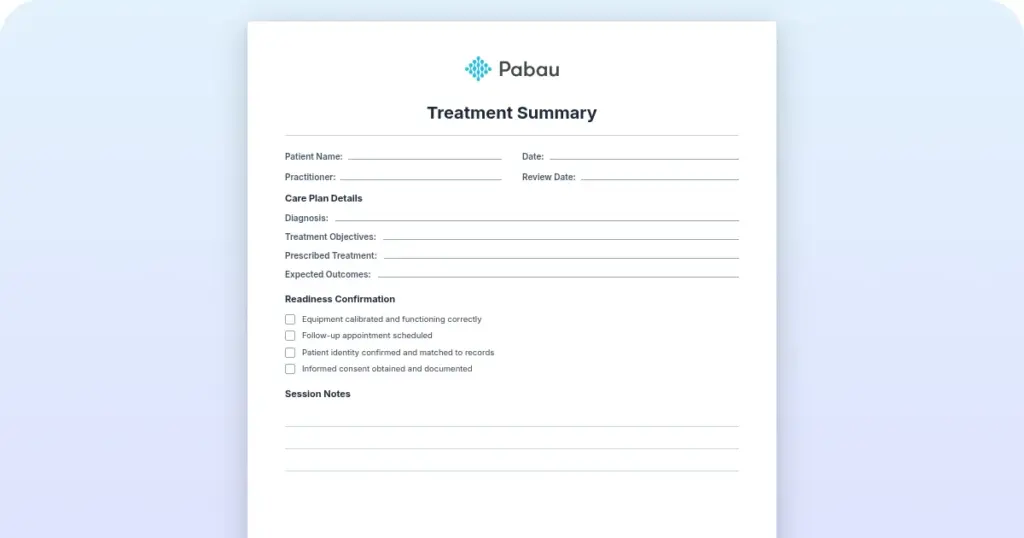
A treatment summary is a written record of what care was delivered during an epi...

Last Updated: Oct 16, 2026
A medication reconciliation form is a structured record of every medicine a patient takes, checked against new orders, with a decision logged for each one. It turns medication reconciliation, the safety check clinicians run at admission, transfer and discharge, into a step any team member can repeat and audit.
Missed or mismatched medicines at care transitions are a well-documented source of harm. That’s why the Joint Commission expects the comparison at every handoff. Below you’ll find a free printable template, a walkthrough of each section, the five discrepancy types to check, and a worked example.
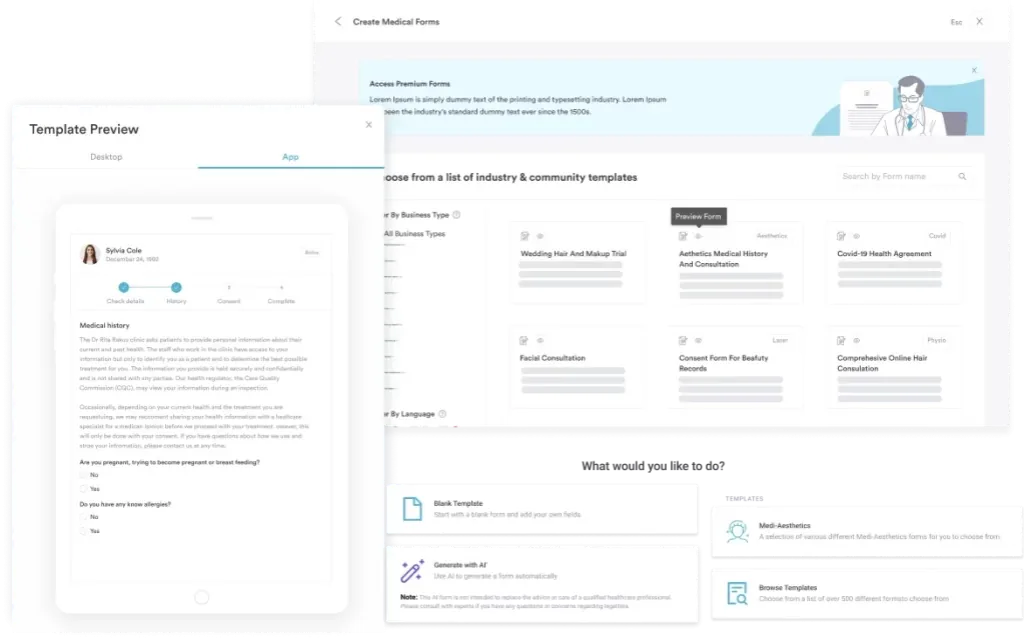
A printable form with patient and community pharmacy details, allergies with reactions, and a checklist of 11 history sources. Six history entries carry discrepancy, resolution plan and start, continue or stop fields, followed by a reconciled list with approval and date.
Download template
A medication reconciliation form compares what a patient takes against new orders at each transition and records a decision for every medicine.
Build the best possible medication history from at least two sources, because patient recall alone misses doses, over-the-counter products and supplements.
The Joint Commission names five discrepancy types to resolve: Omissions, duplications, contraindications, unclear information and changes.
Since January 2026, hospitals follow NPG.14.05.01 and ambulatory programs follow NPSG.03.06.01, with near-identical requirements.
Pabau, the practice management platform we build, sends the medication history form before the visit and files the reconciled list in the patient record.
A medication reconciliation form is a clinical document that lists every medicine a patient takes and checks each against active orders or the care plan. It records the medicine, its dose, route and frequency, who prescribed it, and what the clinician decided to do with it.
The Joint Commission describes reconciliation as comparing the medicines a patient should be taking, and is taking, with newly ordered ones. The form is the written proof of that comparison. Without it, the decision lives in one clinician’s memory.
Two terms come up on almost every version of the form. A best possible medication history, or BPMH, is the verified home list built from more than one source. The reconciled medication list is the final, agreed list the patient leaves with.
The free template follows the order a clinician works in, from who the patient is to what they leave with. Here’s what each section holds and why it’s there.
Start with identifiers and the patient’s community pharmacy. The pharmacy number matters more than it looks, because the pharmacy’s dispensing record is often the fastest way to confirm a dose.
Record the allergy list before any medicine entries. Then tick every source you used for the history. A history built from the patient interview alone reads differently from one confirmed against the pharmacy and the bottles.
Each of the six entries asks for the medicine’s name, dose, route, frequency, indication and prescriber. The last three fields are where reconciliation happens: Discrepancy, Resolution plan, and an action of Start, Continue or Stop.
The form has no separate box for over-the-counter (OTC) products, vitamins or herbal remedies. Give each one its own entry, because products like St. John’s wort can interact with prescribed drugs. If a patient takes more than six medicines, print a second copy of the page.
Use the Resolution plan to say what changes. A dose change reads as Continue, with the new dose and the reason written in the plan.
The reconciled list is the version the patient takes home and the next provider relies on. It repeats the core fields and adds a comments line for instructions, such as “take with food” or “hold until review”. The approving clinician adds their name and the date.
Work through the template in the same order each time, so no section gets skipped under time pressure.
Steps 3 and 5 take the longest. Steps 6 and 7 are what a later reader relies on, because they show the decision and who made it.
The Joint Commission lists five kinds of discrepancy in its elements of performance: Omissions, duplications, contraindications, unclear information and changes. Checking each entry against all five turns the Discrepancy field into a structured check instead of a free-text guess.
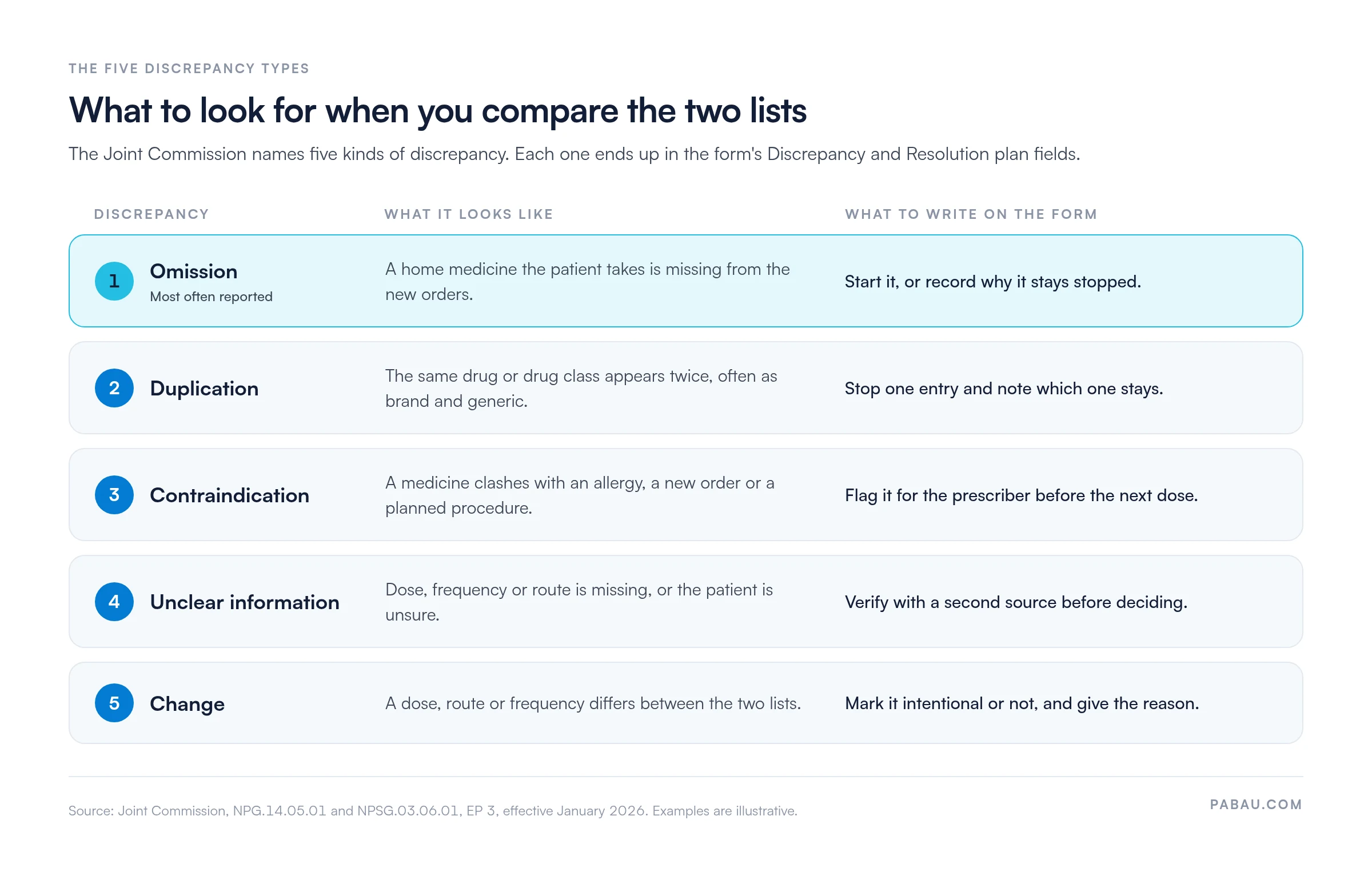
Omissions deserve the most attention. In a pharmacist-led study at a Croatian university hospital, omitted drugs made up 63.9% of unintentional discrepancies at admission. Incorrect doses came second, at 24.2%.
Not every difference is an error. A surgeon may stop an anticoagulant before a procedure on purpose. Write that reason in the Resolution plan, so the next reader can tell a deliberate change from a missed one.
An undocumented intentional change still causes trouble. If the reason isn’t on the form, the next clinician has to treat it as a possible error and chase it down.
The form’s sources checklist has 11 options for a reason. Each source catches some medicines and misses others, so a reliable history combines at least two.
Patient recall alone is rarely enough. The Joint Commission accepts a good-faith effort when a full list can’t be obtained, but that effort still has to be documented. The same sources feed a history and physical form, so collect them once.
Reconciliation belongs wherever care changes hands. Use the form at these points.
On admission, the goal is a best possible medication history built from several sources. Patient recall alone is rarely enough, so cross-check with the pharmacy record where you can. Complete it as early in the stay as possible, ideally before new orders are written.
A transfer resets the comparison. The receiving team compares the transfer orders with the current list, not the original admission list. A structured SBAR nursing handoff carries the reconciled list across, so the next team starts from the agreed version.
At discharge, compare the inpatient orders with the medicines the patient will take at home. Mark each change clearly so the community pharmacy and the patient receive the same instructions. The reconciled list then belongs in the discharge summary sent to the primary care provider.
Outpatient practices reconcile too, especially before a procedure. The Joint Commission lets settings that rarely prescribe decide which medication details they need, based on the services they provide.
Before an injectable or surgical treatment, ask directly about blood thinners, NSAIDs and supplements that raise bruising risk. Patients on GLP-1 drugs such as semaglutide need a check before sedation, because these drugs slow stomach emptying. Follow current anesthesia guidance on whether to hold a dose.
The Joint Commission requires accredited organizations to obtain, compare and communicate accurate medication information at transitions of care. On January 1, 2026, it moved hospitals and critical access hospitals to a new set of National Performance Goals.
For hospitals, reconciliation now sits under NPG.14.05.01, within Goal 14 on effectively managing medications. Ambulatory health care programs still follow NPSG.03.06.01, “Maintain and communicate accurate patient medication information.” The five elements of performance are nearly identical in both.
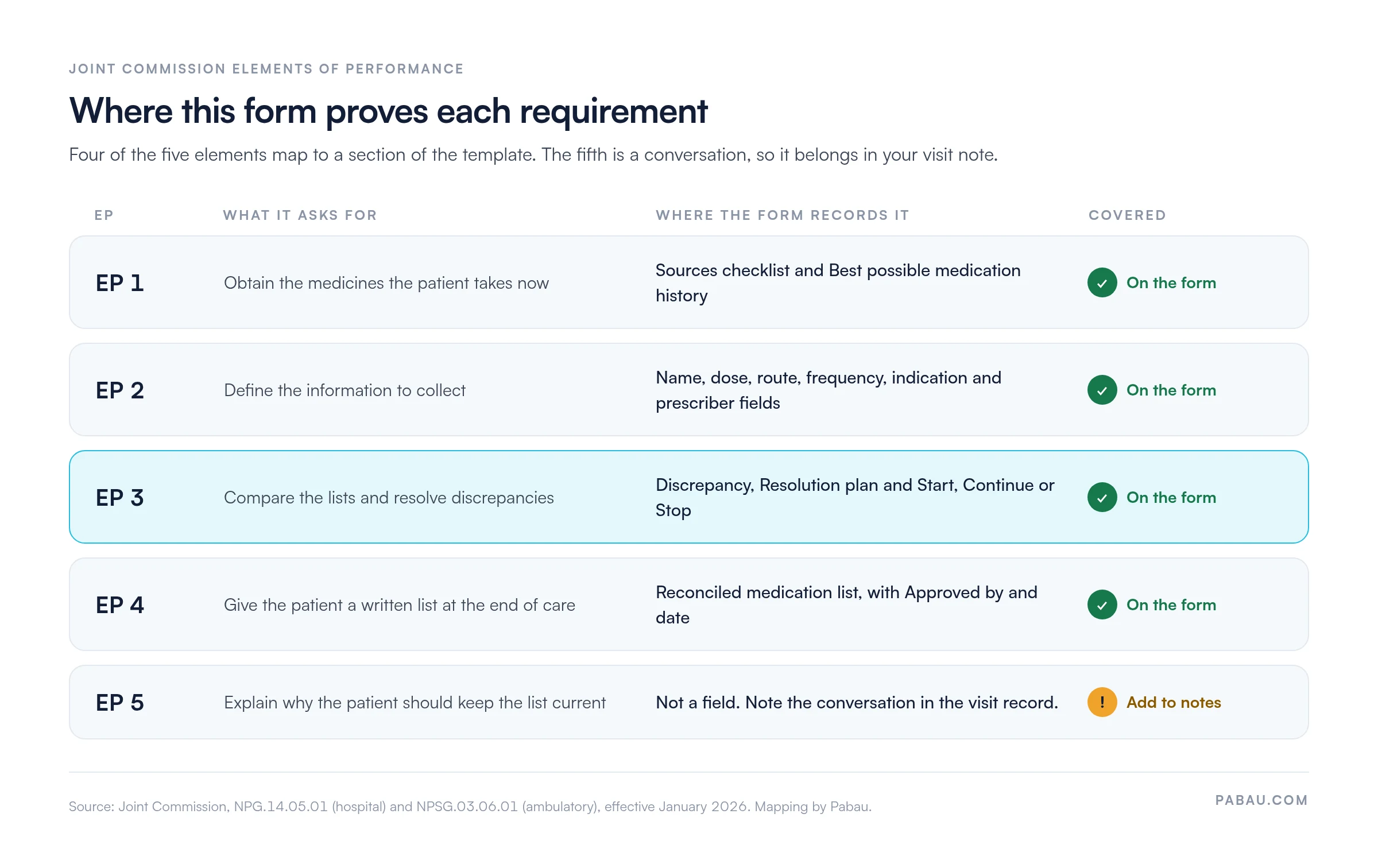
The visual below maps each element of performance to the part of this template that records it.
The Agency for Healthcare Research and Quality publishes the MATCH Toolkit (Medications at Transitions and Clinical Handoffs) for building a reconciliation process. Use it alongside the template when you design local workflows. Check any state, payer or accreditor rules that apply to your setting too.
The process has five stages, and the form records each one. Completing them in order keeps every decision traceable.
The communicate stage also covers the Joint Commission’s fifth element of performance. Tell the patient to carry the list, share it with their primary care provider, and update it when a medicine changes.
A completed set of entries shows how the fields work together. The example below is illustrative and uses a common discharge scenario, not patient data.
Each action comes with a reason. An entry that reads only “Stop” tells the next clinician what happened, but not why.
Most weak records fail on the same few points. Each one is quick to fix once you know to look for it.
Between transitions, a medication log keeps track of doses and changes. The next reconciliation then starts from an up-to-date list.
On paper, reconciliation runs on three copies of the same list. The patient brings one, the clinician writes another, and the pharmacy holds a third. Each handoff is a chance for an entry to drop off.
Pabau’s digital forms send the medication history questions to the patient before the visit. The answers land in the patient record, so the clinician starts the comparison from a written list instead of memory.
Allergies sit in the patient record with the reaction logged against each one. Once the list is approved, you can share it from the record with the patient’s primary care provider. Forms, records and sharing come with every subscription, so no step of the reconciliation waits on an upgrade.
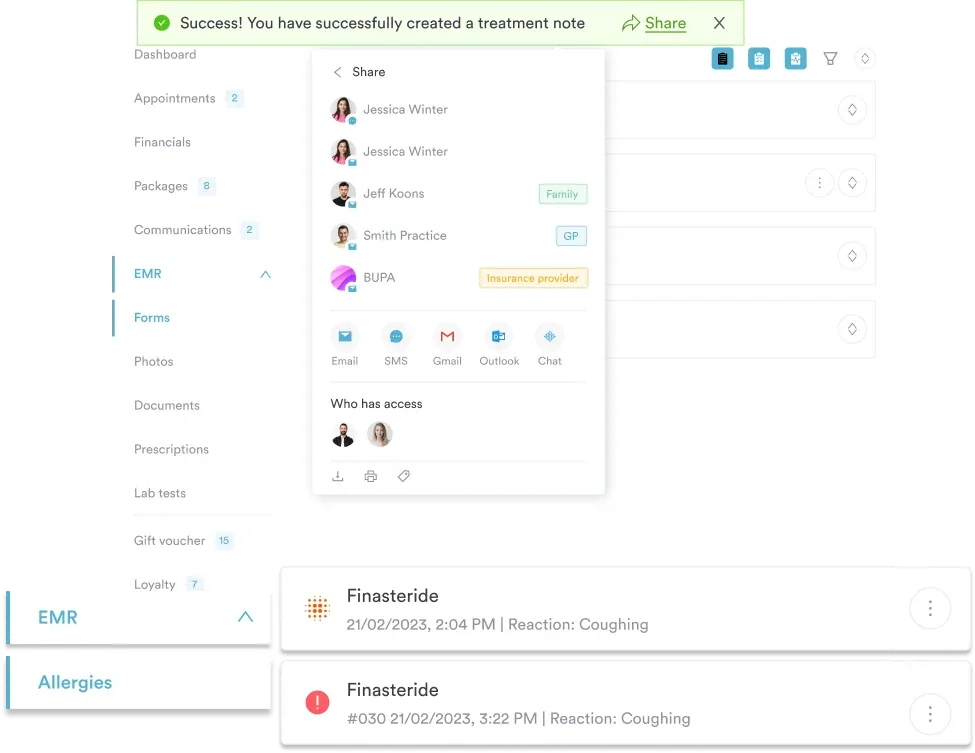

Pabau’s digital forms collect the medication history before the visit and store the reconciled list in the patient record. Your team sees what changed, who approved it and when.

A medication reconciliation form pays off at the handoff, when the next clinician reads it. The template gives you the fields. The value comes from filling the Discrepancy and Resolution plan lines for every entry, every time.
Start with the five discrepancy types and a second source for every history. Those two habits target omissions, the discrepancy studies find most often.
Paper works for a single visit, but it stalls once the list has to travel to a pharmacy or another provider. If your team reconciles often, book a demo to see how Pabau keeps the history, the decisions and the approved list in one patient record.

Handing over at shift change? Nursing handoff report gives you a template, plus SBAR, I-PASS and PACE formats, for carrying medications to the next nurse.
Preparing a patient to go home? Patient discharge form walks through the seven sections a discharge form needs, with a free PDF.
Building the admission workup? Intake assessment and evaluation template covers the history and assessment that sit alongside the admission medication list.
Charting doses after reconciliation? Medication administration record for nursing explains the fields for recording who gave which drug, when and at what dose.
Planning a safe discharge? Discharge planning worksheet helps you organize follow-up before the patient leaves.
Medication reconciliation is the process of comparing a patient’s current medicines with the active orders at each care transition. It produces a clear decision for every medicine: Start, continue or stop.
Include patient identifiers, community pharmacy details, allergies with reactions, and the sources used for the history. For each medicine, record name, dose, route, frequency, indication and prescriber, plus any discrepancy, the resolution plan and the action. Finish with a reconciled list, the approver’s name and the date.
Yes. Accredited hospitals follow National Performance Goal NPG.14.05.01, effective January 1, 2026, and ambulatory programs follow NPSG.03.06.01. Both require organizations to obtain, compare and communicate accurate medication information.
Responsibility depends on the setting and local policy. A prescriber or qualified clinician usually makes the final decisions, while nursing or pharmacy staff often collect the history. The Joint Commission leaves each organization to name the qualified individual who does the comparison.
A best possible medication history is a complete, verified list of the medicines a patient takes before a care transition. It’s built from an interview plus at least one other source, such as the pharmacy record or the medication bottles. It includes prescription, OTC and as-needed medicines.
The Joint Commission lists omissions, duplications, contraindications, unclear information and changes. An omission is a home medicine missing from the new orders, and it’s the type studies report most often. Mark each discrepancy as intentional or unintentional, with a reason.
Reconcile at every transition of care: Admission, transfer between units or providers, and discharge. Outpatient practices should also reconcile after a hospital stay, after a new prescription, and before a procedure. Update the list whenever a medicine is started, stopped or changed.
A medication list records what a patient takes. A medication reconciliation form compares that list with new orders and records a decision and a reason for each medicine. The reconciled list at the end of the form becomes the patient’s updated medication list.
Yes. List over-the-counter drugs, vitamins, herbal products and supplements as their own entries. Some interact with prescription drugs or raise bleeding risk before procedures, and patients often leave them out unless asked.
The free template has six best possible medication history entries and five reconciled list entries. For a patient on more medicines, print an extra page so each medicine keeps its own entry.