Chronic kidney disease nursing care plan
A chronic kidney disease nursing care plan is a structured document that guides ...

4
Last Updated: Oct 14, 2026
A GI bleed nursing care plan is a structured document for a patient with gastrointestinal bleeding. It links your assessment to nursing diagnoses, interventions, expected outcomes and discharge teaching.
Deficient fluid volume is usually the priority diagnosis, followed by ineffective tissue perfusion, acute pain and anxiety.
Gastrointestinal bleeding is a common reason for acute admission. A plan built around fluid status, hemodynamic trends and the likely bleed source keeps the whole team working from the same priorities. Students usually meet the format in a clinical course, and the same structure carries into med-surg and critical-care documentation.
A printable care plan with patient details, a nursing diagnosis checklist and fields for hemoglobin and hematocrit. Separate upper and lower GI bleed sections cover medication history, assessment, interventions, suspected conditions and the physician’s sign-off.
Download template
A GI bleed nursing care plan links assessment findings to NANDA diagnoses, interventions and outcomes.
Deficient fluid volume is usually the priority diagnosis, so track vitals, Hgb and Hct closely.
Document interventions against measurable outcomes so every shift can show progress.
Discharge teaching on warning signs and medication adherence closes the plan.
A GI bleed nursing care plan is a written framework for the nurse’s assessment, diagnoses, actions and measures of success. It keeps the bedside team, the physician and the next shift working from one set of priorities.
A complete assessment starts with the presenting sign. Hematemesis, melena and hematochezia point to different bleed sites, so record the exact character and frequency of each. The rest of the abdominal exam follows the same routine as any gastrointestinal assessment.
An upper GI bleed plan focuses on the upper tract, where hematemesis and melena are common. A lower GI bleed plan focuses on hematochezia and the colon, and the nursing priorities shift accordingly.
NANDA-I nursing diagnoses give the plan its structure. Most GI bleed care plans prioritize fluid volume, tissue perfusion, pain and anxiety. The map below shows how each diagnosis runs from the cue you watch for to the outcome you record.
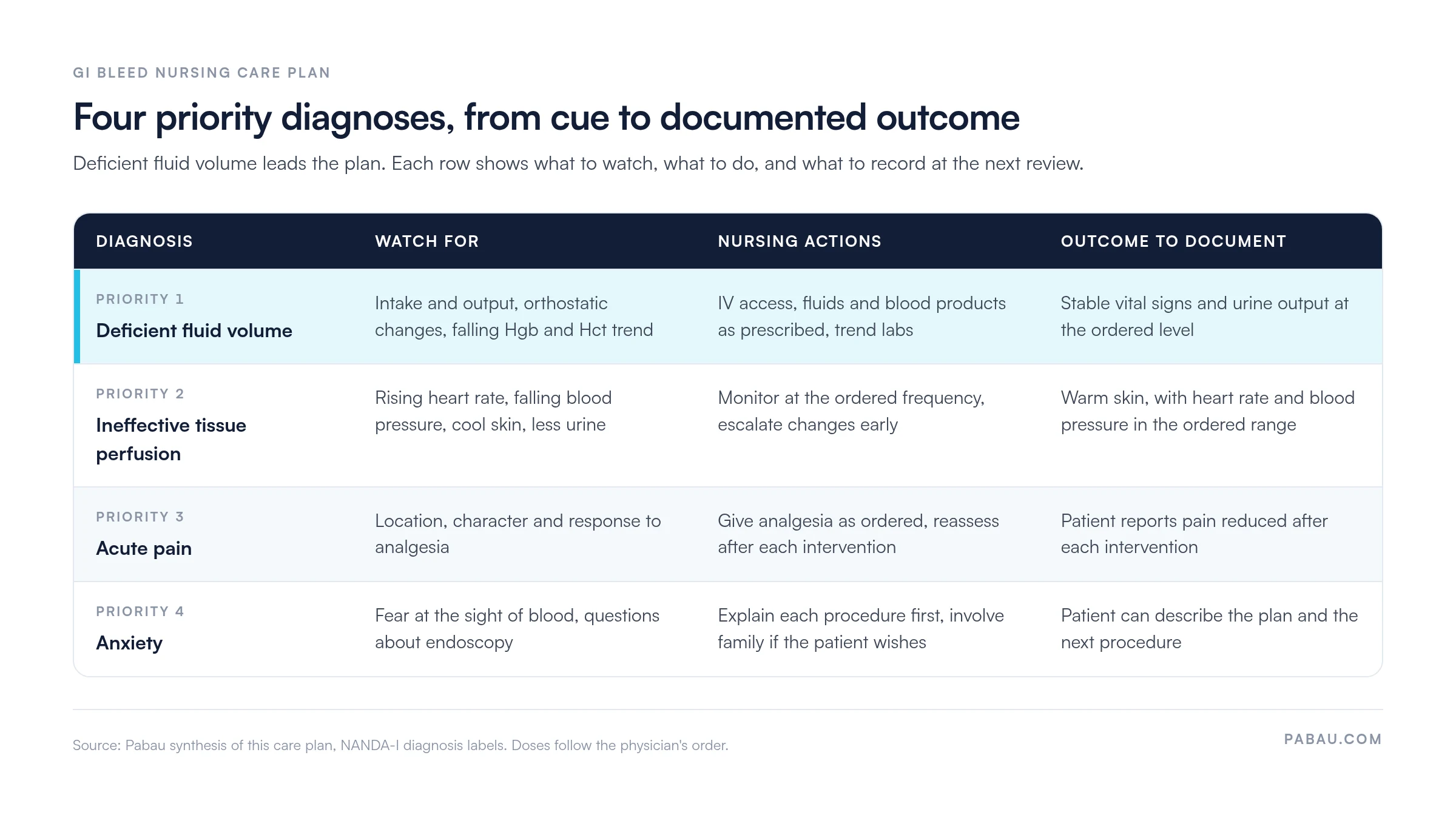
Deficient fluid volume is the most common priority diagnosis in gastrointestinal bleeding. Track intake, output, orthostatic changes and trends in hemoglobin rather than single values. The same monitoring logic sits behind any fluid and electrolyte imbalance plan.
Ineffective tissue perfusion, or risk for shock, is documented when bleeding threatens circulating volume. Watch for rising heart rate, falling blood pressure, cool skin and reduced urine output, and escalate early.
Acute pain is common with peptic ulcer disease and mucosal injury. Assess location, character and response to analgesia, and record changes after each intervention.
Seeing blood in vomit or stool frightens most patients, and an urgent endoscopy adds to it. Explain each procedure before it happens, answer questions plainly, and involve family if the patient wants them there.
GI bleed nursing interventions combine close monitoring with actions the physician has ordered. Nurses carry out and document each step, and they escalate changes in the patient’s condition without waiting for the next round.
A falling hemoglobin trend can also point to ongoing blood loss, which is where an anemia nursing care plan picks up. When a change needs escalating, a structured SBAR handoff gets the physician the trend, not just the latest number.
Medication doses are physician-ordered and vary by institution, so this template does not list them. Check the current prescribing guideline and the order before giving any drug.
Expected outcomes turn each diagnosis into something you can check at the next review. Write them as measurable statements with a timeframe, such as “stable vital signs within the review period” or “urine output maintained at the level ordered.”
If your program asks for standardized outcome labels, the nursing outcomes classification list gives you the wording to match.
Discharge teaching belongs in the care plan from the first day. Cover medication adherence, dietary guidance, the warning signs that need urgent review, and the date of any follow-up endoscopy.
To structure that teaching session and record what the patient understood, pair this plan with a nursing teaching plan.
Use the template as a working draft, then adapt it to the patient in front of you. The steps below follow the order of the form itself.
Students usually write a full academic plan with a rationale for each intervention. Practicing nurses document a shorter bedside version that follows local policy. Both formats should use the same diagnoses and outcomes.
On paper, a care plan lives on a clipboard, the lab trend sits in another system, and the discharge teaching gets noted somewhere else. When the next shift picks up, someone has to piece the story back together.
Pabau, the practice management platform we build, turns forms like this one into digital templates stored against the patient record. Its patient intake software collects history and consent before the visit, and treatment notes sit in the same file.
Follow-up appointments and reminders run from the same calendar, so the endoscopy date in your discharge plan becomes a booked slot.

Pabau stores digital care plans, intake forms and treatment notes against the patient record, so every shift works from the same plan. Follow-up visits and reminders run from the same calendar.

Start with deficient fluid volume, and judge it by trends rather than a single reading. A stable blood pressure can hide a falling hemoglobin, so the plan only works when every shift records the same values the same way.
Write outcomes you can measure, and treat discharge teaching as part of the plan from day one. The trade-off is a little more documentation up front for a handover nobody has to reconstruct. Book a demo to see how Pabau keeps care plans, notes and follow-up visits in one patient record.

Caring for a patient with liver disease? Cirrhosis nursing care plan covers the diagnoses and monitoring that overlap with variceal bleeding risk.
Managing acute abdominal pain? Pancreatitis nursing care plan sets out pain, fluid and nutrition priorities for another acute GI admission.
Monitoring a patient for bowel complications? Small bowel obstruction nursing care plan walks through assessment, NG tube care and fluid balance.
Preparing a patient for GI surgery? Appendicitis nursing care plan covers pre- and post-operative nursing priorities in the same format.
Watching for hemodynamic decline? Decreased cardiac output nursing care plan helps you document perfusion cues and escalation.
It is a structured document for a patient with gastrointestinal bleeding. It links assessment, NANDA-I nursing diagnoses, interventions, expected outcomes and discharge teaching.
Deficient fluid volume is usually the priority diagnosis, followed by ineffective tissue perfusion and acute pain, depending on the presentation.
Students can use the template to structure coursework, but the final plan must follow the policy of their placement and the instructions of their tutor.