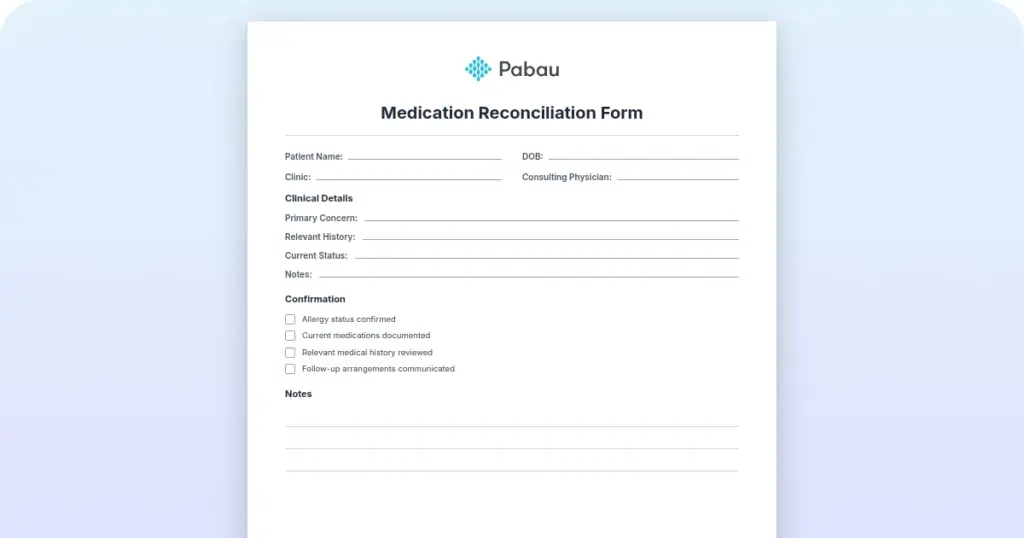
Medication reconciliation form
A medication reconciliation form is a structured record of every medicine a pati...

1
Last Updated: Oct 16, 2026
A treatment summary is a written record of what care was delivered during an episode of treatment, how the patient responded, and what happens next. It goes to the next clinician, to the patient, and into your own record, so all three work from the same account of care.
This treatment summary template gives you a structured, editable format for therapy, physical therapy, aesthetics, dermatology, and medical practices. Practices that rely on memory or loose notes often send incomplete handovers, and a consistent format reduces that risk.
A consistent summary also gives patients a clear record they can take home. In cancer care, the same document plays a more formal role at the end of initial treatment, which is covered below.
A ready-to-use treatment summary form covering patient details, diagnoses, procedures, medications, patient response, follow-up recommendations, and sign-off fields.
Download template
A treatment summary records the care delivered in one episode, the patient’s response, and the next steps for whoever continues care.
Every summary needs patient details, diagnosis, goals, interventions, medications, outcomes, and follow-up actions with a named owner.
Write each section for the reader who acts on it, whether that’s the receiving clinician, the patient, or your own practice later.
In cancer care, a treatment summary is written at the end of initial treatment and often pairs with a follow-up care plan.
Pabau, the practice management system we build, keeps notes, forms, and letters in one patient record, so each summary draws on entries already on file.
A treatment summary is a clinical document that consolidates a treatment episode into one reference point. It usually covers the presenting problem, the care delivered, the patient’s response, and the plan going forward. The National Cancer Institute describes it as a summary of the disease, the treatment received, and any side effects that treatment caused.
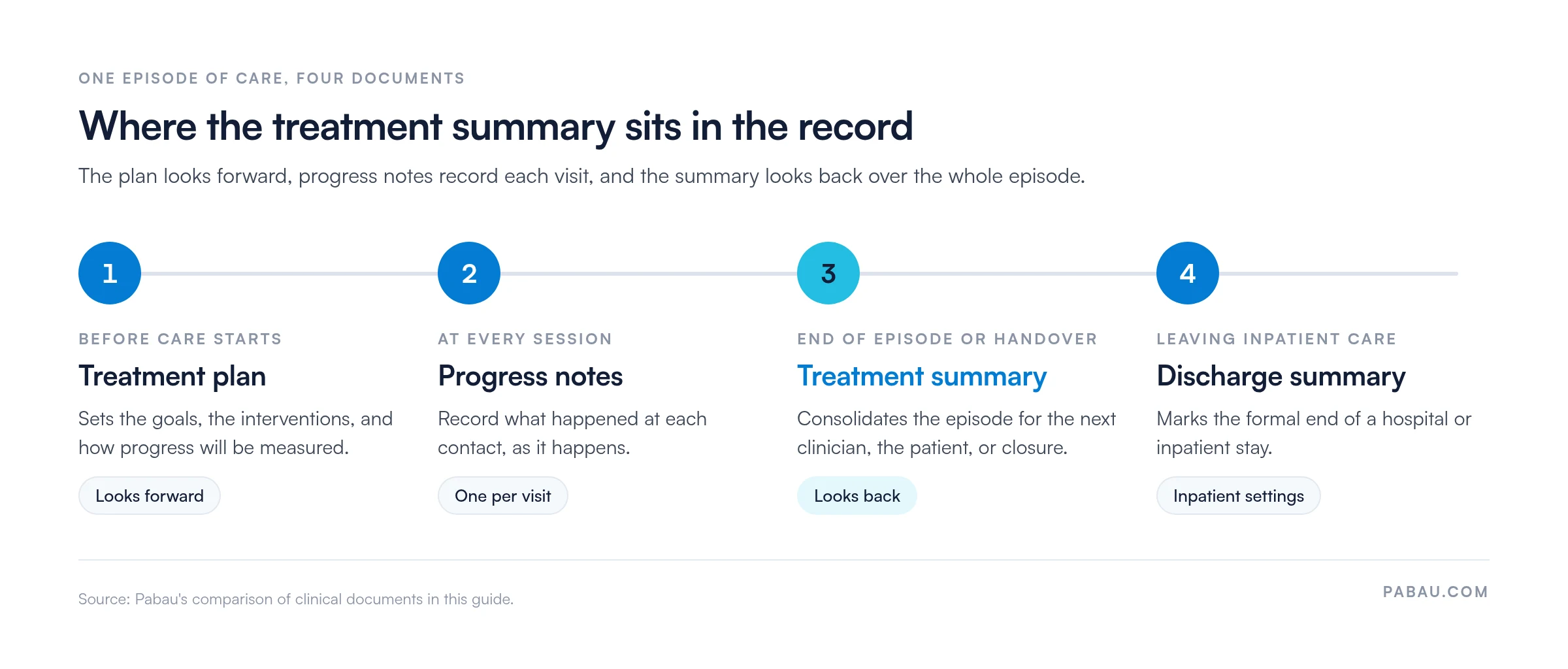
It differs from a treatment plan, which sets out intended care before it starts. It also differs from a discharge summary, which typically marks the formal end of a hospital or inpatient stay. Many practices use a treatment summary at the end of a course of therapy, after a procedure series, or when referring a patient onward.
Scope is the other dividing line. A patient visit summary covers a single appointment, while a treatment summary covers the whole course. A therapist closing 12 weeks of therapy, a physical therapist discharging after a knee rehab program, and an oncologist finishing chemotherapy would all write one.
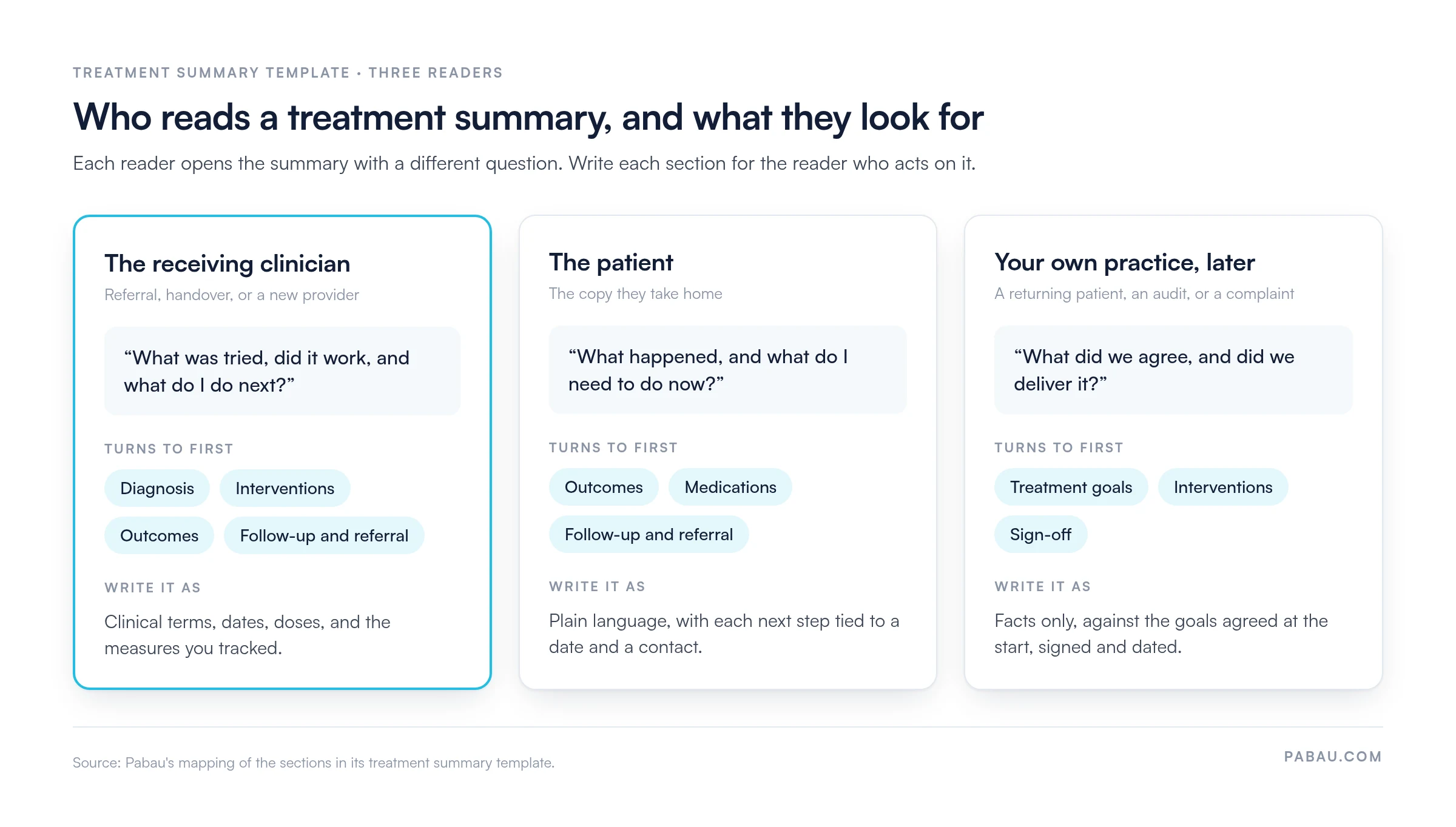
A treatment summary has three readers, and each one opens it with a different question. Trying to serve all three in every line is what makes summaries long and hard to use. Writing each section for the reader who acts on it keeps the document short.
A complete treatment summary covers the same core fields every time, so a reader can find what they need quickly. The table below lists the sections most clinicians expect to see.
Two more fields are worth adding when your setting calls for them. Record any adverse reactions or side effects during the episode, and list the clinicians involved with their contact details. Both matter most when another provider takes over care and needs to ask a follow-up question.
Work through the template in order so each section builds on the one before. Completing it this way takes less time than writing a summary from scratch.
Worked examples make the template easier to picture. Both cases below are anonymized composites, not patient records.
Notice that the stairs goal is reported as partly met. A summary that records a missed goal plainly is more useful to the next clinician than one that rounds it up. It also tells them where to pick up.
Therapists and counselors need the treatment summary to show how sessions connected to the agreed goals. A summary that only lists session dates gives the next clinician little to work with.
Link each goal to the progress notes that tracked it. This keeps the summary consistent with the treatment plan and shows the reader the reasoning behind any change in approach.
Keep psychotherapy notes out of the summary. Under HIPAA, a therapist’s separate session notes have extra protection, and most disclosures need the patient’s specific authorization. The summary should carry the diagnosis, goals, and progress, while the private process notes stay in their own file.
In oncology, a treatment summary is a formal document written when initial cancer treatment ends. In NHS cancer services, a doctor or specialist nurse completes it and shares it with the patient and their GP. It describes the treatment received, possible side effects, and the signs of recurrence to watch for.
In the US, the American Society of Clinical Oncology (ASCO) pairs the treatment summary with a follow-up care plan. Together they form a survivorship care plan, which helps oncologists and primary care providers coordinate care after active treatment.
Outside oncology, these documents are still useful to you. If your practice sees patients after cancer treatment, ask for their treatment summary at intake. It shows which treatments they had and which late effects to keep in mind before you plan care.
A treatment summary usually closes or hands over an outpatient episode, while a discharge summary is typically tied to leaving an inpatient or hospital setting. The two overlap in mental health services, so check which document your service and commissioner expect. The timeline below shows where each document sits in one episode of care.
If the patient is leaving a hospital or inpatient unit, use a discharge summary template instead. It adds admission details, the hospital course, and discharge medications that an outpatient summary rarely needs.
Keep a single source of truth. Pull diagnoses and goals straight from the treatment plan rather than retyping them, so the summary cannot drift from what was agreed.
Most weak summaries fail in the same few ways. Each one costs the next reader time, or sends them back to you with a question.
A strong summary is accurate, brief, and ready to act on. Readers should be able to decide their next step within a minute of opening it.
Privacy rules shape how you store and share summaries. In the United States, the HHS HIPAA Privacy Rule sets out how protected health information may be used and disclosed. UK and EU practices should review the ICO’s UK GDPR guidance on special category health data.
Patients in the US have a right to access their records under HIPAA. A practice generally has 30 days to act on a request, with one 30-day extension allowed. Handing the patient a copy of the summary at the final session often saves a formal request later.
HIPAA does not set how long you keep medical records. Retention periods come from state law in the US. In the UK, check the NHS records management code of practice and your regulator’s guidance. Store each summary under your organization’s retention and access policy.
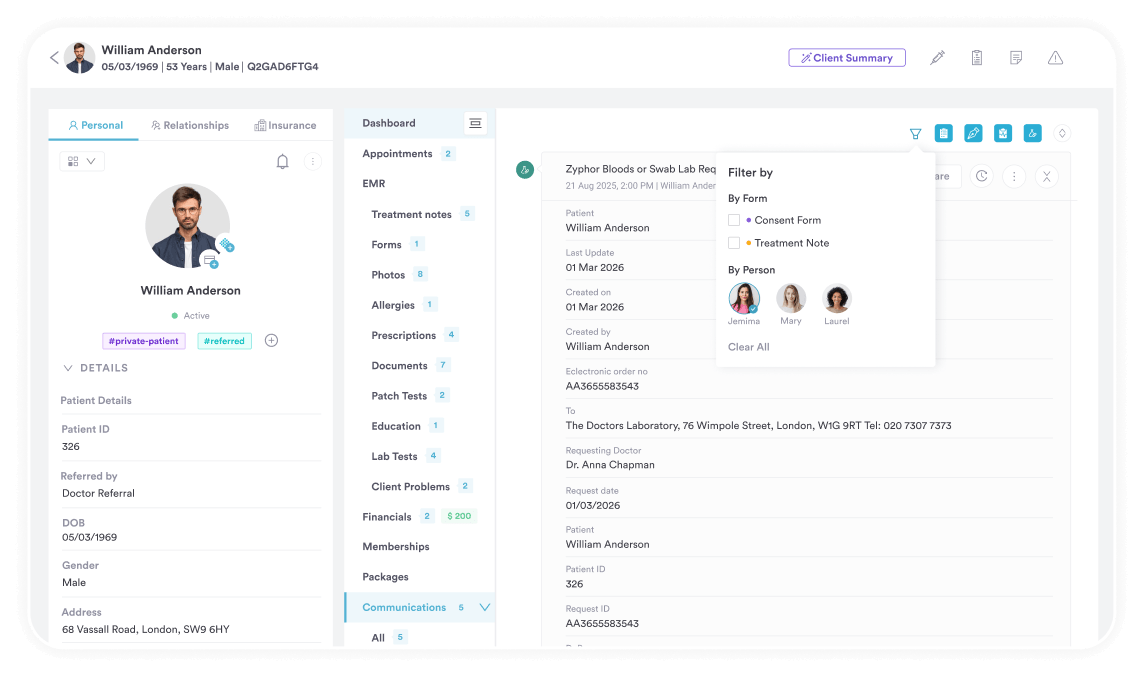
Pabau keeps treatment notes, forms, prescriptions, and lab results in each patient’s Client record. When an episode ends, the facts a summary needs are already on file, dated and signed. You pull them together instead of hunting through emails and paper notes.
Practices that use digital forms collect intake and consent details before the first session. Baseline scores and goals are captured on day one, so the outcomes section has a starting point to compare against.
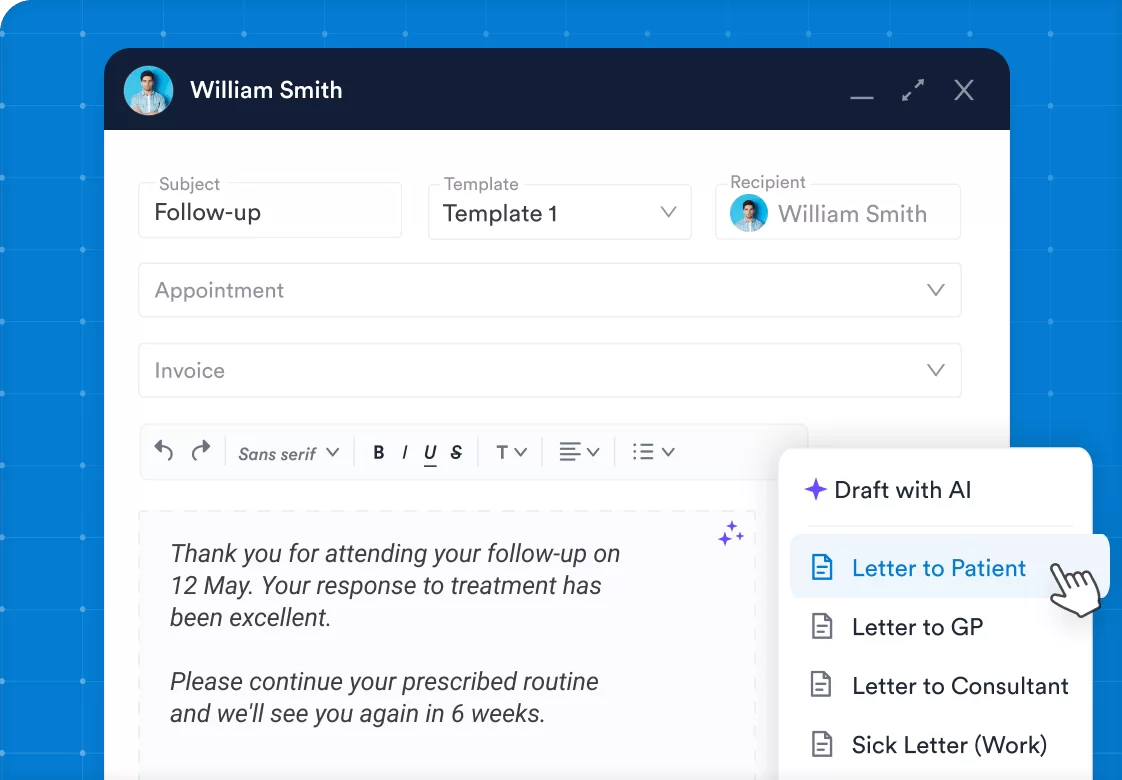
Once the summary is written, Letters and Dictation sends it on. Letters to the patient or their primary care physician (GP) go out from the record. A copy stays on file for the next visit.
Every Pabau subscription includes the full feature set, so notes, forms, and patient letters sit in one system from your first day.

Pabau keeps notes, forms, and patient letters in one patient record. Your team builds each treatment summary from dated entries and sends it to the patient or their primary care physician without retyping.

A treatment summary earns its place when the next reader can act on it in a minute. That depends on three habits more than on the template. Copy goals from the plan, measure outcomes the same way at both ends, and name an owner for every next step.
The trade-off is time at the start of an episode. Recording baselines and goals properly on day one is what makes the closing summary quick to write. Skip that step, and the summary turns into a reconstruction from memory.
Use the template on your next closing episode and note which sections took longest to fill. Those sections show where your record-keeping needs work first. Book a demo to see how Pabau keeps notes, forms, and patient letters in one record, so each summary takes minutes to compile.

Planning the next stage of care? Plan of care explains how to set the goals and interventions a treatment summary later reports against.
Preparing a patient to leave your care? The discharge plan template covers the handover steps that follow a final summary.
Writing up each session? The treatment notes template gives you a consistent per-visit record to summarize later.
Documenting change between visits? Clinical progress notes shows how to record progress in a clinical setting, with examples.
Prefer a structured note format? The SOAP progress notes template organizes each contact into subjective, objective, assessment, and plan.
A treatment summary is a clinical document that records the care delivered during an episode, the patient’s response, and the next steps. It gives the receiving clinician one reference point.
Include patient information, diagnosis, goals, interventions, outcomes, medications, and follow-up. Add referral details if another provider will continue the care.
No. A treatment plan sets out intended care before it starts, while a treatment summary records what was delivered and how the patient responded afterward.
A treatment summary usually closes or hands over an outpatient episode. A discharge summary is typically tied to leaving an inpatient or hospital setting.
Most treatment summaries fit on one or two pages. Keep each section to a few lines, and summarize the trend across sessions rather than copying session notes.
A template supports consistent documentation but does not guarantee compliance on its own. Check your licensing body’s and data protection regulator’s requirements for your setting.
The clinician who led the episode of care writes it, usually at the final session or when handing care over. In cancer care, a doctor or specialist nurse writes it at the end of initial treatment.
Write it when an episode of care ends, when you refer a patient onward, or when care transfers to another provider. Writing it at the last session, while details are fresh, keeps it accurate.
A cancer treatment summary records the diagnosis, the treatments received, and any lasting side effects at the end of initial treatment. Paired with a follow-up care plan, it forms a survivorship care plan.
Yes, in most cases. A plain-language copy helps patients follow their next steps, and patients in the US have a right to access their records under HIPAA.