ICD-10 code S61.201A: Open wound of left index finger without nail damage
ICD-10 code S61.201A covers a left index finger wound of unstated type ICD-10 co...

Last Updated: Oct 16, 2026
Billable Code Specific Code
T31.61 is the billable ICD-10-CM code for burns involving 60-69% of body surface with 10-19% third degree burns.
Let Pabau's smart automation suggest the right codes, reduce claim denials, and keep your practice compliant—effortlessly.
Automate repetitive tasks and focus on what matters most—your patients.
Reduce coding errors and ensure compliance with the latest regulations.
Clean claims, fewer denials, and faster reimbursements.
Powerful insights and reporting to help your practice thrive.
HIPAA compliant SOC 2 certified GDPR-compliant Trusted by 4,000+ clinics worldwide

T31.61 is a billable ICD-10-CM code for burns covering 60-69% of total body surface area, with 10-19% third degree burns.
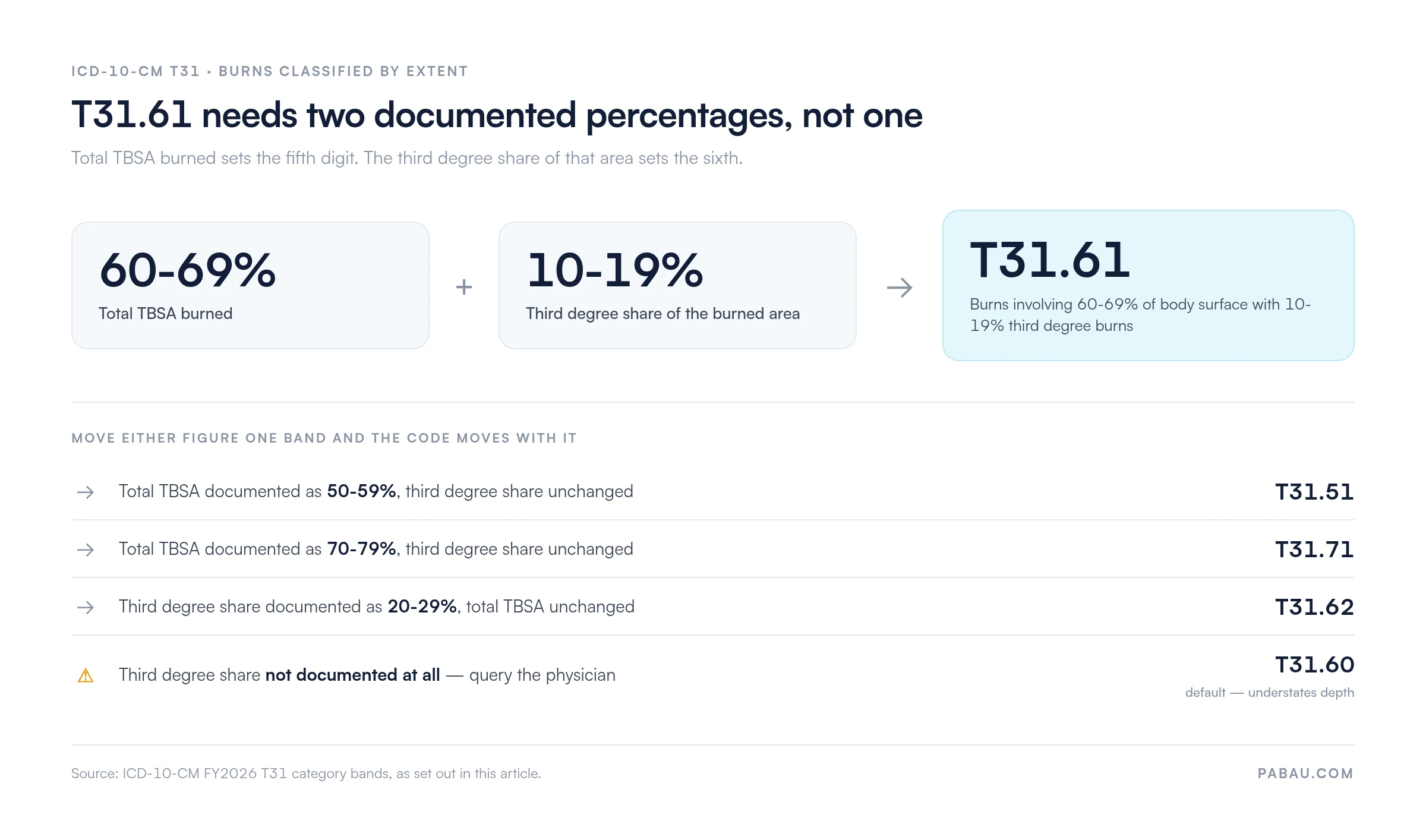
The sixth digit (1) states that 10-19% of the burned area involves full-thickness, third degree destruction.
The record needs both percentages written separately, with the TBSA figure derived by a recognized method such as the Rule of Nines.
When the third degree percentage is missing, query the physician rather than defaulting to T31.60.
Practice management software like Pabau submits professional CMS-1500 claims and tracks every denial in one dashboard.
ICD-10 Code T31.61 is a billable ICD-10-CM code for burns covering 60-69% of total body surface area, with 10-19% third degree. It is valid for HIPAA-covered electronic transactions in fiscal year 2026. The 2026 edition took effect on October 1, 2025, per the CMS ICD-10-CM update tables.
The full official description is: Burns involving 60-69% of body surface with 10-19% third degree burns. Two separate percentages sit inside that one string, and the T31 category will not accept one without the other. This article covers the TBSA calculation, the sixth-digit logic, the documentation each figure needs, and the errors that generate denials.
T31.61 captures a specific subset of major burn injuries. Two separate TBSA measurements must both be present before a coder can assign it.
First measurement: total burned surface. The patient has sustained burns covering 60-69% of total body surface area. At this range the injury is a major burn that typically requires intensive care admission, fluid resuscitation, and specialist transfer.
Second measurement: depth component. Of that 60-69% burned area, 10-19% involves third degree, or full-thickness, destruction. Third degree burns destroy the epidermis and dermis entirely, leaving skin unable to regenerate without surgical grafting.
Coders encounter T31.61 primarily in inpatient hospital and burn unit records. Outpatient assignment is rare at this severity, though follow-up and aftercare encounters are common for months afterward.
T31 codes classify burns solely by extent of body surface involved, expressed as a TBSA percentage. This is distinct from T20-T25 codes, which classify burns by anatomical site and depth. The TBSA-based approach lets severity be reported consistently across patients, whatever body regions were burned.
T31.6 is the parent subcategory (burns involving 60-69% of body surface). Ten child codes hang below it, one for each possible third degree percentage band:
Within the broader T30-T32 block, T31 sits alongside T30 (unspecified body region burns) and T32 (corrosions by extent). Coders should verify code selection against the CDC/NCHS ICD-10-CM web tool for each fiscal year before submission.
The Rule of Nines is the standard method clinicians use to estimate TBSA burned. Each major body region gets a percentage that is a multiple of nine, which keeps bedside estimation fast and consistent.
Coders rely on the physician’s documented TBSA figure rather than calculating it themselves. The documentation still has to reflect a recognized method.
Take bilateral full-leg burns (36%), bilateral arm burns (18%), and the anterior trunk (18%). That totals 72% TBSA before depth is considered, which places the patient in T31.7 rather than T31.6. Documenting the regions burned, the method used, and the resulting percentage is what lets a coder pick the right T31.6x code.
If 30-39% of that body surface is documented as third degree, the code lands on T31.73. The total moves up a band and the depth figure still has to be recorded on its own line.
Pediatric patients require a modified calculation (the Lund and Browder chart) because head-to-leg ratios differ significantly by age. If the medical record reflects a pediatric TBSA assessment, confirm the method is documented before coding.
Document the TBSA calculation method explicitly in the medical record, not just the resulting percentage. Payer auditors can ask for evidence of how the figure was derived, because burn extent drives DRG assignment and reimbursement on T31.6x codes.
The sixth digit in T31.6x tells payers precisely how much of the burned area is full-thickness. Clinicians sometimes record total TBSA but omit a separate depth percentage. That forces the coder toward T31.60, less than 10% third degree, which can understate severity and reduce reimbursement.
For T31.61 specifically, the documented third degree percentage must fall between 10% and 19% of total TBSA. A patient with 65% TBSA burns, of which 15% are third degree, maps precisely to T31.61. If the third degree component were 22%, the correct code would be T31.62 instead.
Where the record puts 60-69% of body surface in the third degree band, ICD-10 code T31.66 is the correct assignment. The total stays in the same 60-69% range, so only the depth figure moves.
Section I.C.19 of the ICD-10-CM Official Guidelines for Coding and Reporting covers injury and burn coding. The guidelines are updated annually by CMS and NCHS, so reference the current fiscal year edition.
Sequencing rules. When multiple burns are present, sequence the code for the highest-degree burn first. For an inpatient stay driven by the burn, T31.61 or the applicable site-based code is sequenced first, depending on the clinical circumstances.
Combination codes and multiple burns. T31.61 captures the overall extent. Separate anatomical burn codes (T20-T25) may also be assigned to specify the body sites involved, and the two are not mutually exclusive.
Acute vs. sequela coding. During the active treatment phase, use T31.61 as the primary injury code. Once active treatment ends, the patient may be seen for a late effect such as a contracture or scar.
Code that late effect with the seventh character S on the site-specific burn code, paired with a sequela condition code. T31 codes themselves carry no seventh character extension in standard usage.
External cause codes. The ICD-10-CM guidelines recommend assigning an external cause code to record how the burn happened. Fire-related burns draw from the X00-X19 range, and sunburn draws X32 for exposure to sunlight. These codes are always secondary to T31.61.
Missing documentation is the leading cause of T31.61 claim denials. The clinical record needs all of the following before the claim goes out.
Burn care claims split across two forms. The acute hospitalization is billed on the institutional claim, while outpatient follow-up, graft review and rehabilitation visits are billed as professional CMS-1500 claims.
Practice management software like Pabau handles the professional side, generating the CMS-1500 claim straight from the invoice. It submits through the Claim.MD clearinghouse, which reaches thousands of US payers, and returns claim statuses and remittance advice to one dashboard.
T31.61 sits within a larger coding ecosystem. The table below covers the codes most frequently paired with or compared to T31.61 in burn care coding. Verify any of them against the AAPC Codify ICD-10-CM lookup before submission.
The T31 code family generates a disproportionate share of inpatient audit findings. Five errors recur across burn center billing teams.
For teams tracking burn-related claim rejections, the reason codes on each remittance show which documentation problems repeat. Reading them against a list of denial codes in medical billing turns a pile of rejections into a short fix list. Effective denial management on T31.6x claims usually targets physician documentation rather than coder error.
Build a T31.6x documentation checklist into your burn unit discharge workflow. Confirm both the total TBSA percentage and the third degree percentage are recorded before the patient leaves the unit. That removes the most common cause of T31.61 denials at the source.
Burn injury treatment rarely ends at discharge. Patients with 60-69% TBSA burns typically require multiple follow-up encounters for wound care, graft monitoring, rehabilitation, and management of late effects. Coding these encounters correctly requires a different framework than acute injury coding.
Aftercare encounters. When a patient returns for routine follow-up after the acute burn episode, use Z48.xx (encounter for surgical aftercare following injury) as the primary code. Add the site-specific burn code from T20-T25 with a seventh character of D for a subsequent encounter.
Sequela encounters. When the patient presents for treatment of a late effect, such as a burn scar contracture, sequence the late effect condition first. Follow it with the site-specific burn code carrying the seventh character S for sequela. That distinction changes how payers process the encounter.
Orthotic supplies. An orthosis supplied during burn rehabilitation is billed to the DME contractor, not on the professional claim alongside the follow-up visit. Fabrication drives the code, so an off-the-shelf device such as HCPCS L1902 sits apart from a custom-molded ankle orthosis.
Most burn billing teams work T31.61 across two systems. The hospital’s system handles the acute stay, and a separate practice system handles the outpatient follow-up that runs for months afterward. Rejections on that second stream often surface weeks later, in a remittance nobody reconciles until month end.
Pabau’s claims management software generates the professional CMS-1500 claim from the invoice you already raised. A real-time 270/271 eligibility check runs before the visit, so coverage problems show up before treatment rather than on a denial. Claim statuses and electronic remittance advice come back into the same dashboard.
Pabau does not choose the code for you, and it should not. The coder still reads the record and assigns T31.61 or its sibling. What changes is the time between submission and knowing where the claim stands. That is when a documentation problem is still cheap to fix, because the record is fresh.

Pabau generates professional CMS-1500 claims from your invoices, checks eligibility in real time, and brings claim statuses and remittances back into one dashboard. See how it fits a burn follow-up caseload.

Assigning T31.61 is straightforward once the record carries both figures. Getting the record to carry them is where the work sits, and only the physician can do it.
So the intervention that pays is upstream of coding. A discharge checklist that asks for the total TBSA percentage and the third degree percentage costs a burn unit almost nothing. Chasing the same two numbers by physician query, three weeks after a denial, costs considerably more.
T31.60 will always be available as a default. It will also always be quietly wrong when the depth was never assessed. Book a demo to see how Pabau tracks burn follow-up claims from invoice to remittance.

Need guidance on clean claim requirements for complex injury codes? What makes a clean claim explains the documentation and submission standards that reduce rejections on high-complexity diagnoses.
Tracking burn claim denials by reason code? Denial codes in medical billing covers the most common payer rejection reasons and how to address each one systematically.
Ready to streamline your burn unit’s billing submissions? Electronic remittance advice outlines how ERA processing reduces manual reconciliation on complex inpatient claims.
ICD-10 Code T31.61 is a billable ICD-10-CM diagnosis code for burns covering 60-69% of total body surface area. Within that burned area, 10-19% must be third degree, or full-thickness. Both percentages need separate documentation to support the assignment.
Yes. T31.61 is a fully billable, specific ICD-10-CM code valid for HIPAA-covered electronic transactions in fiscal year 2026. It became effective on October 1, 2025 per the CMS FY2026 code update tables.
The Rule of Nines is the standard method for estimating total body surface area burned. Each major body region is assigned a percentage that is a multiple of nine. An adult arm is 9%, the anterior trunk 18%, and the posterior trunk 18%. Each leg is 18%, the head and neck 9%, and the perineum 1%. Physicians use it to produce the TBSA figure that coders then use to pick the T31 subcategory.
The FY2026 edition of ICD-10-CM code T31.61 became effective on October 1, 2025. Coders should verify code validity annually against the current CMS ICD-10-CM release tables before submission.
External cause codes record how the burn happened and are always secondary to T31.61. Fire, flame and hot substance exposures draw from the X00-X19 range. Sunburn takes X32 for exposure to sunlight, not X30, which covers excessive natural heat.