



HCPCS code E0198: Water pressure pad billing guide
HCPCS code E0198 is a water pad for a standard mattress HCPCS code E0198 is the ...

Last Updated: Oct 13, 2026

CPT code 22513 reports percutaneous vertebral augmentation with a mechanical device, at one thoracic vertebral body, unilateral or bilateral cannulation.
Fracture reduction, bone biopsy and all imaging guidance are bundled into 22513, so 72291 and 72292 are never billed with it.
One session carries one primary code. Add-on 22515 reports every additional level, thoracic or lumbar, and never stands alone.
LCD L34976 wants an acute fracture on MRI, a documented pain score, and a failed trial of conservative care.
Practice management software like Pabau adds code lookup libraries and electronic claim submission through a clearinghouse.
CPT code 22513 bills percutaneous vertebral augmentation, or kyphoplasty, at one thoracic vertebral body. One fact decides most of these claims. Cavity creation, fracture reduction, bone biopsy and all imaging guidance already sit inside the code. None of them is separately billable, and billing them anyway produces an unbundling denial.
Billers also have to clear a Medicare coverage policy stricter than most, then choose correctly between 22513, 22514 and the add-on 22515.
What follows is the descriptor line by line, the diagnoses Medicare covers, the modifier rules, current payment values, and a pre-submission checklist.
The American Medical Association’s CPT code set gives 22513 a long descriptor, and it reads as five segments. Each one decides something on the claim, so it works better as a bundling notice than as a label.
Any further level treated in the same session goes on add-on code 22515, never on a second primary line.
The difference between the two procedures is mechanical, and it picks the code family for you. Confusing them is one of the most common errors in spine augmentation billing.
NCCI edits enforce that bundling automatically. A separate biopsy line or an imaging guidance line alongside 22513 trips the edit, and the payer strips or denies it.
UK private billing applies the same logic under its own schedule. CCSD code A7520 covers a thoracic sympathectomy diagnostic block under X-ray control, so a separate image-guidance line is unbundling there too.
Three codes cover vertebral augmentation, and they do not combine freely. The index level takes the primary code for its region. Every level after that is a unit of 22515, whichever region it sits in.
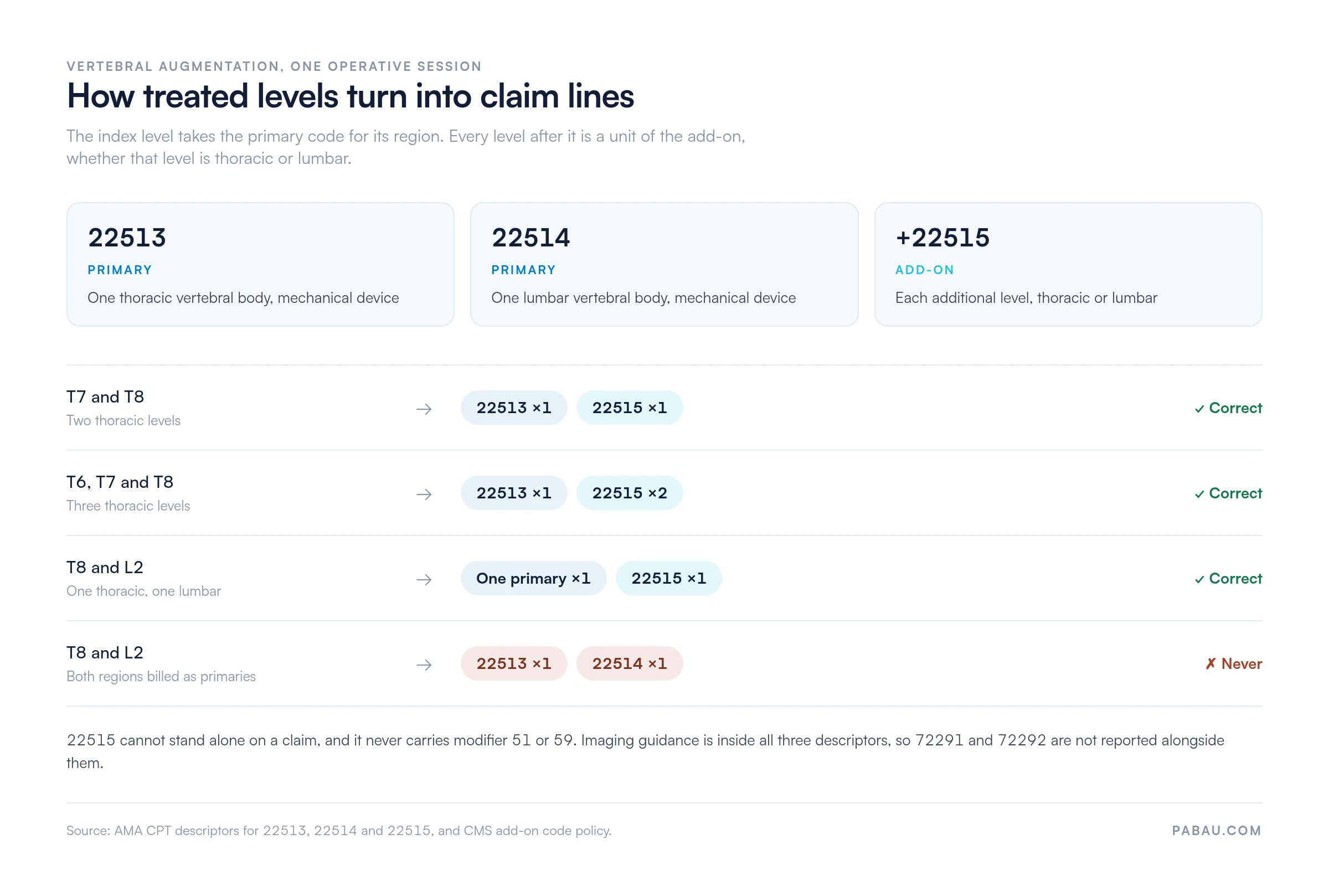
Take a two-level thoracic case at T7 and T8. The claim carries 22513 once and 22515 once. Adding a third level at T6 does not create a second primary. It raises 22515 to two units.
A mixed session works the same way. Treat T8 and L2, and you still report one primary code plus 22515 for the second level. Putting 22513 and 22514 on the same session is the pattern auditors look for.
A device or technique that none of the three descriptors covers reports as 22899, the unlisted spine code. An unlisted code carries no fixed fee, so the payer prices it against the closest specific code. Name that comparison code in the submission.
Confirm 22515 sits on its own claim line with a unit count matching the number of additional levels treated. One unit for two additional levels is an underbilling error, and post-payment review picks it up.
Medical necessity rests on the diagnosis attached to the claim. LCD L34976 and its billing article A57872 name the covered ICD-10-CM codes, and the list is shorter than most coders expect.
The two M84.58X codes only support payment when a qualifying neoplasm diagnosis sits alongside them. The billing article names C41.2, C79.51, C79.52 and C90.00 through C90.02.
The 7th character matters as much as the stem. Only A and S appear on the covered list for these families, so a routine-healing D character will not support the claim.
Check the ICD-10-CM code library when the chart wording does not map cleanly onto one of the six.
Coverage criteria here are clinical, and the chart has to show each one. Contractors review 22513 claims against five points.
Commercial payers write their own rules. Many require prior authorization, and their conservative-care windows run shorter or longer than Medicare’s. Verify the plan’s criteria before the procedure is scheduled, not after the denial arrives.
Modifier handling on this code is mostly subtraction. The descriptor already absorbs laterality and imaging, so the modifiers coders reach for out of habit are the ones that cause trouble.
Three of those rows exist to stop a claim rather than build one. LT, RT and 50 all describe laterality the code already covers, and modifier 59 has nothing to distinguish once imaging guidance is bundled.
Bundling like this is not unique to surgical codes. Fitting is not billed separately on HCPCS code L1950 either, because it forms part of dispensing the custom orthosis. Later repairs carry their own orthotic repair codes.
Payment for 22513 swings by more than an order of magnitude between settings. The reason sits in one RVU component, and it is not the physician’s work.
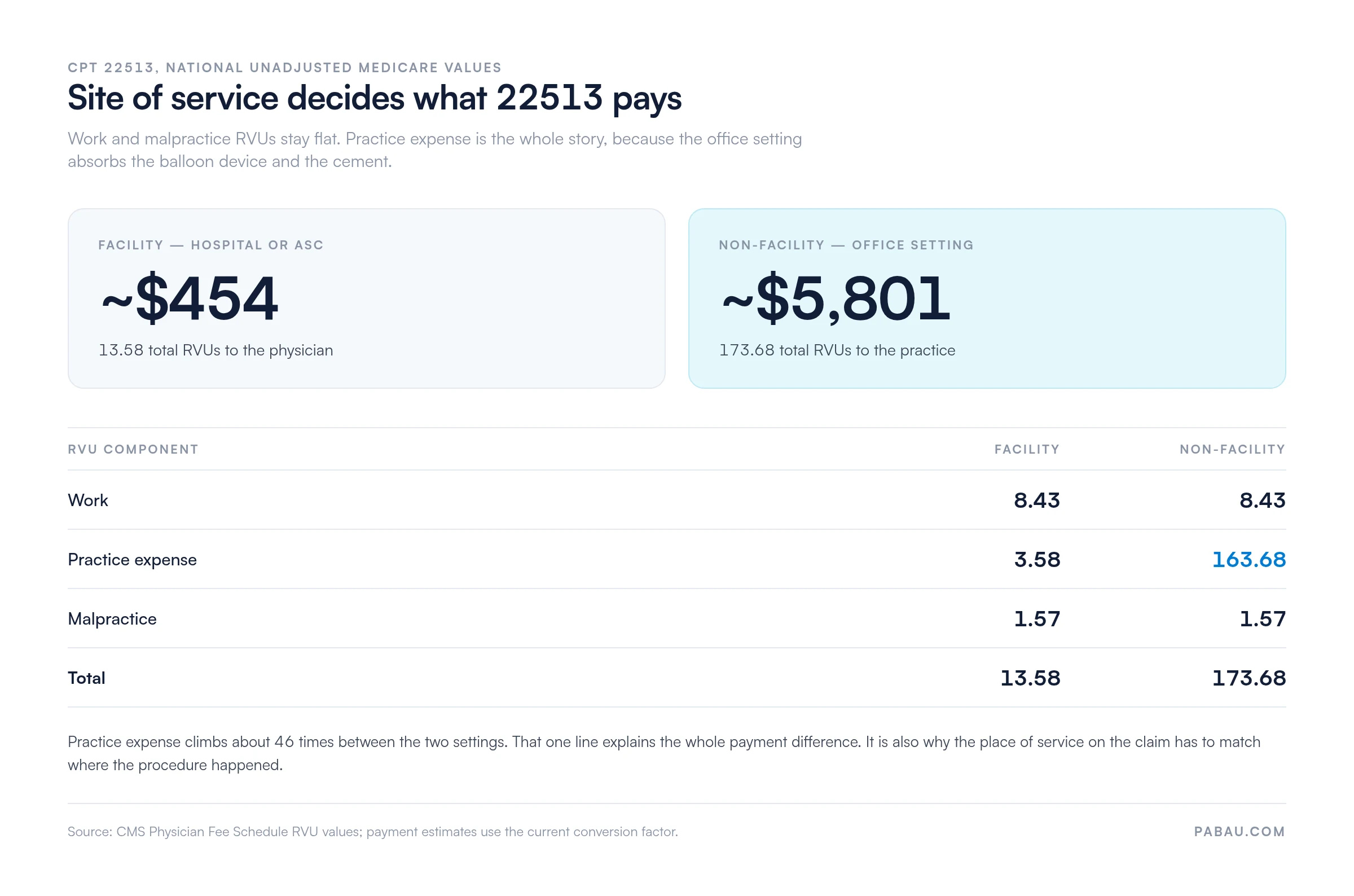
A hospital or ASC supplies the balloon device, the cement and the room, so facility practice expense falls to 3.58. A practice running the case in its own procedure room absorbs those costs, and the non-facility value reflects them.
These are national unadjusted values. Actual payment depends on your MAC jurisdiction and locality. Confirm current figures in the CMS Physician Fee Schedule lookup tool before you build them into a forecast. Rates change annually.
Post-payment denials on vertebral augmentation usually trace back to the chart rather than the claim form. Two records have to hold up under review.
These claims fail in a small number of predictable ways. Working the list below before submission takes far less time than working the denial afterwards.
Clear those seven and most of the denial volume goes with them. A clean claim that leaves the practice right the first time is worth more than a well-run appeal.
Audit 22513 remittances monthly. Pull every record carrying adjustment reason code CO-4 (incorrect code), CO-97 (bundled service) or CO-50 (not medically necessary under the coverage policy). Grouped by code, those three show where coder training pays off first.
Spine billing is a chain, and an error early in it gets expensive late. A wrong level in the operative note becomes a wrong code on the claim. That becomes a denial, then a rework cycle costing a biller 30 to 45 minutes.
Practice management software like Pabau does not replace coder judgment. What it does is hold the clinical record and the claim in one system. Notes, codes and the submission share the same patient record, so nothing gets re-keyed between the chart and the payer.
Pabau ships CPT and ICD-10 code lookup libraries, so a coder finds 22513 or M80.08XA inside the record instead of a separate reference. Claims then go out electronically through the Claim.MD clearinghouse.
Eligibility checks and electronic remittance advice come back into the same dashboard, which is where the CO-50 and CO-97 patterns above become visible.
Our software for billing teams validates the required claim fields before submission, so the blanks that cause front-end rejections get caught in the practice. The outcome is a shorter path from operative note to posted payment.

Pabau holds the operative note, the code libraries and the claim in the same patient record, then submits electronically through Claim.MD. See how the workflow runs for your practice.

Vertebral augmentation billing rewards restraint. The descriptor already contains the cavity creation, the fracture reduction, the biopsy and the imaging guidance. The shortest correct claim is usually the right one.
Treat the descriptor as a checklist rather than a label. Hold the LCD criteria in the chart, keep one primary code per session, and count your 22515 units against the note. Do that consistently and 22513 stops being an audit risk.
Book a demo to see how Pabau keeps spine documentation, code lookup and claim submission in one record. Your 22513 claims then leave the practice complete.

Need to see how an electronic claim actually reaches the payer? Claim.MD clearinghouse guide walks through submission, acknowledgment files and what happens when a claim is rejected at the front end.
Building the charge capture that feeds a 22513 claim? What a superbill contains sets out the fields that have to travel from the encounter to the claim form.
Working a backlog of denied surgical claims? Denial management in healthcare covers triage, appeal timelines and the reporting that stops the same denial repeating.
Reading remittance advice for bundling and necessity denials? Electronic remittance advice explained shows how to read CARC and RARC codes on an 835 file.
Want the compliance frame around spine coding? Medical billing compliance covers audit exposure, documentation retention and the controls a practice needs in place.
No. 22515 is an add-on code, so it is already exempt from the multiple-procedure reduction that modifier 51 signals. Modifier 59 has nothing to separate either, because imaging guidance is bundled into the primary code. Report 22515 on its own line, with the correct unit count and no modifier.
Traditional Medicare does not require prior authorization for 22513. Coverage is applied afterwards against LCD L34976, which is why the chart has to carry the criteria on the day of service. Medicare Advantage plans and commercial payers often do require authorization, so check the plan before scheduling.
22513 carries a 90-day global period, which makes it a major surgical procedure. Routine post-procedure visits inside that window are not separately billable. An unrelated evaluation and management service needs modifier 24, and a return to the operating room needs modifier 78 or 79.
The physician who performs the augmentation bills it, most often a spine surgeon, neurosurgeon or interventional radiologist. A non-physician practitioner can be reported as an assistant with modifier AS where the payer allows it. In a hospital or ASC, the facility bills its technical charge on a separate claim.



