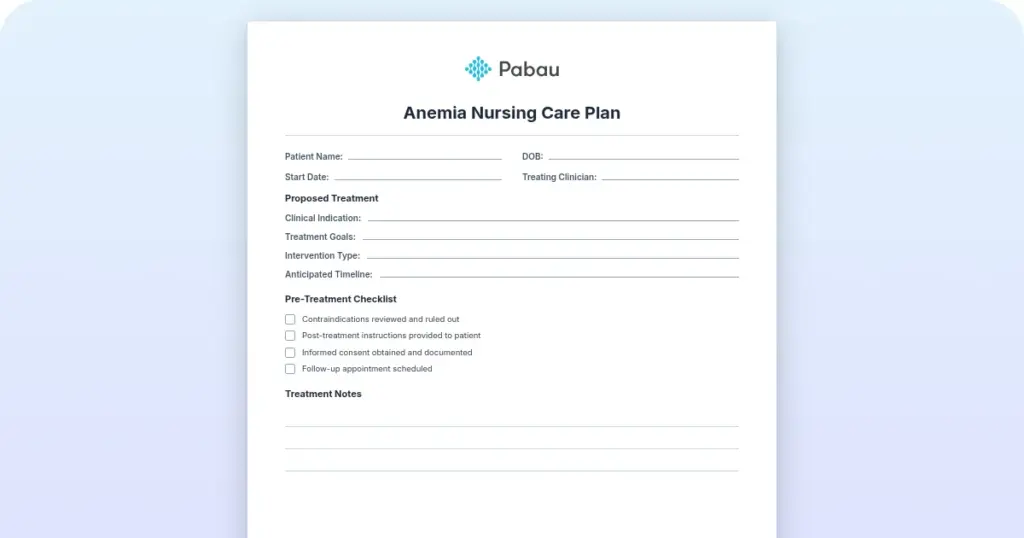
Anemia nursing care plan
An anemia nursing care plan is a structured document that guides a nurse from as...

1
Last Updated: Oct 9, 2026
A nurse note template gives you a fixed structure for recording a patient’s assessment, the interventions you performed, and how the patient responded. The nurse note itself is the clinical and legal record of that care. RNs, LPNs, and nurse practitioners write one to keep care continuous between shifts.
A template keeps notes consistent, quicker to write, and easier to defend. It also helps you meet the documentation standards in your state Nurse Practice Act. That protects both the patient and the nurse who wrote the note.
This guide compares five common nursing note formats and walks through writing a note in seven steps. It also shows a poor and a good note side by side, and the free template below works for SOAP or DAR charting.
A comprehensive clinical documentation template covering patient details, assessment findings, nursing interventions, patient response, and follow-up plan in SOAP or DAR format.
Download template
A nurse note is the clinical and legal record of a patient’s assessment, the care you gave, and how the patient responded.
SOAP (Subjective, Objective, Assessment, Plan) and DAR (Data, Action, Response) are the most widely used formats in US healthcare settings.
Effective nurse notes are specific, timely, factual, and legible, which protects patient care and your malpractice defense.
A defensible note records measured values, the patient’s own words, the intervention, the response, and a timed plan.
Practice software such as Pabau turns this template into a digital form, so nursing teams cut charting time.
A nurse note documents the patient encounter from the nursing perspective. It records what you observed (objective data) and what the patient reported (subjective findings). It also captures your clinical judgment (assessment) and the care you gave (plan or response).
Physician notes focus on diagnosis. Nurse notes emphasize the patient’s day-to-day response, safety monitoring, and continuity between shifts. They also feed the nursing handoff report you give at shift change.
Nursing notes serve three critical functions:
Documentation quality directly affects how patient records are maintained across care settings. Poor notes lead to repeated assessments, missed safety flags, and regulatory findings. Incomplete documentation is a common finding in Joint Commission and CMS surveys.
Five formats dominate clinical practice. Each fits different care settings and documentation workflows.
SOAP is the standard in most acute-care and outpatient settings. Each section builds on the one before, moving from data collection to action. For follow-up visits charted the same way, a SOAP progress notes template keeps every entry in that order.
DAR is event-focused. You record what happened in a single patient encounter, which makes it faster in high-acuity settings where time between notes is short. The DAR notes template walks through the format with more worked examples.
Narrative format allows prose-style charting when your facility doesn’t mandate a structured form. The downside is that narrative notes risk vagueness and inconsistency.
Even in narrative format, organize the note by time, event, observation, and outcome. Avoid opinions (“patient is difficult”) and record specific facts instead. For example: “Patient declined morning care, stating fatigue and pain in left knee rated 7/10 since night shift.”
Follow this sequence to keep each note complete and legally defensible.
See the difference between vague charting and specific, defensible documentation.
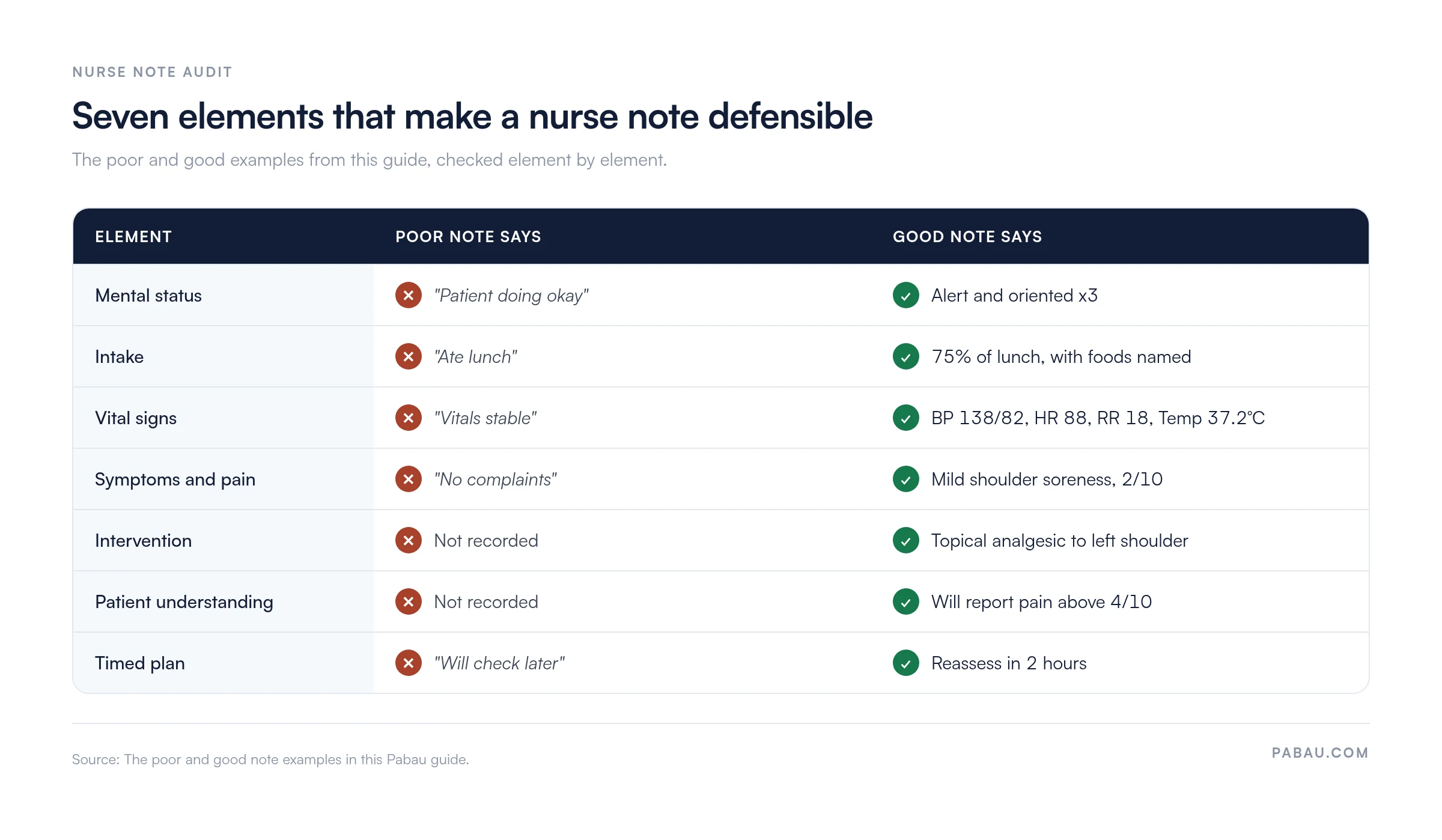
Poor example: “Patient doing okay. Ate lunch. Vitals stable. No complaints. Will check later.”
Why it fails: “Okay” is subjective. There are no vital sign numbers and no interventions. “Check later” is vague and legally indefensible because it sets no concrete plan.
Good example: “Patient alert and oriented x3. Consumed 75% of lunch (chicken, vegetables, water). Vitals: BP 138/82, HR 88, RR 18, Temp 37.2°C. Reports mild shoulder soreness, rates at 2/10. Applied topical analgesic cream to left shoulder. Patient verbalized understanding of pain scale and agreed to report if pain exceeds 4/10. Plan: Continue current pain management, reassess in 2 hours.”
Why it works: It has specific data, measurable responses, and a clear, timed next step. A lawyer or auditor can defend this note.
Set side by side, the two notes differ on seven elements, and the poor note misses every one of them.
A fixed template prevents these errors at the point of charting. The same rules apply to the rest of your nursing documentation, from care plans to incident reports.
Paper charting and manual templates take time you would rather spend with patients. Pabau Scribe, our AI scribe, transcribes your verbal notes into structured clinical documentation in SOAP, DAR, or narrative format. It then stores them in a searchable patient record.
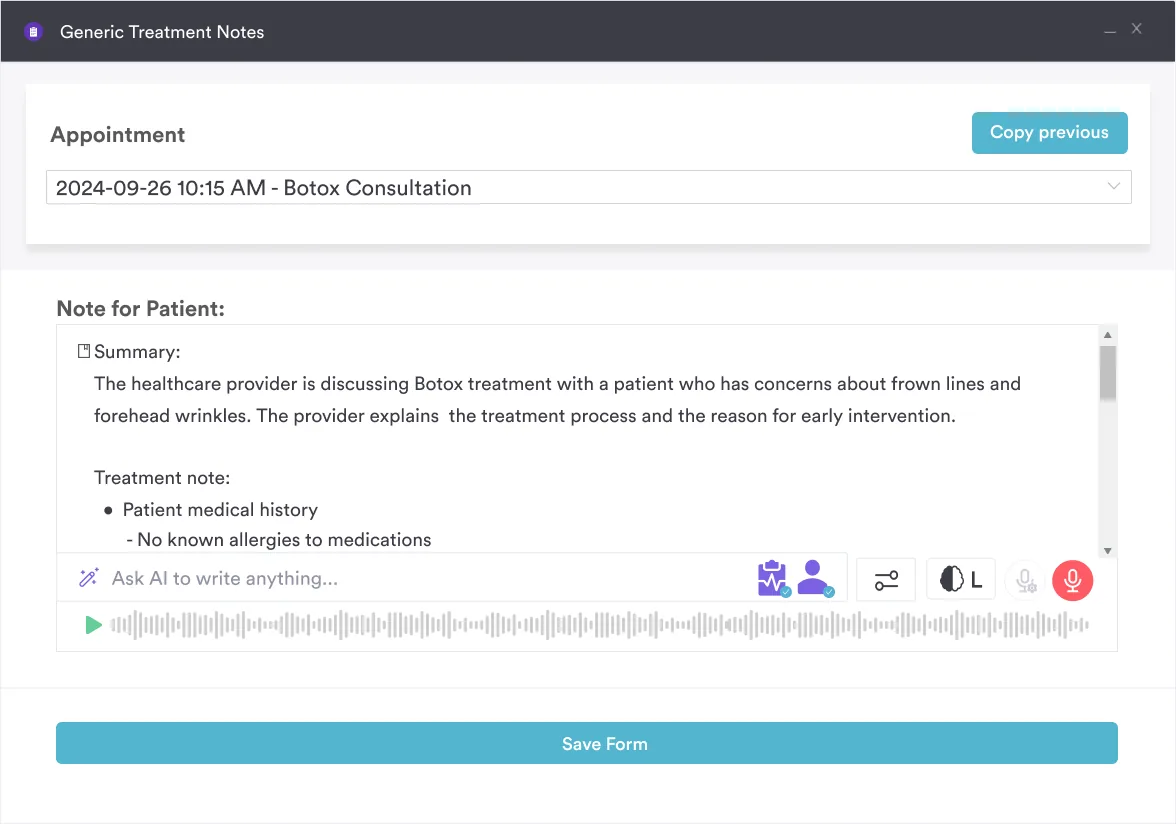
Customizable digital forms guide nurses through required fields, so no section is missed. Autocomplete suggestions, dropdown menus, and prefilled patient data cut charting time.
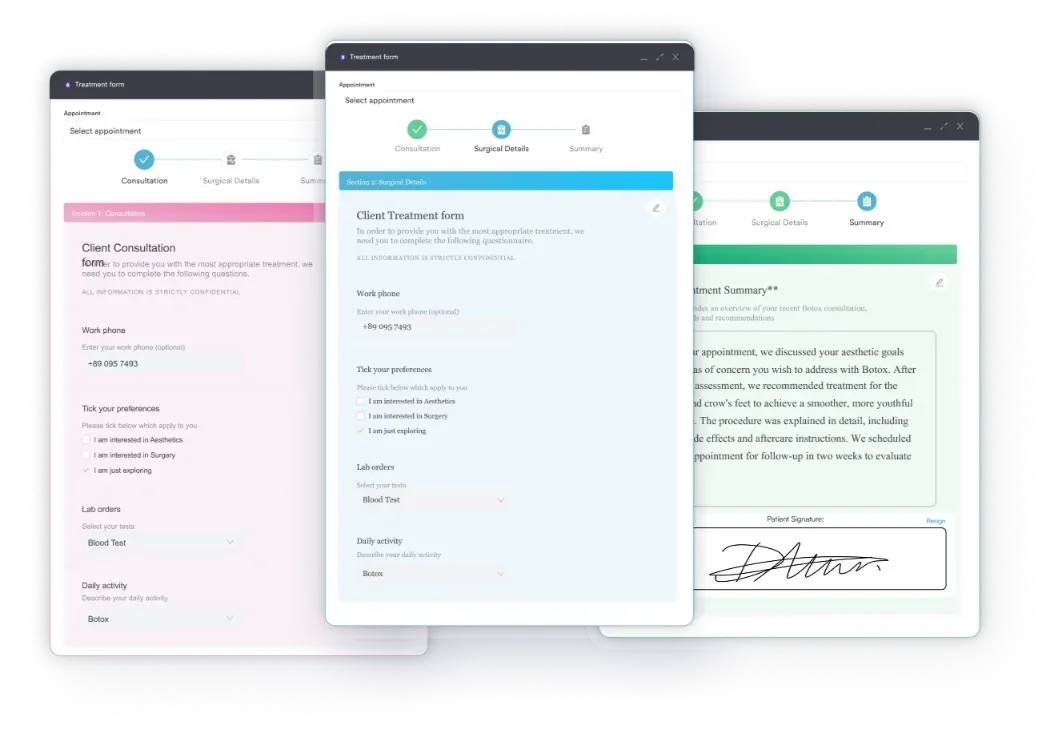
For nursing teams using Pabau: Notes are backed up automatically and tracked in an audit trail. You can review notes from any shift in seconds, compare patient progress over time, and generate compliance reports for regulators or insurers.
Ready to reduce charting burden? Book a demo to see how Pabau’s clinical documentation tools work for your practice.

Pabau turns this template into a digital nurse note that pre-fills patient data, and Pabau Scribe drafts the entry from your dictation. Every note lands in the patient record with an audit trail.

Pick one format and make it your unit’s default. Switching between SOAP, DAR, and narrative from shift to shift makes a chart harder to follow, so consistency matters more than the perfect structure.
Then hold every note to one test. Could another nurse picture exactly what you saw and did? Measured values, the patient’s own words, and a timed plan pass that test. “Stable” and “will check later” never do.
The trade-off is time. A thorough note takes longer to write, but a vague one costs more when a lawyer or surveyor reads it months later. A template, on paper or on screen, settles the structure before the shift starts.
Book a demo to see how Pabau turns this template into a digital nurse note your team can complete and sign on any shift.

Charting on a busy unit? Focus charting (F-DAR) shows how to write nursing notes that hold up when a shift moves fast.
Admitting a new patient? Digital admission nursing note covers the baseline you record on day one, with less paperwork.
Need the essentials at a glance? Nurse charting cheat sheet keeps charting basics on one page.
Writing up a whole shift? Shift note template structures an end-of-shift summary for the next nurse.
Juggling several patients at once? Nursing brain sheet template keeps each patient’s tasks organized across the shift.
A complete nursing note includes patient identification (name, MRN, date, time) and a baseline assessment of vitals, appearance, and level of consciousness. It then records objective findings, the patient’s own statements, and each intervention with dose, route, and time. It closes with the patient’s response and the plan for education, follow-up, and safety measures.
Yes. Nursing notes are admissible as evidence in malpractice litigation, workers’ compensation claims, and regulatory audits. Accurate, timely, factual notes show you provided appropriate care, while poor documentation can be used against you. Courts and auditors often treat uncharted care as care that was not delivered.
Follow your facility’s policy. SOAP is standard in hospitals and outpatient practices because it forces a logical structure. DAR is faster in ICU and acute-care settings. Narrative is rarely mandated anymore, but some long-term care facilities still allow it. Ask your charge nurse or check the facility charting manual.
Most facilities now use electronic records for legal and security reasons. Paper charting may be permitted as a backup when systems fail, or in some community settings. If you use paper, follow the same accuracy and timeliness standards. Check your facility’s documentation policy for approved formats and storage.
Detailed enough to be defensible. Include specific numbers (vitals, pain scores, intake and output), patient statements in quotes or paraphrase, exact times of interventions, and the patient’s response. Avoid vague terms like “good,” “okay,” or “stable.” If another RN reading your note cannot picture what you observed and did, add more detail.
A progress note is a routine update on the patient’s current status and ongoing care. It’s typically shorter and less formal than a full SOAP note. Progress notes cover recurring documentation between major assessments (for example, “Patient resting comfortably. Pain controlled. Ambulated 50 feet with walker assist.”). A full nursing note is more comprehensive and typically completed at shift changes, significant events, or on admission.