Nurse note
A nurse note template gives you a fixed structure for recording a patient’...

2
Last Updated: Oct 9, 2026
An anemia nursing care plan is a structured document that guides a nurse from assessment to evaluation for a patient with anemia. It records the NANDA-I nursing diagnoses, measurable goals, evidence-based interventions with their rationale, and whether each goal was met.
For most patients, the priority diagnoses are Fatigue and Activity Intolerance, both driven by the blood’s reduced capacity to carry oxygen. Interventions center on iron therapy, lab monitoring, energy conservation, and patient teaching. The free template below gives you each section ready to fill in.
Nurses meet anemia on almost every ward and in most outpatient services. The World Health Organization put its global prevalence at about 1.62 billion people. The hard part is turning that clinical evidence into a measurable plan that fits one patient’s anemia type, comorbidities, and learning needs.
A ready-to-use care plan with sections for patient assessment, NANDA-I diagnoses including Fatigue and Activity Intolerance, and short- and long-term goals. It also covers interventions with full rationale and the criteria for evaluating each goal.
Download template
An anemia nursing care plan records assessment, NANDA-I diagnoses, measurable goals, interventions with rationale, and evaluation for one patient.
Fatigue and Activity Intolerance are the two priority nursing diagnoses, because anemia reduces how much oxygen the blood can carry.
Iron therapy, lab monitoring, energy conservation, and patient teaching are the core interventions, and each one needs a documented rationale.
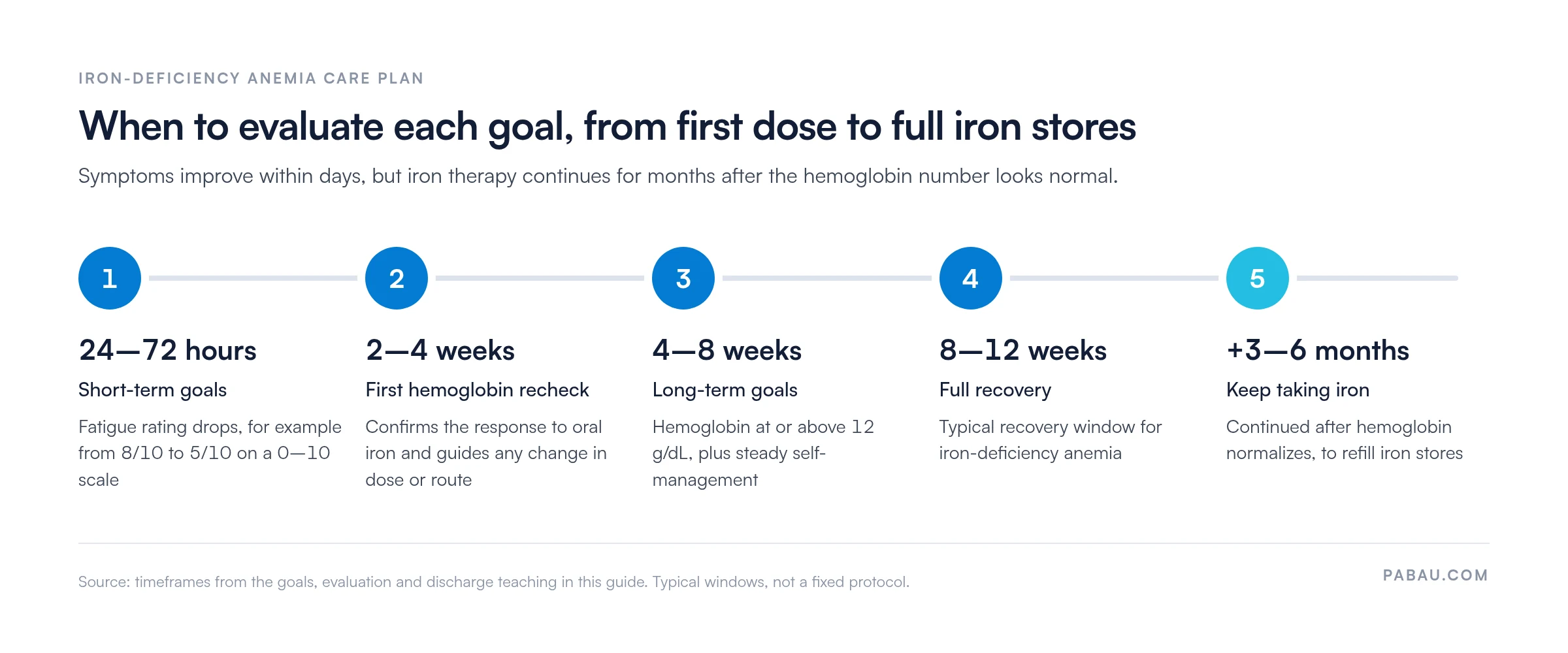
Iron therapy continues for 3-6 months after hemoglobin normalizes, so discharge teaching has to cover adherence well past symptom relief.
Practice software such as Pabau keeps the plan, the labs, and every revision on the patient record, so the next nurse sees the full history.
An anemia nursing care plan is an individualized clinical document. It translates the medical diagnosis, meaning the cause and type of anemia, into nursing actions tied to measurable patient outcomes. It also gives the whole care team one shared record of what the nurse is doing and why.
The plan follows the five steps of the nursing process:
The Joint Commission requires accredited hospitals to plan and document each patient’s care. For most nursing teams, the care plan is how they meet that standard. The American Nurses Association also expects care to be evidence-based, with patient education and discharge planning built in from admission.
Our guide to nursing documentation covers the legal requirements behind those records in more depth.
Anemia presents differently depending on its cause, and each type carries its own clinical risks. Identify the type and severity during the first assessment, because both change your intervention priorities.
Document these assessment cues at every shift:
Anchor the plan in lab values: hemoglobin (normal 13.5-17.5 g/dL in men and 12-16 g/dL in women), hematocrit, MCV, reticulocyte count, and iron studies.
NANDA-I gives nurses a standardized language for formal care plans. For anemia, the two most frequently used diagnoses are Fatigue and Activity Intolerance. Secondary diagnoses depend on the patient’s presentation and readiness to self-manage, and can include Risk for Ineffective Peripheral Tissue Perfusion in severe anemia.
When nutrition is the root cause, pair this plan with an imbalanced nutrition care plan so the dietary goals get their own evaluation.
Nursing goals connect each diagnosis to its interventions. Make them SMART (specific, measurable, achievable, relevant, and time-bound), and tie each one to a Nursing Outcomes Classification (NOC) label. A nursing outcomes classification list helps you pick the right label.
Short-term goals usually cover the acute stay or the first week of outpatient care. Long-term goals run 4-8 weeks and focus on self-management or normal lab values.
Every intervention in a formal care plan needs its clinical rationale, the reason behind the action. That rationale shows you understand the pathophysiology and makes the plan defensible in a peer review or audit.
The table below covers the core anemia interventions, each with its Nursing Interventions Classification (NIC) label. A broader list of nursing interventions helps when a comorbidity adds new diagnoses.
The template turns the five nursing-process steps into fields, so no section gets skipped. Work through it in this order.
Discharge teaching completes the plan. It has to cover medication adherence, diet, symptom recognition, activity limits, and follow-up labs. A nursing teaching plan gives that teaching its own goals and evaluation.
Evaluation tells you whether the plan worked. Compare the patient’s current status against the original goals and NOC outcome criteria. The evaluation nursing care plan template walks through this step in detail.
For iron-deficiency anemia, those checkpoints stretch well past discharge. The timeline below maps when each goal in this plan is due for evaluation.
When a goal isn’t met, name the barrier, such as poor adherence, a comorbid illness, or missed follow-up. Then write the new intervention that addresses it. Repeating this loop keeps the plan accountable and improves care over time.
The core structure stays the same, but the anemia type shifts which interventions and teaching come first.
Practices that offer iron infusions or IV therapy often keep anemia care plans on paper or in a Word file. Lab values get retyped, revisions sit in a separate document, and the next nurse can’t see why a goal changed.
Pabau, the practice management platform we build, turns the care plan into a digital form stored on the patient record. Its patient intake software collects history and symptoms before the visit, so the assessment section starts with the patient’s own answers.
Pabau Scribe, our AI scribe, drafts the clinical note from the consultation for the nurse to review. Each evaluation and revision is saved to the same record, so you can show an auditor how the plan changed and why.

Pabau’s digital forms and Pabau Scribe capture assessments, goals, and revisions on the patient record. Your team sees the full plan history without hunting through files.

Write the anemia care plan to cover the whole recovery. Fatigue goals resolve within days, while hemoglobin and iron stores take weeks to months.
So set evaluation dates for the 2-4 week recheck and the end of iron therapy before the patient leaves. Then make adherence the center of your teaching. A plan that closes at the first good hemoglobin result leaves the patient open to relapse.
Start with the template above, and adapt the diagnoses and goals to the anemia type in front of you. Book a demo to see how Pabau keeps each plan, lab result, and revision on one patient record.

Managing fluid shifts alongside anemia? Fluid and electrolyte imbalance nursing care plan covers assessment, goals, and interventions for patients losing or retaining fluid.
Need the right diagnostic label fast? Nursing diagnosis handbook helps you match patient findings to the correct NANDA-I diagnosis.
Giving oral or IV iron? Medication administration record template documents each dose, route, and time, so adherence is easy to check.
Teaching or learning the nursing process? Nursing process worksheet walks through each step from assessment to evaluation.
Charting on a busy shift? Nurse charting cheat sheet gives you a quick reference for clear, consistent notes.
Fatigue related to decreased oxygen-carrying capacity and Activity Intolerance related to imbalanced oxygen supply and demand are the two highest-priority NANDA-I diagnoses for anemia. Secondary diagnoses include Imbalanced Nutrition in nutritional anemia and Deficient Knowledge when the patient needs teaching. Risk for Ineffective Peripheral Tissue Perfusion applies in severe anemia.
Monitoring frequency depends on anemia severity and treatment type. For hospitalized patients receiving iron or transfusions, hemoglobin is rechecked every 4-8 hours at first. For outpatient iron supplementation, labs are usually drawn 2-4 weeks after treatment starts, then monthly until stable. Chronic anemia may need labs every 3 months once hemoglobin is normal.
A physician care plan diagnoses the medical cause of anemia and prescribes treatment, such as iron, transfusion, or other medications. A nursing care plan turns that diagnosis into NANDA-I nursing diagnoses, measurable outcomes, and specific nursing interventions. Those interventions target the patient’s symptoms, such as fatigue and activity intolerance, and their ability to self-manage. Hospitals typically expect both in the patient record.
Registered nurses (RNs) need an order from a physician or nurse practitioner (NP) before giving iron. Nurse practitioners can prescribe iron independently in many states, and some clinical nurse specialists can too, depending on state scope of practice. Either way, the nursing care plan documents the rationale, dose, route, and expected response.
With a structured template and a finished assessment, many nurses can write an anemia care plan in about 15-30 minutes. The template supplies the diagnoses, goal formats, and rationale columns, so the work is tailoring rather than drafting. Writing one from a blank page takes considerably longer.
Yes. Iron-deficiency anemia plans focus on iron supplementation, dietary counseling, and finding the source of any bleeding. Sickle cell anemia plans emphasize pain crisis management, hydration, oxygenation, and psychosocial support. Both share the same framework of assessment, diagnosis, goals, interventions, and evaluation, but their priorities and teaching differ.