HCPCS Code G0163: Skilled nursing observation and assessment
What is HCPCS Code G0163? HCPCS Code G0163 is a deleted Level II code for skille...

Last Updated: Oct 15, 2026
96910 is the CPT code for photochemotherapy that pairs tar with ultraviolet B light, the Goeckerman treatment, or petrolatum with ultraviolet B light. Coal tar or petrolatum is applied to the skin, and the patient is then exposed to UVB.
Dermatology practices bill 96910 for psoriasis and other inflammatory skin conditions. The adjacent PUVA code, 96912, uses psoralen and UVA light instead, and confusing the two drives most denials on these claims.
Let Pabau's smart automation suggest the right codes, reduce claim denials, and keep your practice compliant—effortlessly.
Automate repetitive tasks and focus on what matters most—your patients.
Reduce coding errors and ensure compliance with the latest regulations.
Clean claims, fewer denials, and faster reimbursements.
Powerful insights and reporting to help your practice thrive.
HIPAA compliant SOC 2 certified GDPR-compliant Trusted by 4,000+ clinics worldwide

CPT Code 96910 covers photochemotherapy with coal tar or petrolatum and UVB light, which is the Goeckerman treatment.
PUVA is a different code. 96912 uses psoralen and UVA light, and mixing the two is the most audited error on these claims.
The 2026 Medicare non-facility rate is roughly $29 to $35. Non-facility pays more because it covers the overhead of an office-based phototherapy suite.
The note must record UVB exposure duration, body surface area, tar concentration, patient response, and a physician order. Missing any one of them is the top denial trigger.
Practice management software like Pabau tracks prior authorizations and captures phototherapy documentation at the point of care.
CPT Code 96910 is the billing code for photochemotherapy that combines coal tar or petrolatum with ultraviolet B light. Dermatology practices bill it for the Goeckerman regimen, most often when treating psoriasis.
The code sits in the Special Dermatological Procedures section of the AMA CPT code set. The AMA CPT Editorial Panel maintains the official descriptor, which reads Photochemotherapy; tar and ultraviolet B (Goeckerman treatment) or petrolatum and ultraviolet B.
The Goeckerman treatment has been used for over a century. Billing staff still confuse 96910 with 96912, because both descriptors open with the word photochemotherapy. The difference is the agent applied to the skin and the light source used. 96910 pairs coal tar or petrolatum with UVB, while 96912 pairs psoralen with UVA.
The 2026 Medicare Physician Fee Schedule (MPFS) sets payment from Relative Value Units (RVUs) and a geographic conversion factor. The national average for 96910 falls in the range below, according to the CMS Physician Fee Schedule lookup tool. Verify your own locality before billing, because geographic adjustment factors vary by MAC jurisdiction.
Non-facility rates are higher because CMS includes practice expense (PE) RVUs for the overhead of running an office-based phototherapy suite. In a hospital outpatient department the facility bills that overhead separately under the OPPS, so the physician receives a lower professional payment.
Work RVUs are identical in both settings, so the whole payment difference comes from practice expense. Pull the current work, practice expense, and malpractice values for your MAC locality from the CMS lookup before you submit.
Modifier selection for 96910 turns on three questions.
The National Correct Coding Initiative (NCCI) edits govern bundling between 96910 and E&M codes billed on the same date.
Commercial payers may impose modifier requirements beyond Medicare’s, so check each payer’s phototherapy policy before billing. Appending modifier 25 without a separately documented E&M encounter is the most common audit trigger on 96910 claims.
Run a pre-claim NCCI edit check before submitting 96910 alongside any E&M code on the same date. Most practice management systems can flag an NCCI conflict before the claim leaves the office, which prevents a denial that takes weeks to appeal.
Incomplete documentation is the leading cause of 96910 claim denials and post-payment audit recoupments. A defensible claim starts in the medical record, so every element below must appear in the visit note before submission.
Missing any of these elements usually produces a medical necessity denial, or a request for additional documentation. Note templates that prompt for each field cut those omissions sharply.
Pabau’s dermatology EMR lets you make each phototherapy field mandatory on the treatment note. The omission then surfaces at the point of care, instead of weeks later at claim review.
The claim also needs a diagnosis that supports medical necessity. Pair 96910 with the ICD-10-CM diagnosis codes the physician documented for the psoriasis or eczema being treated.
Set up a phototherapy note template that will not close until every required field is complete. Configure it once, and the UVB dose, body surface area, tar formulation and patient response are captured at every session.
Dermatology practices frequently delegate phototherapy administration to nurses or medical assistants, which triggers Medicare’s incident-to billing rules. When billing 96910 under the supervising physician’s NPI, the following conditions must be met.
Under CMS incident-to guidance, billing under the physician’s NPI yields the full physician fee schedule rate. Billing under the NPP’s own NPI reduces payment to 85% of that rate. For a high-volume phototherapy practice, the difference compounds quickly. Document the supervision arrangement for each session, not only at the start of a treatment course.
Place of service (POS) code selection directly affects the rate applied to a 96910 claim. The wrong POS code is a clean claim failure, producing either an automatic denial or an incorrect payment.
POS 11 covers the overwhelming majority of 96910 claims billed by private dermatology practices. If your practice is provider-based or sits inside a hospital system, check whether your location counts as on-campus or off-campus for OPPS purposes. That answer decides the POS code and the payment rate you receive.
Most 96910 denials trace back to a small set of recurring errors. Knowing where claims fail lets billing staff build preventive workflows instead of reactive appeals. Pabau validates CPT and ICD-10 code pairs through its Claim.MD clearinghouse integration before a claim reaches the payer.
Categorize your 96910 denials by root cause before you appeal them. Denials on this code cluster around documentation and code selection, so a targeted change to the note template usually beats coder retraining. Run that analysis through your denial management process.
96910 is one of six codes in the Special Dermatological Procedures phototherapy group. Two facts in the note decide which one applies. The first is whatever was applied to the skin, and the second is the light source used.
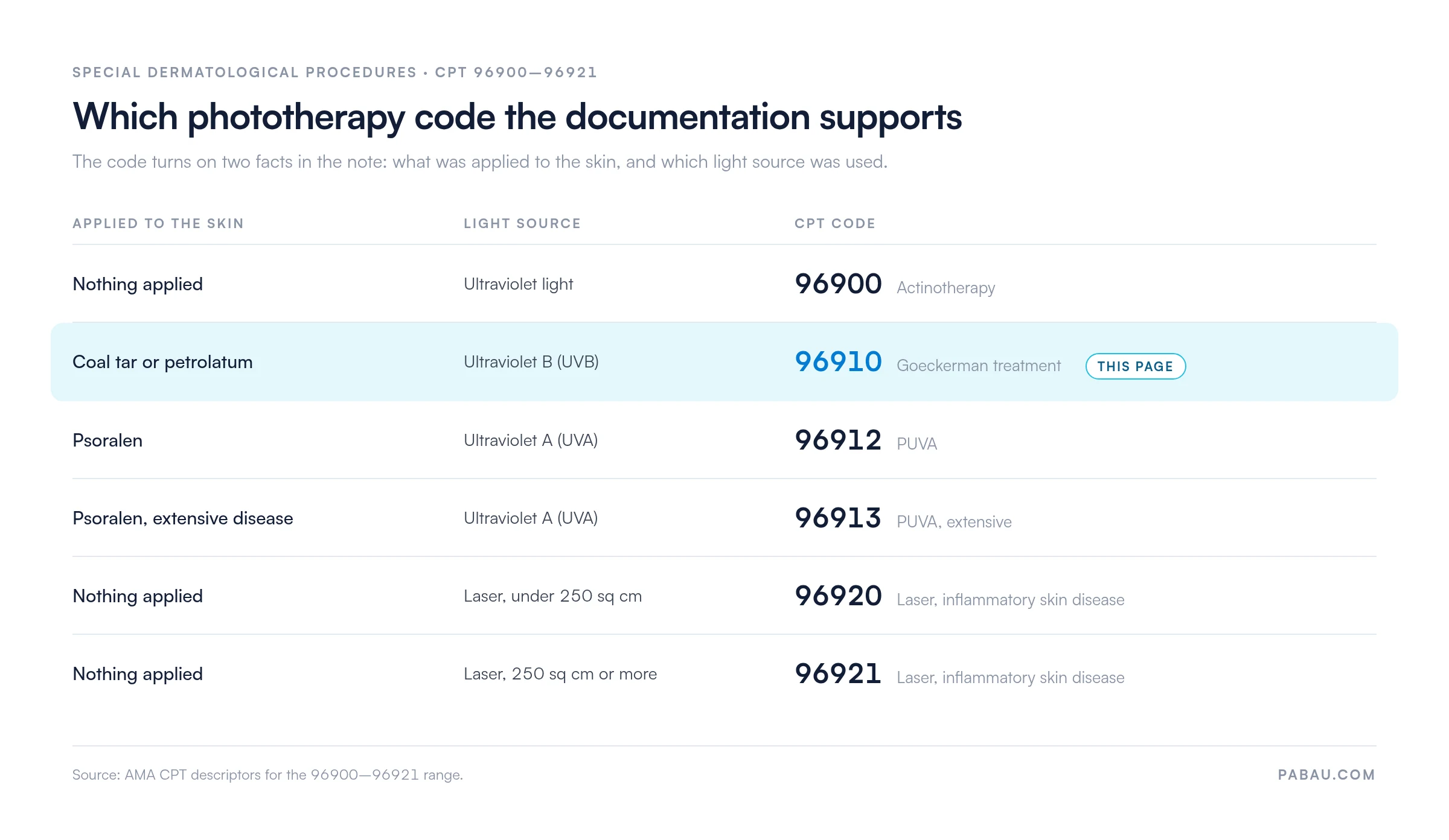
The AAPC Codify CPT lookup carries the full descriptor and crosswalk reference for each code in this family.
Home phototherapy sits outside this family. When the treatment happens at home, the replacement UV lamp bills as a durable medical equipment supply under A4633, not as a treatment session.
CPT 96912 is the PUVA code. It covers photochemotherapy with psoralen, an oral or topical photosensitizing drug, and UVA radiation. The two modalities are not interchangeable for billing.
PUVA needs a longer lead time, because the psoralen is taken one to two hours before treatment. It is used for more refractory disease and carries a different risk profile.
Confirm from the procedure note which light source was used before you select the code. Where the note does not say, query the treating physician rather than defaulting to one code.
Dermatology practices billing 96910 regularly hit two operational problems. Documentation omissions surface only at claim review, and prior authorizations lapse when a phototherapy course runs across several weeks. Software that ties billing to clinical documentation handles both at the workflow level.
Pabau’s claims software for dermatology connects the clinical note to the claim. The data captured during the phototherapy session populates the claim without re-entry. For a practice running several phototherapy patients per session block, that cuts billing time per claim and lifts the clean claim rate.

Pabau helps dermatology practices track phototherapy documentation, manage prior authorizations, and submit cleaner claims. See how it works for your team.

96910 is an easy code to identify and an easy one to bill wrong. Practices lose the money on the note rather than on the code choice, through a missing dose entry or a supervision arrangement nobody wrote down.
The durable fix sits in the note template. A phototherapy note that will not close without the dose, body surface area, formulation and patient response stops the denial before it happens. Prevention recovers far more than appeals do.
Book a demo to see how Pabau captures phototherapy documentation and submits 96910 claims from the same patient record.

Need a starting point for dermatology billing compliance? Medical billing compliance essentials covers the documentation standards that apply across dermatology procedure codes.
Managing prior authorizations across a phototherapy course? Insurance eligibility verification workflows explains how to confirm coverage and auth status before each session block.
Want to understand how the clearinghouse fits into your revenue cycle? How medical claims clearinghouses work walks through the submission-to-payment path for CPT claims.
CPT Code 96910 is the billing code for photochemotherapy with tar and ultraviolet B (UVB) radiation, also known as the Goeckerman treatment. It covers in-office sessions where coal tar or petrolatum is applied to the skin before UVB light exposure. Dermatology practices bill it for psoriasis, eczema, and other inflammatory skin conditions.
The 2026 Medicare non-facility rate for CPT 96910 is approximately $29 to $35, depending on geographic locality. Facility rates are lower, because the hospital outpatient department bills separately for overhead. Verify your own rate in the CMS Physician Fee Schedule lookup tool for your MAC jurisdiction before billing.
CPT 96910 uses coal tar or petrolatum combined with UVB light, which is the Goeckerman regimen. CPT 96912 covers PUVA therapy, which uses psoralen combined with UVA light. The agent applied to the skin and the light source are the distinguishing factors. Using the wrong code when the modality is documented in the chart is a clinical coding denial.
Yes. Under Medicare incident-to billing rules, a nurse or medical assistant may administer the phototherapy session. The supervising physician or qualified NPP must be in the office suite and immediately available. The service must be part of a physician-established plan of care. State scope-of-practice rules and individual payer policies may impose conditions beyond Medicare’s.
POS 11 (office) applies to the vast majority of CPT 96910 claims billed by private dermatology practices. POS 22 applies when the service is delivered in a hospital outpatient department. Using POS 22 for a private office setting triggers the lower facility rate and results in underpayment.
Billing under incident-to rules with the supervising physician’s NPI pays 100% of the Medicare physician fee schedule rate. Billing under the NPP’s own NPI reduces payment to 85% of that rate. For practices running several phototherapy sessions a week, the 15% difference is worth the supervision documentation it takes to claim it.