Psychosis spectrum test: What it screens for and how it works
A psychosis spectrum test is a short clinical screening tool that checks for hal...

Last Updated: Oct 5, 2026
A depression nursing care plan is a written guide that applies the five-step nursing process to a patient with depression. It pairs a PHQ-9 severity score with NANDA-I nursing diagnoses, measurable goals, interventions with rationales, and a date to re-evaluate.
The diagnoses that come up most often are Risk for suicidal behavior, Impaired resilience, Chronic inadequate self-esteem, Impaired social interaction, and Decreased activity tolerance. The 2024–2026 NANDA-I edition retired Hopelessness and renamed Low self-esteem and Activity intolerance, so this guide uses the current labels.
A ready-to-use care plan with sections for patient assessment, nursing diagnoses, expected outcomes, interventions with evidence-based rationales, and evaluation criteria. Fill it in on admission and update it at each reassessment.
Download template
A depression nursing care plan applies the five-step nursing process, pairing NANDA-I diagnoses with measurable goals and evidence-based interventions.
Current NANDA-I labels for depression include Risk for suicidal behavior, Impaired resilience, Chronic inadequate self-esteem, Impaired social interaction, and Decreased activity tolerance.
Hopelessness was retired as a diagnosis in the 2024–2026 edition, but it stays a key suicide risk cue to document.
On the PHQ-9, scores of 10 to 14 mean moderate depression, 15 to 19 moderately severe, and 20 to 27 severe.
Pabau, the practice management platform we build, stores each PHQ-9 score and care plan update in one patient record, so the team sees the trend.
A depression nursing care plan is a written clinical guide built on the ADPIE nursing process: assessment, diagnosis, planning, implementation, and evaluation. It covers major depressive disorder and situational depression. The plan records patient data, the NANDA-I diagnoses that fit, measurable goals, chosen interventions, and outcomes.
Medical diagnoses belong to the psychiatrist or physician. Nursing diagnoses describe the patient’s response to illness, meaning what they experience and how the nurse can support recovery. The plan turns that assessment into shift-to-shift care, so each nurse can see what to do next and whether it’s working.
Assessment starts with subjective and objective data that show how depression is affecting the patient’s thoughts, behavior, physical health, and daily functioning. Nurses use standardized screening tools, observe clinical presentation, and document findings for the diagnosis step.
Subjective data (patient report): mood, sleep, appetite, energy, guilt or worthlessness, poor concentration, thoughts of death or suicide, social withdrawal, and abandoned hobbies.
Objective data (nurse observation): facial expression, grooming or hygiene, posture, speech rate and tone, eye contact, psychomotor agitation or retardation, and weight changes.
The PHQ-9 (Patient Health Questionnaire-9) is the most widely used depression severity scale in clinical settings. Each of the nine items is scored 0 to 3, giving a total from 0 to 27. A score of 5 to 9 indicates mild depression, 10 to 14 moderate, 15 to 19 moderately severe, and 20 to 27 severe, per the original PHQ-9 validation study.
Scores of 0 to 4 are minimal, and 10 or more is the usual cut-off for probable major depression. Item 9 asks about thoughts of being better off dead or of self-harm. Any answer above 0 calls for a direct suicide risk assessment, whatever the total. The scale below shows where each total lands.
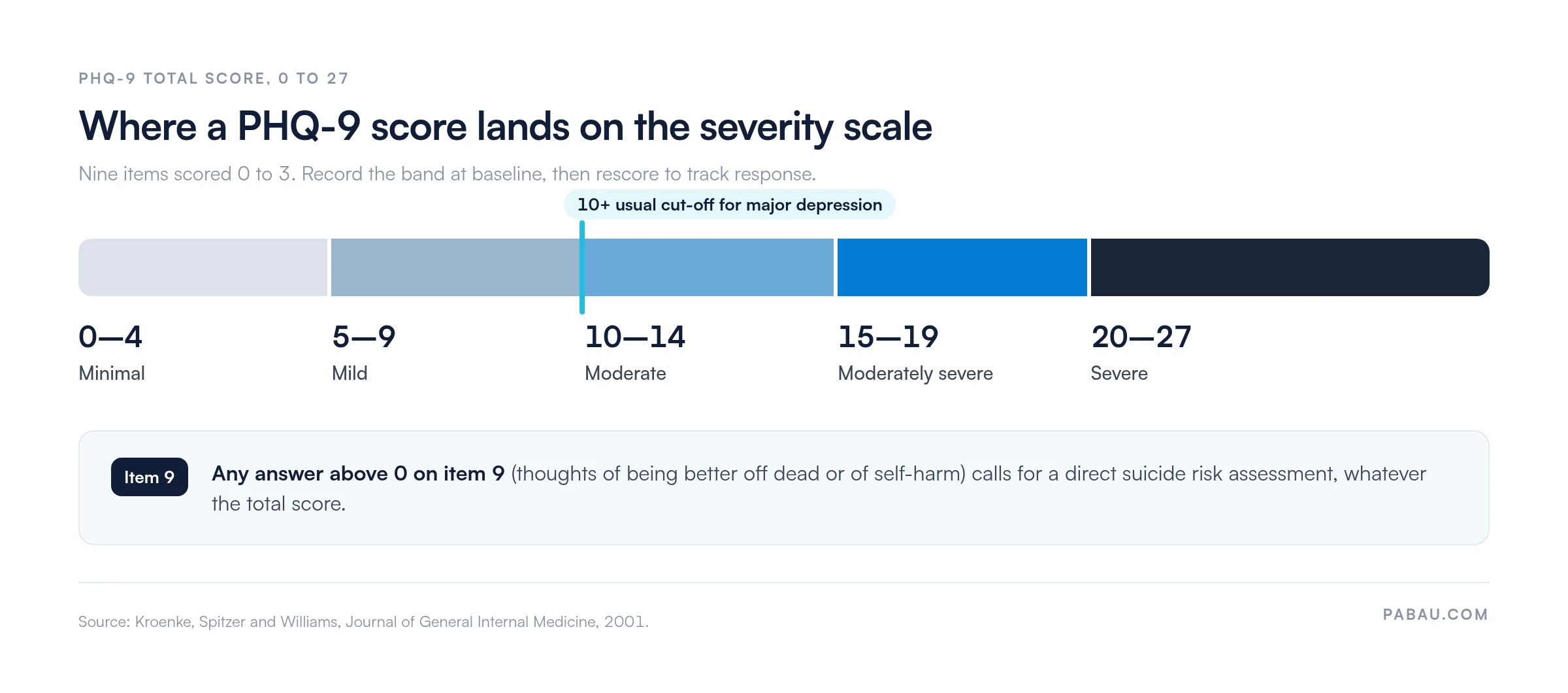
Score the PHQ-9 at baseline, then rescore to track treatment response. Our PHQ-9 and GAD-7 template has the full questionnaire ready to print.
NANDA International (NANDA-I) approves the nursing diagnosis labels used for the patterns seen in depression. Each diagnosis lists related factors (causes or contributing conditions) and defining characteristics (signs and symptoms). Nurses pick the diagnoses that match the patient in front of them, using the current 2024–2026 edition.
Hopelessness (00124) was retired in the 2024–2026 NANDA-I edition. Its features now sit under Impaired resilience (00210) and Chronic inadequate self-esteem (00483). Impaired resilience describes a reduced ability to recover from adverse or changing situations.
Related factors in depression include prolonged stress, loss or abandonment, and repeated failure to reach goals. Watch for passivity, little verbal response, lack of initiative, turning away from the speaker, and statements of despair. Hopelessness still predicts suicide risk, so document it and act on it in the suicide risk assessment.
Chronic inadequate self-esteem (00483) replaces the older Chronic low self-esteem label. It describes a long-standing negative view of oneself, with self-criticism that repeats across situations. In depression it shows up as statements like “I’m worthless,” poor grooming, and rejecting positive feedback.
Risk for suicidal behavior (00289) replaced the older Risk for suicide label in the 2021–2023 edition. Apply it when the patient reports thoughts, plans, or a history of self-harm or suicide attempts.
Risk factors include hopelessness, mood disorder, social isolation, loss, substance use, access to lethal means, and previous attempts. Nurses screen formally by asking directly about intent, plan, and means. They also document protective factors, such as reasons for living, social support, and coping skills.
A suicide risk assessment checklist keeps those questions consistent across shifts. The Joint Commission requires accredited organizations to screen patients treated for behavioral health conditions for suicide risk. It also expects documented safety planning and monitoring.
Impaired social interaction describes too little, too much, or ineffective social exchange. Depression often causes withdrawal. Patients isolate, avoid family and friends, and lose interest in group activities.
Related factors include depression, low self-esteem, anxiety, and altered thought processes. Interventions reconnect the patient with relationships and activities through structured socialization, alongside treatment of the underlying mood symptoms.
Decreased activity tolerance replaces the older Activity intolerance label, and Risk for decreased activity tolerance is its companion diagnosis. It fits a patient whose fatigue and low energy stop them from finishing daily activities. Goals usually build activity up in small, scheduled steps.
Many care plan examples still use labels NANDA-I has since retired or renamed. Use this table to update an older plan before it goes in the chart.
Nursing outcomes are patient-centered, measurable statements of what the patient will achieve by a specific date. They’re written in plain language and use the Nursing Outcomes Classification (NOC) framework for standardization. Short-term outcomes typically target 24 to 72 hours, and long-term outcomes span one to two weeks or longer.
Nursing interventions are the specific actions nurses take, alone or with the wider team, to reach the patient’s goals. Each one needs an evidence-based rationale, which is the clinical reason it helps. Rationales link the intervention to physiology, psychology, safety, or treatment principles.
Independent interventions are actions nurses perform without a physician’s order. They include assessment, monitoring, therapeutic communication, safety measures, and patient teaching, such as practicing coping skills for depression together.
Collaborative interventions require physician orders and coordination with psychiatrists, therapists, social workers, or medical teams.
The example below shows a brief care plan for a patient with major depression, using current NANDA-I labels. A full clinical plan would expand each row with patient-specific data.
Evaluation shows whether the patient reached the stated outcomes. Nurses compare each expected outcome with the patient’s current status and record it as “met,” “partially met,” or “not met.” If an outcome is not met, the nurse revises the assessment, diagnoses, interventions, or timeframes.
Evaluation continues throughout care. Regular reassessment catches rising risk, since new suicidal ideation may require acute admission. It also tracks medication response, with PHQ-9 rescoring after two to four weeks, and keeps mental health EMR documentation current.
Measure outcomes on a fixed schedule, ideally weekly during an acute episode. A worsening PHQ-9 trend or new suicidal ideation is your signal to intervene before a crisis.
A structured care plan keeps depression care consistent and evidence-based, and it protects patient safety in psychiatric and mental health settings. Standardized templates cut documentation time, improve handoffs at shift change, and provide a legal record of the nursing process.
In many mental health practices, the care plan lives on paper or in a shared document. PHQ-9 scores sit on separate forms, and comparing them across visits means flipping back through the chart.
Pabau, the practice management platform we build, keeps that data in one patient record. Patients complete the PHQ-9 as a digital form before the visit, and their answers are saved to the record. Structured patient records show the full care history, so this month’s score sits next to last month’s.
Nurses log assessments, NANDA-I diagnoses, interventions, and outcomes in Pabau’s psychiatry practice software, and automated reminders prompt each follow-up assessment and medication review. The result is simpler therapy practice management, with one record that psychiatrists, therapists, and nurses all work from.
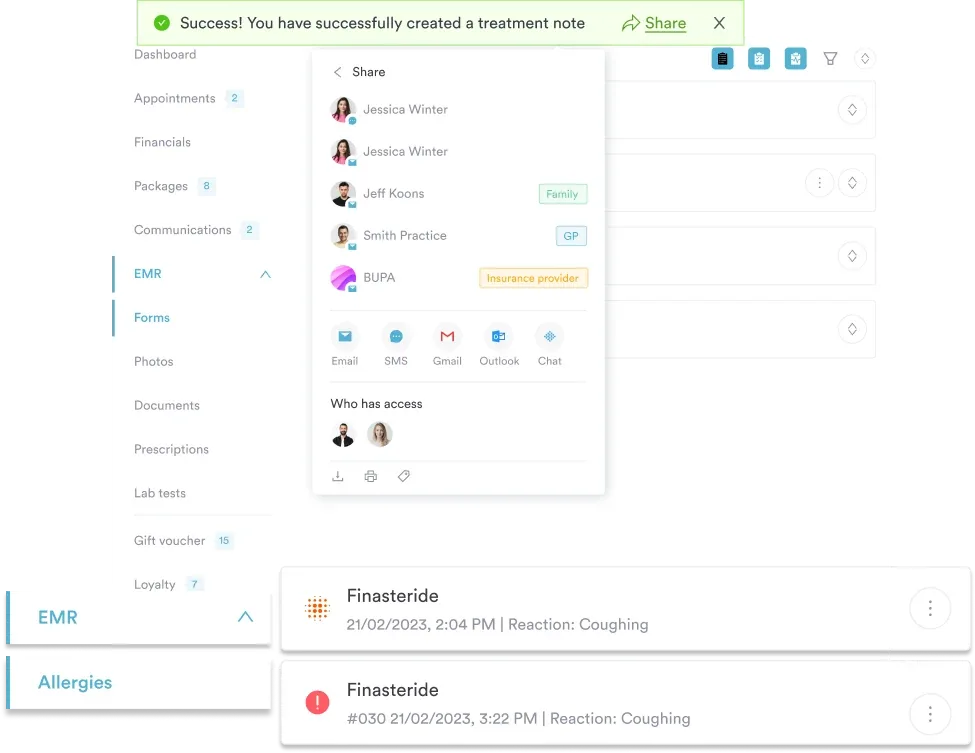

Pabau stores PHQ-9 scores, care plan forms, and treatment notes in one patient record, so every nurse sees the latest plan. Automated reminders keep each reassessment on schedule.

Start with the current NANDA-I labels. A care plan still built on Hopelessness or Activity intolerance is out of date, and fixing it takes minutes.
Then let the PHQ-9 drive the plan. Score it at baseline, set goals against the severity bands, and rescore on a fixed schedule. Treat any positive answer on item 9 as a safety event, whatever the total.
A detailed plan takes longer to write, but it shows the next nurse what changed and why. Book a demo to see how Pabau keeps PHQ-9 scores, care plans, and reminders in one patient record.

Caring for a patient with bipolar disorder? Bipolar disorder nursing care plan covers diagnoses and interventions for manic and depressive episodes.
Is anxiety part of the picture? Anxiety nursing care plan pairs NANDA-I diagnoses with SMART goals and rationales for anxious patients.
Need a clinician-rated severity score? Hamilton depression rating scale scoring explains how to score and interpret the HAM-D alongside the PHQ-9.
Working with older adults? Geriatric depression scale screens older patients for depression with a simple yes-or-no format.
Want a worksheet for therapy sessions? Mind over mood worksheet helps patients practice cognitive behavioral therapy skills between sessions.
The most common NANDA-I diagnoses for depression are Risk for suicidal behavior, Impaired resilience, Chronic inadequate self-esteem, Impaired social interaction, and Decreased activity tolerance. Each reflects a specific human response to depression and guides the choice of nursing interventions.
Independent nursing interventions include therapeutic communication, suicide risk assessment, safety planning, encouraging activity participation, and supporting self-care. Collaborative interventions include administering antidepressant medications, coordinating psychotherapy referrals, and facilitating group therapy participation.
Follow the five-step nursing process. Assess subjective and objective data with tools like the PHQ-9, then choose the NANDA-I diagnoses that match your findings. Write SMART goals, select interventions with rationales, and evaluate goal attainment regularly, revising the plan as needed.
Hopelessness (00124) was retired in the 2024–2026 NANDA-I edition. Its features now fall under Impaired resilience (00210) or Chronic inadequate self-esteem (00483). Hopelessness remains a strong predictor of suicide risk, so document it and complete a safety assessment.
The PHQ-9 (Patient Health Questionnaire-9) is the most common tool. It has nine questions scored 0 to 3, for a total of 0 to 27. Scores of 5 to 9 indicate mild depression, 10 to 14 moderate, 15 to 19 moderately severe, and 20 to 27 severe. Nurses give it at baseline and periodically afterward to measure treatment response.