CPT code 21011: Excision of soft tissue tumor of the face
CPT code 21011: Official descriptor and procedure overview CPT code 21011, as pu...

Last Updated: Oct 8, 2026

CPT code 28820 describes surgical amputation of a toe at the metatarsophalangeal (MTP) joint. It sits in the Amputation Procedures on the Foot and Toes section of the CPT manual.
CMS reclassified CPT 28820 from a 90-day to a 0-day global period. Every post-operative visit is now billed separately with an E&M code.
Common billing errors include the old 90-day global assumption and a missing TA-T9 digit modifier. A claim without a linked ICD-10 code fails on medical necessity.
National Medicare payment runs roughly $290 to $300 in an office setting and $160 to $165 in a facility, before geographic adjustment.
Practice management software like Pabau can flag 0-day global period codes at scheduling and prompt billers to attach the digit modifier before submission.
CPT code 28820 covers amputation of a toe at the metatarsophalangeal joint, where the proximal phalanx meets the metatarsal head. The metatarsal itself stays intact.
CMS has since moved the code from a 90-day global period to a 0-day global period. That one change decides how every follow-up visit gets billed.
This reference covers the official descriptor, clinical indications, and global period mechanics. It also covers Medicare rates, applicable modifiers, ICD-10 crosswalk codes, documentation standards, and the neighboring amputation codes.
CPT code 28820 is defined by the American Medical Association as: Amputation, toe; metatarsophalangeal joint. The procedure removes a toe by disarticulation at the metatarsophalangeal joint. That separates the proximal phalanx from the metatarsal head without resecting the metatarsal.
This code sits within the Amputation Procedures on the Foot and Toes section of the CPT manual (codes 28800-28825).
It is a distinct anatomical level from CPT 28810, a ray amputation described as “Amputation, metatarsal, with toe, single”. CPT 28825 sits one joint further out, at the interphalangeal joint. Choosing the wrong level is one of the most common errors in podiatric surgical billing.
Use the quick-reference table below before submitting any claim for this procedure.
CPT code 28820 is reported when a surgeon disarticulates a toe at the metatarsophalangeal joint. The scope here is billing and coding only. The decision to amputate rests with the treating physician, based on presentation and comorbidities.
Common clinical scenarios that drive this procedure include the diagnoses below. Each one needs a corresponding ICD-10 code to establish medical necessity with payers.
Local Coverage Determinations (LCDs) issued by Medicare Administrative Contractors (MACs) define which diagnoses qualify for coverage. Coverage criteria vary by jurisdiction, so verify the applicable LCD for your region before submission.
The most billing-disruptive change for CPT 28820 in recent years is CMS’s reclassification from a 90-day global period to a 0-day global period. Under a 90-day global, all post-operative care from the day of surgery through 90 days was bundled into the surgical payment.
Under a 0-day global, the surgeon’s fee covers only the day of surgery itself. The visual below shows what moves out of the surgical package, and which neighboring codes kept the 90-day designation.
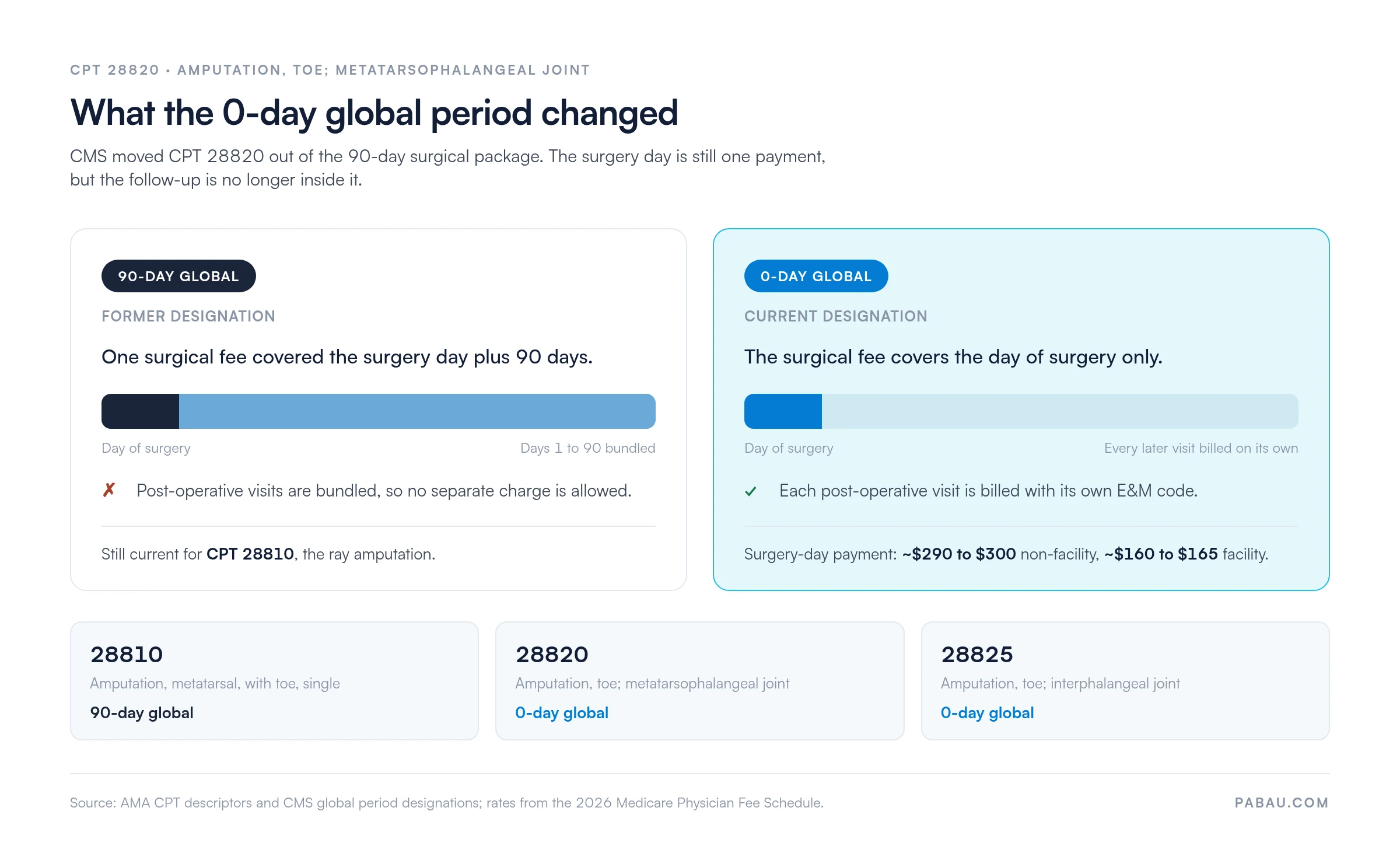
CMS made this reclassification as part of its broader review of surgical global periods. The trigger was data showing that the clinical burden of post-operative care for minor foot procedures ran far below what the 90-day package implied.
The New York State Podiatric Medical Association (NYSPMA) and other specialty groups flagged the billing implications for practices treating diabetic populations with frequent follow-up needs.
After a 0-day global procedure, each post-operative visit is a separately billable encounter. Bill the appropriate E&M code for each visit rather than assuming it is included in the surgical payment.
Medicare reimburses CPT 28820 at different rates depending on the place of service. Facility rates apply in a hospital or ambulatory surgical center (ASC). Non-facility rates apply in an office setting.
The code carries 8.90 total non-facility RVUs and 4.84 total facility RVUs, with a work RVU of 3.42. Applying the 2026 conversion factor of $33.4009 produces the national figures below.
Both are subject to geographic adjustment via the Geographic Practice Cost Index (GPCI), so verify current amounts with the CMS Physician Fee Schedule lookup tool.
Submit claims through a clearinghouse that validates fee schedule compliance before they reach the payer. Practice management software like Pabau routes US claims through Claim.MD, which processes CMS-1500 and 837P files and returns electronic remittance advice for faster reconciliation.
Verify your exact 2026 Medicare payment for CPT 28820 using the CMS Physician Fee Schedule search before finalizing fee schedule negotiations with commercial payers. The national average is only a baseline. Your locality modifier may push the rate 10-20% above or below it.
Modifiers are not optional for toe amputation claims. Missing or incorrect modifiers are a leading cause of denials and audits on CPT 28820 submissions. The table below covers the primary modifiers. Medicare modifier rules apply to Medicare claims, and commercial payer requirements may differ.
Not every modifier on a patient’s account describes a procedure. HCPCS code K0831 takes RR on each monthly capped rental line and NU only when the chair is purchased outright.
Every CPT 28820 claim requires at least one ICD-10 diagnosis code that establishes medical necessity. The table below shows the diagnoses linked most often. Acceptance depends on your MAC’s LCD for lower extremity amputations, so confirm coverage before submission.
Code to the highest level of specificity the clinical documentation supports. Our ICD-10-CM code library lists the full subcategories these diagnoses are drawn from, including the laterality and severity digits payers expect.
Specificity in the diagnosis code is what protects the claim from a medical necessity denial. A vague code invites a request for records even when the surgery was clearly indicated.
Weak documentation is the fastest route to a post-payment audit or a recoupment demand on CPT 28820 claims. The operative note, pre-op evaluation, and follow-up records each have to meet specific standards. Every element of the claim needs to be traceable back to the medical record.
Practices using structured digital charting capture these elements consistently. A properly completed operative note carries straight into the billing record, which cuts the manual work of assembling claim data later.
The three primary toe amputation codes are distinguished by the anatomical level of resection. Selecting the wrong code in this series is a high-frequency audit finding. Review the distinctions below before coding any toe amputation procedure.
Note the global period difference. CPT 28810 retains a 90-day global period, while both 28820 and 28825 carry 0-day designations after the CMS reclassification.
A practice billing a metatarsal amputation with a 0-day global assumption will under-bill significantly. Check the AAPC CPT code range for the full amputation series to confirm current descriptors.
CPT 28820 claims fail for a predictable set of reasons. A denial management process should track these error types by category, so the pattern shows up before it becomes a quarter of lost revenue.
Capsulotomy code 28270 falls under the same unbundling rule. Its AMA “separate procedure” designation means a capsule release at the joint being disarticulated is not reported alongside 28820.
Podiatry practices that treat diabetic foot populations perform toe amputations regularly. At that volume, prompting for digit modifiers and tracking global periods by hand stops working. Purpose-built claims management software moves both checks into the workflow the biller already uses.

Three specific capabilities matter most for CPT 28820:
The outcome is fewer denials on a code whose denial reasons are already known. Billers stop relying on memory for the 0-day rule, and post-operative visits get charged on the day they happen instead of written off weeks later.

Pabau’s claims management software flags 0-day global period codes at scheduling, prompts billers to add digit modifiers, and routes claims through Claim.MD for electronic submission. See how it works for podiatry practices.

Almost every denial pattern on CPT 28820 traces back to a billing workflow that was built for a 90-day global period. Rebuilding that workflow once costs less than appealing the same denial every month.
So the decision worth making now is where the check lives. A biller who has to remember the 0-day rule will eventually forget it on a busy Friday. A prompt at the point of coding will not.
Pabau embeds global period rules, modifier prompts, and claim scrubbing in the podiatry billing workflow. The checks then happen before submission rather than after a denial. Book a demo to see how it handles CPT 28820 and the rest of your podiatry claims.

Need to understand how clearinghouse submissions work for surgical codes? Pabau’s Claim.MD clearinghouse guide explains how 837P files are validated and transmitted to payers.
Looking for denial pattern analysis across your podiatry claims? Denial codes in medical billing covers the most common CARC codes and how to respond to each.
Want to understand how ERA remittances close the billing loop? Electronic remittance advice (ERA) breaks down the 835 transaction and how to reconcile payments efficiently.
CPT Code 28820 is a surgical procedure code describing amputation of a toe at the metatarsophalangeal joint. The American Medical Association maintains it in the Amputation Procedures on the Foot and Toes section of the CPT manual. Podiatric surgeons use it to bill toe disarticulation at the MTP joint level.
CPT 28820 carries a 0-day global period following CMS reclassification. Only the day of surgery is bundled into the surgical payment. Every post-operative visit after the procedure date must be billed separately using the appropriate E&M code.
A digit-specific modifier is required. Use TA for the left great toe and T1-T4 for the left second through fifth toes. Use T5 for the right great toe and T6-T9 for the right second through fifth toes. Some payers also require LT or RT alongside the digit modifier. Modifier -51 applies when CPT 28820 is billed with another procedure on the same date.
The most frequently paired codes are E11.621 (type 2 diabetes with foot ulcer) and E11.52 (diabetic peripheral angiopathy with gangrene). I70.261 (atherosclerosis with gangrene) and M86.671 (chronic osteomyelitis of the ankle and foot) also appear often. The code you choose must reflect the documented clinical indication. It must also be supported by your MAC’s LCD for lower extremity amputations.
CPT 28810 amputates the metatarsal along with the toe, which is more proximal and carries a 90-day global period. CPT 28820 disarticulates only at the metatarsophalangeal joint, preserving the metatarsal, with a 0-day global period. CPT 28825 disarticulates at an interphalangeal joint, more distal than 28820, also with a 0-day global period. The operative report must document the anatomical level to support whichever code is billed.
National average Medicare rates for 2026 are roughly $290 to $300 in a non-facility setting and $160 to $165 in a facility, before geographic adjustment. The code carries 8.90 total non-facility RVUs and 4.84 total facility RVUs, with a work RVU of 3.42. Rates vary by MAC locality, so verify current amounts with the CMS Physician Fee Schedule lookup tool.
Each post-operative visit is billed separately using the appropriate E&M code, such as 99211-99215 for office visits, because CPT 28820 carries a 0-day global period. Document each visit with a complete note supporting the level of service billed. Some payers may require modifier -24 on the E&M code to prevent automatic bundling edits.