



CCSD code G5100: Bypass of duodenum billing guide
CCSD code G5100 bills a bypass that leaves the duodenum in place CCSD code G5100...

Last Updated: Oct 16, 2026

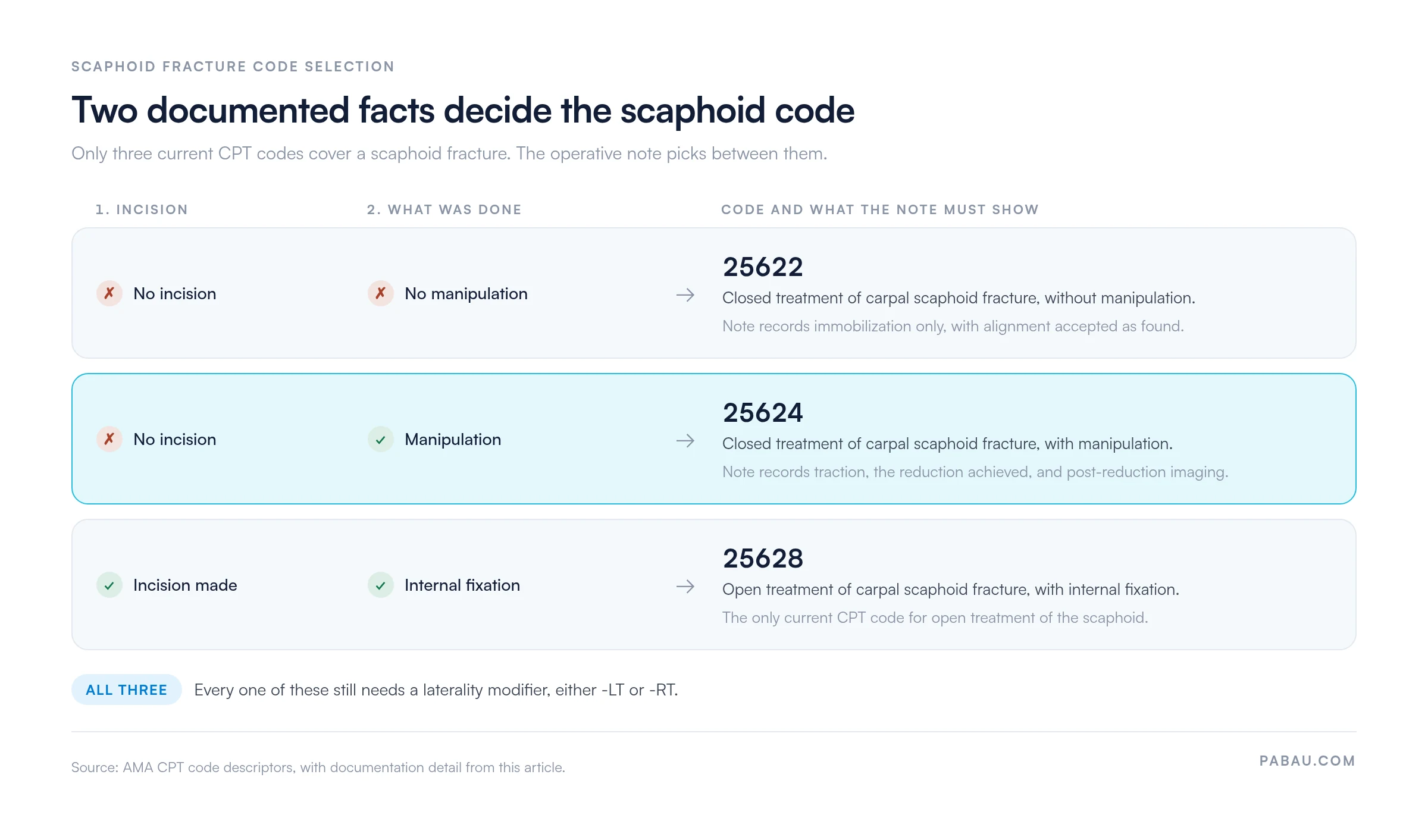
CPT code 25624 describes closed treatment of a carpal scaphoid (navicular) fracture with manipulation, performed without open surgical incision.
Open treatment of the scaphoid has only one current code, 25628, so 25622, 25624 and 25628 are the whole family.
Modifier -LT or -RT is required to indicate laterality. Omitting it is a common reason CPT 25624 claims are denied.
A 90-day global surgical period applies under Medicare, meaning follow-up care within that window is typically bundled into the procedure payment.
Practice management software like Pabau surfaces the right modifiers and paired ICD-10 codes while the claim is being built.
CPT code 25624 is defined by the American Medical Association (AMA) as: Closed treatment of carpal scaphoid (navicular) fracture; with manipulation. It sits in the Musculoskeletal System section of the CPT code set. Within that, it belongs to the Fracture and/or Dislocation subsection of the Forearm and Wrist chapter, codes 25500-25695.
Use it when a physician repositions a displaced scaphoid fracture without opening the skin. Three details decide whether the claim pays. The laterality modifier, the paired ICD-10 code, and the 90-day global period each cause denials on their own.
The scaphoid, also called the navicular, is a small boat-shaped bone on the thumb side of the wrist. Orthopedic literature widely reports it as the most commonly fractured carpal bone. Its blood supply enters at the distal end and runs backward, which is why proximal-pole fractures are the slowest to unite.
When a physician performs closed treatment with manipulation under CPT code 25624, the procedure repositions the fractured scaphoid fragments without a surgical incision. The steps typically include:
The critical distinction for billing is that manipulation must be performed and documented. If the physician examines the fracture and determines reduction is not needed, the correct code is CPT 25622 (without manipulation), not 25624.
Bill CPT 25624 when imaging shows a displaced scaphoid fracture and the physician reduces it by hand, without an incision. Billing it for stable, non-displaced fractures, or for cases managed without active manipulation, constitutes upcoding and exposes the practice to audit risk.
Appropriate clinical indications include:
CPT code 25624 is not appropriate in three situations:
The chart below sets the three codes against the two facts the note has to establish.
Thin documentation is a leading cause of denials on fracture manipulation codes, alongside missing modifiers. Every element below should appear in the operative note or encounter record before the claim goes out. This is also where procedure code documentation requirements vary by specialty, so a structured checklist beats working from memory.
Generating a compliant superbill at the point of care captures these elements while the encounter is fresh. Reconstructing them a week later is where detail goes missing. Broader documentation standards for musculoskeletal claims sit in our guide to medical billing compliance.
Document the manipulation separately from the cast application. Payers sometimes deny CPT 25624 when the note describes only casting, with manipulation implied but not stated. One clear sentence confirming traction, reduction, and post-reduction imaging can be the difference between payment and a denial.
CPT code 25624 does not say which wrist was treated, so a laterality modifier is not optional. Append -RT or -LT on every claim, matched to the wrist named in the note.
The National Correct Coding Initiative (NCCI) edits govern which codes can be billed together. Using modifier -59 without genuine clinical justification is improper unbundling and may trigger a fraud flag. Check NCCI edits before submitting any secondary code alongside CPT 25624. Good denial management workflows include a modifier validation step before claims leave the practice.
Reimbursement for CPT 25624 comes from the CMS Physician Fee Schedule. It assigns relative value units, known as RVUs, then adjusts them by the geographic practice cost index.
Rates update annually and differ by locality and facility status. The figures below are approximate 2025 national averages, for reference only. Verify the current year from the CMS look-up tool before you put a number in a financial model.
The RVU breakdown for CPT 25624 covers work RVUs (the physician’s time and skill), practice expense RVUs (overhead), and malpractice RVUs. Work RVUs account for the largest portion. Tracking payment by CPT code in your revenue cycle management system shows a payer slipping months before the aging report does.
Practice management software like Pabau submits claims electronically through Claim.MD, its US clearinghouse partner, which routes CPT 25624 claims to thousands of payers. Eligibility checks and real-time remittance processing are built in, so fewer manual steps sit between service and payment.
Medicare covers CPT code 25624 when medical necessity is documented and the procedure is performed by a qualified physician. The code carries a 90-day global surgical period, consistent with CMS global period classifications for fracture manipulation codes. This means:
Place of service matters here. Billing POS 11 for a procedure performed in a hospital outpatient setting claims the higher non-facility rate. That is improper billing. Check the place of service against your scheduling and encounter data before submission.
Every CPT 25624 claim requires a paired ICD-10-CM diagnosis code that reflects the documented scaphoid fracture with appropriate specificity. The primary code range is S62.00 through S62.03, with sub-codes naming laterality and displacement. Verify sub-codes against the current ICD-10-CM tabular list using the CDC/NCHS ICD-10-CM web tool.
The 7th character A marks the initial encounter. Use D for a subsequent encounter with routine healing, and S for sequelae. The laterality in the diagnosis code must match the wrist named in the note. A right-wrist code paired with a -LT modifier is an obvious audit trigger.
S62.001A names the scaphoid but leaves the fracture type unspecified. It will process, and a payer comparing the claim to the imaging report may still deny it later. When the report describes a displaced waist fracture, code S62.021A or S62.022A instead.
The scaphoid fracture code family covers three distinct procedures. Selecting the wrong one, particularly confusing CPT 25622 with CPT 25624, is among the most common errors in closed treatment CPT codes for outpatient procedures. The table below clarifies the distinctions.
Two neighboring codes cover the distal radius, not the carpal bones. CPT 25600 is closed treatment without manipulation and CPT 25605 is closed treatment with manipulation. CPT 25624 applies only to the carpal scaphoid.
Using a distal radius code for a scaphoid fracture is an anatomical mismatch that will not survive a medical record audit. Review the AAPC Codify CPT lookup for the full forearm and wrist code range if you need adjacent code verification.
A biller working across a CPT lookup, a modifier reference, and a separate practice management system has three places to lose a detail. One of them is usually the modifier.
Select 25624, miss the -RT, and submit without checking NCCI edits, and the denial may not surface for two to four weeks. By then the case is sitting in accounts receivable aging.
Practices using integrated claims management software reduce this exposure by embedding code validation inside the billing workflow. For sports medicine and orthopedic practice management, that matters more, because musculoskeletal fracture codes come through in volume every week.
Pabau surfaces the applicable modifiers and paired ICD-10 codes when you select a CPT code, inside the same billing screen. It then routes the claim through Claim.MD, with CPT and ICD-10 catalogs, eligibility checking, and remittance processing included.
The pattern holds across specialties, and CPT code billing workflows follow it everywhere. Documentation gets captured at the point of care, codes get validated before submission, and denials get worked from their claim adjustment reason codes. Finding them weeks later in a report is the expensive version. That is what submitting a clean claim the first time takes.

Pabau’s built-in claims management surfaces the right modifiers and paired ICD-10 codes as the claim is built, then routes it through Claim.MD. See how orthopedic and hand surgery teams cut avoidable denials.

One documented act separates CPT 25622 from 25624, and that is whether the physician manipulated the fracture. Get that into the operative note and the rest of the claim becomes mechanical.
Laterality and ICD-10 specificity are both checkable before the claim goes out. A denial on either one points at the workflow rather than the code.
Pabau builds those checks into the billing screen, so orthopedic and hand surgery teams spend less time reworking claims. Book a demo to see how it handles fracture and musculoskeletal billing.

Need a cleaner claims process across all CPT codes? Revenue cycle management explained walks through each stage from charge capture to payment posting for outpatient practices.
Confused about which denial codes apply to musculoskeletal claims? Denial codes in medical billing covers the most common CARC and RARC codes that affect fracture treatment claims.
Want to understand how clearinghouses route CPT claims to payers? Medical claims clearinghouse guide explains payer networks, 837P files, and ERA processing for outpatient procedure codes.
CPT code 25624 is the billing code for closed treatment of a carpal scaphoid (navicular) fracture with manipulation. It describes a physician repositioning a displaced scaphoid fracture without a surgical incision, typically followed by cast immobilization. It is distinct from CPT 25622, which covers the same anatomy without manipulation.
Medicare pays roughly $350 to $450 for CPT 25624 in a non-facility office setting. In a facility setting it pays roughly $150 to $220. Both figures are approximate 2025 national averages, and rates vary by locality and update annually. Verify the current rate with the CMS Physician Fee Schedule look-up tool.
The most important modifiers for CPT 25624 are -RT (right side) and -LT (left side), which are required to indicate laterality. Modifier -51 applies when multiple procedures are performed at the same session. Modifier -59 may be used to distinguish a separate procedure from NCCI-bundled services when clinically justified. Modifier -25 applies when a significant E/M service is performed on the same day.
The ICD-10-CM codes for CPT 25624 sit in the S62.001 to S62.039 range, all covering the navicular (scaphoid) bone. The 5th character sets the fracture type and location, the 6th sets laterality, and the 7th records the encounter. Character A marks the initial encounter during active treatment. Verify current-year codes against the CDC/NCHS ICD-10-CM tool.
CPT 25624 carries a 90-day global surgical period under Medicare. Routine follow-up care within 90 days of the procedure is bundled into the procedure payment and cannot be billed separately. New and unrelated conditions arising during the global period may be billed separately using modifier -24 for E/M services or modifier -79 for unrelated procedures.
Both codes cover closed treatment of a carpal scaphoid fracture. Use 25622 when no manipulation is performed. Use 25624 when the physician manipulates the fracture to achieve reduction. Billing 25624 when the note describes only cast application is upcoding. Use whichever code the clinical note supports.
The note needs imaging that confirms a displaced scaphoid fracture, plus the manipulation technique used and the reduction achieved. It also needs post-reduction imaging, the type of immobilization applied, the laterality, and the place of service. Writing “cast applied” without stating that manipulation was performed will not support CPT 25624 in an audit.



