HCPCS code V2630: Anterior chamber intraocular lens
HCPCS code V2630: official descriptor and code definition HCPCS code V2630 is th...

Last Updated: Oct 15, 2026
65222 is the CPT code for removal of foreign body, external eye; corneal, with slit lamp. It covers removing a foreign body from the corneal epithelium or stroma under slit lamp magnification, billed once per eye.
Slit lamp use is what separates it from 65220, the same corneal removal done without a slit lamp. If the procedure note does not document the slit lamp, payers downcode the claim to 65220.
Let Pabau's smart automation suggest the right codes, reduce claim denials, and keep your practice compliant—effortlessly.
Automate repetitive tasks and focus on what matters most—your patients.
Reduce coding errors and ensure compliance with the latest regulations.
Clean claims, fewer denials, and faster reimbursements.
Powerful insights and reporting to help your practice thrive.
HIPAA compliant SOC 2 certified GDPR-compliant Trusted by 4,000+ clinics worldwide

CPT code 65222 covers corneal foreign body removal with a slit lamp. Use 65220 when no slit lamp is used.
Coding is per eye, not per foreign body, so bill once per eye per encounter however many fragments come out.
Medicare and most commercial payers require the RT or LT laterality modifier, and a missing one is the top denial trigger for this code.
The code carries a 0-day global period, so a same-day E/M needs modifier 25 and follow-up visits on later dates are billable.
CPT code 65222 is billed when a foreign body is removed from the cornea under slit lamp magnification. It is coded once per eye and carries a 0-day global period. Use this table to confirm the code before you build the claim.
CPT code 65222 covers the removal of a foreign body lodged in the corneal epithelium or stroma under slit lamp magnification. It differs from simple irrigation or conjunctival removal in two ways. The corneal surface is examined under biomicroscopic visualization, and the embedded material is mechanically dislodged.
The AMA CPT code set separates the 652xx family by anatomic location (conjunctiva, cornea or intraocular) and by instrument (with or without a slit lamp). Both must be documented to support 65222.
What constitutes a billable 65222 encounter:
Simple saline irrigation that dislodges a superficial particle without slit lamp use does not support 65222. The American Academy of Ophthalmology codes this as 65220 or, if conjunctival, 65205. Scraping away damaged corneal epithelium with no foreign body present is a separate service, billed as 65435.
Inadequate documentation is the most avoidable reason 65222 claims are downcoded to 65220. The procedure note does not need to be long, but it must hit specific elements that payers look for during post-payment review.
Typical procedure steps and their corresponding documentation requirements:
A note that says only “foreign body removed from right eye” does not specify the anatomic location or instrument. That is enough for a denial or a downcode to 65205. Write the slit lamp into the note every time.
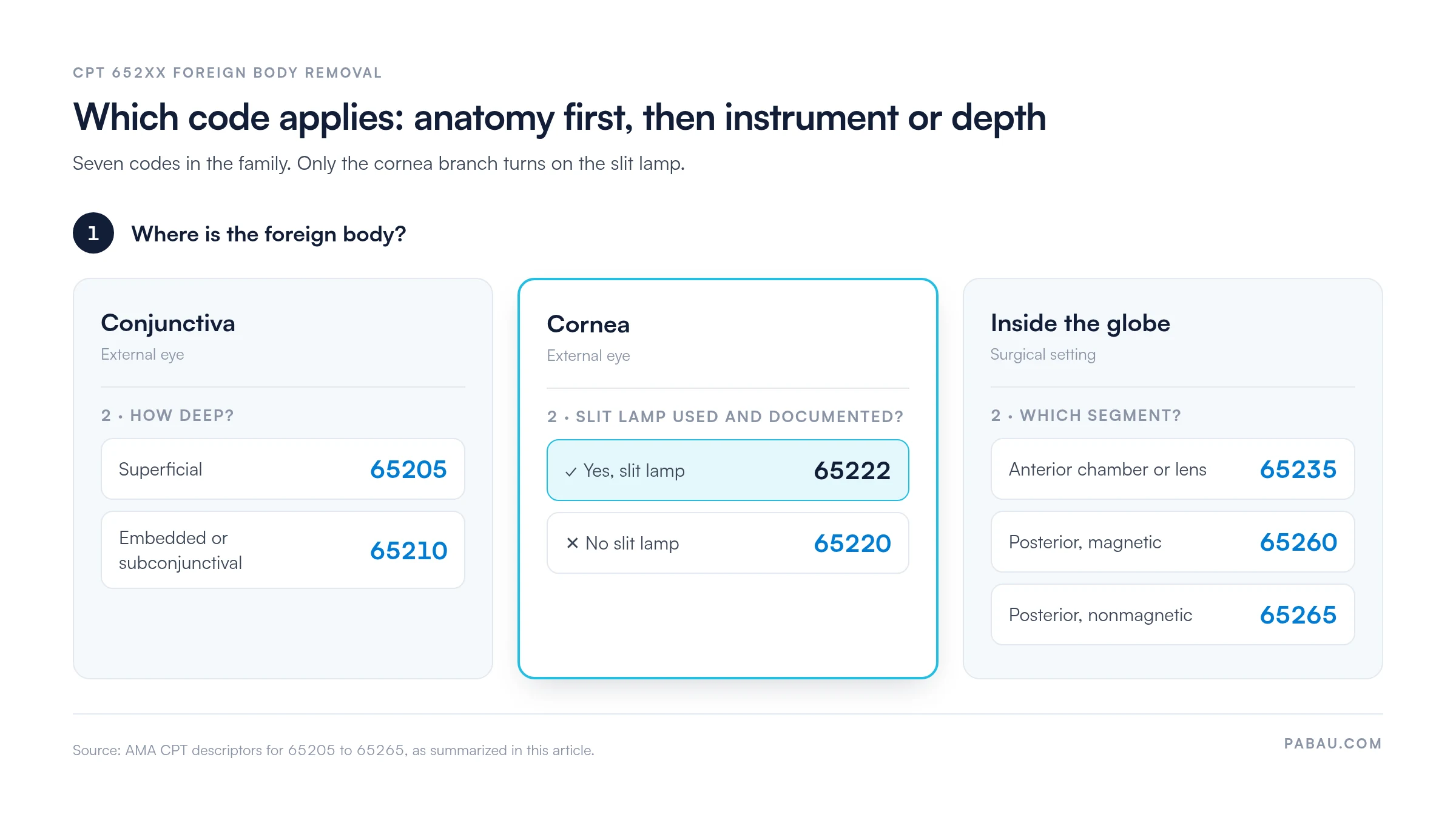
65222 sits in the eye and ocular adnexa range of the CPT procedure codes. Its 652xx foreign body family branches on anatomy first, then on instrument or depth. This table maps the full family.
Decision shortcut: If the foreign body is in the conjunctiva, start at 65205 or 65210. If it is in the cornea, the question is simply whether a slit lamp was used. Yes = 65222. No = 65220.
Intraocular foreign bodies route to 65235, 65260 or 65265 and belong in a surgical facility, not an office encounter. The diagram below walks through the same two questions.
Four modifiers apply regularly to 65222 claims. Using the wrong one, or omitting a required one, accounts for a significant share of denials on this code.
On modifier 25: 65222 is a minor procedure with a 0-day global. The same-day evaluation that leads to the removal is bundled into the procedure payment.
A same-day E/M is billable with modifier 25 only when it is significant and separately identifiable beyond the usual pre-procedure assessment. That applies to new and established patients alike. An example is reviewing diabetic eye disease while also removing the foreign body. Document the E/M separately, and do not add modifier 25 simply because a brief exam preceded the procedure.
Verify your MAC’s bilateral billing policy before using modifier 50 on 65222. Some MACs require two separate line items (65222-RT and 65222-LT) rather than a single 65222-50 line. Filing the wrong format will trigger a denial even when the procedure itself was performed correctly.
Medicare pays for CPT code 65222 based on the Relative Value Units (RVUs) assigned to the code. Those RVUs are multiplied by the annual conversion factor and adjusted by a geographic practice cost index (GPCI) for each Medicare Administrative Contractor (MAC) locality. The CMS Medicare Physician Fee Schedule look-up tool returns the exact national and locality-adjusted rates for any year.
National non-facility rates are higher than facility rates. The practice expense component changes when the service moves from an office to an ambulatory surgery center or hospital outpatient department. For a minor procedure like 65222 performed in an ophthalmology office, the non-facility rate applies in most cases.
For current RVU components, use the FastRVU 2026 RVU look-up tool, which mirrors CMS data and allows locality filtering. Private-payer rates vary by contract, so check the fee schedule you agreed with each payer.
CPT code 65222 carries a 0-day global period. The CMS Medicare Physician Fee Schedule lists it with global indicator 000, the same as 65205, 65210, and 65220. That makes it a minor procedure: the global package covers the date of service only, with no post-operative window after it.
What is included in the payment for 65222:
What can be billed separately:
Rust ring billing is the most variable area for this code. The AAO guidance indicates that rust ring removal is generally considered part of the original foreign body removal when it happens in the same session. When the clinician defers it to a later visit, some payers accept a separate 65222 on that date, while others bundle it.
Because the global period is 0 days, that later visit needs no global-period modifier such as 58 or 79. Use the subsequent-encounter diagnosis (T15.01XD or T15.02XD), document why removal was deferred, and confirm the policy with your payer before submitting.
Most payers do not require prior authorization for CPT code 65222 because corneal foreign body removal is an urgent procedure. Requiring pre-approval for a patient presenting with acute eye pain and a metallic fragment in the cornea is not consistent with medical necessity standards.
That said, documentation of acuity matters. The procedure note should reflect the urgent nature of the visit: patient-reported onset, occupational exposure history, and the clinical urgency that required same-day intervention. This protects the claim in a medical necessity review.
Place of service (POS) code also affects payment. Most 65222 claims use POS 11 (office).
If the procedure takes place in an emergency room or ambulatory surgery center, use that site’s POS code. Expect a lower physician payment there, because the facility overhead is paid separately. A POS that doesn’t match where the service took place overstates the payment, which makes it a compliance problem for the practice.
Claims for corneal foreign body removal with slit lamp are denied for predictable reasons. Building a denial checklist into the pre-submission workflow catches most of them before the claim leaves the practice. Systematic denial management workflows reduce resubmission lag and protect cash flow.
Running a clean claim submission checklist against 65222 encounters before batch submission catches laterality errors and missing modifiers before they generate a denial cycle.
Pairing the correct ICD-10 code with 65222 is essential for medical necessity and laterality alignment. The T15 category covers foreign body on the external eye. Use the most specific code available, which means coding laterality (right or left) rather than defaulting to unspecified.
The laterality character in ICD-10-CM T15 codes is the fifth character: 0 = unspecified eye, 1 = right, 2 = left. The sixth is the placeholder X, and the seventh is the encounter character.
Always document the affected eye in the clinical note so the laterality codes can be assigned correctly. Payers that cross-check the ICD-10 laterality against the CPT modifier (RT/LT) will deny claims where these do not agree.
A clean medical billing workflow for 65222 runs through five linked steps. Each is easy to get right when the system enforces it, and easy to miss when it doesn’t.
Steps for a clean 65222 claim in an EHR or practice management system:
Add a pre-submission scrub rule in your practice management system that flags any 652xx claim without an RT or LT modifier. This single rule eliminates the most common denial trigger for the entire corneal and conjunctival foreign body removal code family without any manual review overhead.
Pabau, the practice management platform we build, runs these checks in its eye care claims software. It flags the modifier and ICD-10 laterality mismatches behind most 65222 denials before the claim goes out.
Claims go out through Pabau’s Claim.MD integration, which connects practices to more than 4,000 US payers. It covers CMS-1500 and 837P submission, real-time eligibility verification, and ERA posting.
The outcome is fewer 65222 claims coming back for rework. Your billing team stops chasing laterality and modifier errors and spends that time on new encounters instead.

Pabau’s claims management flags missing modifiers, laterality mismatches, and ICD-10 errors before claims leave the practice. Your billing team spends its time on new encounters instead of rework.

65222 claims fail on two points above all others. The slit lamp is missing from the procedure note, or the RT or LT modifier is missing from the claim.
Neither fix needs a policy change or extra staff. Add a note template that prompts for slit lamp use, and a scrub rule that holds any 652xx claim without RT or LT. With both in place, the two most common causes of rework on this code are caught before submission.
Pabau runs those checks automatically and sends claims through Claim.MD with laterality-matched ICD-10 codes. Book a demo to see how it keeps 65222 claims clean from procedure note to payment.

Want these claim checks built into your billing? Claims management software covers the end-to-end billing workflow, from code selection through ERA posting.
Unsure how clearinghouse submission works? Medical claims clearinghouse guide explains how 837P files reach payers and how ERAs come back.
Want to understand the 837 file format behind electronic claims? 837 file overview covers the transaction set used for CMS-1500 and professional claims.
Removing corneal epithelium rather than a foreign body? CPT code 65435 covers corneal epithelium removal, with or without chemocauterization.
Billing the eye exam for a new patient? CPT code 92002 covers the intermediate ophthalmological exam for a new patient.
CPT code 65222 covers removing a foreign body from the cornea under a slit lamp biomicroscope. It includes the slit lamp examination, mechanical dislodgement with a needle or spud, and any same-session rust ring removal. The code applies when the foreign body sits in the corneal epithelium or stroma, not the conjunctiva. Slit lamp use must also be documented in the procedure note.
The only difference is slit lamp use. 65222 requires the slit lamp to be used and documented. 65220 applies when the corneal foreign body is removed without one, such as in an emergency room or urgent care setting. Both codes cover the cornea, so the instrument is the only distinction.
CPT code 65222 is coded per eye, not per foreign body. If three metallic fragments are removed from the right cornea in one encounter, the code is billed once with modifier RT. The American Academy of Ophthalmology confirms this in its coding guidance: the unit of service is the eye, not the number of particles extracted.
Four modifiers apply. RT (right eye) or LT (left eye) shows laterality and is required on every single-eye claim. Modifier 50 marks a bilateral procedure in the same session. Modifier 25 goes on a significant, separately identifiable E/M service billed the same day. Modifier 79 applies only when 65222 falls inside the global period of an earlier, unrelated surgery. 65222 itself has a 0-day global.
CPT code 65222 has a 0-day global period. The CMS Medicare Physician Fee Schedule lists it with global indicator 000 as a minor procedure. The same-day evaluation is bundled. A same-day E/M is billable with modifier 25 only when it is significant and separately identifiable beyond the usual pre-procedure assessment, and documented separately. Follow-up visits on later dates are not bundled and can be billed as E/M services.
The two most common triggers are a missing RT or LT modifier and a downcode to 65220 when slit lamp use isn’t documented. Other frequent causes include a T15.0- laterality code that doesn’t match the CPT modifier, and a same-day E/M billed without modifier 25. A place-of-service code that doesn’t match where the service took place also triggers denials.