CCSD Code V1730: Extraoral fixation of mandible
What is CCSD code V1730? CCSD code V1730 is the UK private medical insurance cod...

Last Updated: Nov 24, 2026
Billable Code
65220 is the CPT code for removal of foreign body, external eye; corneal, without slit lamp. It covers taking a foreign body off the cornea using topical anesthetic and irrigation, a cotton-tipped applicator, or a needle.
The slit lamp decides the code. If the provider used one during the removal, bill 65222 instead. Medicare also expects an RT or LT modifier on each 65220 line, paired with a laterality-specific T15.0 diagnosis code.
Let Pabau's smart automation suggest the right codes, reduce claim denials, and keep your practice compliant—effortlessly.
Automate repetitive tasks and focus on what matters most—your patients.
Reduce coding errors and ensure compliance with the latest regulations.
Clean claims, fewer denials, and faster reimbursements.
Powerful insights and reporting to help your practice thrive.
HIPAA compliant SOC 2 certified GDPR-compliant Trusted by 4,000+ clinics worldwide

CPT code 65220 covers corneal foreign body removal without a slit lamp, and slit lamp use during the removal moves the claim to 65222.
Medicare and most commercial payers expect an RT or LT laterality modifier on every 65220 claim line.
Pair 65220 with T15.01XA for the right eye or T15.02XA for the left eye at the initial encounter. A wrong seventh character is a common denial trigger.
Pabau, a practice management platform, supports electronic insurance claims in the US through Claim.MD, with eligibility checks and remittances.
CPT code 65220 is the procedure code for “Removal of foreign body, external eye; corneal, without slit lamp.” The CPT Editorial Panel, convened by the American Medical Association, maintains that code set, as the AMA’s CPT code set overview explains. The code sits in the Eye and Ocular Adnexa section (65091 through 68899), within the removal of foreign body range, 65205 through 65265.
In the typical case, a patient arrives with a metal fragment, wood chip, or airborne particle on the cornea. The provider applies topical anesthetic, then removes it with irrigation, a cotton-tipped applicator, or a 25-gauge needle or eye spud. What makes the claim 65220 is that no slit lamp was used for the removal. If the provider used one at any point during the removal itself, 65222 applies instead.
Use this quick-reference table for charge entry and claim review. It gives no dollar rate, because MPFS rates update each January. Look up the current figure in the CMS Physician Fee Schedule lookup tool.
The record behind a 65220 claim must establish three things: The clinical indication, the method used, and which eye was treated. A claim missing any one of them is open to denial or audit.
Required documentation elements:
A note may document a slit lamp exam at the start of the encounter to locate the foreign body. If it then states that the removal itself used no slit lamp, 65220 still applies. What counts is whether the slit lamp was used during the removal.
A frequent coding error on corneal foreign body claims is billing 65220 when the slit lamp was used. The rule is simple. If a slit lamp was used during the removal, bill 65222.
Downcoding from 65222 to 65220 because “it looks like a simple case” is incorrect. If the physician used the slit lamp, the note records it and the claim carries 65222, however straightforward the removal looked.
Anatomy drives code selection across the main eye foreign body removal codes. Cornea and conjunctiva are distinct structures, so the note must name the location clearly. Two questions settle the code: Where the object sat, and how it came out. An object cut out of the eyelid tissue is a separate case, billed with CPT 67938.
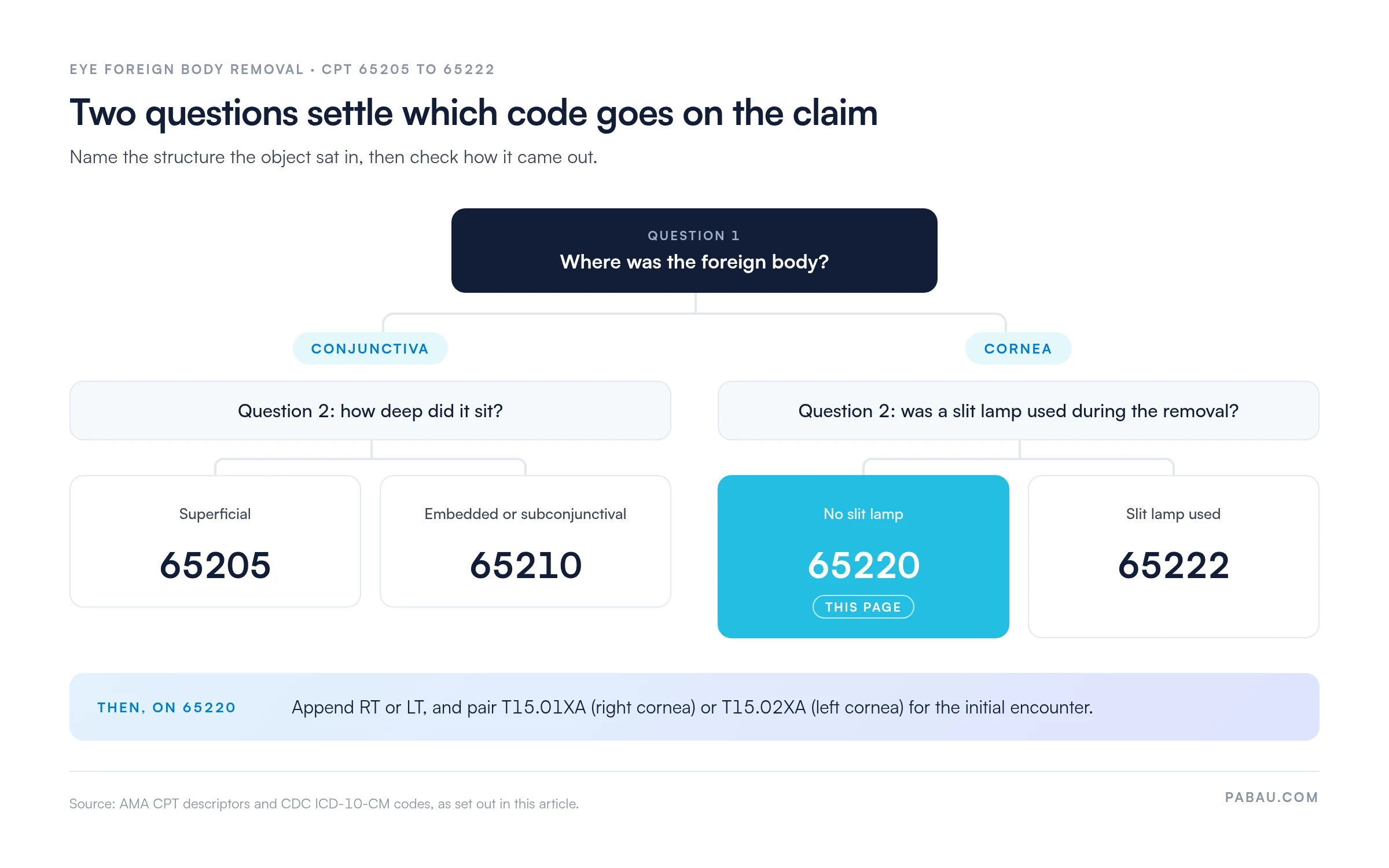
When a foreign body spans both the conjunctiva and cornea, code the primary site. If the documentation is vague about location, query the provider before you submit. A claim with the wrong anatomic code describes a procedure that did not happen, and auditors treat it that way.
A metallic foreign body left in place long enough stains the corneal stroma with a rust ring, a hemosiderin deposit. The ring stays after the metal fragment comes out. The usual code for removing it is 65435, which covers removal of corneal epithelium. Whether it can be billed separately on the same date depends on the NCCI edits in effect at the time of service.
Same-date scenario: If the rust ring comes out at the same encounter as the foreign body, NCCI edits may bundle 65435 into 65220. Check the current NCCI table before you submit both codes for the same date. Modifier 59 (distinct procedural service) may allow separate payment when the rust ring removal was a separate procedure with its own documentation. Payer acceptance varies.
Subsequent-visit scenario: Sometimes the patient returns on a later date only for rust ring removal, after the foreign body was extracted. In that case, 65435 is billable as a standalone procedure. The note must document that the foreign body is gone and the rust ring is the sole indication for the return visit.
The correct ICD-10-CM codes for a corneal foreign body are in category T15.0. The seventh character marks the encounter as initial, subsequent, or sequela. Getting it wrong is a common denial trigger for CPT code 65220 claims. Verify codes against the CDC ICD-10-CM lookup tool for the current code year.
The “X” placeholder in T15.01XA is required. The code runs to seven characters, and the claim fails the edit without the placeholder. Keep T15.00XA (unspecified eye) as a last resort. Payers prefer laterality-specific codes, and the clinical note almost always names the eye.
Eye procedure codes have strict modifier requirements. Submitting a clean claim for CPT code 65220 means appending the right modifier before the claim leaves your system.
Bilateral corneal foreign body removal in a single encounter is unusual but does occur in occupational injury scenarios. When both eyes are treated, check what the payer prefers. Some want modifier 50 on a single line, and others want two lines, RT on one and LT on the other. Medicare follows the MPFS bilateral indicator for the code. Commercial payers vary, so confirm before submission.
Yes. CPT 65220 can be billed on the same date as the ophthalmology E&M codes 92012 (established, intermediate) or 92014 (established, comprehensive). The exam must be a significant, separately identifiable service beyond the decision to remove the foreign body.
The documentation must show that the E&M addressed elements not simply part of the pre-operative assessment for the removal. For example, the physician assessed best-corrected visual acuity and examined the anterior and posterior segments for other pathology. They also updated the problem list, separate from the foreign body issue. That work counts as a separately identifiable service.
Medicare reimbursement for CPT code 65220 is calculated from the Medicare Physician Fee Schedule (MPFS). Place of service affects the rate. Non-facility (POS 11, office) pays a higher amount, because the practice carries the overhead. Facility (POS 22 outpatient hospital, POS 23 emergency room) pays a lower physician rate, because the facility bills its overhead separately.
Rates update each January 1 with the annual MPFS final rule. Use the CMS MPFS Look-Up Tool for the current year’s rate, because figures printed in billing guides go stale within months.
Prior authorization: Most payers do not require prior authorization for CPT 65220, given its minor-surgery global period classification and urgent/unplanned presentation. However, commercial payer policies vary and change annually. Confirm with each plan’s provider portal rather than assuming universal PA exemption. The insurance eligibility verification step before the encounter is the right time to identify any payer-specific PA requirements.
Most 65220 denials are preventable. The denial management workflow for this code follows a consistent pattern. The usual causes are a missing modifier, a wrong ICD-10 extension, or upcoding to 65222 when the note does not support it.
Two scrubber rules catch the first two rows of this table before submission. One checks every eye code for RT or LT, and the other checks every T15.0 code for its seventh character. When an EOB denial does arrive, look up its CARC and RARC codes in our guide to medical billing denial codes.
Run a weekly edit check on the eye procedure codes billed in the previous seven days. Filter your claim scrubber for CPT codes 65205 to 65222 and confirm RT or LT is on every line. Laterality omissions are the fastest fix in ophthalmology billing. Set the check up once, and it catches the error before it costs you a denial cycle.
In many practices, the removal note is free text, and a biller reads it days later to pick the code, the eye, and the diagnosis. Each of those three choices is a chance for the claim to drift from what happened in the exam room.
In Pabau, a practice can build a treatment form for foreign body removal. It records the eye treated, the removal method, and whether a slit lamp was used. The biller then codes from those answers instead of interpreting a narrative.
For US practices, Pabau’s streamlined claims management sends CMS-1500 and 837P claims through the Claim.MD clearinghouse. It also runs eligibility checks before the visit and brings ERA remittances back for matching.
The result is a claim built from the same answers the provider recorded, which leaves less for the biller to interpret.

Pabau records the eye treated and the removal method on structured forms. It then sends US claims through Claim.MD, with eligibility checks and ERA remittances.

The safest habit with 65220 is to settle the code in the exam room. A note that names the eye and says outright whether a slit lamp was used leaves the biller with no judgment calls.
The cost is a few extra seconds of documentation per patient. In return, the RT or LT modifier, the T15.0 seventh character, and the choice between 65220 and 65222 all follow from the record.
Pabau supports electronic insurance claims in the US by integrating with Claim.MD’s clearinghouse for US payers, with eligibility checks and remittances. Book a demo to see how Pabau handles eye procedure documentation and claims for your practice.

Removed an embedded conjunctival foreign body instead? CPT code 65210 covers the embedded and subconjunctival removals that fall outside 65220.
Was the foreign body on the conjunctival surface? CPT code 65205 explains billing for superficial conjunctival foreign body removal.
Billing an eye exam on the same day? CPT code 92014 covers the comprehensive established-patient exam that pairs with modifier 25.
Seeing repeated claim rejections on eye procedure codes? Denial management in healthcare covers the full workflow for investigating, correcting, and appealing rejected claims.
Want to understand how the 837P claim format works? 837 file structure and submission explains how claim data maps from your practice management system to the payer.
CPT code 65220 covers removal of a foreign body from the cornea without a slit lamp. The provider typically uses topical anesthetic, then irrigation, a cotton-tipped applicator, or a needle. It is billed per eye with an RT or LT modifier.
CPT 65220 applies when the foreign body is removed without a slit lamp. CPT 65222 applies when a slit lamp was used during the removal. The instrument decides the code, whatever the complexity of the foreign body. Bill 65222 whenever the note documents slit lamp use during the removal.
The primary ICD-10-CM codes are T15.01XA (foreign body in cornea, right eye, initial encounter) and T15.02XA (left eye, initial encounter). For follow-up visits, use T15.01XD or T15.02XD. The “X” placeholder is required, because each code runs to seven characters and an incomplete code fails the payer’s edit.
The most common reasons are a missing RT or LT modifier and a wrong ICD-10 seventh character. Billing 65220 when the note shows slit lamp use is another, since that case is 65222. So is a same-day E&M billed without modifier 25. Each one is correctable on appeal with supporting documentation.
Yes, provided a significant, separately identifiable E&M service was performed beyond the decision to remove the foreign body. Append modifier 25 to the E&M code, never to 65220. The clinical note must clearly separate the E&M work from the procedural note for the removal.
CPT 65220 is billed per eye. Use modifier RT for the right eye or LT for the left eye. For the rare bilateral same-date case, check whether the payer wants modifier 50 on one line or separate RT and LT lines. Medicare follows the MPFS bilateral indicator, and commercial payers vary.