HCPCS Code J7620: Ipratropium albuterol billing guide
What is HCPCS Code J7620? HCPCS Code J7620 is the Level II code for a premixed n...

Last Updated: Nov 24, 2026
67938 is the CPT code for removal of embedded foreign body, eyelid. It applies when an object has lodged in eyelid tissue, such as the skin, orbicularis muscle or tarsal plate, and has to be cut out.
The code sits in the eyelid reconstruction range (67930-67975) of the CPT Surgery section and carries a 10-day global period. A foreign body on or in the conjunctiva is reported with 65205 or 65210 instead.
Let Pabau's smart automation suggest the right codes, reduce claim denials, and keep your practice compliant—effortlessly.
Automate repetitive tasks and focus on what matters most—your patients.
Reduce coding errors and ensure compliance with the latest regulations.
Clean claims, fewer denials, and faster reimbursements.
Powerful insights and reporting to help your practice thrive.
HIPAA compliant SOC 2 certified GDPR-compliant Trusted by 4,000+ clinics worldwide

CPT code 67938 covers surgical removal of a foreign body embedded in eyelid tissue, not one on the conjunctiva or cornea.
Every 67938 claim needs the side named, with eyelid modifiers E1 to E4 or RT and LT, depending on what the payer accepts.
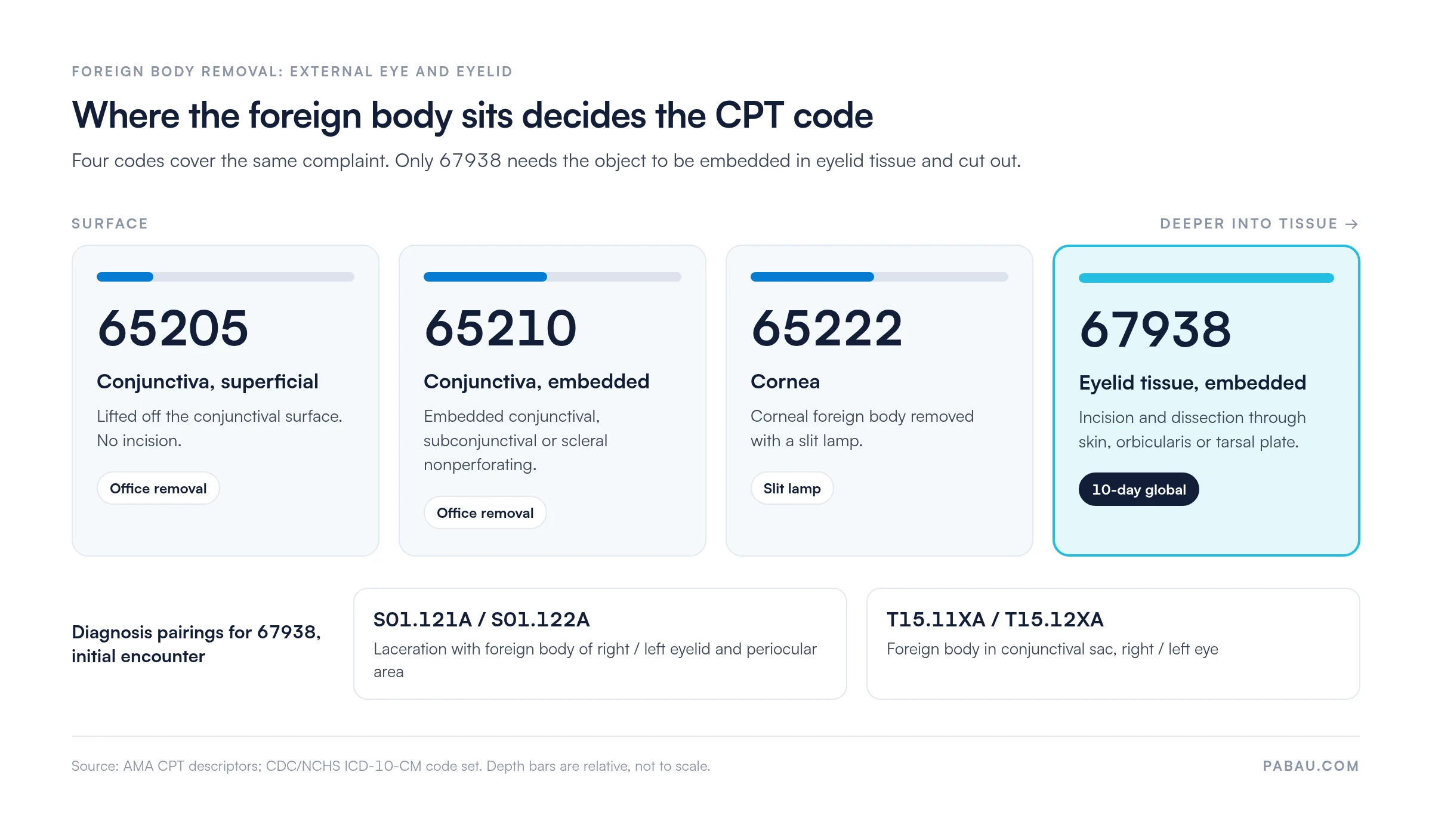
For an initial encounter, pair 67938 with S01.121A or S01.122A for a laceration with a foreign body of the right or left eyelid.
T15.11XA (right eye) and T15.12XA (left eye) fit when the record places the object in the conjunctival sac, and laterality must match the operative note.
Pabau’s claims management software sends 67938 claims through the Claim.MD clearinghouse and flags a missing prior authorization code on the case.
CPT code 67938 is the procedure code for removing a foreign body embedded in the eyelid. It applies when the object has to be cut out of the lid tissue. In the CPT code set it sits under reconstruction procedures on the eyelids, in the 67930-67975 range of the Surgery section. It is reportable in facility and non-facility settings and carries a 10-day global period.
The key word in the descriptor is “embedded.” A foreign body sitting on the conjunctival surface is not an eyelid procedure and belongs in the 65205-65222 range. Confirm the foreign body has penetrated eyelid tissue before billing 67938. The ocular adnexa subsection (67311-67999) groups three families of codes: extraocular muscles, the orbit, and the eyelids.
Embedded foreign body eyelid surgery removes material that has penetrated the substance of the eyelid, typically the tarsal plate or the soft tissue around it. The surgeon reaches it through incision and dissection, then extracts it. That depth and technique separate it from conjunctival or corneal removals.
Common culprits are metal fragments from workshop or industrial injuries, wood splinters, glass shards, and small projectiles. The eyelid is built from skin, orbicularis muscle, the tarsal plate (a dense fibrous layer that gives the lid its shape), and conjunctiva. Once a foreign body sits in the tarsal plate or deeper, it needs surgical access.
The typical surgical sequence runs as follows:
Medical necessity rests on showing that the foreign body cannot be removed by non-surgical means. The note should also say what leaving it in place would risk, such as infection, impaired lid function, or structural damage. Document any failed conservative attempts before the case proceeds to surgery.
The most frequent coding error on eyelid foreign body cases is reporting a conjunctival or corneal code for an object embedded in the lid. A superficial conjunctival foreign body is reported with 65205, and an embedded conjunctival one with 65210.
A corneal foreign body removed at the slit lamp goes to 65222 instead. Read side by side, the four codes turn on a single question: how deep the object sits, and in which tissue.
Billing forums regularly ask whether 67938 applies to contact lens removal. It does not. A stuck or lodged contact lens is not a surgically embedded foreign body in eyelid tissue. Report that encounter with the appropriate evaluation and management code, or with a contact lens service code (92310-92326). A 67938 claim for a contact lens is an improper code assignment that payers deny, and it can trigger a documentation audit.
The diagnosis code has to describe where the foreign body was found, and its laterality must match the side in the operative note. A laceration with a foreign body of the eyelid falls in S01.12-, while a foreign body in the conjunctival sac falls in T15.1-. A right-eye diagnosis on a claim carrying a left-eye modifier will be denied.
ICD-10-CM codes update every fiscal year. Confirm that the codes above are still valid for the date of service with the CDC/NCHS ICD-10-CM web tool. The 7th character (A for initial, D for subsequent, S for sequela) reflects the phase of care, not the visit number.
A clean claim submission for 67938 depends on an operative note that covers each element a payer checks when reviewing medical necessity.
The operative note must include:
If intraoperative photography or imaging recorded the foreign body, file it with the operative note. Check the payer’s local coverage policy before the procedure date, since some contractors publish their own documentation criteria for eyelid surgery.
Run an eligibility check and confirm whether the payer has an active LCD for eyelid foreign body removal before scheduling. Some Medicare Administrative Contractors publish documentation criteria that go beyond the standard operative note elements. Flag patients whose payer requires prior authorization for eyelid procedures, so the authorization is in place before the case date.
Modifiers on 67938 claims follow standard Medicare and NCCI rules for eye and eyelid procedures. A wrong or missing modifier leads to a denial or a reduced payment.
Check which laterality form each payer accepts before the claim goes out. NCCI bundling edits change quarterly, so check the current edits for 67938 at the time of billing. The AAPC Codify CPT lookup shows current NCCI edits alongside code descriptors.
Medicare reimburses CPT code 67938 under Part B through the Medicare Physician Fee Schedule (MPFS). Payment is the total Relative Value Units (RVUs) multiplied by the annual conversion factor. Geographic practice cost indices (GPCIs) then adjust it for the practice location.
The RVU components behind a 67938 payment are listed below. Verify current-year figures before billing.
Non-facility payment is higher than facility payment because the practice carries the overhead when the procedure happens in the office. Use the CMS Physician Fee Schedule lookup for the current-year amount in your locality. Rates change each January 1. For a quick RVU calculation with GPCI adjustments, the FastRVU 2026 lookup tool shows current-year values.
Commercial payer rates vary by contract but often benchmark at a percentage of the Medicare allowed amount. Prior authorization requirements differ by payer and plan year. Run insurance eligibility verification at scheduling to confirm coverage, benefits, and any prior authorization requirement.
Most 67938 denials come from a short list of preventable errors. Each one below has a matching fix in denial management workflows.
Track first-pass acceptance, denial rate by payer, and days to payment for 67938. A cluster of denials from one carrier, or on one modifier combination, points to the process that needs fixing.
Build a 67938 pre-submission checklist. Confirm the code is eyelid (not conjunctival or corneal), the laterality modifier is applied, and the ICD-10 laterality matches it. Check that prior authorization is on file if required. Then confirm the operative note records mechanism, depth, technique, and side.
Most practices bill 67938 from an operative note in one system and a claim form in another. The laterality, the diagnosis, and the authorization code get re-keyed by hand, and that is where mismatches creep in.
Pabau, a practice management platform with built-in denial-reducing claims management, keeps the operative note and the claim on the same patient record. The prior authorization code, dates, and sessions sit on the case, and Pabau warns the team when one is missing.
US claims go out as CMS-1500/837P files through the Claim.MD clearinghouse. Eligibility responses and ERA remittances come back against that patient record. A rejected 67938 claim shows up the day it happens, not at month-end reconciliation.

Pabau’s claims management software submits 67938 claims through the Claim.MD clearinghouse, checks eligibility, and posts ERA remittances against the patient record. Book a demo to see it in an oculoplastic or ophthalmology practice.

A 67938 claim stands or falls on one fact the coder cannot infer. The foreign body was embedded in eyelid tissue and had to be cut out. If the operative note says so plainly, with the lid, the depth, and the technique, the code holds up. If it does not, the claim reads like a 65205 or 65210 and gets denied.
Treat the side as the second fact to lock down. The modifier, the ICD-10 laterality, and the note all have to name the same eyelid. Book a demo to see how Pabau keeps the operative note, prior authorization, and claim for eyelid procedures in one record.

Need a clearinghouse that handles ophthalmology claims end-to-end? Medical claims clearinghouse guide explains how clearinghouses validate, route, and report on surgical procedure codes before they reach the payer.
Trying to reduce your overall claim rejection rate? Claim.MD clearinghouse integration overview covers how Pabau routes CPT claims through Claim.MD with real-time eligibility and ERA responses.
Unsure how to read the remittance after a 67938 denial? Electronic remittance advice (ERA) guide walks through how to interpret 835 remittance files and identify CARC denial codes.
Want to see where 67938 denials hit your revenue? Revenue cycle management explained covers the end-to-end process from procedure to payment posting.
CPT code 67938 covers surgical removal of a foreign body embedded within eyelid tissue. The object has penetrated the skin, orbicularis, or tarsal plate and needs incision and dissection to extract. It does not cover conjunctival removal (65205 or 65210) or corneal removal (65222).
Use 67938 when the foreign body is embedded in eyelid tissue (skin, orbicularis, or tarsal plate) and requires surgical extraction. Use 65205 when it sits superficially on the conjunctiva and comes off without incision, and 65210 when it is embedded in the conjunctiva. Use 65222 when it is in the cornea and removed with a slit lamp. The anatomical location documented in the operative note decides the code.
S01.121A (right eyelid) and S01.122A (left eyelid) describe a laceration with a foreign body of the eyelid on the initial encounter. T15.11XA (right eye) and T15.12XA (left eye) fit when the record places the object in the conjunctival sac. The ICD-10 laterality must match the modifier on the claim and the operative report. Use the D 7th character, such as T15.11XD, for subsequent encounters.
Yes, Medicare reimburses 67938 under Part B through the Medicare Physician Fee Schedule. The non-facility rate is higher than the facility rate because CMS applies different practice expense RVUs depending on where the procedure happens. Dollar amounts change each January 1, so use the CMS MPFS lookup tool for current values in your locality.
Every 67938 claim needs laterality: the eyelid modifiers E1 to E4, or RT and LT where the payer accepts them. Modifier -78 applies if the patient returns to the operating room for a related complication within the global period. Modifier -59 applies when 67938 is billed with another same-day procedure that has a distinct indication. Modifier -24 goes on E&M codes (not 67938 itself) for unrelated visits during the global period.
No. Contact lens removal, even when complicated, does not involve a foreign body embedded in eyelid tissue. It does not meet the descriptor for 67938. Using 67938 for it is an improper code assignment. Bill the encounter with the appropriate E&M code or a contact lens service code (92310-92326), depending on the services provided.
The most frequent denial reasons are a wrong code (65205 or 65222 instead of 67938) and a missing laterality modifier. Thin medical necessity documentation and missing prior authorization follow. For a wrong-code denial, rebill with 67938 and attach the operative note. For a missing modifier, file a corrected claim with the laterality modifier. For a medical necessity denial, appeal with the full operative note and a letter of medical necessity.