HCPCS code V5259: Digital binaural ITC hearing aid billing
HCPCS code V5259 reports a digital ITC hearing aid pair HCPCS code V5259 reports...

Last Updated: Oct 22, 2026
65205 is the CPT code for removal of foreign body, external eye; conjunctival superficial. It covers a loose particle lifted off the conjunctiva in a single visit.
Location matters most. A corneal foreign body never belongs on 65205, and an embedded one moves to 65210. Those two errors are common causes of 65205 denials. The code has a 0-day global period, so same-day E/M billing and bilateral modifiers need care, even for experienced billing teams. The sections below cover code choice, diagnosis pairings, modifiers and a pre-submission checklist.
Let Pabau's smart automation suggest the right codes, reduce claim denials, and keep your practice compliant—effortlessly.
Automate repetitive tasks and focus on what matters most—your patients.
Reduce coding errors and ensure compliance with the latest regulations.
Clean claims, fewer denials, and faster reimbursements.
Powerful insights and reporting to help your practice thrive.
HIPAA compliant SOC 2 certified GDPR-compliant Trusted by 4,000+ clinics worldwide

CPT code 65205 covers removal of a superficial foreign body from the conjunctiva, not the cornea.
Embedded conjunctival, subconjunctival or scleral nonperforating foreign bodies move to 65210.
Corneal foreign bodies use 65220 without a slit lamp or 65222 with one.
Pair 65205 with T15.11XA for the right eye or T15.12XA for the left on the first visit.
Pabau, our practice management software, pre-fills 65205 claims from the patient record. It adds CPT and ICD-10 lookups, required-field checks and Claim.MD submission.
CPT code 65205 is defined by the American Medical Association as removal of foreign body, external eye; conjunctival superficial. The code is active for 2026. It sits in the Eyeball subsection of Eye and Ocular Adnexa, under Removal of Foreign Body. Its neighbors are listed in our CPT codes library.
Three checks decide whether 65205 is the right code.
A loose particle caught under the upper lid is still superficial. Everting the lid to reach it doesn’t turn the case into 65210. The descriptor doesn’t name a removal method either. Irrigation, a moistened cotton swab, jeweler’s forceps or a needle tip all qualify, as long as the note names the technique.
With the scope settled, the next job is the note itself. A typical conjunctival foreign body visit runs in a set order. Each step maps to something the payer expects to see in the record.
Skipping a step leaves the claim open to a medical necessity denial. For example, a note that records localization but not technique gives an auditor grounds to deny it.
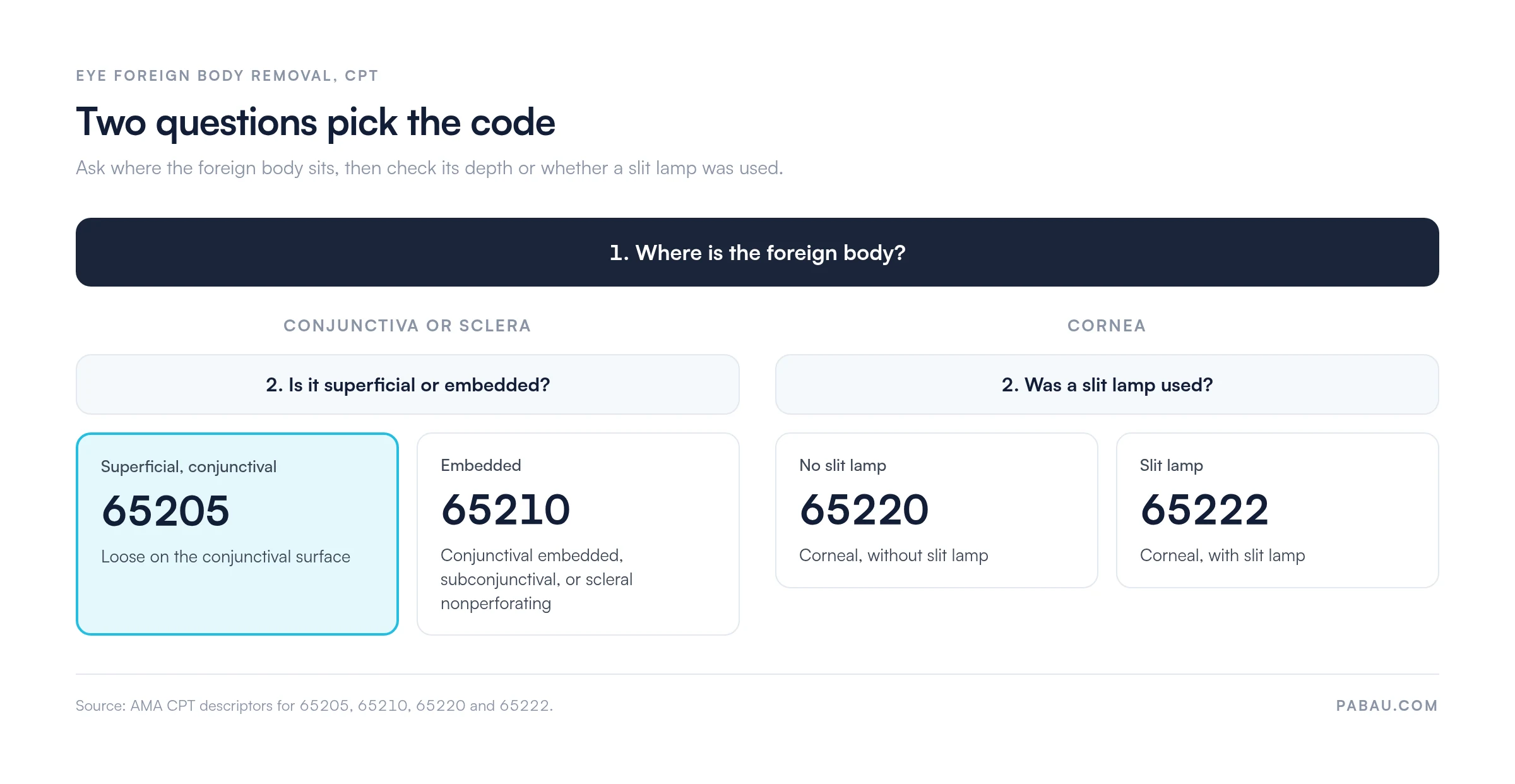
Four codes cover foreign bodies on the outer eye, and they split by site and depth. Picking the wrong one is a common reason 65205 claims come back. When in doubt, cross-check the descriptors in AAPC Codify.
The decision runs in two steps, as the diagram below shows. First, is the foreign body on the cornea or the conjunctiva? If it’s conjunctival, is it sitting loose or embedded in the tissue? A corneal case removed at the slit lamp belongs on CPT code 65222 instead.
Once the procedure code is right, the diagnosis has to match it. Medical necessity for 65205 comes from the T15.1 subcategory, foreign body in conjunctival sac. Payers expect laterality, and a Z-code alone won’t support the procedure.
Check the current code set on the CMS ICD-10 page before you submit.
Always code to the highest specificity the chart supports. If the note says right eye, T15.10XA is a coding error, not a safe fallback. Sequela codes (7th character S) apply only to late effects after the injury has healed. They don’t cover complications during the acute treatment course.
Under the CMS Medicare Physician Fee Schedule, CPT code 65205 carries a 0-day global period. There’s no post-operative period, which is why same-day E/M questions come up so often. For current payment rates by locality, check FastRVU’s RVU lookup tool.
Payment follows the usual facility and non-facility split.
The POS code must match where the procedure took place. A POS 11 claim for work done in a hospital outpatient department is a compliance risk and an audit trigger.
Commercial payers usually pay a multiple of the Medicare allowable, set by contract. Practices that submit through the Claim.MD clearinghouse can check payer eligibility before submission.
Payment rates are only half the picture, because modifiers decide whether the line pays at all. Modifier choice on 65205 is a common audit trigger in eye care billing. Most problems come from bilateral cases and same-day services.
For bilateral removal, check the MPFS bilateral indicator and your MAC’s policy before choosing -50 or RT/LT lines. Some payers want one line with -50. Others want two lines, 65205-RT and 65205-LT.
Never use both methods on the same claim, because that reads as duplicate billing.
Medicare treats 65205 as a minor procedure. The exam that leads to the decision to remove the foreign body is included in its payment. So an E/M on the same date is payable only when it covers separate, significant work.
Quick test: did the visit go beyond the foreign body? A full eye exam prompted by new vision changes counts. So does evaluating an unrelated condition at the same visit. If the answer is yes, follow these three rules.
Chapter 12 of Medicare’s Claims Processing Manual sets out this guidance. Without modifier -25 on the E/M, automated edits deny it as bundled into the procedure.
Run a monthly audit of every encounter where 65205 and an E/M code share a date of service. Flag any without modifier -25 on the E/M. In a busy ophthalmology practice, missed modifiers add up quickly. A consistent pattern also draws payer scrutiny.
A clean claim for 65205 starts in the procedure note. Run through this list before the claim leaves the practice.
Here’s how that looks in practice. A note that reads “conjunctival FB removed” fails on technique and on confirmation. This version passes: “Superficial foreign body, inferior palpebral conjunctiva OD, seen at slit lamp. Removed with moistened cotton-tipped applicator. Slit-lamp recheck confirmed complete removal.”
Even with a good checklist, some claims still come back. Strong denial management starts with knowing which errors to prevent. Here are six common denial reasons for 65205 claims, each with a quick fix.
Software can catch some of these early. Look for a system that pre-fills claims from the record and offers code lookup. It should also hold back any claim with missing required fields before it reaches the clearinghouse. Keep up with billing compliance too, since payer edits change each year with CPT and ICD-10 updates.
Many eye care teams code 65205 from the note, then re-key the claim in a separate billing tool. Each re-keyed field is another chance for a wrong eye, a missing code or a mismatched POS.
Pabau, the practice management platform we build, removes that second step. The CPT code attached to the service lands on the claim, and ICD-10 slots fill from the patient’s recorded problem list. Built-in CPT and ICD-10 lookup libraries help when a code needs checking. The claim can’t be sent until its required fields are complete.
In the US, Pabau’s claims management software submits through Claim.MD and checks payer eligibility before submission. It also handles 835 electronic remittance advice (ERA) posting and claim-status tracking. That way, your revenue cycle management doesn’t depend on a spreadsheet.

Pabau pre-fills claims from the patient record, checks required fields, and submits US claims through Claim.MD. See how it fits your eye care billing workflow.

CPT code 65205 rewards a precise note. Confirm the foreign body is conjunctival and superficial, name the technique, and record complete removal. Then the claim carries what a payer needs to pay it.
The trade-off is a little more structure in every procedure note. A template with laterality, technique and confirmation fields takes seconds per visit, and it saves a resubmission later.
Book a demo to see how Pabau turns that note into a complete claim.

Want to see how claims move after submission? Claim.MD clearinghouse review explains how the clearinghouse handles submission, remittance and claim status.
Got a denial back? Denial codes in medical billing covers the top 20 CARC codes and how to fix them.
Removing a corneal foreign body instead? CPT code 65222 covers corneal foreign body removal with a slit lamp.
Billing a patient who pays up front? What is a superbill? explains what a superbill includes and how patients use it to claim.
No. Report 65205 once per eye per session, however many conjunctival particles you remove. A corneal foreign body in the same eye is a separate service. Bill it with 65220 or 65222 and its own T15.0 code. Some payers then expect modifier -59 or XS on the second code.
Yes, where state scope of practice allows foreign body removal. Medicare covers optometrists for services within their state license. Check your state board rules and each payer’s credentialing before you bill.
No. The code describes a removal, so the note must show a foreign body was found and taken out. If the exam finds only irritation or an abrasion, bill the exam and code that finding instead.
Only when the exam is separately identifiable from the removal. Add modifier -25 to the 92002 to 92014 exam code and document it apart from the procedure note. If the visit was only about the foreign body, bill 65205 alone.
Use the T15.0 subcategory, foreign body in cornea. T15.01XA is the right eye and T15.02XA is the left eye, initial encounter. These pair with 65220 or 65222, not 65205.