HCPCS code J7190: Factor VIII billing, units and reimbursement
HCPCS code J7190 bills human Factor VIII by the unit HCPCS code J7190 describes ...

Last Updated: Nov 10, 2026
65436 is the CPT code for removal of corneal epithelium with application of a chelating agent, such as EDTA. Surgeons use it most often to clear calcific band keratopathy from the corneal surface.
The chelating agent is what separates it from CPT 65435, which covers epithelial removal without one. 65436 is a 90-day global procedure, and the EDTA itself is included in the payment.
Let Pabau's smart automation suggest the right codes, reduce claim denials, and keep your practice compliant—effortlessly.
Automate repetitive tasks and focus on what matters most—your patients.
Reduce coding errors and ensure compliance with the latest regulations.
Clean claims, fewer denials, and faster reimbursements.
Powerful insights and reporting to help your practice thrive.
HIPAA compliant SOC 2 certified GDPR-compliant Trusted by 4,000+ clinics worldwide

CPT code 65436 reports removal of corneal epithelium with application of a chelating agent such as EDTA, most often for band keratopathy.
The chelating agent is the dividing line: epithelial removal without one is CPT 65435, a 0-day global code.
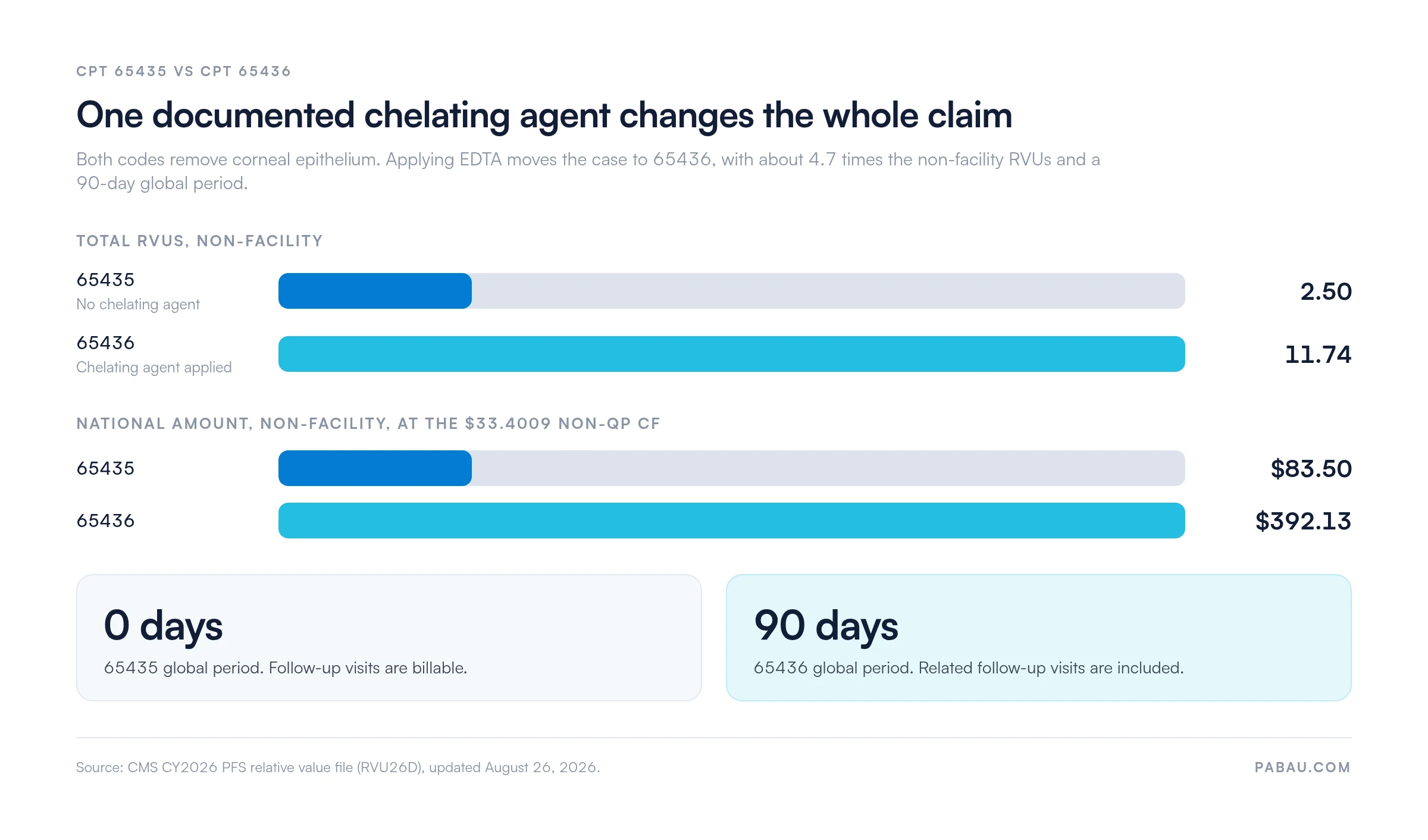
65436 carries a 90-day global period and 11.74 non-facility RVUs, about $392.13 at the 2026 non-QP conversion factor.
The EDTA solution is included in the procedure, so it is not billed as a separate supply.
Bilateral surgery indicator 1 applies, so a same-day bilateral case pays 150% of the single-eye amount.
CPT code 65436 describes removal of corneal epithelium with application of a chelating agent, for example EDTA. It sits in the cornea subsection (65400-65785) of the eye and ocular adnexa surgery range.
Source for the payment indicators: the CMS CY2026 PFS relative value file (RVU26D), updated August 26, 2026.
Chelation removes calcium that has settled in the anterior cornea. The classic target is band keratopathy, a gray-white calcific band across the exposed part of the cornea.
The surgeon first removes the epithelium over the deposit. A chelating solution, usually EDTA, is then applied to the exposed surface so it binds the calcium and lets it be cleared.
Most cases end with a bandage contact lens and topical medication while the epithelium heals. The 90-day global period then covers the routine follow-up visits.
For coding, the procedure name matters less than one fact in the operative note. Was a chelating agent applied? That answer decides between 65436 and 65435.
65435 and 65436 share the same base descriptor, removal of corneal epithelium. 65435 covers removal with or without chemocauterization by abrasion or curettage. 65436 adds the application of a chelating agent.
The two codes sit far apart in value and in follow-up rules. The table and chart below use figures from the CMS CY2026 PFS relative value file (RVU26D).
Read more about the parent code in our CPT code 65435 guide. Other cornea codes get confused with this pair less often, but they do turn up on the same claims.
Add a required field to the operative note template that asks whether a chelating agent was applied, and which one. A yes supports 65436, and a no points to 65435. One field removes the most common coding question on this pair.
A chelating agent treats calcium, so the diagnosis should describe a calcific corneal deposit. Band keratopathy is the core indication. Always code the eye the note names.
Watch for H18.59- on templates built for this code. It means other hereditary corneal dystrophies, so it does not describe a calcific degeneration. Confirm every code in the current CDC/NCHS ICD-10-CM files before you submit.
An auditor reviewing 65436 checks one point first: that a chelating agent was applied. These elements make the claim hold up.
A clean claim starts with a note that answers each point. If the agent is missing, the note supports 65435 at most.
The EDTA itself is not a separate charge. The American Academy of Ophthalmology states that the EDTA is included in the procedure. Do not add a supply line for it.
A bandage contact lens fitting (92071) on the same day needs a check against the current NCCI procedure-to-procedure edits. Do not assume it pays separately with a corneal surface procedure.
Amniotic membrane placement (65778, 65779) is sometimes done in the same session. Check the current NCCI table for the pair. Report it only when the note documents the graft as a distinct service.
65436 is an eye procedure with a 90-day global period, so laterality and global-period modifiers carry most of the weight.
Many commercial payers want two lines with RT and LT for a bilateral case instead of modifier 50. Check each payer’s format before you bill.
CPT code 65436 carries a 90-day global period in the 2026 Medicare Physician Fee Schedule. The package starts the day before surgery and ends 90 days after it.
These services are included in the surgical payment:
These services can still be reported during the global period:
Follow-up billing is where the two codes part ways day to day. A follow-up visit after 65435 is billable, while the same visit after 65436 usually is not.
CY2026 uses two conversion factors. Qualifying APM participants (QPs) are paid at $33.5675, and everyone else at $33.4009. The table shows both, using national RVUs from the CMS CY2026 PFS relative value file (RVU26D).
Each amount is total RVUs multiplied by the conversion factor. Your MAC then applies the local geographic practice cost index, so your allowed amount will differ.
The facility rate applies in an ASC or hospital outpatient department, where the facility is paid separately. The place of service code on the claim tells your MAC which rate applies. Commercial contracts set their own rates.
Recalculate the fee schedule in your billing system whenever CMS posts a new RVU file. A 65436 charge still built on 2025 values, or on 65435 values, underbills every case.
Most 65436 denials trace back to the note, the global period, or the diagnosis. A structured denial management workflow helps you spot the pattern behind each one.
Our guide to denial codes in medical billing explains the CARC and RARC codes on the remittance.
Ophthalmology billing slows down when the claim and the record live in different systems. Pabau, the practice management platform we build, keeps the clinical note, the codes your team records, and the claim on one patient file.
Pabau’s claims management runs through the Claim.MD clearinghouse. It submits claims and tracks them from the codes and diagnoses your team records. Your coders still choose 65436 or 65435, and Pabau carries that choice to the payer.
Pabau’s custom forms also let you build the operative note template your surgeons already follow. Add a field for the chelating agent, and the answer your coders need is in the note.

Pabau’s claims management through Claim.MD submits claims and tracks them from the codes and diagnoses your team records. The note, the claim, and its status stay on one patient file.

CPT code 65436 turns on one documented fact: a chelating agent touched the cornea. When it did, the case is a 90-day major procedure worth more than four times the RVUs of 65435.
That value brings obligations. Pair it with a calcific corneal diagnosis, leave the EDTA off the claim, and protect the global period with the right modifiers. Practices that settle the agent question in the note rarely argue about this code later.
Book a demo to see how Pabau submits and tracks your ophthalmology claims.

Billing epithelial removal without a chelating agent? CPT code 65435 covers the parent code, its 0-day global, and its documentation.
Removing a foreign body from the cornea instead? CPT code 65222 covers slit-lamp foreign body removal, its documentation, and its billing rules.
Want to decode a denial on a 65436 claim? Denial codes in medical billing explains the CARC and RARC codes on remittance advice.
CPT code 65436 describes removal of corneal epithelium with application of a chelating agent, such as EDTA. It is used most often to clear calcific band keratopathy from the cornea.
Both codes cover removal of corneal epithelium. 65436 adds the application of a chelating agent such as EDTA, while 65435 is removal with or without chemocauterization by abrasion or curettage. 65435 has a 0-day global period and 65436 has a 90-day global period.
CPT 65436 has a 90-day global period in the 2026 Medicare Physician Fee Schedule. Related follow-up visits during those 90 days are included in the surgical payment.
Nationally, 65436 carries 11.74 non-facility and 9.52 facility RVUs. At the non-QP conversion factor of $33.4009, that is about $392.13 non-facility and $317.98 facility, before local GPCI adjustment.
No. The American Academy of Ophthalmology states that the EDTA is included in the procedure, so it is not billed as a separate supply.
Band keratopathy, H18.421, H18.422 or H18.423 by eye, is the core indication. Other calcerous corneal degeneration, H18.43, also fits. Add a documented cause such as hypercalcemia, E83.52, as a secondary code.