

HCPCS Code L0472: Hyperextension TLSO billing guide
HCPCS code L0472: Official descriptor and device definition HCPCS code L0472 des...

Last Updated: Nov 5, 2026
65210 is the CPT code for removal of foreign body, external eye; conjunctival embedded, subconjunctival, or scleral nonperforating.
It covers foreign bodies and concretions that need instrumented extraction, plus material beneath the conjunctiva or in the sclera with the eye wall intact. Coders most often confuse it with 65205, which covers superficial conjunctival foreign bodies that lift out without tissue resistance. Payers check the documented depth against the code billed.
Let Pabau's smart automation suggest the right codes, reduce claim denials, and keep your practice compliant—effortlessly.
Automate repetitive tasks and focus on what matters most—your patients.
Reduce coding errors and ensure compliance with the latest regulations.
Clean claims, fewer denials, and faster reimbursements.
Powerful insights and reporting to help your practice thrive.
HIPAA compliant SOC 2 certified GDPR-compliant Trusted by 4,000+ clinics worldwide

CPT code 65210 covers embedded conjunctival foreign bodies, concretions, and subconjunctival or scleral nonperforating foreign bodies, not superficial removal.
Depth of embedment separates it from 65205. Use 65210 when the note documents tissue resistance or instrumented extraction beyond simple irrigation.
Append RT or LT for laterality, or modifier 50 for a bilateral procedure. Missing laterality is a common denial trigger on 65210 claims.
Claims management software such as Pabau’s checks each claim for missing or invalid details before it goes to the clearinghouse.
CPT code 65210 is the surgical code for removing an embedded foreign body from the external eye without perforating the eye wall. It applies when the material is embedded in the conjunctiva, sits beneath it, or lies in the sclera. Conjunctival concretions fall under the same code.
The American Medical Association, which maintains the CPT code set, places 65210 in the eye and ocular adnexa subsection (65091-68899) of the Surgery section. Its neighbors sit in our CPT codes library.
The descriptor covers three clinical presentations, and each one carries its own billing note.
Any removal method counts for these three presentations, whether needle tip, spud, jeweler’s forceps, or slit-lamp-guided instrumentation. Topical anesthesia and conjunctival irrigation in the same session are bundled into 65210 and cannot be billed separately.
Several adjacent codes cover what 65210 does not, so route each claim to the right one before submission.
A conjunctival embedded foreign body and a corneal foreign body sometimes come out of the same eye in one session. Bill each code separately, with its laterality modifier. The corneal removal goes on 65222 when a slit lamp is used. Folding both into a single 65210 understates the work performed.
Documentation decides whether a CPT code 65210 claim survives audit. A payer reviewer reads the clinical note for evidence of the depth and method billed.
For a conjunctival embedded foreign body, the clinical steps usually run in this order.
For concretions, the palpebral conjunctiva is everted and each calcareous deposit is lifted individually. For subconjunctival foreign bodies, the conjunctiva may be incised to reach and extract the material.
Every CPT 65210 claim needs the elements below to pass medical necessity review. A superbill that captures them at the point of care saves reconstructing them later.
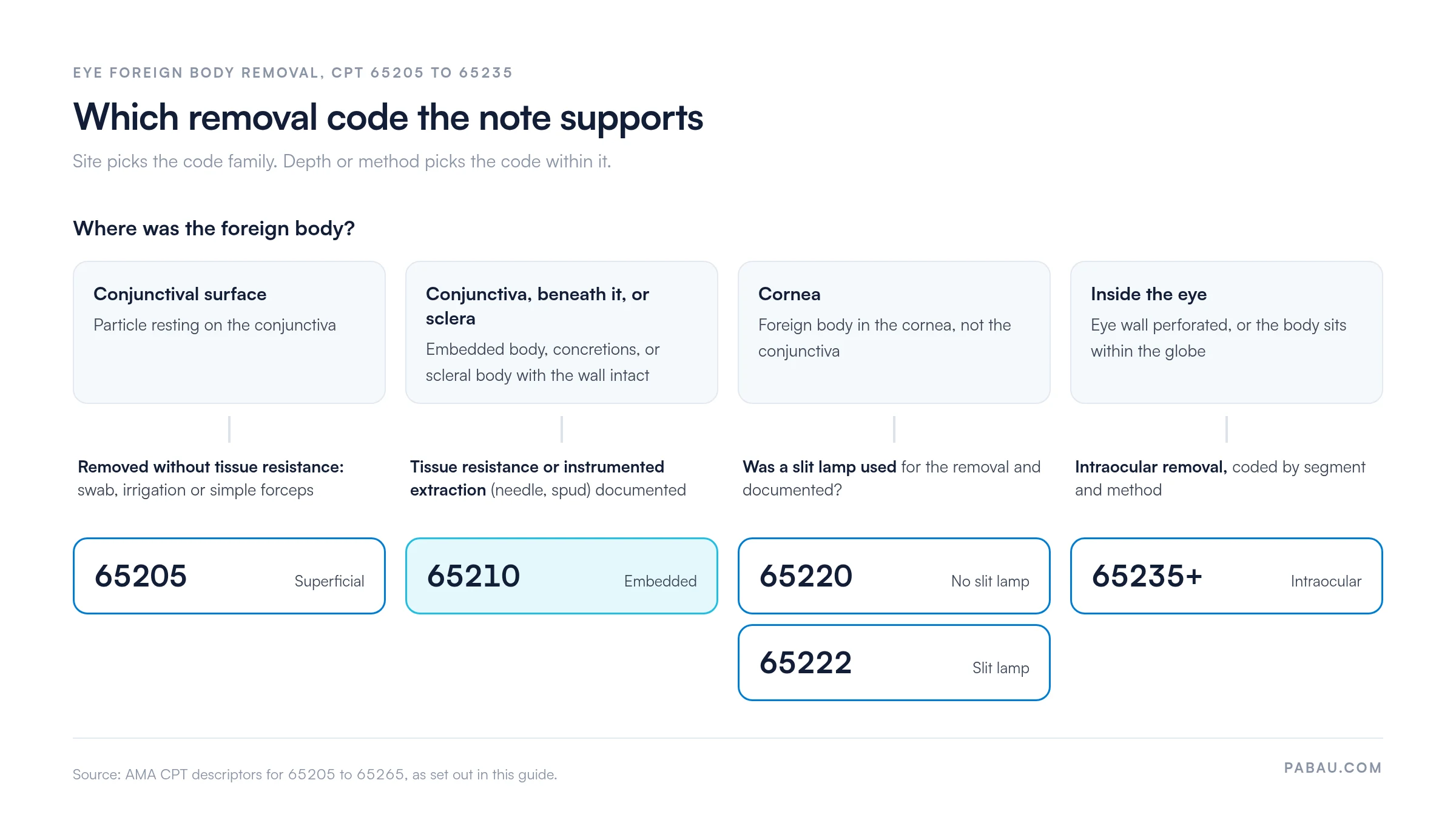
Codes in the 65205-65222 range are easy to confuse because they describe the same procedure at different sites and depths. Two variables decide the code. The first is the anatomical site, conjunctiva or cornea. The second is the depth of embedment or the instrument used.
The 65205 vs 65210 decision test: Ask whether the note documents tissue resistance, instrumented extraction with a needle or spud, or embedment. If yes to any of those, 65210 applies.
If the note describes irrigation, a moistened cotton-tip applicator, or particle removal with no resistance, 65205 is correct. Billing 65210 when the note supports only 65205 is an upcoding risk that payers audit.
The full path from site to code, including the corneal and intraocular codes on either side, fits on one page.
Every CPT 65210 claim requires a supporting ICD-10-CM diagnosis code that identifies the anatomical site and laterality matching what was billed.
Payers cross-reference the diagnosis against the procedure code, and a mismatch is denied automatically. Use the CDC ICD-10-CM tool to confirm current-year code validity before submission.
The 7th-character suffix matters. Use “A” for the initial encounter when the foreign body is being actively treated. Use “D” for subsequent visits related to the same injury (follow-up, incomplete removal, monitoring). ICD-10-CM codes update annually, so verify them against the tabular list CMS publishes each October.
Carry laterality through to both the ICD-10 diagnosis code and the CPT modifier. Payers auto-compare: a right-eye diagnosis code paired with a left-eye modifier LT triggers an automated mismatch denial. Audit your superbill template to ensure laterality fields flow through to both the diagnosis and modifier lines before submission.
Four modifiers come up routinely on CPT 65210 claims. RT and LT mark laterality, and modifier 50 marks a bilateral procedure. Modifier 25 goes on a separate evaluation and management (E/M) service billed the same day.
The modifier 50 vs RT/LT question is payer-specific. Medicare generally accepts modifier 50 appended to a single 65210 line and pays 150% of the single-procedure rate. Many commercial payers prefer two line items instead, 65210-RT on one and 65210-LT on the next, each paid at 100%.
Check the payer’s billing guidelines or contact their provider relations line before submitting a bilateral claim for the first time.
Yes. CPT 65210 can be billed with an E/M code on the same date of service when the E/M service is significant and separately identifiable. It must be documented apart from the pre-procedure evaluation, which is bundled into 65210.
CMS global surgery rules assign CPT 65210 a 0-day global period. That bundles the same-day pre-procedure examination into the procedure. The clinician may also evaluate an unrelated condition, such as a new medication for concurrent ocular surface disease. In that case, modifier 25 goes on the E/M code.
The documentation must support the E/M independently. Payers audit these claims by looking for two distinct sections in the note. One covers the foreign body removal, and the other covers the separate E/M service. A note that blends the two will not support modifier 25.
Medicare reimbursement for CPT 65210 is calculated from the relative value units (RVUs) CMS assigns to it. CMS updates them each January in the Physician Fee Schedule. Because rates vary by geographic locality and the conversion factor changes annually, publishing a fixed dollar figure here would be inaccurate within months.
Use the CMS Physician Fee Schedule search tool to look up the current national non-facility and facility rates for 65210 by your MAC jurisdiction. The FastRVU lookup tool provides work RVU, practice expense RVU, and malpractice RVU breakdowns alongside the calculated payment for any geographic modifier.
Three payment variables are worth checking for each claim.
Submitting through a clearinghouse such as Claim.MD lets you check eligibility before the encounter. Electronic remittance advice then comes back once payment posts.
Denials on CPT 65210 trace back to three causes. The wrong code is selected, a modifier is missing or mismatched, or the documentation does not support the depth billed. Each has a specific fix.
A clean claim for CPT 65210 passes every payer edit on the first submission. Scrubbing modifiers, diagnosis-to-procedure matching, and documentation completeness before submission is how a practice gets there. A denial management workflow catches the rest before they age into write-offs.
Run a quarterly audit of your 65210 claims against your 65205 claims. If 65210 volume runs well above 65205, review a random sample of 65210 notes. The skew may reflect a case mix that is genuinely embedded-heavy. It may also be an upcoding pattern that a payer audit will find before you do.
Most payers classify CPT 65210 as an acute procedure and do not require prior authorization. Foreign body removal is generally considered medically necessary when the clinical documentation supports the presentation.
Run insurance eligibility verification before the encounter to confirm coverage, deductible status, and any specialty network requirements.
Medicaid programs vary by state. Some state Medicaid plans require prior authorization for surgical ophthalmology codes even when other payers do not. Commercial payers may ask for more documentation, such as a referral from a primary care provider. Some want evidence that the patient first sought care in an emergency setting.
Check each payer’s billing policies, and the local coverage determination (LCD) for Medicare claims. Never assume a payer skips prior authorization because Medicare does.
Confirm the compliance requirements specific to your payer mix each plan year. Fee schedules, bundling edits, and documentation requirements can change with annual contract renewals and CMS guideline updates.
The embedment detail that separates 65210 from 65205 has to be captured at the point of care. Coders who rebuild it from memory later are guessing. When the clinical note and the claim sit in one system, the coder works from what the clinician recorded.
Pabau, the practice management platform we build, pre-fills each claim from the invoice raised for the visit. Its claims management software checks the claim for missing or invalid details before it goes to the Claim.MD clearinghouse. Eligibility is verified through Claim.MD, and prior authorization codes are stored against the patient.
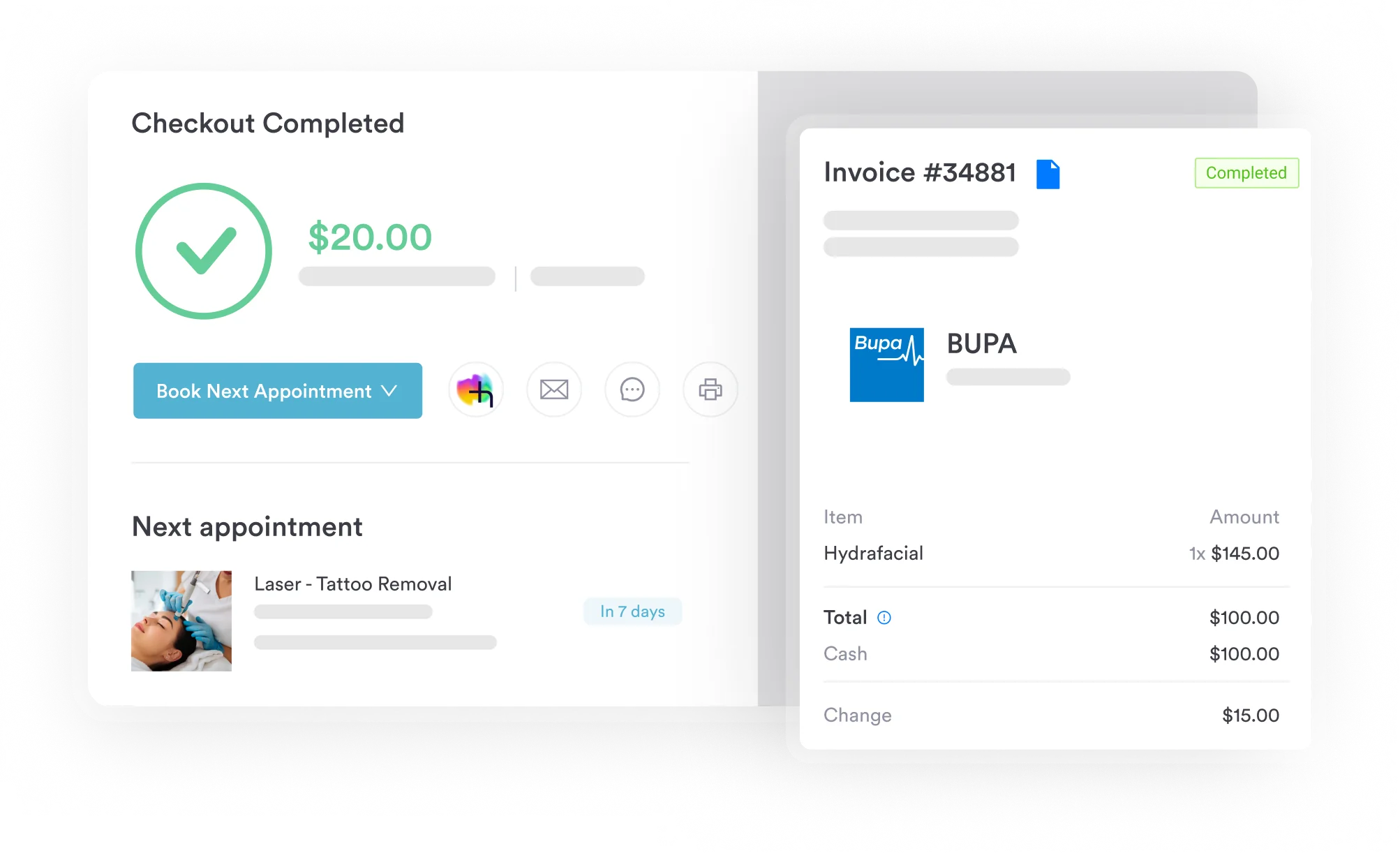
Once a claim is submitted, its status is tracked, and a rejected claim is flagged as needing action with the error named. Electronic remittance advice comes back through Claim.MD, so each payment reconciles against the original invoice.

Pabau checks each claim for missing or invalid details, verifies eligibility through Claim.MD, and tracks every claim to payment. See how it cuts rework on eye procedure billing.

A CPT code 65210 claim stands or falls on one line in the note. If the clinician records tissue resistance, or the needle or spud used to lift the foreign body out, the claim supports 65210. If the note says irrigation or a swab, 65205 is the code, however long the removal took.
Build that line into the exam template and match the ICD-10 laterality to the modifier. Those two habits hold up on audit, and they cost the clinician a few seconds per patient.
Book a demo to see how Pabau checks each 65210 claim for missing details before it reaches the clearinghouse.

Need a clearinghouse for ophthalmology claims? Claim.MD clearinghouse guide explains how the integration handles electronic claim submission and ERA processing for US practices.
Confused by claim rejection codes? Denial codes in medical billing breaks down the CARC codes that appear on rejected claims and what each one takes to resolve.
Looking to understand revenue cycle end to end? Revenue cycle management overview covers the full claim lifecycle from patient registration through payment posting.
CPT code 65210 is the surgical code for removing an embedded foreign body from the external eye. It covers conjunctival foreign bodies and concretions that need instrumented removal. It also covers material beneath the conjunctiva or in the sclera, as long as the eye wall is intact. Superficial conjunctival foreign bodies go on 65205 instead.
CPT 65205 covers superficial conjunctival foreign bodies removed without tissue resistance, such as a particle lifted off with a moistened swab or irrigation. CPT 65210 covers embedded foreign bodies, concretions, or subconjunctival material that needs instrumented extraction. Documented tissue resistance, or the use of a needle or spud, is what moves a claim from 65205 to 65210.
Yes. Conjunctival concretions (calcareous or follicular deposits on the palpebral conjunctiva) are explicitly included in the 65210 descriptor. When multiple concretions are removed in a single session, one unit of 65210 is billed per eye treated, not one unit per concretion removed.
Modifier 50 applies when the same foreign body removal procedure is performed on both eyes in the same session. Medicare accepts modifier 50 and pays 150% of the single-procedure rate. Many commercial payers instead require two line items with modifier RT on one and modifier LT on the other, each reimbursed at 100%. Check your payer’s billing guidelines before submitting a bilateral 65210 claim.
The primary ICD-10-CM codes are T15.11XA (foreign body in conjunctival sac, right eye, initial encounter) and T15.12XA (left eye, initial encounter). For subconjunctival or scleral presentations, use T15.81XA, or T15.91XA when the location is unspecified. The diagnosis laterality must match the CPT modifier laterality exactly, or the claim will deny automatically.
Yes. Medicare covers CPT 65210 when medical necessity is documented. The code has a 0-day global surgery period, meaning no pre- or post-operative visits are bundled beyond the same day. Payment rates are determined by the CMS Physician Fee Schedule and vary by geographic locality. Use the CMS fee schedule search tool to find the current national and local rates for your MAC jurisdiction.



