CPT code 96450: Intrathecal chemotherapy billing guide
CPT code 96450: Official descriptor and procedure overview CPT code 96450 is the...

Last Updated: Oct 9, 2026
65435 is the CPT code for removal of corneal epithelium; with or without chemocauterization (abrasion, curettage).
Ophthalmologists report it when they scrape or polish away the corneal surface layer. Common reasons are recurrent erosion, epithelial basement membrane dystrophy (EBMD), and band keratopathy treated without a chelating agent. The code sits in the cornea Removal or Destruction subsection (65435-65450) and carries a 0-day global period. EDTA chelation is reported with 65436 instead.
Let Pabau's smart automation suggest the right codes, reduce claim denials, and keep your practice compliant—effortlessly.
Automate repetitive tasks and focus on what matters most—your patients.
Reduce coding errors and ensure compliance with the latest regulations.
Clean claims, fewer denials, and faster reimbursements.
Powerful insights and reporting to help your practice thrive.
HIPAA compliant SOC 2 certified GDPR-compliant Trusted by 4,000+ clinics worldwide

CPT code 65435 covers removal of the corneal epithelium by abrasion or curettage, with or without chemocauterization.
Excising a discrete corneal lesion is CPT 65400, and EDTA chelation for band keratopathy is CPT 65436.
The global period for 65435 is 0 days, so follow-up visits on later days aren’t bundled into the procedure payment.
NCCI bundles 65435 with 92071 and 65778, so check the current edit before adding a second line on the same date.
Pabau’s billing software pre-fills the claim from the patient record and checks required fields, while code and modifier choices stay with your coder.
CPT code 65435 reports removal of the corneal epithelium, the thin outer cell layer of the cornea. The surgeon takes it off by abrasion or curettage, with or without chemocauterization. The word that matters in the descriptor is “removal.” The code fits therapeutic clearing of the surface layer, not excision of a lesion that reaches deeper tissue.
Procedures commonly reported with 65435 include:
Some neighbors are excluded. Excising a discrete corneal lesion is CPT 65400. Scraping for a smear or culture is CPT 65430. Pterygium excision is 65420 without a graft or 65426 with one. If the surgeon applies a chelating agent such as EDTA, the code is 65436.
Billers usually check the same six facts before a claim goes out. Here they are in one place.
Medical necessity for 65435 rests on the diagnosis code on the claim. Payers check the pairing, and a missing laterality digit is a common reason for rejection.
Most codes above end in a laterality digit. It is the 5th character for H18.11-H18.13 and the 6th for H18.42x and H18.83x. H18.52 has none, so the eye goes in the note and on the CPT line as -RT or -LT.
Submitting H18.83 without its final digit creates an invalid code, and clearinghouses reject it before a payer sees it. The same applies to bullous keratopathy. H18.10 is the unspecified-eye code, so swap it for the specific side once the chart names it.
A 65435 note must show therapeutic removal of the epithelium. A diagnostic scraping or a lesion excision tells a different story. Notes that only say “debridement,” with no layer, instrument or extent, often fail audit.
Cover each element below. Pairing this list with a superbill documentation workflow keeps details from slipping at the point of care.
Here’s a note that works: “Debridement of corneal epithelium with diamond burr, 6 mm zone, right eye, for recurrent corneal erosion.” A note that reads “eye cleaned up” gives the payer nothing to approve.
CPT 65400 is excision of a corneal lesion, except pterygium. CPT 65435 is removal of the surface epithelial layer. The two sit in different subsections: Excision for 65400, Removal or Destruction for 65435. They still get mixed up, especially in EBMD cases where the chart note uses lesion language.
The practical test is simple. Did the surgeon remove one identifiable lesion, or clear the surface across a zone? A note that mentions pathology submission almost always points to 65400. A burr, curette or alcohol-assisted clearing points to 65435, and EDTA points to 65436.
Five nearby codes cause most of the confusion. The chart below shows the order of questions that settles which one applies.
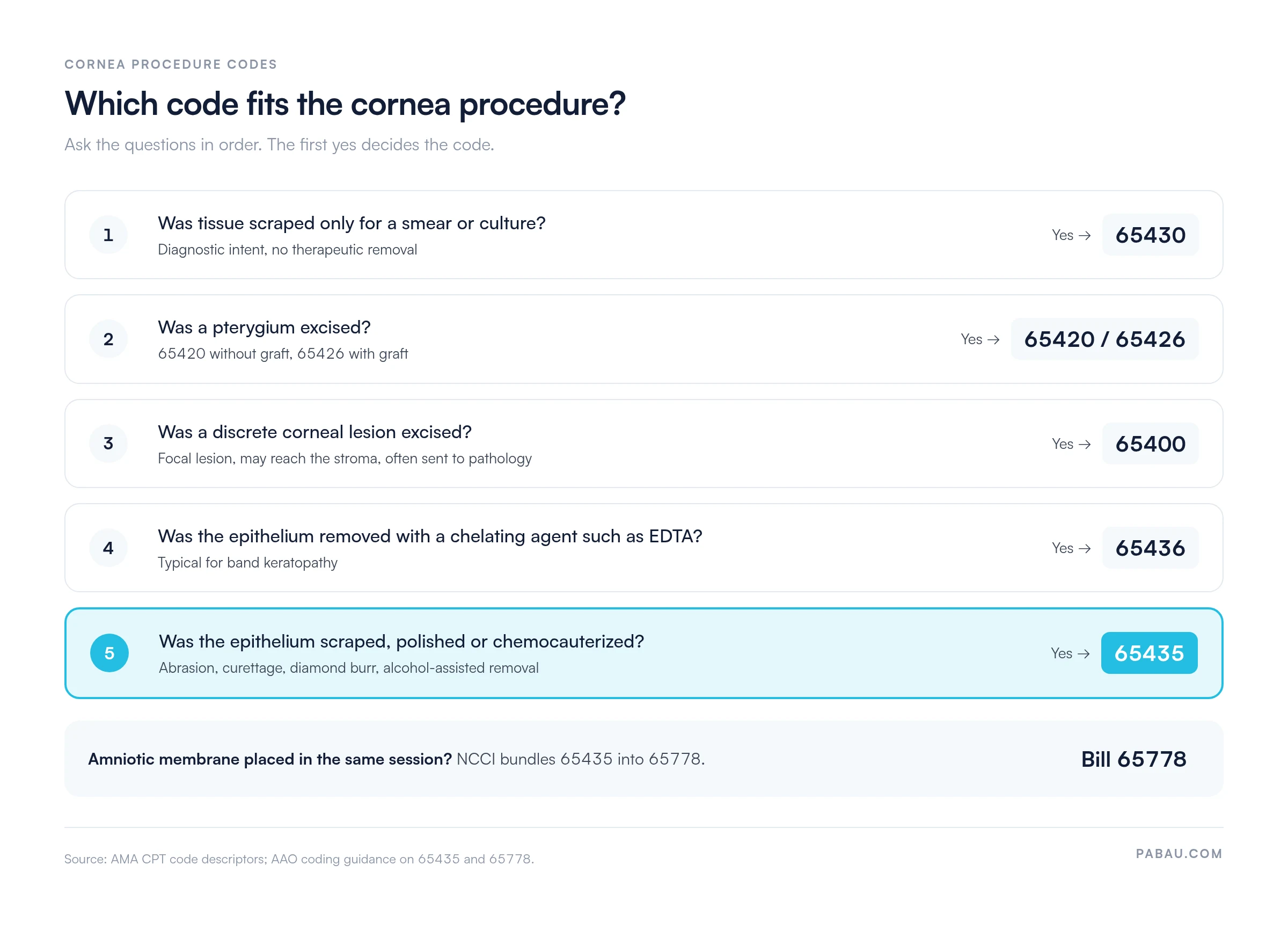
65430 and 65435 overlap when a surgeon scrapes for a culture and also debrides the area. Both may apply, but each needs its own documented intent. For amniotic membrane cases, AAO coding guidance is to bill 65778 alone when both happen in one session.
CPT 92071 is fitting of a contact lens for treatment of ocular surface disease. NCCI bundles it with 65435, so billing both on the same date triggers an edit against 92071.
NCCI edits update every quarter, so a pair’s status can change between code cycles. Recheck it whenever the quarterly files come out.
Eye procedures lean on laterality modifiers more than most surgical specialties. A missing or wrong eye modifier is a common, avoidable denial on 65435.
For bilateral same-session procedures, check the MPFS bilateral indicator for 65435 before you submit. It decides whether -50 applies and how payment adjusts. Some Medicare Advantage and commercial plans also want two lines with -RT and -LT.
The CMS global period for CPT code 65435 is 000, which means zero post-operative days. The surgical package covers the procedure day only. There is no 10-day window to schedule around.
The CMS Physician Fee Schedule lookup lists the global indicator for every code. Check it when a payer’s policy seems to contradict this.
Medicare pays 65435 at about $83.50 in an office and $60.46 in a facility. Both figures are national averages using the 2026 conversion factor of $33.4009. Your MAC locality adjusts them, so check your own rate each year.
The facility rate is lower because the ASC or hospital bills its own fee for the room, staff and supplies. Medicaid rates vary by state, and commercial rates depend on your contract. The AAPC Codify CPT lookup helps cross-check RVUs when you set your fee schedule.
Traditional Medicare doesn’t routinely require prior authorization for 65435 when a covered diagnosis and solid documentation are in place. Other payers can be stricter.
Keep a prior-auth log for 65435 cases. Record the plan, auth number, approval date and expiry date for every commercial or Medicare Advantage patient. A lapsed authorization on the procedure date is a denial the log would have caught.
Most problems surface at a predictable point on the claim’s path. Here’s the route, step by step.
Before you submit, run through this short checklist:
Denials on 65435 tend to repeat the same six patterns. Each has a fix you can put in place before the next claim. A monthly review of denial management data shows which ones hit your practice.
Claim-field validation catches empty fields and badly formed codes. It won’t spot a wrong eye, a bundled pair or a POS mismatch, so those stay on the checklist above.
Each denial arrives with a reason code on the remittance. A guide to denial codes for billers explains what each one means and how to respond.
Run a quarterly denial report filtered to 65435. If CO-4 (modifier missing or inconsistent) or CO-97 (bundled service) ranks high, the laterality and bundling fixes above target the cause.
In many eye practices, a coder still keys the 65435 claim by hand from the operative note. That’s where a missing digit or an empty field slips through. Pabau starts the claim from the record instead.
Pabau pre-fills the claim form from the patient record and the visit. CPT, HCPCS and ICD-10-CM lookup libraries help your coder find the right code fast. Before the claim leaves, Pabau checks that every required field is filled in.
In the US, Pabau sends claims through Claim.MD. That covers eligibility checks, claim submission, ERA posting and claim status tracking. Code choice, modifiers and NCCI decisions stay with your coder, and our claims software for ophthalmology keeps the paperwork around those decisions moving.

Pabau pre-fills claims from the patient record, offers CPT and ICD-10-CM lookups, and checks required fields before sending. See how it fits your eye practice.

Billing 65435 well comes down to three calls made before the claim is built. Confirm the surgeon removed epithelium rather than a lesion. Confirm no chelating agent turned it into 65436. Then check the same-day lines against NCCI.
The 0-day global period works in your favor. Medically necessary follow-ups on later days are billable, so don’t write them off out of habit. A clean claim also needs complete fields and the right eye on every line. Book a demo to see how Pabau pre-fills and checks those claims for your eye practice.

Need a prior-auth form for corneal procedures? Medical prior authorization form gives you a ready template to send payers before the procedure date.
Want to know what happens between submission and payment? Medical claims clearinghouse guide explains how claims are scrubbed and routed to payers.
Want to understand how electronic remittance works after a claim pays? Electronic remittance advice guide covers ERA files, CARC codes, and how to post payments efficiently.
Looking to reduce your overall denial rate across all procedure codes? Denial codes in medical billing explains the most common CARC and RARC codes and how to respond to each one.
Often, yes. A superficial keratectomy limited to the epithelium and basement membrane, such as diamond burr polishing for EBMD, is usually reported with 65435. Excising a discrete lesion is 65400.
65400 excises a discrete corneal lesion that may reach the stroma. 65435 removes the surface epithelium across a zone. Pathology submission points to 65400, while a burr, curette or alcohol points to 65435.
Not on the same date. NCCI bundles 92071 into 65435. Check the current modifier indicator before trying -59, and bill a fitting separately only on an independent date.
Check the MPFS bilateral indicator for 65435 first. It decides whether -50 applies. Some plans want two lines with -RT and -LT instead, so confirm the payer’s rule.
It is 0 days. A same-day E/M is included unless it is significant and separately identifiable, which takes modifier -25. Medically necessary visits on later days are billed separately.
No. EDTA chelation for band keratopathy is reported with CPT 65436. 65435 covers abrasion or curettage with or without chemocauterization. Pair 65436 with H18.421-H18.423 for the treated eye.