CPT code 85651: Erythrocyte sedimentation rate, non-automated
CPT code 85651: Definition, descriptor, and code summary CPT code 85651 is the p...

Last Updated: Nov 24, 2026
67808 is the CPT code for excision of chalazion; under general anesthesia and/or requiring hospitalization, single or multiple. One line covers every chalazion removed in that session, on one lid or several.
The anesthesia and care setting decide the code, not the lesion count. Excisions done without general anesthesia or hospitalization go to 67800, 67801, or 67805, chosen by the number of chalazia and lids involved.
Let Pabau's smart automation suggest the right codes, reduce claim denials, and keep your practice compliant—effortlessly.
Automate repetitive tasks and focus on what matters most—your patients.
Reduce coding errors and ensure compliance with the latest regulations.
Clean claims, fewer denials, and faster reimbursements.
Powerful insights and reporting to help your practice thrive.
HIPAA compliant SOC 2 certified GDPR-compliant Trusted by 4,000+ clinics worldwide

CPT code 67808 applies to chalazion excision under general anesthesia or requiring hospitalization, whether one or several chalazia are removed.
ICD-10-CM codes H00.11-H00.16 support 67808 claims, and payers expect the eye and lid named in the operative report.
AAO advises reporting 67808 on one line with no additional modifier. Add E1-E4 eyelid modifiers only where the payer or MAC requires lid-level reporting.
Pabau, a practice management platform, tracks prior authorizations on the patient’s case and sends US claims through Claim.MD.
CPT code 67808 is the ophthalmic surgery code for excision of a chalazion (meibomian gland cyst) under general anesthesia and/or requiring hospitalization, single or multiple.
The American Academy of Ophthalmology’s coding guidance quotes that descriptor and confirms the code covers one or more chalazia, regardless of location.
The code sits in the 67700-67999 eyelid procedures range of the CPT surgery section, next to 67800, 67801, and 67805. The American Medical Association owns and maintains the CPT code set.
A chalazion forms when a meibomian gland (tarsal gland) becomes blocked and the lipid secretion thickens into a cyst. Most resolve with warm compresses or steroid injections. Surgical excision under general anesthesia becomes necessary when conservative treatment fails and the lesion is large or recurrent. It is also the route when the patient cannot tolerate in-office incision and curettage (I&C).
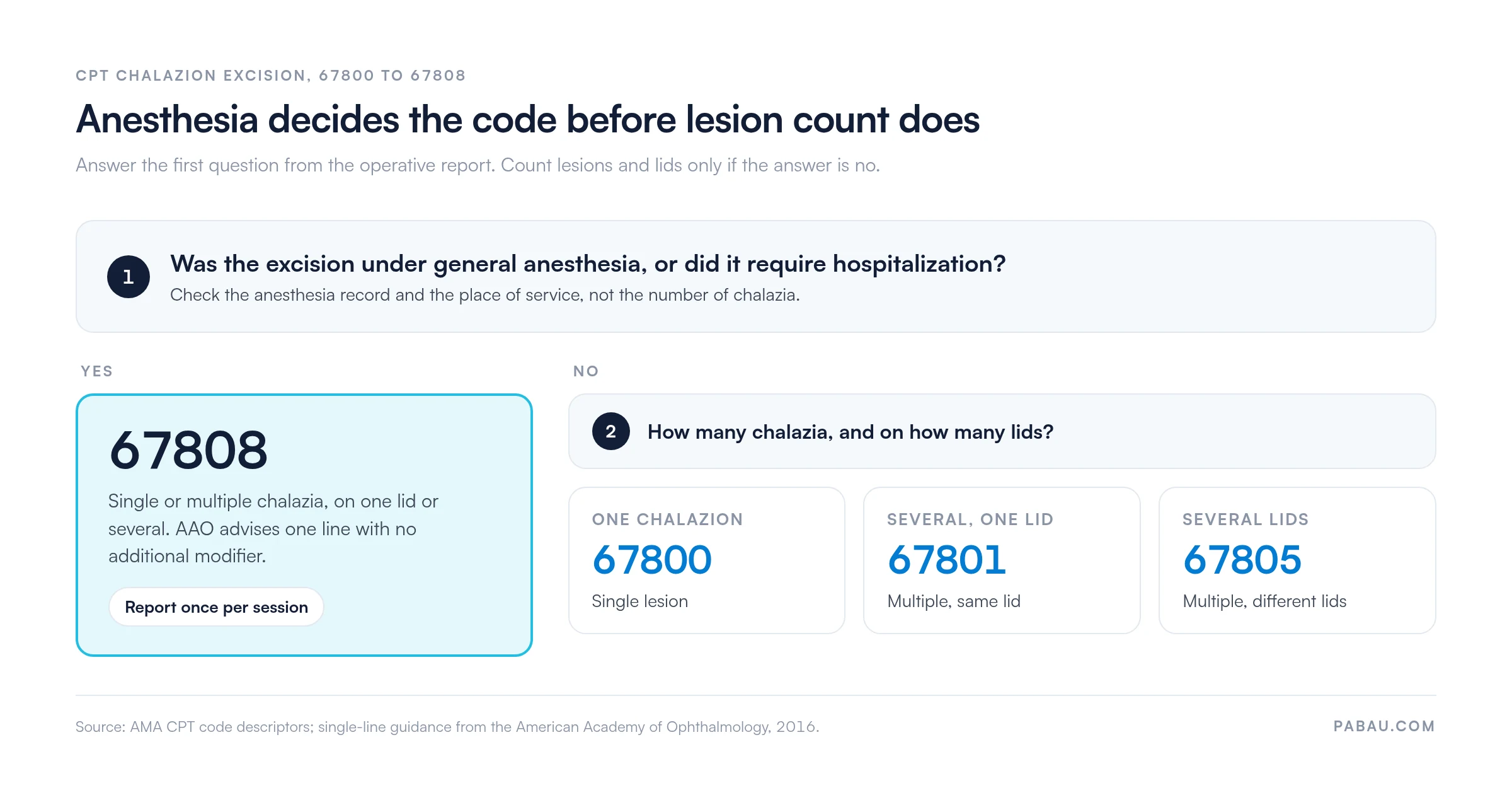
The chalazion excision codes split along two questions, asked in order. First, was the excision done under general anesthesia or did it require hospitalization? Only when the answer is no do the number of chalazia and the lids involved decide between 67800, 67801, and 67805.
Key rule: CPT code 67808 is used whether one or several chalazia are removed. What matters is general anesthesia or hospitalization. Lesion count and lid distribution split the code only for 67800-67805. If the operative report shows general anesthesia and the coder picks 67801 or 67805, the claim misstates the procedure and may be denied or down-coded.
Verify the CPT-to-ICD-10 crosswalk for these codes at CrossCoder before submitting.
The diagram below turns that rule into the two questions a coder answers from the operative report.
Chalazion maps to category H00.1 in ICD-10-CM, with fifth-character specificity for the eye and the lid. H00.1 itself is not billable, so payers expect one of the codes below. Stopping at the H00.1 category is a documentation mismatch, and so is using H00.19 when the operative report names the lid. Either can trigger a medical-necessity review.
When chalazia are removed from more than one lid in one session, report the most specific diagnosis code for each treated site. Use the CPT-to-ICD-10 crosswalk on AAPC Codify to validate the pairing before submission.
Take the eye and lid position from the operative report before assigning an H00.1x code. When chalazia are removed from both eyes, document each site separately in the chart. Submitting H00.19 when the op note names the right upper and left lower lids invites a medical-necessity audit.
The American Academy of Ophthalmology advises reporting CPT code 67808 on one line with no additional modifier. The code already covers one or more chalazia regardless of location, so a bilateral case does not need two lines. Some payers still want lid-level reporting, so check the payer or MAC policy before adding a modifier.
Bilateral billing note: When chalazia come out of both eyes in one session, AAO guidance is a single 67808 line with no modifier. Check the MPFS bilateral indicator and your MAC’s policy before using -50 or two lines.
The operative note does the heavy lifting for CPT 67808 claims. Payers auditing this code look for evidence that conservative treatment failed and a clinical reason for general anesthesia. They also check for an accurate description of the procedure. Missing any one of these can trigger a records request or a denial.
For submitting a clean claim, the documentation package for CPT 67808 should include:
Prior authorization for CPT 67808 varies by payer. Medicare generally does not require it for this code, but many commercial and Medicaid managed care plans do, particularly for elective scheduling. A grounding in medical billing fundamentals helps billing staff anticipate which payers will ask for authorization.
Medicare reimburses CPT 67808 through the Physician Fee Schedule (MPFS), with separate allowables for facility and non-facility settings. Because 67808 involves general anesthesia or hospitalization, it is usually performed in a facility (ASC or hospital OR). That makes the facility rate the relevant figure for most claims.
RVU values and dollar allowables for CPT code 67808 change with each annual CMS fee schedule update. Use the CMS Physician Fee Schedule search tool to pull the current-year allowable for your payment locality. For the work, practice expense, and malpractice RVU components, the FastRVU lookup tool lists current MPFS data by CPT code.
Key factors affecting your 67808 allowable:
Denials for CPT 67808 tend to repeat the same few errors. Effective denial management workflows start by catching those errors before the claim leaves the practice.
Build a five-point CPT 67808 pre-submission checklist. Confirm the op note gives the reason for general anesthesia and the H00.1x code names the eye and lid. Add only the modifiers the payer requires. Attach the prior authorization number and keep conservative treatment notes in the record. Running the checklist before the claim goes to the clearinghouse catches the denial triggers listed above.
A practice running separate tools spreads a 67808 case across three places. The surgery is booked in a calendar, the authorization number lives in a payer portal or spreadsheet, and the claim is built in billing software. Each handoff is a chance for the authorization or the eligibility check to slip.
In Pabau, the authorization code, its dates and the approved sessions are tracked on the patient’s case, with a warning when one is missing. For US claims, Pabau’s claims management software works through Claim.MD. Staff run eligibility checks, submit CMS-1500/837P claims, and receive ERA remittances there.
The result is fewer places to check when a 67808 claim comes back. The authorization sits on the case, and the remittance comes back from Claim.MD. Our guide to the Claim.MD clearinghouse explains how claims and remittances move through it.

Pabau tracks each prior authorization on the patient’s case and sends US claims through Claim.MD, with eligibility checks and ERA remittances.

Anesthesia and hospitalization decide the chalazion code before anything else does. If the operative report shows general anesthesia or an inpatient stay, the code is 67808, on one line, whatever the lesion count. Without either, choose among 67800, 67801, and 67805 by the number of chalazia and lids.
A correctly coded claim can still fail on what surrounds the code. Settle the reason for general anesthesia, the record of failed conservative care, and any authorization the plan requires before the surgery date. Then check your payer’s modifier policy rather than adding RT, LT, or -50 by default.
Book a demo to see how Pabau tracks prior authorizations on the case and sends 67808 claims through Claim.MD.

Need a framework for managing surgical claim denials systematically? Denial management in healthcare covers the end-to-end workflow for identifying, appealing, and preventing high-volume denial patterns.
Want to understand how the clearinghouse fits into your billing cycle? Medical claims clearinghouse guide explains how payer connectivity, claim validation, and ERA routing work together.
Looking to benchmark your practice’s billing performance? Revenue cycle management overview outlines the KPIs and workflow checkpoints that high-performing practices track.
CPT code 67808 covers excision of a chalazion (meibomian gland cyst) under general anesthesia and/or requiring hospitalization. It applies whether one or several chalazia are removed in that session, so the lesion count does not change the code.
CPT 67808 applies when the excision is done under general anesthesia or requires hospitalization. Without either, 67800 covers a single chalazion, 67801 multiple on the same lid, and 67805 multiple on different lids. Choose by anesthesia and hospitalization first, then by count and lids.
It depends on the payer. Medicare generally does not require prior authorization for CPT 67808. Many commercial and Medicaid managed care plans do, and their documentation rules vary by plan. Confirm with each payer before scheduling, and include the record of failed conservative treatment with the request.
The usual pairings are H00.11 through H00.16, which identify the eye and, where documented, the upper or lower lid. H00.19, chalazion unspecified eye, unspecified eyelid, is best avoided when the operative report names the lid.
The American Academy of Ophthalmology advises reporting 67808 on one line with no additional modifier, even when chalazia are removed from both eyes. Some payers ask for the E1-E4 eyelid modifiers to show the lid. Check the payer or MAC policy before adding E1-E4, RT/LT, or -50.
Medicare reimbursement for CPT 67808 comes from the MPFS, using RVU values adjusted by your locality’s Geographic Practice Cost Index. Rates change with each annual CMS fee schedule update. Use the CMS Physician Fee Schedule search tool to retrieve the current facility and non-facility allowables for your locality.
Chalazion excision is generally covered when it is documented as medically necessary. Payers typically look for failed conservative treatment, such as warm compresses or steroid injections, and a functional impact like vision interference or recurrence. Removal for cosmetic reasons alone may be excluded.