CPT Code 78811: Limited area PET scan billing guide
CPT Code 78811: Official descriptor and procedure overview CPT Code 78811 descri...

Last Updated: Nov 24, 2026
85651 is the CPT code for a non-automated erythrocyte sedimentation rate (ESR), the manual test of how far red blood cells settle in one hour. Its official descriptor is "Sedimentation rate, erythrocyte; non-automated."
Use 85651 when a technician sets up and reads the tube by hand, most often by the Westergren method. An ESR run on an automated analyzer is billed with CPT 85652 instead.
Let Pabau's smart automation suggest the right codes, reduce claim denials, and keep your practice compliant—effortlessly.
Automate repetitive tasks and focus on what matters most—your patients.
Reduce coding errors and ensure compliance with the latest regulations.
Clean claims, fewer denials, and faster reimbursements.
Powerful insights and reporting to help your practice thrive.
HIPAA compliant SOC 2 certified GDPR-compliant Trusted by 4,000+ clinics worldwide

CPT code 85651 covers a manual (non-automated) ESR, and the Westergren method is the most common manual reference method.
CPT 85652 is the automated ESR code, and billing one in place of the other is a frequent coding error on sedimentation rate claims.
Medical necessity needs an ICD-10 code for an inflammatory, autoimmune or infection workup, and the accepted codes vary by MAC’s LCD.
CMS lists 85651 as a CLIA-waived test, so a Certificate of Waiver covers it and Medicare accepts it without the QW modifier.
Pabau, a practice management platform, connects to Claim.MD for eligibility checks, CMS-1500/837P claim submission and ERA remittances.
CPT code 85651 is the procedure code for a manually performed erythrocyte sedimentation rate (ESR).
The test measures how far red blood cells settle in anticoagulated blood over one hour. CMS Change Request 13455 lists 85651 as “Erythrocyte sedimentation rate – non-automated,” a nonspecific screening test for inflammatory activity.
The test is non-specific but useful as an inflammatory marker in rheumatoid arthritis, temporal arteritis and chronic infection. “Non-automated” in the descriptor means the laboratory ran the test by hand rather than on an analyzer. The Westergren method is the most common manual reference method.
The code sits in the Hematology and Coagulation subsection of the CPT Pathology and Laboratory section. Use the table below as a quick reference before billing.
The erythrocyte sedimentation rate test measures inflammation indirectly. When inflammation is present, plasma proteins like fibrinogen cause red blood cells to clump and fall more rapidly through the column of blood. A higher fall rate, measured in millimeters per hour, points to active inflammation or tissue destruction.
The Clinical and Laboratory Standards Institute (CLSI) H02-A5 standard names the Westergren method as the ESR reference technique. It is the most common manual method billed under 85651, though the code itself covers any non-automated ESR. A manual Westergren test runs as follows:
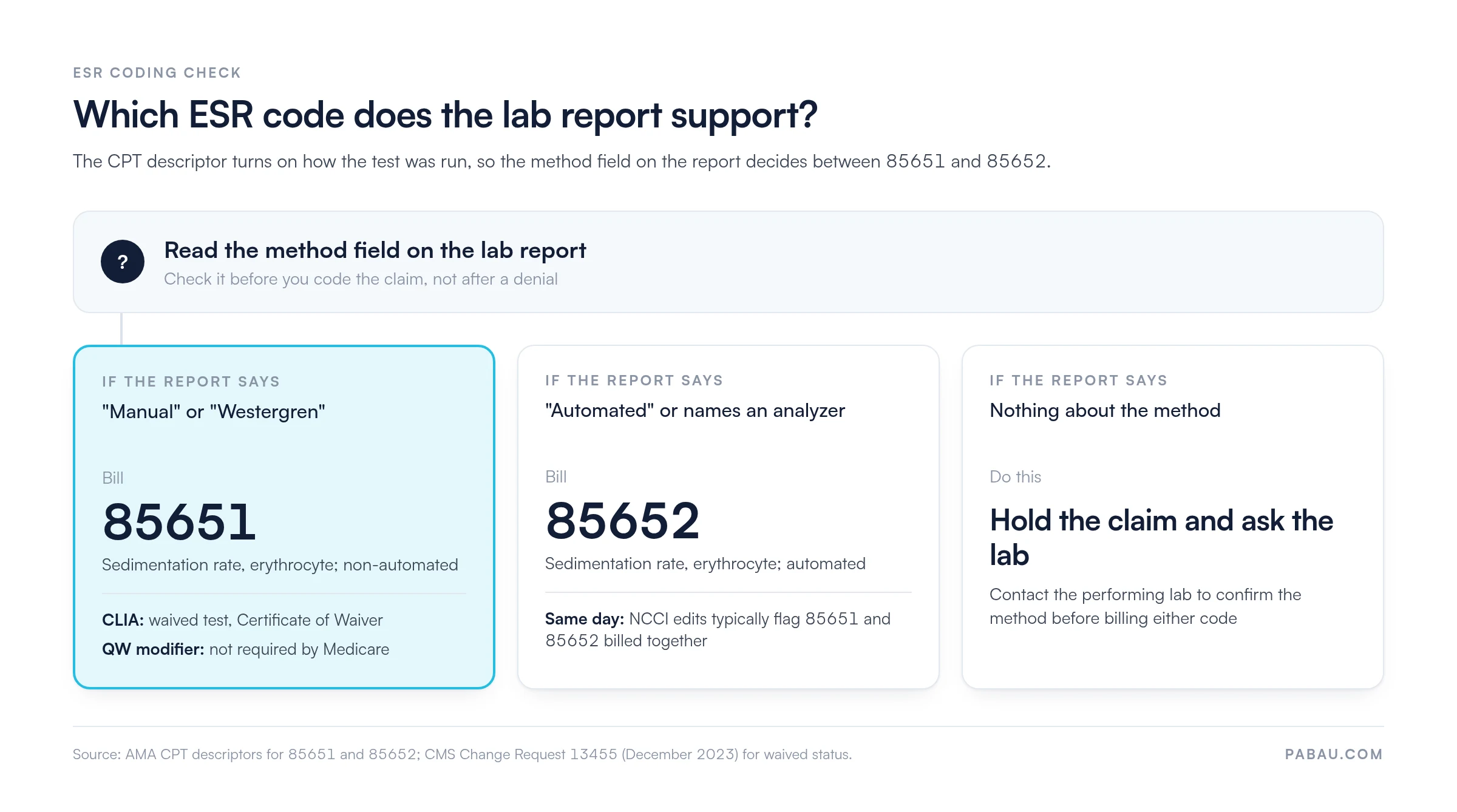
Because the technician sets up and reads the tube by hand instead of loading an analyzer, the work is billed under CPT 85651, not 85652. Coders should confirm the test report specifies a “manual” or “Westergren” method before selecting 85651. If the report says “automated” or names an analyzer, 85652 is the correct code.
CPT 85651 covers a manual ESR, and CPT 85652 covers an automated ESR. They are distinct procedures with separate payment rates. Billing one in place of the other is a frequent coding error on sedimentation rate claims. The claim may then be denied or paid at the wrong rate.
To confirm which code applies, read the laboratory test report. Its method field will state “Westergren” or “manual,” or it will name an instrument model. If the report does not specify a method, contact the performing lab before billing.
Medicare and most commercial payers require a valid ICD-10-CM diagnosis code that establishes medical necessity before they will pay an ESR claim. Payers enforce this through Local Coverage Determinations (LCDs) issued by Medicare Administrative Contractors (MACs). The accepted ICD-10 codes may differ between MAC jurisdictions, so check your applicable LCD.
The following ICD-10-CM codes are among the most commonly accepted for CPT code 85651 billing across payer LCDs. This is not an exhaustive list, and coverage is LCD-dependent.
CRP (CPT 86140) is a companion inflammatory marker often ordered alongside the erythrocyte sedimentation rate. The two tests have separate CPT codes and no bundling conflict. Both are separately billable when clinically indicated and supported by appropriate ICD-10 codes.
Always verify your applicable MAC’s LCD for ESR before billing CPT code 85651. Noridian, Palmetto GBA, CGS and Novitas each publish their own coverage policies. An ICD-10 code accepted in one jurisdiction may not be covered in another. Search the CMS LCD database at cms.gov to find the current policy for your region.
Medicare pays for CPT code 85651 under the Clinical Laboratory Fee Schedule administered by the Centers for Medicare and Medicaid Services. Rates are updated every year. Independent labs, hospital outpatient departments and physician office labs also fall under different payment rules.
Rather than citing a dollar amount that will go stale, check the CMS Clinical Laboratory Fee Schedule page. Download the current CLFS file and find code 85651 to see this year’s payment amount. Lab codes on the CLFS have no work, practice expense or malpractice RVU breakdown, so Physician Fee Schedule and RVU lookups do not apply.
Key payment variables to check for CPT code 85651:
Pabau connects to the Claim.MD clearinghouse to run eligibility checks before the test. It then submits ESR claims as CMS-1500/837P files, and ERA remittances come back through Claim.MD.
Payers evaluate ESR claims against three layers of requirements: physician order documentation, medical necessity via ICD-10 linkage and place-of-service compliance. A claim that meets all three before submission avoids the most preventable denials.
Use this pre-submission checklist for every CPT code 85651 claim. Good medical billing practice runs it on every claim as a standing step.
Once a claim clears this checklist, Pabau’s claims management software supports claim submission through Claim.MD.
The documentation that must accompany or support a CPT 85651 claim includes:
A complete superbill links the procedure code, ICD-10 code, ordering provider and date of service in one document. That simplifies both claim submission and audit defense.
ESR denials follow predictable patterns. The same few reasons tend to recur, so workflow changes fix more of them than case-by-case appeals do.
A structured clean claim submission process checks ICD-10 linkage, the test method and CLIA status before the claim leaves. That step prevents most of these denials at the source. For recurring denials, a formal denial management workflow tracks root causes by denial code, so appeals give way to prevention.
ESR rarely reaches the lab in isolation. Most orders arrive as part of an inflammatory workup that includes one or more companion tests. Each has its own CPT code, and each requires its own ICD-10 linkage on the claim.
When several lab tests are ordered on the same date, each claim line carries its own CPT code and its own supporting ICD-10 code. Never report ESR under a panel code that does not include it in the official panel definition.
State Medicaid programs and state-funded family planning programs set their own coverage policies for laboratory tests, and they frequently diverge from Medicare LCD requirements. California’s Family Planning, Access, Care, and Treatment (Family PACT) program is a notable example.
Family PACT has issued billing guidance that references CPT codes 85651 and 85652 for infection and inflammatory workups in family planning patients. Under Family PACT, ESR may be a covered laboratory service when ordered for a covered reproductive health condition. The program has its own diagnosis linkage requirements, separate from Medicare LCD policies.
Three habits help with any state-specific program:
Use the AAPC Codify crosswalk to map your ESR ICD-10 diagnosis code against the specific LCD for your MAC. The crosswalk shows which diagnosis codes each policy accepts, which heads off a medical necessity denial before the claim is sent.
Accurate ESR billing depends on clean data moving from the order to the submitted claim. That means the right method code, the right ICD-10 linkage and the right place of service. Pabau supports the revenue cycle management workflow through its Claim.MD clearinghouse connection. It runs eligibility checks, submits CMS-1500/837P claims and receives ERA/835 remittances.
When a payer denies an ESR claim, the CARC denial codes on the remittance name the reason. Common ones cover missing medical necessity, an incorrect procedure code and a place-of-service mismatch. ERA remittances come back through Claim.MD, so your billing team can work each denial by its root cause.

Pabau connects to Claim.MD for eligibility checks, CMS-1500/837P claim submission and ERA remittances. Your team sends lab claims and tracks payment from one system.

The errors that sink ESR claims are preventable. The usual causes are the wrong method code, an ICD-10 code missing from the LCD and a lab without the right CLIA certificate.
Build the checks into ordering and coding rather than fixing claims one at a time. Confirm the method on the lab report, match the diagnosis to your MAC’s LCD and keep the Certificate of Waiver on file. Do that, and an 85651 claim goes out once instead of twice.
Pabau connects to Claim.MD for eligibility checks, CMS-1500/837P claim submission and ERA remittances. Book a demo to see how Pabau handles lab billing from order to payment.

Need a clearinghouse for lab claim submission? Claim.MD clearinghouse overview explains how the integration handles electronic claim submission and ERA remittances for US practices.
Seeing recurring denials on lab claims? Medical billing compliance guidance covers the documentation and workflow standards that prevent systematic billing errors.
Looking for the 837 electronic claim format reference? 837 file format guide explains the HIPAA transaction standard used to submit CPT claims electronically to clearinghouses and payers.
Ordering CRP alongside ESR? CPT code 86140 covers the C-reactive protein test that often accompanies 85651 in an inflammatory workup.
CPT code 85651 is the billing code for a manual (non-automated) erythrocyte sedimentation rate test, officially described as “Sedimentation rate, erythrocyte; non-automated.” It falls under the Hematology and Coagulation subsection of CPT’s Pathology and Laboratory section. The test measures how far red blood cells settle in a tube over one hour, as an indicator of inflammation.
CPT 85651 covers a manually performed ESR, most often by the Westergren method, while CPT 85652 covers an automated ESR run on an analyzer. With 85651, a technician sets up and reads the tube by hand. With 85652, a machine runs the test. Billing one in place of the other is a frequent coding error, and the claim may be denied or paid at the wrong rate.
Commonly accepted ICD-10-CM codes include M05.79 (rheumatoid arthritis with rheumatoid factor of multiple sites without organ or systems involvement) and M31.6 (temporal arteritis). Others are M32.9 (systemic lupus erythematosus), M45.9 (ankylosing spondylitis) and R50.9 (fever, unspecified). The covered list depends on your MAC’s Local Coverage Determination, so check the applicable LCD before billing.
No, not without documented medical necessity for each. NCCI edits typically flag billing both 85651 and 85652 on the same date of service. If a practice performed both a manual and an automated ESR on the same day, it needs documented clinical justification. Review the claim against the current NCCI table and applicable LCD before submission.
Yes. Medicare and most commercial payers require a signed, dated physician order or laboratory requisition as a condition of payment for CPT 85651. The order must name the test and document the clinical indication. Missing or unsigned orders are a common audit finding and can lead to both claim denial and post-payment recovery requests.
Yes. CMS lists 85651 as a CLIA-waived test, so a lab with a CLIA Certificate of Waiver can perform and bill it. Medicare recognizes 85651 as waived without the QW modifier, unlike most newer waived tests.
C-reactive protein testing (CPT 86140) is separately billable alongside CPT 85651 when both are clinically indicated. The ICD-10 codes supporting CRP and ESR are often the same inflammatory or autoimmune diagnosis codes. Each test needs its own diagnosis linkage on the claim, but NCCI sets no bundling conflict between them.