CPT Code 28005: Incision of bone cortex, foot
CPT Code 28005: Definition and clinical scope CPT Code 28005 is the Current Proc...

Last Updated: Oct 22, 2026
69205 is the CPT code for removal of foreign body from external auditory canal; with general anesthesia. It covers objects such as beads, insects, or hearing aid parts lodged in the ear canal when the patient needs general anesthesia for safe removal.
69205 is the with-general-anesthesia counterpart of 69200, which covers the same removal without general anesthesia. The anesthesia type documented in the operative note determines which of the two applies, not the object itself.
Let Pabau's smart automation suggest the right codes, reduce claim denials, and keep your practice compliant—effortlessly.
Automate repetitive tasks and focus on what matters most—your patients.
Reduce coding errors and ensure compliance with the latest regulations.
Clean claims, fewer denials, and faster reimbursements.
Powerful insights and reporting to help your practice thrive.
HIPAA compliant SOC 2 certified GDPR-compliant Trusted by 4,000+ clinics worldwide

CPT code 69205 covers foreign body removal from the external auditory canal (EAC) with general anesthesia, not cerumen removal or middle ear procedures.
General anesthesia documented in the operative note is required to use 69205. Without it, use 69200 (without general anesthesia); 69209 and 69210 apply to cerumen removal, not foreign bodies.
Medicare’s bilateral indicator for 69205 is 1, so removal from both ears is billed on one line with modifier 50 at 150% payment.
In the 2026 Medicare Physician Fee Schedule, 69205 carries 1.18 work RVUs and a 10-day global period.
Pabau’s claims management software sends claims through Claim.MD and tracks their status and remittance, so your team can follow each 69205 claim.
CPT code 69205 carries the official American Medical Association (AMA) descriptor: Removal of foreign body from external auditory canal; with general anesthesia. The code sits in the Surgery section, Auditory System subsection, under External Ear in the removal range 69200-69222. Its neighbor 69200 covers the same removal without general anesthesia. Both codes share one anatomical scope: the external auditory canal, not the middle or inner ear.
The table below sets 69205 beside its neighbors in the 692xx range, including the two cerumen codes it is often confused with.
69205 is valid only for the external auditory canal. A foreign body in the middle ear, or one that needs a more complex surgical approach, falls under a different code family. Document the anatomical location explicitly.
CPT code 69205 covers the removal of any non-cerumen foreign body lodged in the external auditory canal when general anesthesia is clinically necessary. General anesthesia is typically needed because the patient cannot cooperate with an awake procedure.
Common clinical scenarios that justify 69205 include:
The operative note must document why general anesthesia was medically necessary, not simply that the patient preferred it. Payer reviews of 69205 claims focus on this element. A note that says only “patient requested GA”, with no clinical reason, invites a post-payment recovery demand.
The documented anesthesia type is the single factor that separates 69200 from 69205. The foreign body itself, the patient’s age, and the difficulty of removal do not determine the code. Cerumen removal is a separate code pair, 69209 and 69210, shown below only as a contrast.
The diagram follows the order a coder reads the note: first what came out of the canal, then how it was removed.
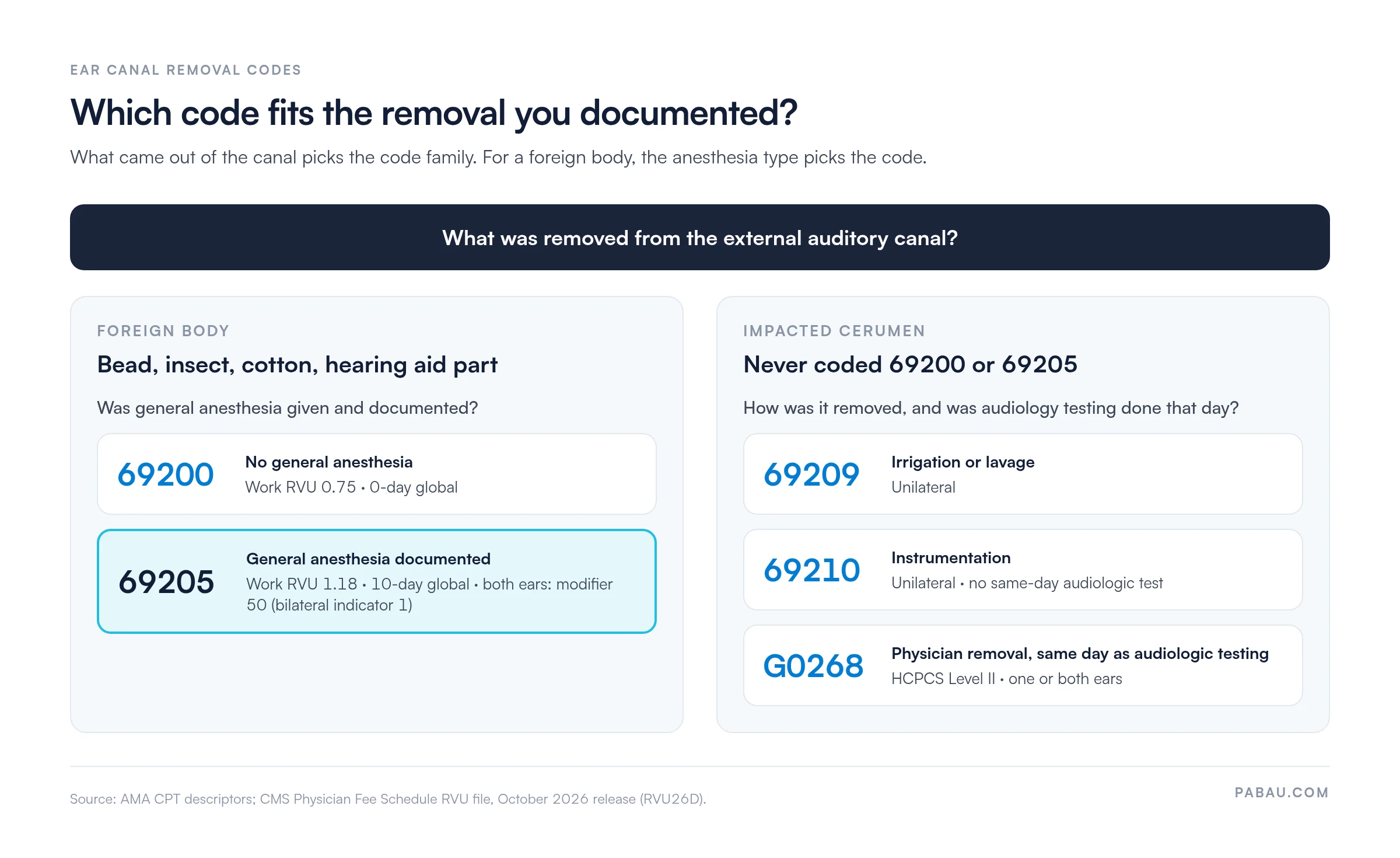
Common mistake: A coder bills 69200 even though the operative report documents general anesthesia. It happens when the coder defaults to the lower code without reading the anesthesia section. The claim then reports a lesser service than the one performed, and the place-of-service code no longer fits the code billed.
CPT code 69210 is for removal of impacted cerumen, not removal of a foreign body. These are different procedures with different clinical indications, payer coverage rules, and reimbursement amounts.
The clinical documentation makes the distinction. If the operative note describes a foreign body, use 69200 or 69205. If it describes impacted cerumen, use 69209 or 69210. Cerumen removal stays on those two codes even when general anesthesia was given, and is never coded 69205.
G0268 is an HCPCS Level II code for physician removal of impacted cerumen, one or both ears. It applies on the same date as audiologic function testing. It is a cerumen code, so it has no role in foreign body or implant removal.
CMS created G0268 so a physician who removes impacted cerumen can be paid when an audiologist performs audiologic testing that same day. When the audiologist removes the cerumen, the removal counts as part of the diagnostic test and is not paid separately.
One wrong modifier on a 69205 claim can mean a denial, an overpayment demand, or an NCCI violation. The bilateral rule needs the closest look, because 69205 follows the standard Medicare bilateral payment adjustment.
The bilateral rule in practice: A 4-year-old has a bead in each ear, and both are removed in one general anesthesia session. For Medicare, bill 69205-50 on a single claim line with one unit. Medicare then pays 150% of the single-ear amount, not 200%. A few MACs accept RT and LT lines instead, but payment still follows the 150% rule.
Check the bilateral surgery indicator for 69205 in the Medicare Physician Fee Schedule each January, because CMS can change indicators in its annual update. In the October 2026 file it is 1, which means modifier 50 and 150% payment.
An operative note that leaves out any of the following elements can lead to a denial or audit finding. Payers review 69205 claims closely because general anesthesia makes the episode costlier than a 69200 removal. Reviewers look for documentation that justifies the anesthesia.
With those elements in the note, claims management software can carry the claim to the payer and track it through to payment.
Medicare pays CPT code 69205 under the Medicare Physician Fee Schedule (MPFS), using relative value units (RVUs). Each RVU component is adjusted by its geographic practice cost index (GPCI), then the total is multiplied by the conversion factor.
In the October 2026 CMS RVU file, 69205 carries 2.62 total facility RVUs. At the 2026 conversion factor of $33.4009, that is a national facility amount of about $87.51 before GPCI adjustment. CMS marks the non-facility practice expense as not applicable, because the procedure is rarely or never performed in an office.
Use the CMS Physician Fee Schedule lookup tool to retrieve the current-year national amounts and your locality’s GPCI-adjusted rate.
The surgeon’s fee and the anesthesia provider’s fee are billed separately. The anesthesiologist or CRNA submits a separate claim using anesthesia base units plus time units under the applicable anesthesia CPT code. Combining both fees on a single claim under 69205 is a billing error and an audit trigger.
Prior authorization requirements for CPT code 69205 vary by payer and Medicare Administrative Contractor (MAC) jurisdiction. Because general anesthesia raises the total cost of the episode, commercial payers are more likely to require pre-authorization than for 69200. Checking insurance eligibility verification before scheduling the OR case is the first step in preventing a retroactive denial.
Five causes come up repeatedly on 69205 claims, and each has its own fix. A guide to medical billing denial codes shows which CARC reason code maps to each issue below.
For appeals on 69205 denials, attach the operative note, the anesthesia record, and the pre-authorization reference number (if authorization was required). A clean claim submission process aims to catch these issues before the claim reaches the payer. A 69205 checklist built on the five causes above does the same job for each claim before it goes out.
A structured denial management workflow helps practices that see many pediatric ear foreign body cases. Tracking denials by code and modifier shows whether the root cause sits in the documentation or in coder training.
Yes, CPT 69205 can be billed with a same-day E&M code. The E&M must be a separately identifiable evaluation and management service, beyond the decision to perform the procedure.
Modifier 25 is required on the E&M code, not on 69205. The clinical note must document what the E&M covered on its own. Examples include a hearing assessment, a review of systems unrelated to the foreign body, or family counseling about how the object got in. A note that simply records “patient presents with foreign body in ear, taken to OR” does not support a separately billable E&M.
Build a same-day E&M checklist for your ENT practice. Before appending an E&M to a 69205 claim, confirm the note documents a reason for the encounter beyond the decision to remove the foreign body. If the only visit content is pre-procedure assessment for the 69205 itself, the E&M cannot be separately billed.
Many ENT practices code the case in one system, submit through a separate clearinghouse portal, and chase remittances by hand. A bilateral 69205 claim paid at the wrong rate can then sit unnoticed for weeks.
Pabau’s claims management software sends claims to Claim.MD, a US clearinghouse, without leaving the platform. Claim status and electronic remittance advice (ERA) come back into Pabau, so your team sees each 69205 claim’s progress in one place.
Pabau does not choose the code or review the operative note, so your coders still make that call. What changes is the follow-up. When the remittance posts, your team can compare the paid amount with the fee schedule and act on a short payment quickly.

Pabau’s claims management software sends claims through Claim.MD and tracks status and remittance in one place. See how ENT practices follow surgical ear claims from submission to payment.

A paid 69205 claim rests on two decisions: whether the note documents general anesthesia, and how a bilateral removal is reported. Miss the first and the claim is undercoded or denied. Miss the second and Medicare pays the wrong amount, often without anyone noticing.
Start by adding anesthesia and laterality fields to your operative note template, then confirm the bilateral indicator each January. Pabau’s claims management sends claims through Claim.MD and tracks their status and remittance, so the team can follow each 69205 claim. Book a demo to see how it tracks surgical ear claims from submission to payment.

Need to understand how claim denials are categorized? Denial codes in medical billing covers CARC and RARC reason codes and how to read remittance advice when a 69205 claim is rejected.
Want a primer on the clearinghouse submission process? Medical claims clearinghouse explains how 837P files move from your billing system to the payer and where edits are applied.
Looking to streamline insurance eligibility checks before scheduling? Revenue cycle management walks through the full billing workflow from eligibility verification to payment posting for surgical procedure codes.
CPT code 69205 is the AMA procedure code for removal of a foreign body from the external auditory canal performed under general anesthesia. It is the with-anesthesia counterpart to CPT 69200, which covers the same procedure without general anesthesia.
The only clinical difference is the anesthesia type. CPT 69200 covers foreign body removal from the external auditory canal without general anesthesia. CPT 69205 covers the same procedure when general anesthesia is administered and documented. The foreign body type, patient age, and difficulty of removal do not determine which code applies.
Yes, for Medicare. The bilateral surgery indicator for 69205 is 1, so modifier 50 applies. When foreign bodies are removed from both ears in one session, bill one line, 69205-50, with one unit. Medicare pays 150% of the single-ear amount. Commercial payers may want RT and LT lines instead, so check each payer’s bilateral policy.
The operative note must document the foreign body type and its location in the external auditory canal. It must confirm general anesthesia was given and explain why it was necessary. It also records laterality, surgeon identity, site of service, and pre- and post-procedure findings showing complete extraction. Missing any of these elements increases audit and denial risk.
Yes, but only when the E&M documents a separately identifiable service beyond the decision to perform the procedure. Modifier 25 must appear on the E&M code. If the note only records the pre-operative assessment for the 69205, the E&M cannot be separately billed.