

ICD-10 code S61.201A: Open wound of left index finger without nail damage
ICD-10 code S61.201A covers a left index finger wound of unstated type ICD-10 co...

Last Updated: Oct 16, 2026
Billable Code Specific Code
S42.399S is the billable ICD-10-CM code for other fracture of shaft of unspecified humerus, sequela.
Let Pabau's smart automation suggest the right codes, reduce claim denials, and keep your practice compliant—effortlessly.
Automate repetitive tasks and focus on what matters most—your patients.
Reduce coding errors and ensure compliance with the latest regulations.
Clean claims, fewer denials, and faster reimbursements.
Powerful insights and reporting to help your practice thrive.
HIPAA compliant SOC 2 certified GDPR-compliant Trusted by 4,000+ clinics worldwide

ICD-10 code S42.399S covers other fracture of shaft of unspecified humerus, sequela, and is billable under FY2026.
The 7th character ‘S’ means the visit treats a late effect of a healed humerus fracture, not the acute injury.
Never report S42.399S on the same claim as an acute fracture code for the same site.
When laterality is documented, use S42.391S for the right humerus or S42.392S for the left.
Pabau converts a completed invoice into a CMS-1500 claim, submits it through Claim.MD, and tracks the payer response.
ICD-10 Code S42.399S is a billable diagnosis code for other fracture of shaft of unspecified humerus, sequela. Use it when a patient returns for care aimed at a late effect of a healed humerus shaft fracture. It does not cover ongoing treatment of the original break.
The code is valid for submission under the FY2026 ICD-10-CM edition, effective October 1, 2025. It sits in the S42 category for fractures of the shoulder and upper arm, inside the S42.3 subcategory for shaft injuries.
Because laterality is unspecified, query the documentation before you submit. If the notes record a right or left side, S42.391S or S42.392S is the more specific choice.
The table below summarizes the billing properties of ICD-10 Code S42.399S for quick reference.
The 7th character is the most clinically significant part of this code. It tells payers what phase of care is being billed and determines whether the claim will pass adjudication.
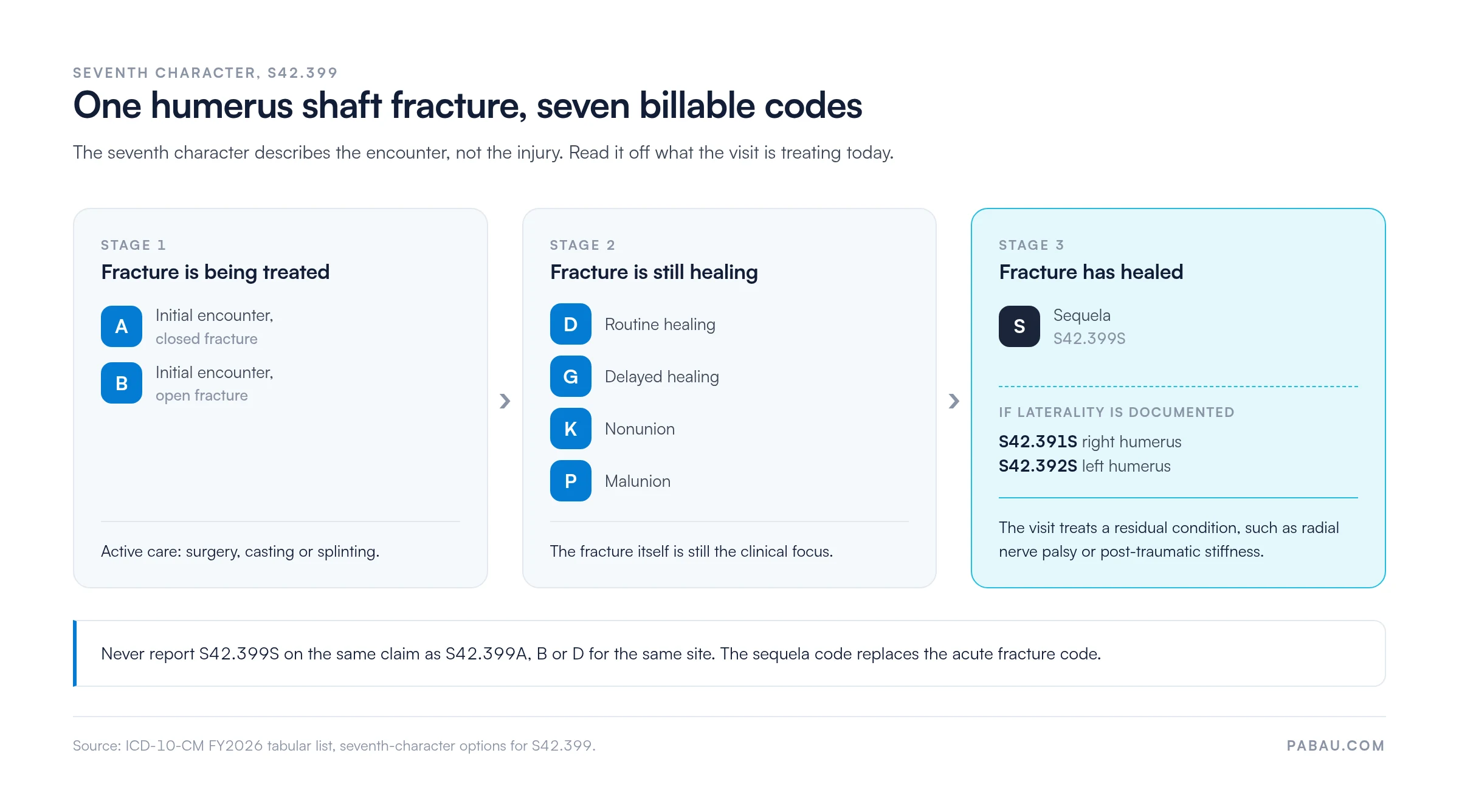
Seven 7th characters are available on this code. Each describes a different encounter type, and picking the wrong one is a leading cause of rejection on humerus fracture claims.
The ‘S’ designator applies once the original fracture has finished healing. The patient now presents with a residual condition such as chronic stiffness, nerve palsy, or post-traumatic arthritis. That condition is a direct consequence of the earlier injury, and the sequela code replaces the acute injury code rather than adding to it.
Grouped by healing stage, the seven options collapse into three decisions.
The humeral shaft is the long cylindrical portion of the upper arm bone, between the shoulder and elbow joints. Published epidemiological data puts shaft fractures at roughly 3% to 5% of all fractures seen in orthopedic practice. They occur across every age group, from high-energy trauma in younger patients to low-energy falls in older adults.
Sequelae following a humeral shaft fracture are clinically significant because the radial nerve runs in the spiral groove of the humeral shaft. Damage during the original injury or during healing can produce lasting neurological deficits that require their own management episodes.
Common conditions coded as sequelae of this fracture include:
Rehabilitation carries most of these cases, and physical therapy EMR software keeps the documentation consistent across a run of sequela encounters.
ICD-10 Code S42.399S sits inside a layered code structure. Reading the hierarchy shows where a code’s specificity comes from. It also shows why a fracture at the far end of the same bone lands elsewhere, at S42.452A.
Coders and clinicians use several terms interchangeably with the clinical description behind this code. The following all map to S42.399S when the encounter meets the sequela criteria:
“Late effect” is the older ICD-9 terminology. ICD-10-CM replaced it with “sequela,” and both describe the same clinical idea. A condition arises as a consequence of a prior injury, after the acute phase has closed. The CDC/NCHS ICD-10-CM web tool carries the full alphabetic index, which is where you confirm that a documented phrase leads here.
Start with one question. Is the fracture still being treated? If it is, D is the character for a subsequent encounter. If it has healed and the visit addresses what the fracture left behind, S is the character for a sequela. Payers apply different coverage rules to each, so the answer changes what gets paid.
Sequela (S): The original fracture has healed. The patient presents with a distinct condition caused by that fracture, such as radial nerve palsy or post-traumatic stiffness. Code the residual condition first, then S42.399S.
Subsequent encounter (D): The original fracture is still healing. The patient attends for routine monitoring, cast changes, or physical therapy while the fracture site consolidates. The fracture is still the primary clinical focus.
Under the ICD-10-CM Official Guidelines, Section I.C.19, the sequela code is never reported with the acute fracture code for the same site. The rule holds across the whole injury chapter, so a spinal cord sequela such as S14.118S behaves the same way. Getting the pairing right is most of what makes a clean claim on a late-effect encounter.
Sequela coding needs documented evidence that the acute phase has closed. Before assigning S42.399S, check that the provider’s notes state the fracture is healed. The notes should also show that care is now directed at a residual complication rather than the fracture. Missing that documentation is the top reason sequela claims trigger audits.
Coders in orthopedic and sports medicine settings meet the whole S42.399 family, plus the laterality codes and the pattern-specific shaft codes such as codes such as S42.332G. The table below organizes the ones that come up most. Practices running these cases through sports medicine software keep the clinical detail and the code assignment in the same record.
Malunion and nonunion are named outcomes that the 7th character carries on its own. For a traumatic humerus shaft fracture, S42.399P reports malunion and S42.399K reports nonunion. Neither needs a second code layered on top.
The M84.0 and M84.1 categories do cover malunion and nonunion of fracture, so they look like a fit. Their Excludes1 notes rule out traumatic fractures in the S42 range, which sends you straight back to the 7th character. Other long bones work the same way, as S52.042Q and S72.435M show.
M84.3 is the stress fracture category, not a second route to malunion or nonunion. Its codes also need their own 7th character, so M84.321 is not billable by itself. The AAPC ICD-10-CM lookup confirms which combinations are valid for the current fiscal year.
Where more than one late effect is documented, the AHA Coding Clinic is the place to settle sequencing. The wider point for the practice is that medical billing accuracy on these claims rests on the 7th character, not on finding an extra code.
The CPT codes reported with S42.399S depend on what service the sequela encounter delivers. Physical therapy and evaluation services are the most frequent pairings. Surgical revision also applies where malunion or nonunion is what is being treated.
The codes above are common pairings rather than mandated ones. The AMA maintains CPT separately from ICD-10-CM, so check each code against the current CPT codebook for the applicable year.
Practice management software like Pabau sends the finished encounter out through its Claim.MD integration. That converts a completed invoice into a CMS-1500 claim, runs a payer eligibility check, submits the claim, and tracks its status and remittance. Out-of-network practices hand reimbursement to the patient, and the superbill format is what makes that possible.
The ICD-10-CM Official Guidelines for Coding and Reporting (Section I.C.19) govern sequela coding for injury codes in the S00-T88 range. Three documentation requirements directly determine whether a sequela claim holds up under audit.
Thin sequela documentation is a known trigger for post-payment audits. Medical billing compliance frameworks recommend periodic claim review on sequela codes, especially in high-volume orthopedic practices. Mapping the revenue cycle end to end shows where these coding errors surface.
Sequela codes in ICD-10-CM are systematically exempt from Present on Admission (POA) reporting requirements. This is a structural property of the 7th character S designation, not a code-specific ruling.
POA reporting asks inpatient facilities to say whether a condition was present when the patient was admitted. A sequela is by definition a late effect of an earlier injury encounter. It cannot carry a meaningful POA status against a new admission, and CMS designates sequela codes as exempt accordingly.
For inpatient coders that has one practical consequence. When S42.399S appears on a hospital claim, leave the POA indicator blank or use your facility’s exempt indicator. Assigning Y, N, W or U to an exempt code can flag the claim for review, which is where denial management starts costing time.
In most orthopedic practices the sequela visit is documented in one system and billed in another. Someone reads the note, retypes the codes into a claim form, and then chases the payer response through a separate portal.
Pabau keeps the treatment note, the invoice and the claim on the same client record. Its claims management tools turn a completed invoice into a CMS-1500 claim, check the patient’s eligibility with the payer, and submit it through Claim.MD.
Status updates and electronic remittance advice come back against that same record. You can see which sequela claims paid without opening a second system. When a denial lands, the note behind the 7th character sits alongside the claim.

Pabau turns completed invoices into CMS-1500 claims, checks payer eligibility, and tracks status and remittance against the client record. That leaves fewer systems to reconcile when a claim comes back.

Two habits cause most of the denials on these claims. One is applying the ‘S’ character before the record shows the fracture healed. The other is accepting the unspecified code when the notes already name a side.
Both are documentation problems before they are coding problems. Ask what the visit is treating. If the answer is the fracture itself, the character is D or G. If it is what the fracture left behind, the character is S.
Answer that in the note and the claim follows without argument. Book a demo to see how Pabau handles sequela and multi-encounter billing for orthopedic and rehabilitation practices.

Coding an open fracture instead? S72.466E shows how the open-fracture 7th characters change the code on a long bone.
Need a sequela code in another injury section? S60.152S applies the same late-effect rules to a nerve injury of the hand.
Still treating the fracture? S12.131D walks through the subsequent-encounter side of the same decision.
Coding a different part of the humerus? S42.452A covers the distal end, where laterality and displacement both change the code.
ICD-10 Code S42.399S is a billable ICD-10-CM diagnosis code for “other fracture of shaft of unspecified humerus, sequela.” Use it when a patient is treated for a late complication of a previously healed humerus shaft fracture. The code is valid for FY2026, effective October 1, 2025.
Yes. S42.399S is a billable and specific ICD-10-CM code, valid for claim submission under the FY2026 edition. It is the fully specified 7-character code required for reimbursement. Its parent code, S42.399, is not billable on its own.
Yes. S42.399S is exempt from POA reporting requirements. Sequela codes in ICD-10-CM carry a systematic POA exemption, because a late-effect condition cannot carry a meaningful present-on-admission status against a new inpatient encounter.
Common pairings include 97110 for therapeutic exercises, 97530 for therapeutic activities, and 99213 to 99214 for established patient office visits. Surgical repair of a nonunion or malunion of the humerus uses 24430 or 24435. These are contextual pairings rather than mandated combinations, so verify each one against the current AMA CPT codebook.
Yes, whenever the record documents a side. S42.391S covers the right humerus and S42.392S covers the left. Reach for S42.399S only when the documentation genuinely does not state which arm was fractured, and query the provider before you submit.



