ICD-10 Code S53.013D: Anterior subluxation of unspecified radial head
ICD-10 Code S53.013D: Quick reference summary Use the table below as your first ...

Last Updated: Nov 6, 2026
Billable Code Specific Code
S56.392A is the billable ICD-10-CM code for other injury of extensor or abductor muscles, fascia and tendons of left thumb at forearm level, initial encounter.
It covers the abductor pollicis longus, extensor pollicis brevis and extensor pollicis longus of the left thumb, injured above the wrist. Strains (S56.312A) and lacerations (S56.322A) of these units have their own codes, so "other injury" means trauma such as a contusion or crush injury. The 7th character A applies while the injury is under active treatment.
Let Pabau's smart automation suggest the right codes, reduce claim denials, and keep your practice compliant—effortlessly.
Automate repetitive tasks and focus on what matters most—your patients.
Reduce coding errors and ensure compliance with the latest regulations.
Clean claims, fewer denials, and faster reimbursements.
Powerful insights and reporting to help your practice thrive.
HIPAA compliant SOC 2 certified GDPR-compliant Trusted by 4,000+ clinics worldwide

ICD-10 code S56.392A covers other injury of the extensor or abductor muscles, fascia and tendons of the left thumb at forearm level, initial encounter.
Only three thumb units qualify: abductor pollicis longus, extensor pollicis brevis and extensor pollicis longus. Wrist and finger extensors code elsewhere in S56.
S56.392A is billable. The parent code S56.392 cannot be submitted without its 7th character.
The 6th character sets laterality: S56.391A is the right thumb, S56.392A the left, and S56.399A unspecified.
Pabau’s claims management software keeps the note and the claim in one record, so laterality and injury type are coded from the source.
ICD-10 code S56.392A covers other injury of the left thumb’s extensor or abductor muscles, fascia and tendons at forearm level, at the initial encounter.
It applies to a contusion, crush or similar trauma to those units above the wrist while the injury is under active treatment. The code is billable, and the table below sets out where it sits in ICD-10-CM.
Every character in an ICD-10-CM code carries a specific meaning. Reading S56.392A left to right:
S56.39- is the residual injury type within the thumb extensor subcategory. Strains of the same left thumb structures code to S56.312A, and lacerations to S56.322A. An injury documented with no type at all codes to S56.302A.
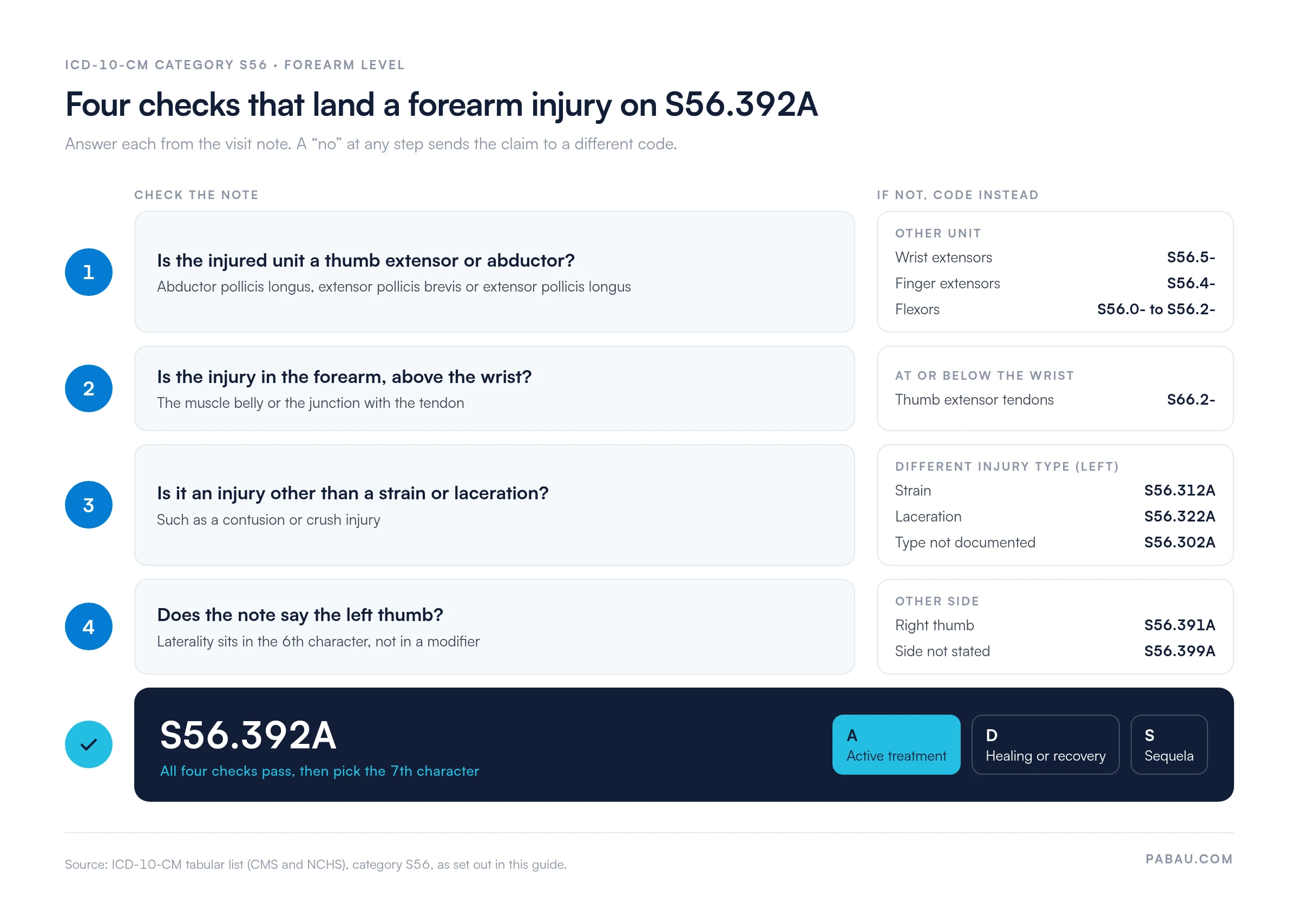
Any other injury type lands in S56.392A, such as a contusion or crush injury to the left thumb extensors above the wrist. In physical therapy and sports medicine encounters, picking a general forearm code over this one is a common accuracy issue. The chart below runs the four checks in the order a coder meets them in the note.
Yes. ICD-10 code S56.392A is billable and valid for submission to payers under the ICD-10-CM code set maintained by CMS. The 7th character A completes the required character count, making S56.392A a claim-ready diagnosis code.
The parent code S56.392 (without a 7th character) is not billable. ICD-10-CM codes that require a 7th character cannot be submitted at the truncated level, and payers reject S56.392 as incomplete. Understanding the basics of medical billing helps clarify why the 7th character is mandatory for claim acceptance.
The 7th character in S56.392A defines the phase of care, not the number of visits. All three options apply to code S56.392:
Per ICD-10-CM Official Guidelines Section I.C.19.a, 7th character A applies while the patient receives active treatment. Examples include surgical treatment, an emergency department encounter, and evaluation and continuing treatment by a physician.
Once active treatment ends, D covers encounters during the healing or recovery phase. That includes splint changes, medication adjustment, and other follow-up visits. Physical therapy for a healing left thumb extensor injury is usually reported with S56.392D, not S56.392A.
S56.392A covers three muscle-tendon units of the left thumb, injured where they run through the forearm. The abductor pollicis longus abducts the thumb at its base. The extensor pollicis brevis extends the thumb at the knuckle, and the extensor pollicis longus extends its tip.
All three arise on the back of the forearm, from the radius, ulna and interosseous membrane. Their tendons then cross the wrist on the thumb side. Forearm level means the muscle belly or the junction with the tendon, above the wrist.
What S56.392A does not cover is equally important for coding accuracy:
Excludes2 notes: Category S56 lists two Excludes2 notes. They are injury of muscle, fascia and tendon at or below the wrist (S66.-), and sprain of joints and ligaments of the elbow (S53.4-). Excludes2 means the condition is not part of S56, but both codes may be reported when the patient has both.
Code also: S56 instructs you to code any associated open wound of the forearm (S51.-) as well.
S56.392A is for trauma. Overuse conditions of the same tendons, such as de Quervain tenosynovitis (M65.4), code to Chapter 13. So does a spontaneous, nontraumatic rupture of an extensor tendon (M66.2-).
Within S56.39-, the 6th character sets laterality. No modifier is involved, and the three options are fixed:
The left side is rarely the hard part of this code. The harder check is that the injured unit belongs to the thumb. A left forearm contusion that weakens wrist extension codes to S56.592A, not S56.392A, because the wrist extensors sit in S56.5-.
Query the provider when the note names neither the side nor the structure. Most payers accept an unspecified code only when a query is not clinically feasible.
Supporting documentation must show that the code selected is accurate and medically necessary. For ICD-10 code S56.392A, payers and auditors look for these elements:
Submitting a clean claim for S56.392A starts with a visit note that links the side, the structure, the level and the injury type. When any of these is missing, the claim is at higher risk of a medical necessity denial.
Before submitting a claim with S56.392A, check the note for four details. It should say left thumb and name a thumb extensor or abductor. It should place the injury above the wrist and describe something other than a strain or laceration. Those four details map to the code’s subcategory, injury type, laterality and level.
ICD-10-CM external cause codes describe how, where, and during what activity an injury occurred. The guidelines do not mandate them nationally, but some state reporting rules and some payers do. They matter most in sports medicine, since sport and recreation drive many forearm tendon injuries.
Check payer-specific requirements before submission. Where a payer expects an external cause code, a claim without one can come back for more information.
The CPT codes most often paired with ICD-10 code S56.392A follow the usual path for an acute thumb extensor injury. That path runs through evaluation, imaging, immobilization and rehabilitation.
Each CPT code billed alongside S56.392A must be supported by the documentation for this diagnosis. An ultrasound billed as 76882 needs an order that names the thumb tendon being assessed. A splint billed as 29125 needs the side and the injury in the note. Therapy codes must reference the left thumb extensor injury in the treatment plan.
Denials for ICD-10 code S56.392A cluster around a predictable set of errors, and each one has a direct fix. Effective denial management workflows start by tracking which of these patterns drives rejections at your practice.
Reviewing medical billing denial codes alongside your S56.392A rejections shows which payer edit is triggering each denial. That tells you whether the fix belongs in coding, documentation or payer setup.
Track S56.392A denials by CARC code. CARC 11 (the diagnosis is inconsistent with the procedure) usually signals a CPT-ICD linkage problem. CARC 16 (the claim lacks information) often means a missing 7th character or external cause code. CARC 50 (not deemed a medical necessity) points back to the documentation.
A left thumb extensor claim fails on details that live in the clinical note: which thumb, which structure, which level, and which phase of care. When the note and the claim sit in different systems, those details get lost in re-keying.
In Pabau’s practice software, the clinical record and the claim sit in one place. Your billing team codes from the note itself, with the side and the injury type in view. Pabau’s claims management software handles submission, eligibility checks, claim status and remittance posting in that same record.
Claims route through the Claim.MD clearinghouse, which Pabau integrates with for US claims. It applies payer edits before submission. An incomplete code or a diagnosis-procedure mismatch comes back to your team before the payer ever sees it.

Pabau’s claims management software keeps the clinical note and the claim in one record, checks eligibility, and submits through the Claim.MD clearinghouse. See how it works in a live demo.

S56.392A is narrower than its place in the forearm category suggests. It applies only when the injured unit is one of the three left thumb extensors or abductors, above the wrist. The injury also has to be something other than a strain or laceration.
Every other combination has its own code, and most errors on this code trace back to one of those boundaries. The fix sits upstream of billing. A note that names the thumb, the structure and the level makes the code obvious and the claim defensible.
Book a demo to see how Pabau keeps that note and the claim in one workflow.

Is the injured unit a finger extensor, not the thumb? ICD-10 code S56.412D shows how the S56.4- finger extensor codes are built and billed.
Does a payer want the external cause status on the claim? ICD-10 code Y99.8 covers the status code for leisure, sport and student activity.
Seeing repeat denials without a clear pattern? Electronic remittance advice (ERA) explained covers how to read ERA files to find denial root causes by CARC code.
ICD-10 code S56.392A is the billable code for other injury of the left thumb extensor or abductor muscles, fascia and tendons at forearm level. The A marks an initial encounter. It covers the abductor pollicis longus, extensor pollicis brevis and extensor pollicis longus above the wrist. Strains (S56.312A) and lacerations (S56.322A) of the same structures have their own codes.
Yes. S56.392A is billable and valid for payer submission. The parent code S56.392, without the 7th character, is not billable. A claim submitted with S56.392 alone will be rejected as an incomplete code.
S56.391A codes other injury of the extensor or abductor muscles, fascia and tendons of the right thumb at forearm level. S56.392A codes the same injury of the left thumb. The 6th character is the only difference: 1 for right, 2 for left, and 9 for unspecified (S56.399A).
No. The extensor carpi radialis longus and brevis and the extensor carpi ulnaris code to S56.5-, other extensor muscle at forearm level. Finger extensors such as the extensor digitorum code to S56.4-. S56.392A is limited to the extensor and abductor units of the thumb.
The ‘A’ is the 7th character for initial encounter. It applies while the patient receives active treatment, such as emergency care, surgery, or evaluation and continuing treatment by a physician. It does not mean the first visit. Once active treatment ends, follow-up and therapy visits move to ‘D’ (subsequent encounter).
S56.392A is used while the left thumb extensor or abductor injury is under active treatment. S56.392D applies once active treatment has ended and the patient is in routine healing or recovery care, including most therapy visits. Switching to D too early, or keeping A too long, both misstate the phase of care.
The most frequent reason is submitting the parent code S56.392 without a 7th character. Others are using the code for a wrist or finger extensor injury, choosing the wrong side, and applying the wrong encounter suffix. Missing external cause codes and weak CPT-ICD linkage cause the rest.