ICD-10 Code V09.01XS: Pedestrian injured in nontraffic accident involving military vehicle, sequela
ICD-10 Code V09.01XS: Code description and clinical meaning ICD-10 code V09.01XS...

Last Updated: Oct 26, 2026
Billable Code Specific Code
S42.452A is the billable ICD-10-CM code for displaced fracture of lateral condyle of left humerus, initial encounter for closed fracture.
Let Pabau's smart automation suggest the right codes, reduce claim denials, and keep your practice compliant—effortlessly.
Automate repetitive tasks and focus on what matters most—your patients.
Reduce coding errors and ensure compliance with the latest regulations.
Clean claims, fewer denials, and faster reimbursements.
Powerful insights and reporting to help your practice thrive.
HIPAA compliant SOC 2 certified GDPR-compliant Trusted by 4,000+ clinics worldwide

ICD-10 Code S42.452A describes a displaced fracture of the lateral condyle of the left humerus, initial encounter for closed fracture.
The nondisplaced left-side counterpart is a different code, S42.455A. The sixth character encodes displacement and laterality together, so check both.
When the record does not say whether a fracture is displaced, Section I.C.19.c of the ICD-10-CM Official Guidelines codes it to displaced.
Category S42 offers seven 7th characters: A, B, D, G, K, P, and S. Character A applies only during active treatment.
Practice management software like Pabau checks that a claim carries its required fields, then submits and tracks it through Claim.MD.
ICD-10 Code S42.452A is a billable ICD-10-CM diagnosis code. Namely, its full official descriptor is displaced fracture of lateral condyle of left humerus, initial encounter for closed fracture. In fact, you can confirm the wording in the CDC/NCHS ICD-10-CM web tool.
Four details are packed into this single code. First, the fracture is displaced, meaning the bone fragments have shifted out of place. Also, it involves the lateral condyle, the bony bump at the far end of the humerus. Finally, it is on the left side, and the patient is presenting for active treatment.
The detail that matters most here is displacement. For example, a nondisplaced fracture at the same site on the same side is S42.455A, not S42.452A. As a result, all four details need to be noted before this code goes on a claim.
Each character position in S42.452A carries a distinct meaning. That way, reading the code from left to right helps coders catch errors before sending the claim.
The sixth character does two jobs at once, which is where errors in this family start. Specifically, values 1, 2, and 3 are the displaced codes for the right, left, and unspecified side. Also, values 4, 5, and 6 are the nondisplaced codes in the same order, as the grid below sets out.
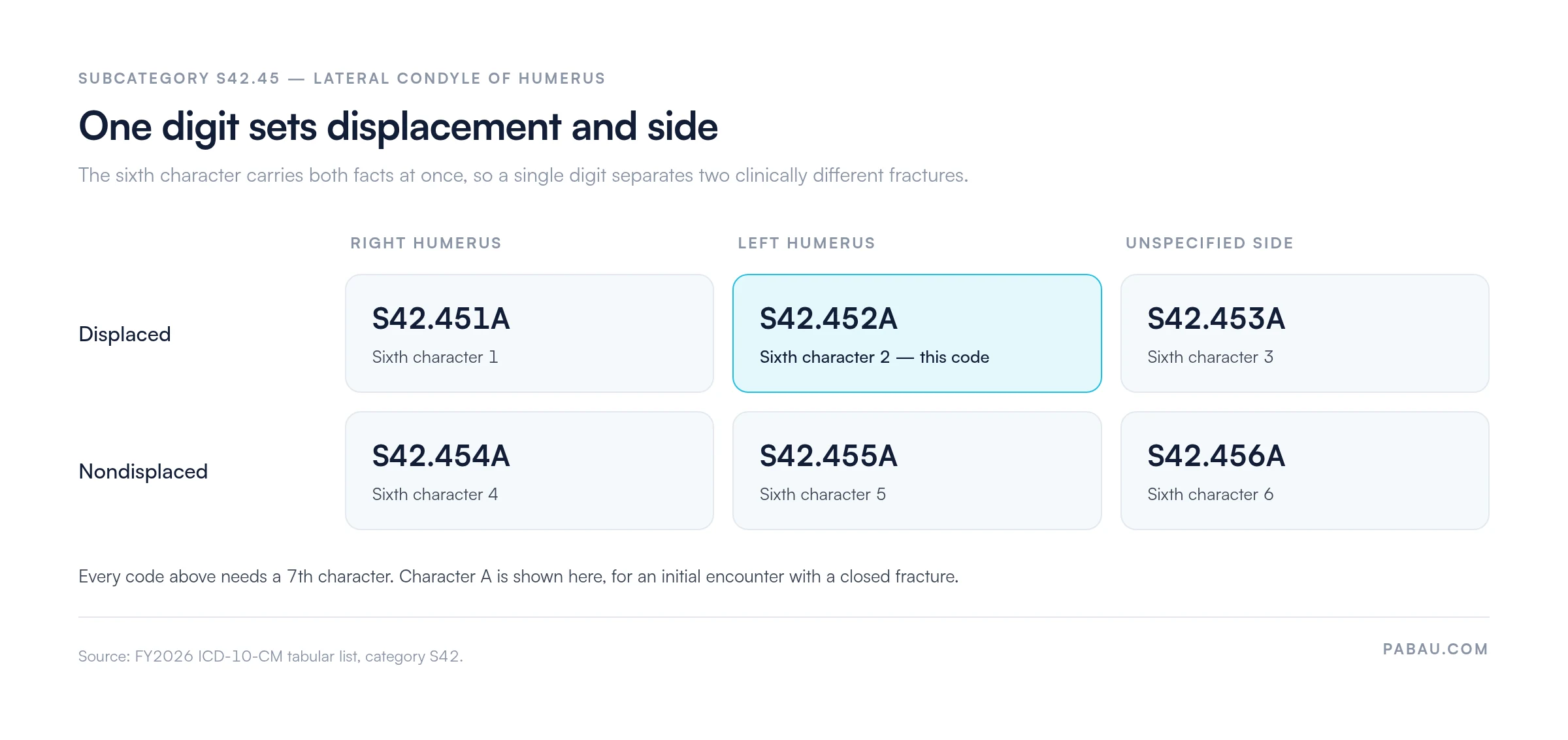
Both defaults in this code come from one guideline. Namely, per Section I.C.19.c of the ICD-10-CM Official Guidelines for Coding and Reporting, a fracture not documented as open or closed is coded to closed. Similarly, a fracture not documented as displaced or nondisplaced is coded to displaced.
S42.452A therefore carries both defaults. It is the code to reach for when the record is silent on displacement, provided the site and the side are noted.
The 7th character is the element coders misapply most often in fracture coding. Namely, category S42 offers seven, and only one is for an initial encounter with a closed fracture. As a result, a wrong suffix at a follow-up visit is a common reason orthopedic claims get flagged for more paperwork.
The 7th character reflects the encounter type rather than the visit number. For example, a second-opinion visit for active surgical planning still uses the A suffix. Then, the suffix changes to D once active treatment gives way to routine healing checks.
Practice management software like Pabau checks that a claim carries the required fields before it is sent. The 7th character itself stays a coding decision that still needs a human eye.

S42.452A sits in a family of six codes at the S42.45 level. Namely, three describe displaced fractures and three describe nondisplaced fractures, each running right, left, and unspecified. As a result, choosing the wrong displacement set is the most common specificity error in this group.
S42.44 deserves a second look, because the code numbers sit next to each other while the anatomy does not. Namely, S42.44 is the medial epicondyle, on the inner side of the elbow. In contrast, S42.45 is the lateral condyle, on the outer side.
When checking records for laterality, coders should not guess from the dominant hand or the mechanism of injury. Instead, the fracture side must be documented in the note, the imaging report, or the operative report. Also, the AAPC ICD-10-CM code lookup lets coders browse the full S42 range and verify descriptors quickly.
S42.452A is a billable ICD-10-CM code. In fact, its seven characters meet CMS rules for sending claims. However, the parent codes S42.4, S42.45, and S42.452 are not billable on their own. Instead, they act as header nodes in the tabular list, and S42.452 needs a 7th character before it can go on a claim.
Three rules from the ICD-10-CM Official Guidelines for Coding and Reporting matter most for this code.
Getting S42.452A right depends on building a clean claim. In addition, Pabau’s Claim.MD integration handles electronic claim submission, real-time eligibility verification, and claim status tracking for US practices. Also, for a broader view of the revenue cycle, our guide to what medical billing involves covers the end-to-end process.
Cross-check the imaging report and the treating clinician’s note for both displacement and side before assigning S42.452A. A fracture read as displaced on the X-ray but recorded as nondisplaced in the visit note needs a provider query, not a judgment call.
Lateral condyle fractures of the humerus present differently by age and mechanism. For instance, children are affected most often. Namely, the usual mechanism is a fall on an outstretched hand or a direct lateral elbow impact. As a result, that produces a Salter-Harris type IV pattern at the lateral condyle physis.
In adults, the same mechanism more often produces a supracondylar or a wider distal humerus fracture. Still, an isolated lateral condyle fracture is less common in adults. Also, clinical signs often include lateral elbow swelling, point tenderness over the condyle, and trouble straightening the elbow.
Imaging usually starts with anteroposterior and lateral plain X-rays, with oblique views added to judge displacement. Indeed, displacement is the finding that changes both the code and the treatment plan. In some cases, CT is ordered when plain films leave the degree of displacement unclear.
Documented displacement usually moves the case toward surgery. Namely, displaced lateral condyle fractures are commonly treated with closed reduction and percutaneous pinning, or with open reduction and internal fixation. In contrast, nondisplaced fractures are more often casted, and they carry S42.455A rather than S42.452A.
Additionally, practices managing orthopedic caseloads can find workflow support in Pabau’s sports medicine software, which handles scheduling, notes, and billing for injury-focused practices.
Every element of S42.452A needs to be noted. In fact, an auditor checking a chart for this code expects four details recorded clearly. Namely, those are the fracture site (lateral condyle), the affected side (left), the displacement status (displaced), and the encounter context (active treatment).
For surgical cases, the operative report is where this gets noted. In addition, it should describe the fracture as displaced at the time of surgery, along with the reduction method and the fixation used.
For cases managed in a cast, the office note should carry the imaging finding of displacement. It should also record the cast type, the duration, and the next imaging review date.
Practices running physical therapy EMR workflows with orthopedic care benefit from shared documentation rules. Those rules carry the fracture diagnosis across the whole course of care, so the 7th character moves correctly as the patient goes from acute treatment to rehab.
For an overview of how denial management in healthcare applies to musculoskeletal claims, that guide covers the denial patterns most relevant to trauma codes. Practices can also review the full list of denial codes in medical billing. In short, that list shows which remittance codes signal a documentation problem rather than a coverage one.
Document fracture displacement clearly in every note. As a result, a note reading “displaced fracture of the left lateral humeral condyle on AP and lateral views” leaves the coder nothing to query.
Chart notes and operative reports rarely use the official wording. Instead, the descriptions below all map to S42.452A when they appear in documentation for an initial encounter with a closed fracture.
Query the provider when a note says only “lateral condyle fracture, left” with no displacement statement. The guideline default sends you to S42.452A, but explicit documentation is what protects the claim in an audit. Also, the alphabetic index maps most of these wordings back to the S42.45 subcategory.
ICD-10 Code S42.452A is a diagnosis code only. Therefore, it has to be paired with a CPT procedure code that reflects what the provider did during the encounter. For instance, the codes below are the ones most often submitted alongside a displaced lateral condyle humerus fracture at an initial encounter.
Verify each pairing against payer-specific local coverage determinations before sending the claim, because medical necessity rules vary.
CPT pairings should be verified against current AMA CPT descriptors and payer LCDs before submission. For instance, the Check ICD-10 tool provides CPT-to-ICD-10 crosswalk data drawn from CMS and NCHS datasets. Practices submitting orthopedic claims electronically can also review what makes a clean claim to cut front-end rejections. A single code lookup covering CPT, ICD-10-CM, and HCPCS ranges saves time when cross-checking a pairing like this one.
Five mistakes account for most rejections and records requests on this code.
Encounter suffix errors are the most common fracture-coding mistake. In fact, the move from S42.452A to S42.452D does not happen on a fixed date. Instead, it happens when intent shifts from active treatment to routine healing checks, as shown below.
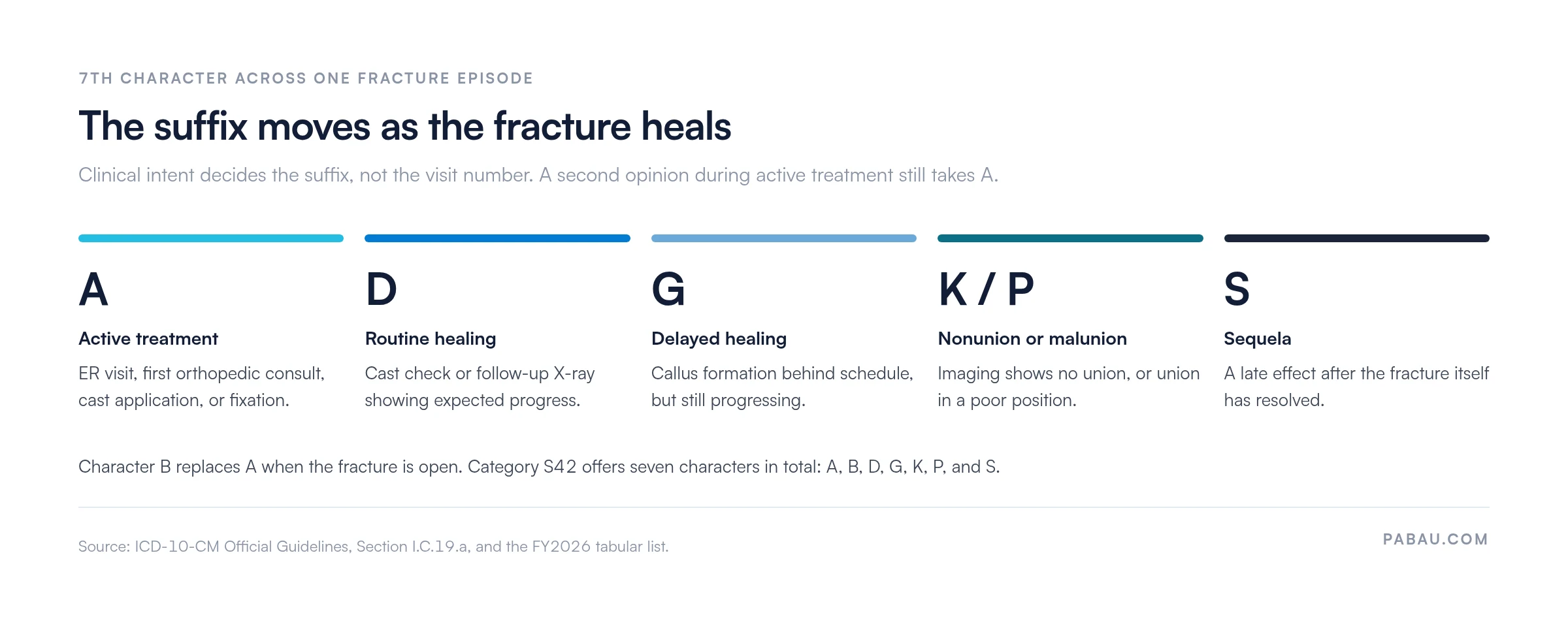
Keeping S42.452A on every follow-up visit risks an overcoding audit finding. The subsequent-encounter characters also carry clinical detail: G delayed healing, K nonunion, and P malunion.
S42.452S covers a different scenario: the original fracture has healed, and the patient now has a late effect, such as post-traumatic lateral elbow arthritis. The sequela code accompanies the code for that condition, not replacing it.
Pabau tracks each fracture claim after it leaves the practice. Claim status updates and every electronic remittance advice return to the same patient record. A suffix correction can then be matched to it.
Our guide to medical billing compliance covers the audit risk areas for trauma codes. Two related humerus codes: S42.332G covers a displaced oblique shaft fracture, and S42.399S covers a shaft fracture sequela.
In fact, orthopedic practices often run fracture claims across three systems. Specifically, the code sits in the chart note, the claim goes out through a separate billing tool, and the payer response lands in an inbox. When a claim comes back rejected, someone matches it to the encounter by hand.
Pabau keeps that sequence on one patient record. Specifically, its claims management software checks that each claim carries the required fields, such as membership numbers and authorization codes, before it goes out. In addition, submission, real-time eligibility checks, and claim status updates run through our Claim.MD integration.
Code selection stays with the coder, including the displacement digit and the 7th character. Instead, what changes is the time between a rejection and a corrected resubmission. Finally, the encounter, the codes, and the payer response all sit in the same place.

Pabau checks that every claim carries its required fields, then submits and tracks it through our Claim.MD integration. Spend less time chasing rejected orthopedic fracture claims.

Displaced lateral condyle fractures of the left humerus are tricky to code. The family holds six near-identical codes, the guideline default runs toward displaced, and the encounter suffix changes as the fracture heals. However, S42.452A becomes straightforward once the note states site, side, displacement, and encounter type.
Pabau’s Claim.MD integration handles electronic submission, eligibility checks, and claim status tracking for orthopedic and sports medicine practices. To see how that works for fracture and trauma billing, book a demo with the Pabau team.

Shaving a lesion over 2.0 cm? CPT code 11308 shave removal guide covers shaving a scalp, neck, hand, foot, or genital lesion larger than 2.0 cm.
Need the femur version of this decision? S72.466E applies the same displacement and encounter checks to a supracondylar femur fracture.
Shaving a small lesion on the face? CPT code 11311 shave removal guide covers a face, ear, eyelid, nose, lip, or mucous membrane lesion from 0.6 to 1.0 cm.
Coding a late effect at the elbow? S51.029S shows how a sequela code pairs with the code for the residual condition.
Choosing the right anatomic site for a shave removal? CPT code 11313 shave removal guide explains the anatomic site groups and diameter measurement rules behind this shaving code.
ICD-10 Code S42.452A is a billable ICD-10-CM diagnosis code. It describes a displaced fracture of the lateral condyle of the left humerus, initial encounter for closed fracture. It applies while the patient is receiving active treatment. The nondisplaced left-side equivalent is a different code, S42.455A.
The 7th character A marks an initial encounter, meaning the patient is receiving active treatment for the fracture. Section I.C.19.a of the ICD-10-CM Official Guidelines applies it to any visit where the provider is actively managing the injury. Category S42 also offers B, D, G, K, P, and S.
A displaced fracture of the lateral condyle means the fragment at the outer bony prominence of the distal humerus has shifted out of alignment. These fractures are most common in children after a fall on an outstretched hand. Displacement usually moves treatment toward reduction and fixation rather than casting alone.
The two codes describe the same site and the same side but differ on displacement. S42.452A is the displaced fracture and S42.455A is the nondisplaced one. The sixth character carries that distinction, so a single digit separates the two codes.
Section I.C.19.c of the ICD-10-CM Official Guidelines states that a fracture not documented as displaced or nondisplaced is coded to displaced. That makes S42.452A the correct code for a left lateral condyle fracture when displacement is not stated. The same section codes a fracture to closed when open or closed is not documented.