ICD-10 Code S53.013D: Anterior subluxation of unspecified radial head
ICD-10 Code S53.013D: Quick reference summary Use the table below as your first ...

Last Updated: Nov 6, 2026
Billable Code Specific Code
S59.011G is the billable ICD-10-CM code for Salter-Harris Type I physeal fracture of lower end of ulna, right arm. It covers the subsequent encounter for fracture with delayed healing, once active treatment is over and the provider documents that healing is slower than expected.
Its closest neighbor is S59.011D, which covers routine healing at a subsequent visit. The choice between them rests on what the provider writes about healing progress.
Let Pabau's smart automation suggest the right codes, reduce claim denials, and keep your practice compliant—effortlessly.
Automate repetitive tasks and focus on what matters most—your patients.
Reduce coding errors and ensure compliance with the latest regulations.
Clean claims, fewer denials, and faster reimbursements.
Powerful insights and reporting to help your practice thrive.
HIPAA compliant SOC 2 certified GDPR-compliant Trusted by 4,000+ clinics worldwide

S59.011G is a billable ICD-10-CM code for a right distal ulna physeal fracture at a subsequent encounter with delayed healing. It is not used for initial treatment or routine follow-up.
The 7th character G needs explicit provider documentation that healing is slower than expected. Without it, payers may deny the encounter or expect the routine-healing character D.
Salter-Harris Type I fractures pass through the physis only and can look normal on plain X-ray, so MRI is sometimes needed to confirm them.
Pabau, the practice management platform we build, connects to the Claim.MD clearinghouse for electronic claim submission to thousands of US payers.
ICD-10 Code S59.011G is the billable code for a Salter-Harris Type I physeal fracture of the right distal ulna, with delayed healing. It is used at a subsequent encounter, once active treatment is over and the provider documents that healing is slower than expected. The table below confirms the descriptor, billable status, and code hierarchy.
S59.011G encodes five distinct clinical and administrative facts. Each character position has a fixed meaning under ICD-10-CM conventions.
Every character must be correct before submission. If the record documents the right arm and the claim carries the left-arm variant S59.012G, that mismatch alone can trigger a laterality denial.
The Salter-Harris system classifies physeal fractures by which anatomical zones the fracture line passes through. Type I is the least structurally destructive pattern. It is also the one most likely to be missed on initial imaging.
The key clinical nuance for Type I is that the fracture runs only through the cartilaginous physis. Plain X-rays can look entirely normal at the first visit, and MRI is sometimes needed when films are non-diagnostic.
That subtlety carries straight into documentation. A note that says “physeal fracture” without the Salter-Harris type gives the coder no basis for S59.011G. The type has to appear explicitly in the chart.
These fractures are predominantly pediatric, because Salter-Harris injuries need an open growth plate and plates close with skeletal maturity. A skeletally mature adult with unusual anatomy can still present with a physeal-pattern injury, though this is uncommon. Read the chart rather than assuming the patient is a child.
The 7th character G records two facts at once: the encounter is subsequent, and healing is delayed. The clinical record has to support both for the character to hold up under payer review.
Subsequent encounter: Under the ICD-10-CM Official Guidelines (Section I.C.19.a), a subsequent encounter covers visits after active fracture treatment is complete. The initial fracture management visit uses the 7th character A. That may be the ER presentation, the first orthopedic appointment, or the reduction procedure. Every follow-up after active treatment is subsequent.
Most coding errors happen in the choice between the subsequent-encounter characters. The chart below runs through that choice in the order a coder should ask it.
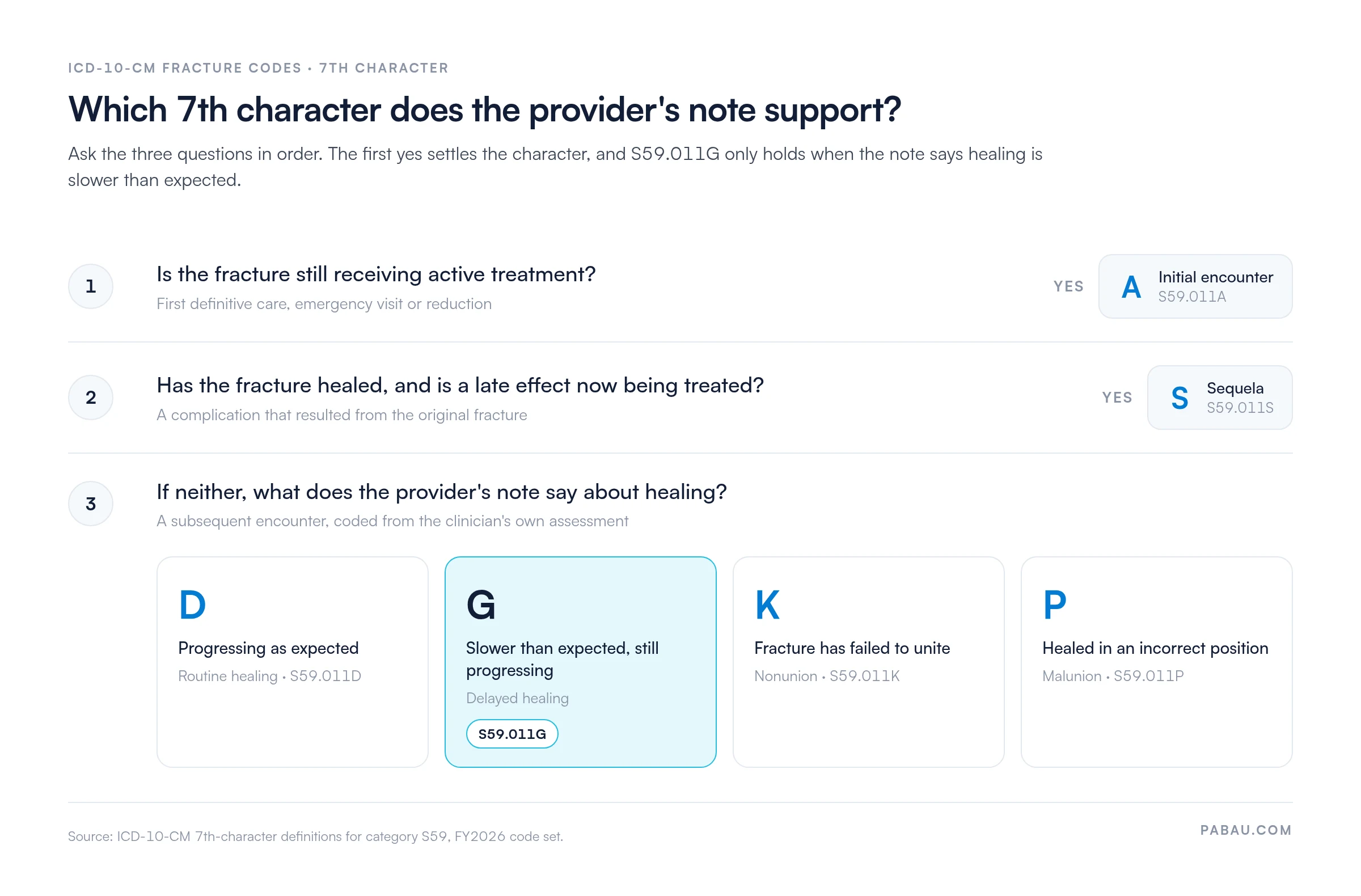
The table sets out the clinical scenario behind each character.
Delayed healing vs nonunion: Delayed healing (G) means the fracture is still moving toward union, only more slowly than the usual clinical timeline. Nonunion (K) means healing has stopped and union is no longer expected without intervention.
The provider has to make that call explicitly in the notes. Coders cannot infer it from imaging reports alone, so the clinician’s assessment must name one or the other. The medical billing fundamentals explain why it matters financially, since a nonunion usually brings a different treatment plan and different payer scrutiny.
Ask the treating provider to add a one-sentence healing assessment to every fracture follow-up note. ‘Healing is progressing routinely’ or ‘Healing is delayed, not yet at nonunion’ is enough. That single sentence settles the choice between D, G, and K, and protects the claim from delayed-healing denials.
S59.011G belongs to a family of codes that differ only by laterality or 7th character. The table below maps the most common selection errors.
The D-vs-G choice is the most common error in this code family. Many coders default to D for every subsequent encounter and miss the G character when the notes document delayed healing. Per the CDC/NCHS ICD-10-CM coding tool, both characters are valid for subsequent encounters, and the clinical record drives the selection.
Every element of the code descriptor must be supported by the clinical record. Missing documentation for any single element is enough for a payer to downcode or deny the claim.
When plain X-ray is non-diagnostic, as it often is with Salter-Harris Type I, the note should document and reference the MRI findings. The provider’s statement that healing is delayed, grounded in that imaging, is what makes the record defensible. A clean claim for S59.011G depends on that chain being complete before the claim goes out.
S59.011G claims are denied for predictable reasons. Most rejections trace back to the same handful of documentation and sequencing errors.
Payers may also deny G when the visit falls inside the usual healing window and the note doesn’t explain the delay. Medicare, Medicaid, and commercial payers differ on the documentation they want for delayed-healing claims, so check each payer’s policy.
Building denial management workflows into the billing cycle pays off when S59.011G volumes are high. When a claim does come back, the guide to denial codes decodes the CARC reason codes attached to it.
At a subsequent encounter for delayed healing, the procedures reported alongside S59.011G typically fall into three groups: Fracture management, evaluation and management, and imaging.
Global fracture care period: When a closed treatment code such as 25530 or 25535 has been reported, a 90-day global period typically applies. E/M visits inside that window are generally bundled and can’t be billed separately unless the visit addresses an unrelated problem.
Follow-up films aren’t part of the surgical package, so the wrist X-ray is reported with 73100 on its own line.
Several situations require additional codes or coding decisions beyond the core S59.011G assignment.
Salter-Harris fractures occur most often in children, whose growth plates stay open until skeletal maturity. In pediatric follow-up, the orthopedic and therapy notes should record activity restrictions and growth plate monitoring. No separate pediatric modifier is needed. S59.011G applies at any age, provided growth plate involvement is documented.
Workers’ compensation payers typically require external cause codes that identify the mechanism of injury. An appropriate code from the W (fall) or Y (other external cause) range should accompany S59.011G on the claim. Most workers’ comp submissions treat the external cause code as mandatory, so leaving it off a work-related forearm injury is a common denial trigger.
Because Salter-Harris Type I fractures can look normal on first X-ray, some are first documented as “wrist pain” or “forearm sprain.” A later MRI may then confirm the physeal fracture.
The initial encounter character A applies to the first visit where the fracture is actively treated. That is not necessarily the first visit where the patient presented with the injury. Follow-ups after that use the subsequent-encounter characters, and S59.011G applies only where the note documents delayed healing.
Growth plate injuries in skeletally mature patients are uncommon. When a patient with closed growth plates fractures through the former physeal zone, the Salter-Harris classification may not apply. The provider’s documentation must confirm growth plate involvement for the S59.01x series to be appropriate. If imaging shows closed growth plates, consider whether a different fracture category describes the injury more accurately.
In many practices, the coder picks the 7th character from a visit summary rather than the provider’s note. The one sentence that separates D from G sits in a chart the coder may never open.
In Pabau, the clinical note and the claim live in one system. The coder reads the healing assessment before choosing the character. Our claims software for practices then submits the claim through the Claim.MD clearinghouse, which reaches thousands of US payers.
Eligibility checks, claim status, and remittances come back against the same patient record. A rejected S59.011G follow-up surfaces the day it happens, while the provider still remembers the visit.
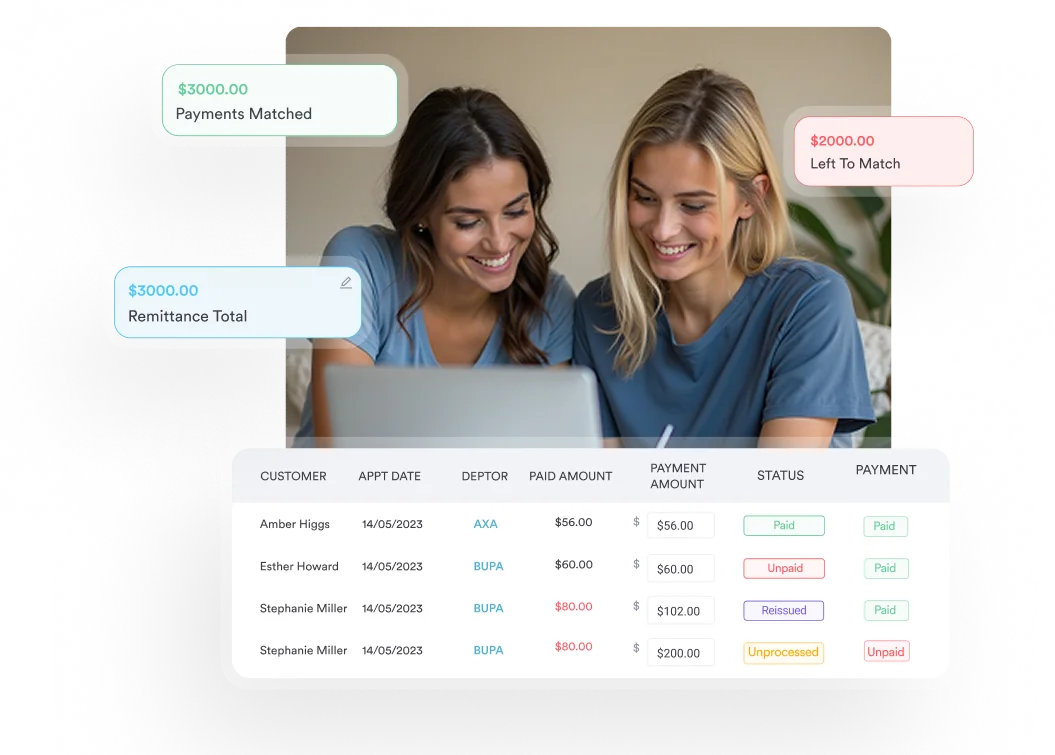

Pabau keeps the provider’s note and the claim in one system, then submits through the Claim.MD clearinghouse to thousands of US payers. See how orthopedic and sports medicine practices catch coding errors before they become denials.

S59.011G and S59.011D differ by one sentence in the clinical note. If the provider never writes that healing is delayed, the G character has nothing to stand on and payers will reject it.
So the work belongs upstream, in the follow-up template rather than the denial queue. Add a required healing-assessment line to every fracture follow-up note, and the D, G, or K choice is made before the claim is coded.
Pabau submits those claims through Claim.MD to thousands of US payers, with the note and the claim in one place. To see how that works in an orthopedic or sports medicine practice, book a demo.

Need to understand how clearinghouse submission works for fracture codes? Claim.MD clearinghouse overview explains how electronic claim validation catches ICD-10 mismatches before payer submission.
Looking for guidance on the broader medical billing process? Revenue cycle management guide covers how fracture care claims move from coding through payment posting.
Want to understand how 837P files carry ICD-10 codes to payers? 837 file format guide explains how ICD-10 diagnosis codes are structured in electronic claim submissions.
ICD-10 Code S59.011G is the billable code for a Salter-Harris Type I physeal fracture of the right distal ulna, with delayed healing. It is used at follow-up visits after active fracture treatment, when the provider documents that healing is slower than expected but has not reached nonunion.
Yes. S59.011G is a valid, billable ICD-10-CM code at the full 7-character level in the CMS ICD-10-CM code set. It can be submitted on claims for applicable encounters, provided the supporting clinical documentation is complete.
S59.011D is used at a subsequent encounter when the fracture is healing routinely and on schedule. S59.011G applies when healing is slower than expected but union has not failed, which would call for K instead. The provider must document the healing status explicitly, because coders cannot infer D or G from imaging alone.
Use G at any subsequent encounter where the provider’s note states that fracture healing is delayed. That means healing is not progressing at the expected rate for that fracture type and patient. The note must distinguish delayed healing from nonunion. If the provider documents nonunion, use K, and if healing is on schedule, use D.
No. The 7th character G marks a subsequent encounter, so it cannot be assigned to a first treatment visit. The correct code for the initial encounter is S59.011A. Using G at an initial visit triggers a code-sequencing denial from payers.
The clinical record must name Salter-Harris Type I and confirm right arm laterality. It must show the visit is a follow-up after active treatment, with a clinician statement that healing is delayed rather than routine. Imaging that supports the delayed-healing assessment completes the record. A payer can deny the claim if any of these elements is missing.