Anja Dodevska

Today I feel worksheet: Free printable PDF for kids and adults
What the worksheet asks a person to write The today I feel worksheet asks a pers...

1
Last Updated: Nov 16, 2026
Free PDF 3 pages, print-ready Clinician-reviewed
A stinking thinking worksheet helps patients catch the distorted thoughts that drive relapse, low mood and unhelpful behavior, then test those thoughts against the evidence. Stinking thinking is the recovery-community name for the negative automatic thoughts that cognitive behavioral therapy (CBT) calls cognitive distortions.
This three-page worksheet takes a patient through four steps. They list three negative thoughts, weigh the evidence for and against each one, challenge them, and write a balanced reframe. Addiction recovery and mental health teams use it in session, in groups and as homework between appointments.
A three-page worksheet in four parts: list three negative thoughts, weigh the evidence for and against each one, challenge it, and reframe it. A closing Reflections box records what the patient noticed.
Start from scratch, or upload this PDF or any form you already use, and Pabau's AI Form rebuilds it with tick boxes, text fields and a signature. Attach it to the treatment once, and every patient gets it on time.
AI Form rebuilds the consent, history and aftercare forms you already use. You review each one, then publish.
Patients complete forms on their phone before they arrive, so the front desk stops retyping paper.
Every signed form is versioned and attached to the treatment record, ready when you need it.
Set how long a consent stays valid. Returning patients skip forms they have already signed.
Supports HIPAA and GDPR compliance AES-256 encryption 4.8 on G2 4.7 on Capterra Trusted by 4,000+ practices worldwide

A stinking thinking worksheet turns vague negative thoughts into written, testable statements.
The PDF runs in four parts: identify three negative thoughts, examine the evidence, challenge each thought, then reframe it.
Stinking thinking maps closely to cognitive distortions, so CBT language and recovery language can sit side by side.
Patients can finish the challenge and reframe parts between sessions, then review the sheet with their clinician.
Store completed worksheets in a secure, access-controlled patient record to meet HIPAA or GDPR duties.
A stinking thinking worksheet is a structured exercise that guides a patient from three negative thoughts to the evidence for and against each one. A 2015 relapse prevention review names cognitive therapy as one of the main tools for changing that negative thinking.
The term comes from 12-step recovery culture, where it describes self-defeating thinking that makes relapse more likely. On the sheet, the patient challenges every thought and rewrites it in a more balanced form. Clinicians working in CBT call this process cognitive restructuring.
The worksheet does not diagnose anything, and it does not treat addiction or mental illness on its own. It is a structured exercise that supports therapy, group work, and relapse prevention planning, and its effects depend on the wider clinical plan.
Use the worksheet as a short, repeatable exercise rather than a one-off form. The steps below follow the four parts of the PDF, so patients learn the process in the same order they will use alone.
In individual sessions, complete Parts I and II together and set Parts III and IV as homework. The diagram below follows one thought through that split.
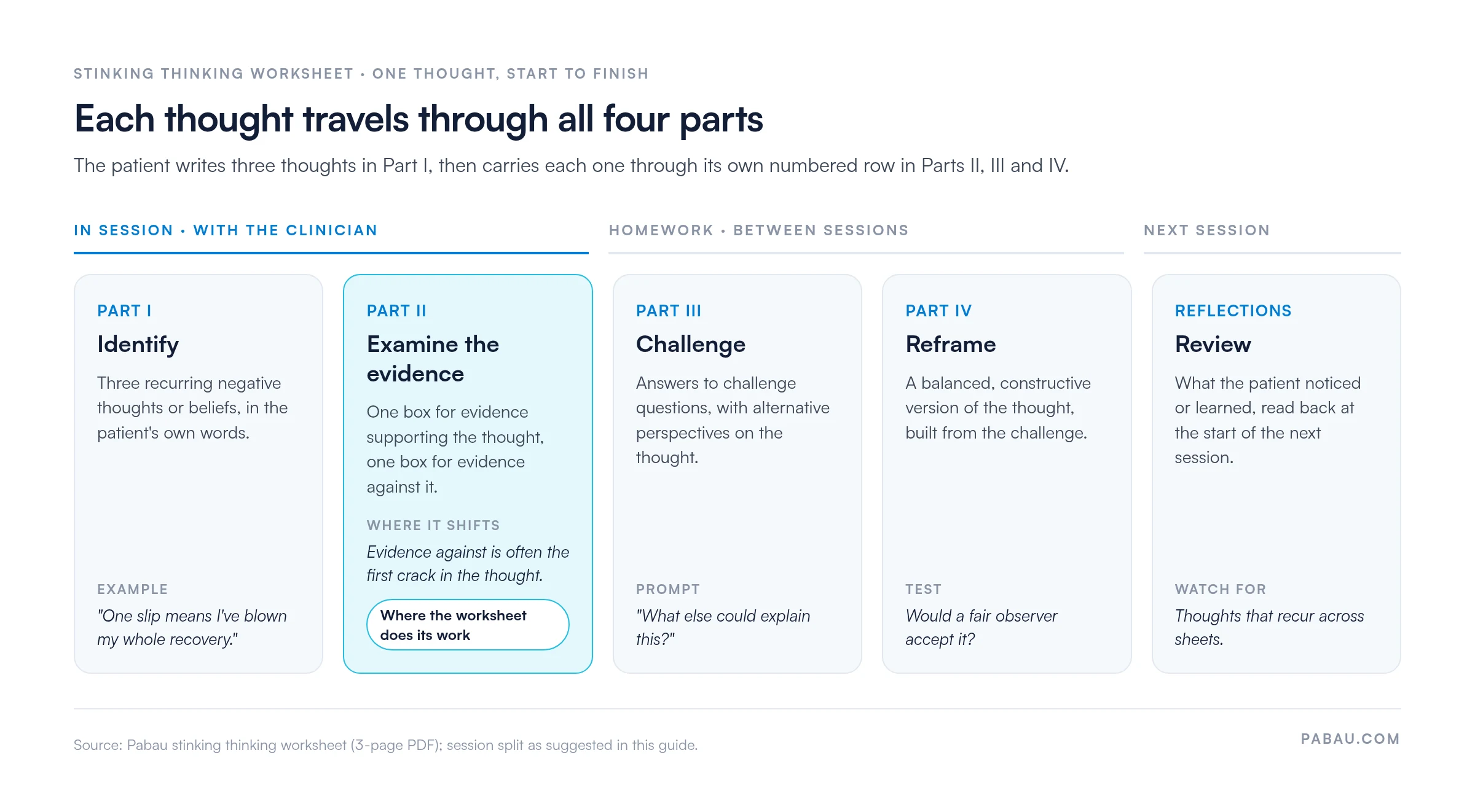
During Part III, you can also ask the patient to name the thinking error behind each thought. The sheet has no field for it, so treat that as an optional prompt. In group therapy, read one completed example aloud before members work on their own sheets.
Clinicians and patients use the same core categories of thinking errors. The worksheet does not ask patients to label them, but naming one can sharpen the challenge in Part III. The list below gives a brief working definition for each.
Burns’s cognitive therapy texts and Beck’s model describe these categories in detail, and the same taxonomy underpins most CBT worksheets.
Patients often hold more than one error in the same thought, so if you use labels, start with the strongest one. When one pattern dominates, a catastrophizing worksheet or an all-or-nothing thinking worksheet targets it directly.
In addiction recovery, stinking thinking often shows up before cravings, risky decisions, or missed meetings. Catching the thought early gives the patient a chance to act differently before the urge builds. The worksheet works best as one part of a relapse prevention plan that also covers triggers, supports, and coping skills.
The worksheet does not promise sobriety or prevent relapse by itself. Practitioners should present it as a skill that supports recovery work already underway, alongside medical care and any program the patient attends.
Challenging a thinking error means testing it against what has happened, so the patient reaches the balanced view on their own. Socratic questions keep you asking rather than telling. Ask what has happened in similar situations before, what a friend would say, and what the most likely outcome is.
The PDF runs to three pages, and each part opens with a short written instruction. Each of the three thoughts gets its own numbered row in Parts II, III and IV, so patients carry the same thought through every step.
The sheet has no fields for the triggering situation, an emotion rating or a named thinking error. Add those in conversation if your approach needs them. Review the completed sheet at the start of the next session. Thoughts that recur across sheets show where a patient needs more practice.
Adults in substance use recovery often respond best to plain, direct wording that mirrors their own language. Keep the recovery framing and avoid clinical jargon unless the patient asks for it.
Adolescents usually need shorter sections, concrete examples, and a practical link to school or peer situations. Forensic and corrections settings need careful framing, because labels such as criminal thinking errors can stigmatize. Focus on the behavior and the thought, not the person’s identity.
In general mental health practice, pair the worksheet with the clinical assessment already in use, and check that it fits the patient’s stated goals.
Stinking thinking is the recovery-community term, and cognitive distortions is the clinical term for the same kind of biased thinking. Both describe negative patterns that distort how a person interprets events.
Use recovery language with patients who prefer it, and CBT language in clinical notes and referral letters. The worksheet works with either vocabulary because the process is the same. For patients already fluent in CBT terms, a cognitive distortions worksheet covers the same ground under the clinical name.
Paper worksheets set as homework often come back half finished, or not at all. When they do return, someone scans them into a patient file, and the evidence lists from Part II are hard to compare across weeks.
Pabau, the practice software for therapists we build, lets you rebuild the worksheet as a digital form. Patients fill it in through the patient portal before their next appointment. Each completed sheet lands in the patient record, so you can open it at the start of the session.
The sheet then sits beside your session notes, so you can compare this week’s reframes with last month’s without a separate filing step.

Pabau’s digital forms let patients complete CBT worksheets through the patient portal, and every sheet is saved to the patient record for review in session.

The value of this worksheet sits in Part II. A patient who writes down evidence against a thought has already started to loosen it, and the challenge and reframe follow from there.
Keep the sheet as it is, and add any extra prompts, such as naming the thinking error, in conversation. Then review it every session, so the patient sees the same thoughts losing ground over time. Book a demo to see how Pabau sends worksheets to patients and keeps each completed sheet in their record.

Want a version that starts from the triggering situation? Thinking traps worksheet takes a patient from the situation to a reframed, balanced thought.
Prefer the A-B-C-D-E structure? ABCDE CBT worksheet gives patients a step-by-step method for disputing a negative belief.
Watching for one addiction replacing another? Cross addiction worksheet covers history, triggers, warning signs and recovery goals.
Need a structured mental health assessment? Psychiatric evaluation template gives clinicians a step-by-step framework for comprehensive assessments.
Stinking thinking is a recovery-community term for negative, self-defeating thoughts that can lead toward relapse. Clinicians often describe the same pattern as cognitive distortions.
Yes, stinking thinking is commonly discussed in addiction recovery because distorted thoughts can come before cravings and risky choices. It is one factor among many, so it should sit within a wider relapse prevention plan.
Therapists usually complete Parts I and II with the patient in session, then set Parts III and IV as homework. The completed sheet is reviewed at the start of the next session.
Thinking errors are systematic biases in how a person interprets events, such as all-or-nothing thinking or catastrophizing. CBT uses them to help patients test thoughts against evidence.
A worksheet slows the thought down. The patient weighs the evidence for and against it, challenges it, and writes a more balanced reframe. Consistent practice builds the habit outside the session.