Monika Lazarevska

Mental health maintenance plan
What is a mental health maintenance plan? A mental health maintenance plan is a ...

5
Last Updated: Nov 12, 2026
Free PDF 3 pages, print-ready Clinician-reviewed
“We’re just not close anymore” rarely means all closeness has gone, and a types of intimacy worksheet helps a couple find which kind has. Our free version is a three-page PDF covering emotional, intellectual, physical, experiential and spiritual intimacy. Each dimension has a short definition, two reflection questions and space for action steps. The last page gives the clinician room for notes, observations and a follow-up plan. Use it in couples therapy, in individual sessions or as a check-in at home.
A three-page PDF with a definition, two reflection questions and an action-steps space for each of the five intimacy dimensions. It ends with sections for additional notes, observations and recommendations, and a follow-up plan.
Start from scratch, or upload this PDF or any form you already use, and Pabau's AI Form rebuilds it with tick boxes, text fields and a signature. Attach it to the treatment once, and every patient gets it on time.
AI Form rebuilds the consent, history and aftercare forms you already use. You review each one, then publish.
Patients complete forms on their phone before they arrive, so the front desk stops retyping paper.
Every signed form is versioned and attached to the treatment record, ready when you need it.
Set how long a consent stays valid. Returning patients skip forms they have already signed.
Supports HIPAA and GDPR compliance AES-256 encryption 4.8 on G2 4.7 on Capterra Trusted by 4,000+ practices worldwide

The worksheet covers emotional, intellectual, physical, experiential and spiritual intimacy, with two reflection questions and an action-steps space for each.
Each copy is for one person, so give each partner their own and let them answer privately before comparing.
There are no ratings or scores, so track change by comparing written answers and the follow-up plan between sessions.
The clinician’s page holds additional notes, observations and recommendations, and a follow-up plan.
Completed worksheets hold sensitive details about a relationship, so store them in the patient record under HIPAA or GDPR rules.
The worksheet splits intimacy into five dimensions: emotional, intellectual, physical, experiential and spiritual. Researchers have long measured closeness this way, and the 1981 PAIR inventory assesses five types of intimacy, from emotional to recreational.
No single list is agreed, so treat the worksheet’s five as a practical framework for conversation, not a clinical standard.
A couple’s presenting complaint usually sits in one or two of these areas. A partner who feels emotionally distant may still describe the relationship as physically close. That contrast makes a useful starting point for the first session.
Emotional intimacy is the sense that someone knows your inner world and responds with care. The worksheet asks how comfortable the person feels sharing emotions with a partner, friends or family. It then asks them to describe a recent moment when they felt emotionally connected.
Physical intimacy covers far more than sex, including hugging, hand-holding and everyday affection. The worksheet asks how satisfied the person is with the level of physical touch in the relationship.
It also asks which non-sexual touch they appreciate most. Where partners name different kinds of touch, a love languages chart gives them shared words for those preferences.
The PDF doesn’t ask about consent, so make it part of how you run the section. Tell both partners they can pause or skip any question, and keep sexual detail for a separate assessment if it’s needed.
The spiritual section reads as religious to some couples, but its definition includes values and a sense of purpose. If a couple stalls there, a personal values worksheet helps each partner name their values first.
The worksheet is a three-page PDF with a short definition, two reflection questions and an action-steps space for each of the five dimensions. It opens with a client details header and a short note on what intimacy covers.
The chart below shows every question in the order the patient meets it.
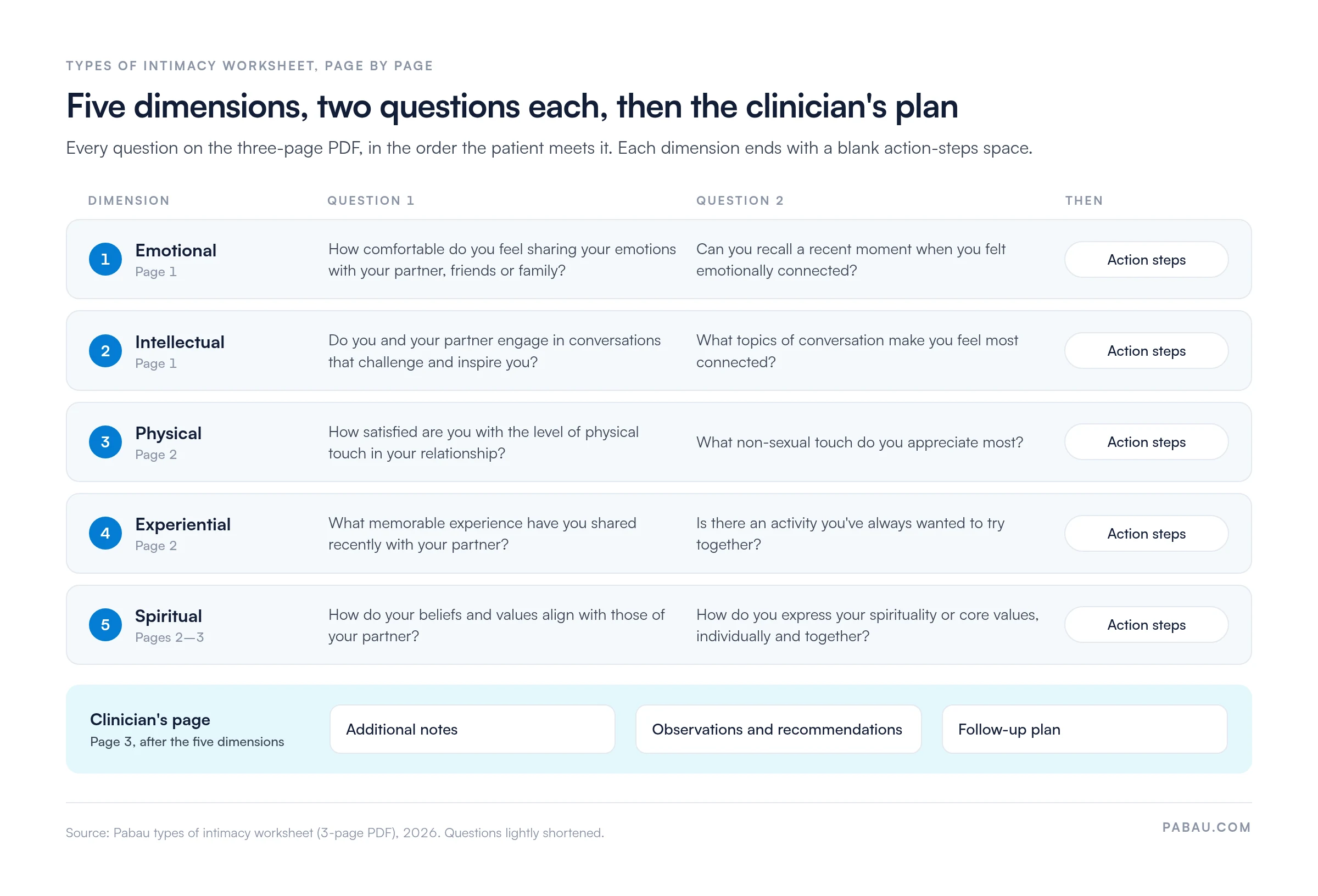
Two details shape how you use it. The header takes one name, so each copy belongs to one person. And there are no rating scales, so progress shows up in the written answers and the follow-up plan rather than in a score.
Introduce the worksheet as a shared tool, never a test. In couples work, a typical session runs like this.
In individual therapy the steps shrink to one copy. The first emotional question already asks about friends and family as well as a partner, so it works for patients who are single.
Couples can complete the worksheet on their own, ideally somewhere calm with no screens and no time pressure. Each partner answers the reflection questions on their own copy first. Then the couple compares answers, one dimension at a time.
If a topic feels too heavy to handle alone, the couple can bring the completed sheets to a therapist. Their answers give the first session a head start.
Attachment theory, developed by Bowlby and tested by Ainsworth, describes how early bonds shape later closeness. Intimacy and attachment are related but distinct. The worksheet explores how someone experiences closeness now, and it doesn’t label anyone’s attachment style.
If attachment patterns come up in the debrief, an attachment theory worksheet lets you explore them separately. For background on the research, see the American Psychological Association’s overview of attachment.
Boundaries support intimacy. When partners know their limits will be respected, they can relax into closeness.
Several patterns regularly block emotional closeness. Each one links to a dimension in the worksheet, which gives the clinician a way into the topic without forcing a disclosure.
Where fear of vulnerability dominates, a fear of vulnerability test can show how strong it is before you debrief. After a breach of trust, the action steps work best alongside dedicated rebuilding trust worksheets.
Trauma can shape how safe closeness feels. Pace the worksheet carefully, invite answers rather than require them, and don’t probe a disclosure the couple hasn’t offered.
Exercises turn the action steps into habits. Suggest one or two a week, and keep each one under 20 minutes.
On paper, two partners mean two loose sheets of personal answers. Copies get forgotten at home, and the clinician’s plan sits in a separate file from the session notes.
Pabau, the practice software behind smoother therapy practice management, lets you rebuild the worksheet as a digital form. Each partner completes their own copy on their phone before the appointment. The answers flow into their patient record, next to your notes and follow-up plan.
Automated reminders prompt patients to finish the form before they arrive, so the session starts with answers, not blank pages. The same digital intake forms cover consent and history, so a couple’s paperwork lives in one place.

Pabau sends the worksheet as a digital form to each partner and saves their answers to the patient record. Your notes and follow-up plan sit right beside them.

The worksheet’s value is in narrowing the problem. Ten questions move a couple from “we’re not close” to the one or two dimensions that need work.
Keep the copies separate and debrief one dimension at a time. Then treat the follow-up plan as the part you’ll come back to. The trade-off is depth over coverage, and that pace suits most couples better than a single marathon session.
Book a demo to see how Pabau sends the worksheet to both partners and keeps their answers with your session notes.

Need more structured exercises for couples? Couples therapy worksheet covers conflict, communication, trust and intimacy, with a section for each partner.
Using the Gottman approach in your sessions? Gottman method worksheets give you structured couples exercises and homework for between sessions.
Want a quick weekly check-in between sessions? Relationship check-in gives couples 15 prompts across eight areas of the relationship.
Working with a partner who fears rejection? Rejection sensitivity test measures anxious expectation of rejection in nine items.
Working with couples in a mental health practice? Mental health EMR software keeps notes and outcomes organized.
Sex is one form of physical intimacy. Intimacy is the wider sense of closeness, which also covers emotional, intellectual, experiential and spiritual connection. A couple can have an active sex life and still feel distant in the other areas.
Talking through a book, a news story or a big decision, and feeling that your partner takes your ideas seriously. You can disagree and still feel closer afterward.
Conversations that stay on logistics, feeling lonely while together and keeping worries to yourself are common signs. If several apply, start with the worksheet’s emotional section.
There’s no fixed schedule. Set the review point in the follow-up plan, once the action steps have had a few weeks to work. Then compare the new answers with the first copy.
Yes. Closeness shifts with life events such as a new baby, illness, job stress or caring for a parent. A dip in one dimension doesn’t mean the relationship is failing.