Mental health self-care checklist
A mental health self-care checklist is a structured daily tool for tracking the ...

6
Last Updated: Oct 20, 2026

A positive psychology worksheet asks clients to name strengths, values, gratitude, affirmations, and goals in one form.
This template runs six sections, and each answer gives you something different to read in the next session.
Seligman’s PERMA model sits behind the exercises, so one page covers emotion, engagement, relationships, meaning, and progress.
Homework comes back more often when you model the first entry in session, then read the answers out loud afterwards.
Practice management software like Pabau can send the worksheet, chase the response, and file it beside your session notes.
Six ready-to-use sections in one printable form. Your client fills in a short profile, three daily gratitude entries, and five strengths. Then come five values, five affirmations, three SMART goals, and one positive experience.
Download templateA positive psychology worksheet asks your client to write down what is already going right for them. That sounds soft, but it hands you material a symptom checklist never will. You learn which strengths the client will use, which values sit behind their goals, and who they lean on.
The template above runs six short sections, and each one answers a different clinical question. Let’s take the sections one at a time, then cover the handover, the review, and who benefits most.
A positive psychology worksheet is a structured form that records a client’s strengths, values, gratitude, affirmations, and goals.
Therapists, counselors, and coaches use it alongside symptom-focused work rather than in place of it. Practices running mental health EMR software tend to send it digitally.
The framing matters more than the paper, since a client who has spent six weeks itemizing symptoms often finds the first strengths question genuinely hard.
Most tools in this category trace back to Martin Seligman’s PERMA model, and this template is no exception. PERMA names five parts of flourishing.
Those are positive emotions, engagement, relationships, meaning, and accomplishment. Penn’s Positive Psychology Center maintains the current description of the model.
Read down that last column and the design of the form makes sense. One page touches all five parts. That is why it works as a first homework assignment rather than a specialist exercise.
Fill the form in yourself first. The order runs profile, gratitude, strengths and values, affirmations, goals, then a positive experiences journal.
The profile page carries two lines that do a lot of work. One asks for something that brings the client joy. The other asks for a challenge they are facing right now.
Gratitude comes next, and it is the section clients rush. Three entries a day sounds trivial until you read them back. A client who writes “my family” has given you a category.
Compare that with “my sister called on Tuesday when I had gone quiet”, which is an event. Only the second gives you something to work with. If a client takes to this part, a daily gratitude journal gives them more room than three lines.
The strengths and values lists both ask for five. That is a lot for someone in a low mood, so drop it to three and say so out loud.
Then mark where the two lists overlap. A client who writes “patience” as a strength and “family” as a value has handed you their next goal.
For deeper work on this part, a full character strengths assessment covers the 24 strengths in the VIA classification.
Affirmations and goals close the form, and both fail the same way. They float free of evidence. An affirmation that points at something the client has already done will hold up under pressure.
A SMART goal that traces back to one of their listed values gets worked on. If the values section came back thin, run it again before you touch the goals.
Here is the whole form at a glance, with what each answer is worth reading for.
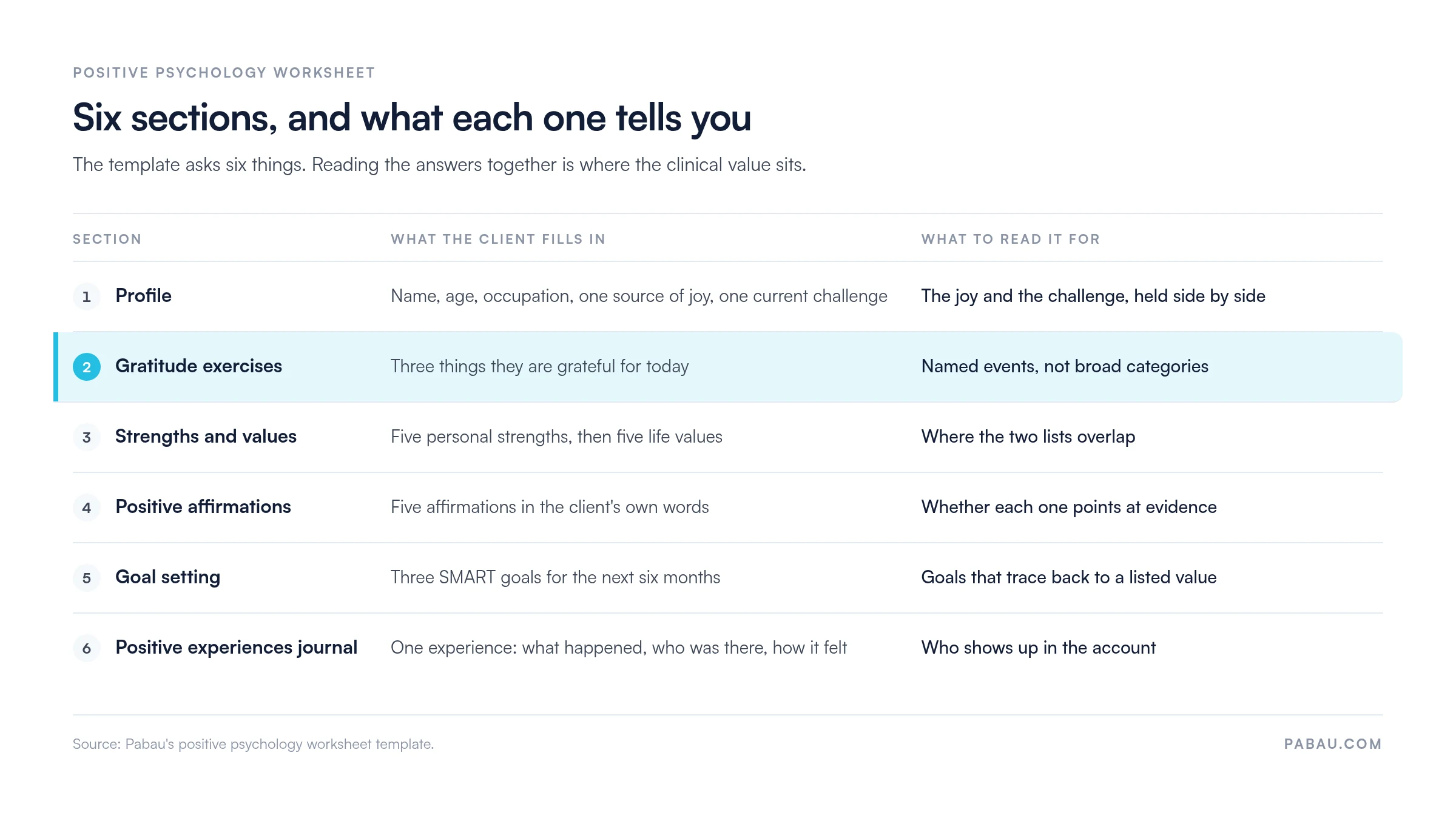
Most of the value is won or lost at handover. Five steps cover it, and the second one matters most.
Consistency beats effort here. One gratitude line a day, reviewed, does more than a full page scribbled in the waiting room. Between the bigger exercises, a short mental health check-in keeps the contact going without adding much to the client’s load.
The clients who gain most are the ones who have started describing themselves only through their diagnosis. Past that, the fit shifts by setting.
Practices running psychology practice software can attach the completed form to the client record. Whoever picks the case up next then reads the same material you did.
Picture a client three sessions into treatment for low mood. In week one, the gratitude entries read “my dog”, “coffee”, “my job”. All three are categories.
By week two, after you have quoted those back, the entries name events. A colleague covered a shift. Someone next door took in a parcel. Week three, the same two names keep appearing. That is a social support map the client drew without being asked for one.
Week four, an affirmation shifts from “I am strong” to “I asked for help on Tuesday and it worked”. The symptom score may not have moved much. Even so, the material for the next six sessions is now sitting on the page.
Plenty of clients stall at week one, and that pattern is worth naming too. Either way, you learn something a rating scale would never have given you.
Duplicate the blank form before the first assignment, then reissue the identical sheet at week six. Comparing like for like beats asking a client whether they feel better. Clients rarely notice their own change in wording. Showing them the two sheets side by side lands harder than telling them they have improved.
The usual approach is to email the worksheet as a PDF attachment and hope. The client opens it on a phone, cannot type into it, means to print it, and never does.
By the next session there is nothing to review, and the exercise quietly drops out of the treatment plan.
Practice management software like Pabau handles that part differently. The worksheet lives as a digital form, so the client completes it on the device already in their hand.
Customizable digital forms support branching questions. A client who lists patience as a strength gets asked where they used it this week.
Responses land in the client record next to your session notes, and the client portal covers secure delivery and reminders. Reissue the same form six weeks later and both versions sit in one timeline.
The comparison then takes seconds instead of a hunt through your inbox.
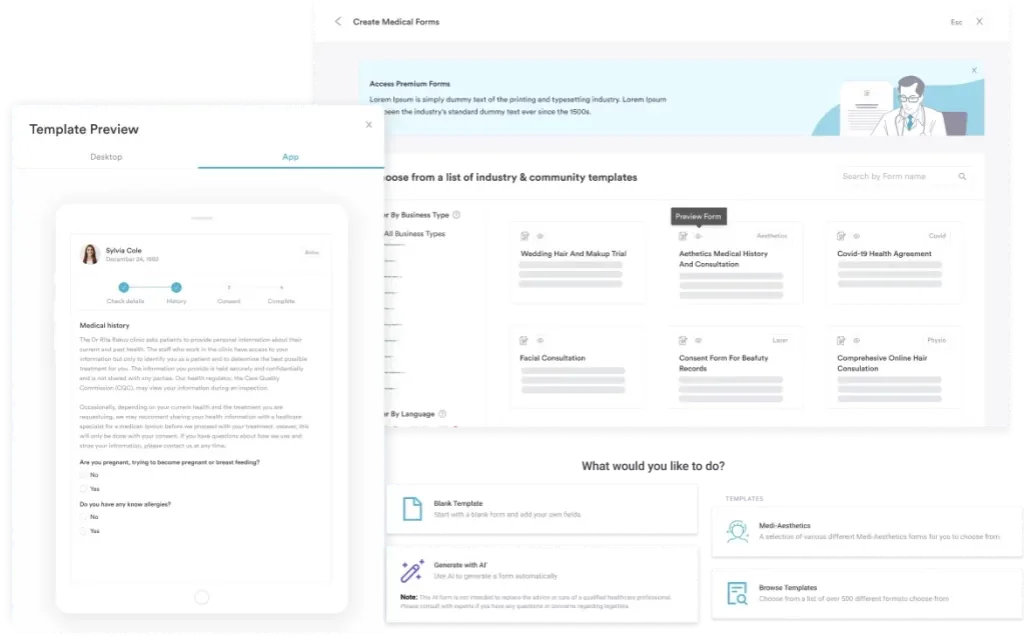

Pabau’s digital forms and client portal deliver positive psychology worksheets, chase the responses, and file them with your session notes. Progress stays visible in one client record.

This worksheet is easy to download and easy to waste. The outcome turns on ten minutes of handover, plus five minutes reading the answers back.
Try it with one client this week. Model the first gratitude entry in session, hand the form over, then read it out loud at the next appointment. If the form comes back blank, that tells you something worth naming as well.
Keeping the form, the responses, and your notes in one place is what makes the six-week comparison possible at all. Practice management software like Pabau does that part for you.
Book a demo to see how digital forms and the client portal keep therapy homework moving between sessions.

Need a gentler strengths exercise? My strengths and qualities worksheet gives clients more room than five blank lines, and suits younger clients well.
Client stuck when things get hard? Coping skills worksheet maps what already works for them under stress, which pairs neatly with the strengths section.
Goals drifting week to week? Goal setting worksheets break the SMART section into something a client can revisit between sessions.
Not sure how to document the review? PIRP note template gives you a structure for recording what the worksheet surfaced in session.
Need the diagnostic picture too? SCID assessment covers the structured interview that strength-based work sits alongside.
No. Treat it as an addition to therapy. Keep your usual symptom monitoring and risk checks running alongside it. Review the entries in session rather than letting them pile up unread.
Take the objection seriously and slow the exercise down. Ask for one small thing that went right this week instead of five strengths. Forced positivity is a common reason clients quietly abandon this kind of homework.
Not as homework. During acute risk, stabilization and safety planning come first. Bring the strengths and support questions back once the immediate risk has settled. Do the first pass together in session.
Yes, and the strengths section works particularly well in a group. Have members name a strength they see in someone else. Keep the values and goals sections private, since those invite comparison.
Cut the number of items and swap writing for drawing where you can. Under about age 10, one gratitude picture beats three written lines. Teenagers usually manage the full form, though the occupation field can go.
No formal certification is required for a licensed clinician. Reading Seligman’s work on PERMA and the VIA strengths classification will sharpen your reviews. Most of the skill sits in the follow-up questions you ask.