Maja Popovska

Today I feel worksheet: Free printable PDF for kids and adults
What the worksheet asks a person to write The today I feel worksheet asks a pers...

1
Last Updated: Nov 16, 2026
Free PDF 3 pages, print-ready Clinician-reviewed
A processing trauma worksheet is a structured clinical tool that guides a patient through reviewing a traumatic experience. It helps them name the thoughts and reactions attached to it and build healthier ways to make sense of it. Therapists use it as homework or an in-session aid within an established treatment plan, not as a standalone treatment for PTSD. It supports frameworks such as Cognitive Processing Therapy (CPT), EMDR and trauma-focused CBT. Bodies including the National Institute for Health and Care Excellence (NICE) recognize these as evidence-based. Introduce it only once the patient can manage distress between sessions.
A three-page worksheet with trigger ratings, negative thought challenges, thought records, affirmations, behavioral experiments, relaxation logs and a support network plan. It closes with a recap of key insights to revisit.
Start from scratch, or upload this PDF or any form you already use, and Pabau's AI Form rebuilds it with tick boxes, text fields and a signature. Attach it to the treatment once, and every patient gets it on time.
AI Form rebuilds the consent, history and aftercare forms you already use. You review each one, then publish.
Patients complete forms on their phone before they arrive, so the front desk stops retyping paper.
Every signed form is versioned and attached to the treatment record, ready when you need it.
Set how long a consent stays valid. Returning patients skip forms they have already signed.
Supports HIPAA and GDPR compliance AES-256 encryption 4.8 on G2 4.7 on Capterra Trusted by 4,000+ practices worldwide

A processing trauma worksheet is a homework and in-session aid, not a standalone treatment for PTSD.
Worksheets sit inside structured frameworks such as CPT, EMDR and trauma-focused CBT, each with its own components.
Complex PTSD usually needs stabilization and emotion regulation before any trauma processing begins.
Worksheets are unsuitable during active crisis or dissociation without clinical oversight.
Digital forms and secure patient records in practice software such as Pabau keep worksheet data private and organized.
A processing trauma worksheet is a clinician-led document that breaks trauma processing into concrete steps. It gives therapist and patient a shared record to work on between sessions. The VA’s Cognitive Processing Therapy guidance describes the same pattern, with worksheets helping patients explore stuck points outside session.
The worksheet captures the event in the patient’s own words. It also records the thoughts and body reactions that followed, and the meaning the patient has attached to them.
Clinically, its job is to make abstract processing visible. Patients often describe trauma in general terms, and a structured prompt helps them name specifics. Therapists then have something concrete to work from in the next session.
Therapists use worksheets because they turn session content into a repeatable structure. A worksheet lets a patient continue processing between appointments. It also gives the clinician a record of how the patient’s language and beliefs shift over time. This matters most in models where repeated practice drives change.
Worksheets also support psychoeducation. Patients who understand how trauma affects memory, attention and threat detection tend to engage more readily with the processing tasks. The National Center for PTSD publishes clinician and patient resources on trauma-related reactions that can sit alongside a worksheet.
A worksheet is still only one part of care. It supports, but does not replace, a trauma-informed therapeutic relationship and a clinician’s judgment about readiness.
A strong worksheet follows a logical sequence, moving from safety and orientation to processing and then to forward planning. Clinicians adapt the detail to the patient’s stage of recovery. A worksheet that asks for too much detail too early can increase distress.
Each section can be shortened for patients with limited capacity. The point is to keep the patient in control of how much they disclose.
Worksheets differ by modality, because each framework asks the patient to do something different with the material. The three below are the most common. Whichever you use, follow the manual for the specific protocol you are delivering.
CPT worksheets typically center on stuck points, the beliefs that keep trauma unprocessed. Patients identify the belief, examine the evidence for and against it, and write a more balanced alternative on a cognitive restructuring worksheet. The National Center for PTSD’s CPT overview describes these components in detail.
EMDR worksheets record information that supports the eight-phase protocol, such as the target memory, subjective units of distress (SUDs) and negative and positive cognitions. They should never replace the bilateral stimulation and phase sequencing that define EMDR, which only a trained clinician should deliver.
Trauma-focused CBT worksheets commonly include thought records, safety planning and coping skill practice. These tasks are well suited to between-session homework once the patient understands the model.
Complex PTSD usually follows prolonged or repeated trauma, and it often includes difficulties with emotion regulation, self-concept and relationships. Standard processing worksheets can overwhelm patients with C-PTSD if they are introduced too early.
Clinicians working with complex presentations should consult current guidance on C-PTSD treatment before adapting any tool.
The worksheet suits clinicians working with adults who have experienced single or repeated trauma. It is most useful in psychology, counseling and mental health practices where session structure and between-session homework are part of care.
The main benefit is consistency. A shared structure helps clinicians track progress and gives patients a clear next step between appointments.
Documentation also improves. A completed worksheet provides a dated record of the patient’s account and coping plan, which supports clinical notes and continuity if care is handed over.
Grounding techniques help a patient return to the present when processing pushes them outside their window of tolerance. Common options include paced breathing, naming objects in the room and orienting to surroundings. Clinicians should practice these in session before assigning them as homework.
Pair grounding with the coping plan on the worksheet so the patient knows exactly which tool to use if a session or task becomes overwhelming.
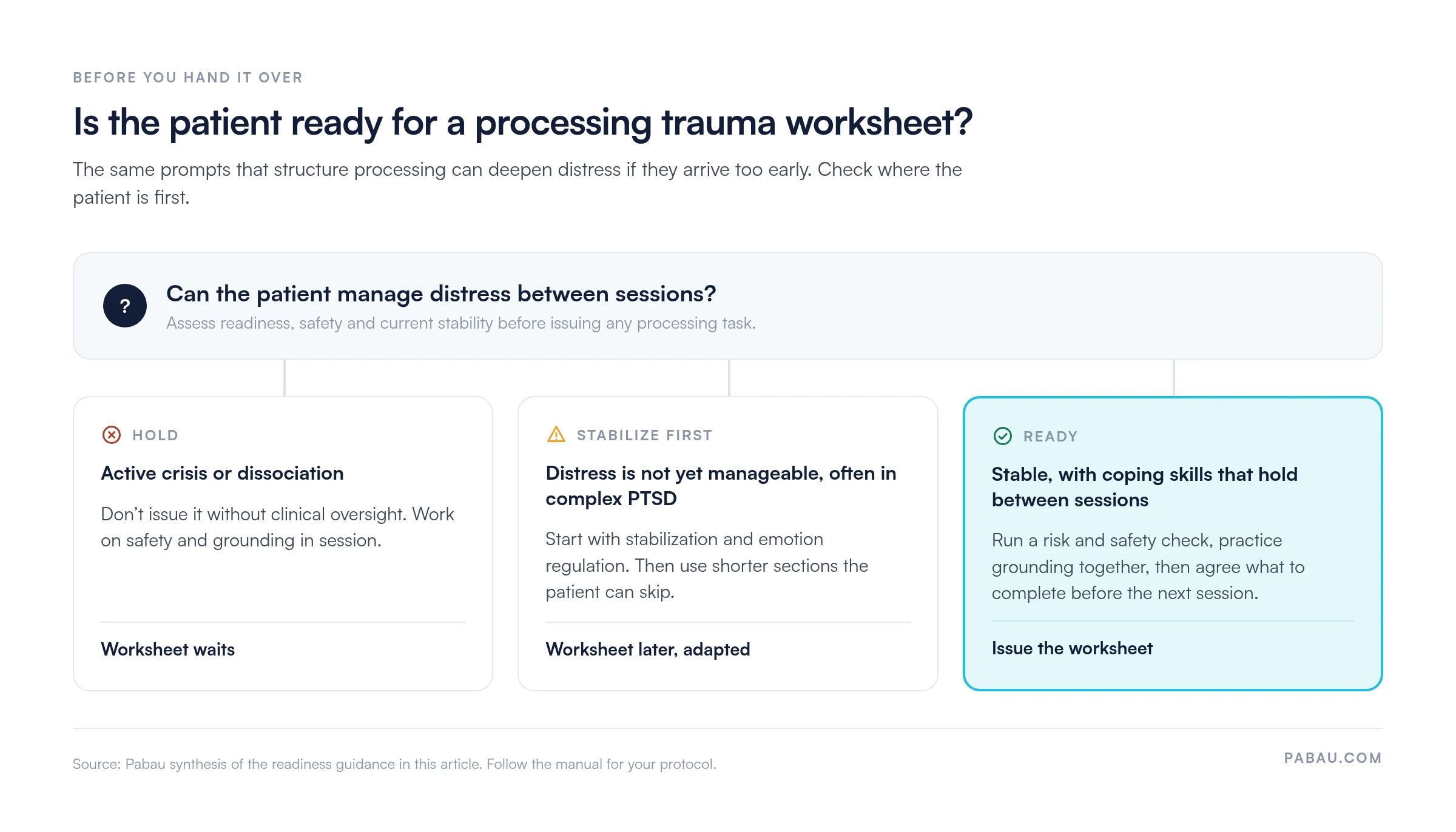
Introduce the worksheet only after assessing readiness, safety and the patient’s current stability. Explain its purpose in plain language and agree how much the patient will complete between sessions. Where the patient stands on readiness decides which of three routes you take.
The downloadable worksheet has four sections, covering trauma triggers, cognitive restructuring, coping skills and a support system. It closes with a short recap of key insights for the patient to revisit.
Follow-up matters as much as completion. A worksheet left unreviewed can feel like an unmet expectation for the patient. When treatment winds down, carry the coping strategies into a mental health maintenance plan so they outlast therapy.
On paper, a completed worksheet travels home with the patient, comes back in a bag, and gets scanned or filed by hand. Each handoff leaves a sensitive disclosure somewhere you can’t control.
Pabau, the software for therapy practices we build, lets you send the worksheet as one of your digital forms. Patients complete it online before their next session, so nobody carries paper between appointments.
The answers land in the patient record alongside consent and session notes. You open the completed worksheet at the start of the session instead of chasing it, and earlier worksheets stay on file to compare.
Practices should still confirm their own HIPAA or GDPR obligations before storing worksheet data digitally, because compliance depends on the jurisdiction and the practice’s policies.

Send worksheets as digital forms patients complete before their session. Every response sits with consent and session notes in one patient record.

A processing trauma worksheet earns its place only when the patient is ready for it. Hand it out before stabilization, and the same prompts that structure processing can deepen distress. Start with grounding and a coping plan, and let the patient set the pace of the trauma account.
Its value also depends on what happens after the patient completes it. Review it at the next session, and the patient’s own words become the material for cognitive work. Leave it unreviewed, and it becomes one more task the patient carried alone.
For your practice, the trade-off is convenience against control. Paper copies are easy to issue but hard to secure, and trauma disclosures are among the most sensitive records you hold. Keeping each completed worksheet in the patient record, next to consent and session notes, makes review routine and storage defensible. Book a demo to see how Pabau keeps trauma worksheets, consent forms and clinical notes together in one secure patient record.

Need a structured trauma history before processing starts? Trauma History Questionnaire (THQ) maps a patient’s lifetime trauma exposure before you assign any processing work.
Unsure whether a patient is ready to process? Window of tolerance worksheet helps patients notice when they leave their window, so you can time processing tasks safely.
Delivering EMDR alongside written homework? EMDR worksheets template covers the session records that support the phased EMDR protocol.
Working on stuck points in CPT? Cognitive restructuring worksheet walks patients through testing an unhelpful belief and writing a balanced alternative.
Building trauma-informed habits across your team? Trauma-informed care cheat sheet sets out SAMHSA’s six principles for applying trauma-informed care in daily practice.
A processing trauma worksheet is a structured clinical tool for reviewing a traumatic event. It guides the patient through the reactions the event caused and the beliefs attached to it. It is used alongside therapy, not as a standalone treatment.
Yes, with adaptation. Clinicians usually stabilize the patient first and shorten or sequence the tasks so they are manageable between sessions.
The worksheets themselves are supporting tools. The frameworks they draw on, such as CPT, EMDR and trauma-focused CBT, have evidence bases, and the worksheet should follow the protocol being delivered.
Patients should not use a trauma processing worksheet without professional oversight. Self-guided use can increase distress if the material is processed without support.